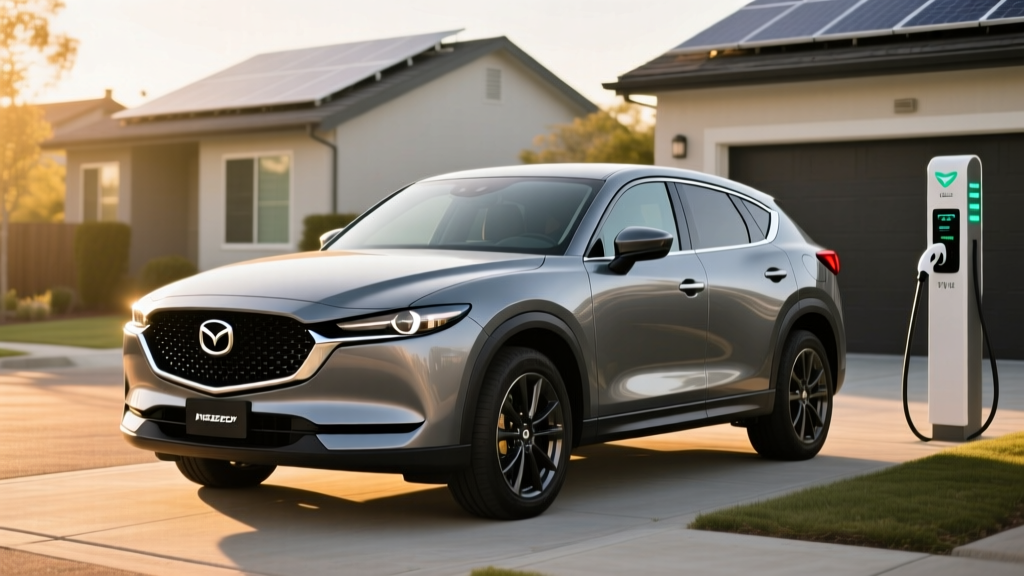
The Mazda CX-50 has carved out a niche as the rugged, outdoorsy crossover in Mazda's lineup. For 2026, the Mazda CX-50 Hybrid SUV pairs that adventure-ready styling with Toyota's proven hybrid powertrain, delivering a meaningful fuel-economy upgrade without sacrificing the brand's trademark driving dynamics. If you're shopping for a compact hybrid SUV that doesn't look or feel like an appliance, this is one of the most compelling options on the market.
But how does it actually perform in real-world driving? What does the hybrid system add — and what does it cost? This guide breaks down every number that matters: EPA MPG, powertrain specs, warranty coverage, pricing, and how the CX-50 Hybrid compares to plug-in hybrid and full EV alternatives.
HEV vs PHEV: Where the CX-50 Hybrid Fits
Before diving into specs, it's important to clarify what the CX-50 Hybrid actually is — because Mazda does not currently offer a plug-in hybrid (PHEV) version of the CX-50 in the U.S. market for 2026.
| Feature | Conventional Hybrid (HEV) | Plug-In Hybrid (PHEV) | Battery Electric (BEV) |
|---|---|---|---|
| Plug in to charge? | No | Yes | Yes |
| Electric-only range | None (motor assists only) | 20–45 mi typical | 200–400+ mi |
| Battery size | ~1–2 kWh | ~10–20 kWh | ~60–100+ kWh |
| Gas engine? | Yes | Yes | No |
| Federal tax credit (§30D) | No | Up to $7,500* | Up to $7,500* |
| Home charging needed? | No | Recommended (Level 2) | Essential |
The CX-50 Hybrid is a conventional hybrid (HEV). It uses a small battery and electric motor to assist the gasoline engine — you never plug it in, and it cannot drive on electric power alone for meaningful distances. Energy is recovered through regenerative braking and the engine itself. This makes it ideal for buyers who want better fuel economy without changing their fueling habits or installing a home charger.
If you're looking for a Mazda with plug-in capability, the CX-90 PHEV is the brand's current electrified flagship, offering about 26 miles of electric-only range. But for the compact CX-50, hybrid is the only electrified option.
Fuel Economy: EPA Ratings and Real-World MPG
The headline number for the 2026 Mazda CX-50 Hybrid SUV is its fuel efficiency. Mazda uses Toyota's fourth-generation hybrid system — the same architecture found in the RAV4 Hybrid — tuned for Mazda's chassis and all-wheel-drive layout.
| Driving Cycle | MPG |
|---|---|
| City | 39 MPG |
| Highway | 37 MPG |
| Combined | 38 MPG |
Source: EPA Fuel Economy
Real-World MPG Expectations
Hybrids typically exceed their EPA city ratings in stop-and-go traffic because regenerative braking recaptures energy that a gas car wastes as heat. In our experience with Toyota-sourced hybrid systems, drivers who do a lot of city and suburban driving often see 40–42 MPG in warm weather.
Highway driving is where hybrids lose their advantage. At sustained 70–80 mph speeds, the electric motor provides minimal assistance, and the gas engine does most of the work while pushing a boxy SUV through the air. Expect 34–36 MPG on flat interstate runs. In cold weather (below 30°F), the engine runs more frequently to maintain cabin heat and battery temperature, which can drop city MPG into the low-to-mid 30s until the system warms up.
Compared to the non-hybrid CX-50 with the base 2.5L engine (26 MPG combined), the hybrid delivers roughly 46% better fuel economy. Over 15,000 miles per year at $3.50/gallon, that's approximately $650–$750 in annual fuel savings.
Powertrain and Performance Specs
The CX-50 Hybrid pairs a 2.5-liter four-cylinder Atkinson-cycle engine with two electric motor-generators and an electronically controlled continuously variable transmission (eCVT). All-wheel drive is standard on every hybrid trim — a third motor on the rear axle provides torque to the rear wheels when needed.
| Specification | Value |
|---|---|
| Engine | 2.5L 4-cylinder Atkinson-cycle |
| Combined system horsepower | 219 hp |
| Transmission | eCVT (electronically controlled) |
| Drivetrain | AWD (standard, electronic rear motor) |
| 0–60 mph | ~7.2 seconds |
| Towing capacity | 1,500 lbs (hybrid) |
| Battery type | Nickel-metal hydride (NiMH), ~1.6 kWh |
| EPA combined MPG | 38 MPG |
| Fuel tank | 14.5 gallons |
| Total driving range | ~550 miles |
The 219-hp combined output is a meaningful step up from the base CX-50's 187 hp, and it's close to the turbo model's 227 hp (on regular fuel). The difference is in delivery: the hybrid's electric motors provide instant torque at low speeds, making it feel responsive off the line and during passing maneuvers. The eCVT is smooth but can drone under hard acceleration — a characteristic of all planetary-gear hybrid systems, not unique to Mazda.
One trade-off: the hybrid's towing capacity drops to 1,500 lbs compared to the turbo CX-50's 3,500 lbs. If you plan to tow a small trailer or jet skis, the turbo model remains the better choice. For everything else, the hybrid's powertrain is more than adequate.
Pricing, Trims, and Tax Credit Eligibility
The 2026 Mazda CX-50 Hybrid is available across multiple trims, starting with the Preferred Hybrid and topping out with the Premium Plus Hybrid. Pricing includes destination charges.
| Trim Level | MSRP (incl. destination) |
|---|---|
| Preferred Hybrid | $35,515 |
| Premium Hybrid | $38,715 |
| Premium Plus Hybrid | $41,915 |
Federal Tax Credit Status
Because the CX-50 Hybrid is a conventional hybrid (HEV) and cannot be plugged in, it does not qualify for the federal §30D Clean Vehicle Credit. That credit — up to $7,500 — is reserved for battery electric vehicles (BEVs) and plug-in hybrids (PHEVs) that meet battery-sourcing, critical-mineral, MSRP, and buyer-income requirements as defined by the IRS.
Some states offer their own hybrid incentives or rebates, but these vary widely by jurisdiction and change frequently. Check your state's energy office or department of environmental quality for current programs. A tax professional can confirm whether any local incentives apply to your situation.
Battery Warranty, Reliability, and Replacement Costs
Hybrid Battery Warranty: Mazda covers the CX-50 Hybrid's battery and hybrid system components for 8 years / 100,000 miles (whichever comes first). In states that follow California Air Resources Board (CARB) emissions standards — including California, New York, Massachusetts, and several others — hybrid battery coverage extends to 10 years / 150,000 miles.
How Reliable Is the Hybrid System?
This is where the Toyota partnership pays dividends. The CX-50 Hybrid uses Toyota's hybrid synergy drive architecture, which has been in continuous production since the 1997 Prius. Millions of vehicles worldwide use variants of this system, and long-term reliability data is among the strongest in the industry.
The hybrid battery in the CX-50 is a nickel-metal hydride (NiMH) pack — a mature, well-understood chemistry that degrades slowly and predictably. Unlike the lithium-ion packs in EVs and PHEVs, NiMH batteries are less sensitive to heat and don't require active liquid cooling. They are also less prone to sudden capacity loss.
Based on data from Toyota RAV4 Hybrid owners (which shares the same core system), hybrid battery failure before 150,000 miles is uncommon. When failures do occur outside warranty, replacement costs typically range from $2,000 to $4,000 for a refurbished or new pack, including labor. Individual module replacement (repairing rather than replacing the full pack) can cost $500–$1,500 at a specialist shop.
For context, the hybrid system's electric motor-generators and power electronics are generally more reliable than a conventional automatic transmission — there are no friction clutches, bands, or hydraulic valve bodies to wear out. The eCVT is essentially a planetary gearset with very few moving parts.
Driving Impressions and Practical Ownership
The CX-50 Hybrid drives like a Mazda first and a hybrid second. The steering is weighted and precise, the chassis is composed on twisty roads, and the ride quality strikes a good balance between comfort and sportiness. The hybrid system is largely transparent in normal driving — you won't notice the transitions between electric and gas power unless you're watching the energy-flow display.
Where the hybrid character becomes noticeable:
- Low-speed crawling: The electric motor handles initial acceleration, making stop-and-go traffic quiet and smooth.
- Hard acceleration: The eCVT holds the engine at a fixed RPM, producing a drone that some drivers find objectionable. It's no worse than a Subaru or Toyota hybrid, but it's a departure from the conventional automatic feel of the turbo CX-50.
- Regenerative braking: The brake pedal has a slightly different feel as the system blends regenerative and friction braking. There's a noticeable transition point around 15–20 mph where the friction brakes engage. Most drivers adapt within a day or two.
Cargo space is unchanged from the gas CX-50 at approximately 31.4 cubic feet behind the rear seats and 56.4 cubic feet with the rear seats folded. The hybrid battery is packaged under the rear seat, so there's no cargo floor compromise — a significant advantage over some competitors that lose under-floor storage.
Who Should Choose the CX-50 Hybrid vs a PHEV or EV?
Choose the Mazda CX-50 Hybrid if:
- You want 38 MPG combined without plugging in or changing your routine
- You don't have reliable access to home or workplace charging
- You want a premium-feeling compact SUV under $42,000
- You live in an area with limited public charging infrastructure
- You value AWD for snow or light off-road use
Consider a PHEV (like the Toyota RAV4 Prime or Hyundai Tucson PHEV) if:
- You can install a Level 2 home charger and want 30–42 miles of electric-only commuting
- Your daily round-trip commute is under 40 miles and you want to drive mostly on electricity
- You want eligibility for the federal §30D tax credit (up to $7,500, subject to income and sourcing rules)
Consider a full EV (like the Hyundai Ioniq 5 or Tesla Model Y) if:
- You have reliable home charging (Level 2)
- You want zero tailpipe emissions and minimal maintenance
- Your daily driving is under 250 miles and you're comfortable with road-trip charging planning
- You want the lowest per-mile fuel cost (electricity at $0.12/kWh ≈ $0.04/mile vs. $0.09/mile for the hybrid at 38 MPG and $3.50/gal)
The CX-50 Hybrid occupies a specific and practical niche: it's for buyers who want meaningful fuel savings without the infrastructure, behavioral, or financial commitment of a plug-in vehicle. It's a bridge, not a destination — and for many households, that bridge is exactly the right choice in 2026.
Pros
- 38 MPG combined — 46% improvement over gas CX-50
- 219 hp with smooth electric torque delivery
- Standard AWD on every hybrid trim
- No plug-in required — zero lifestyle change
- Toyota-sourced hybrid system with proven long-term reliability
- No cargo space compromise vs. gas model
- Premium interior materials and Mazda driving dynamics
Cons
- No federal tax credit eligibility (HEV, not PHEV/BEV)
- eCVT drone under hard acceleration
- Towing capacity limited to 1,500 lbs (vs. 3,500 for turbo)
- No plug-in option available for CX-50
- Hybrid premium over base gas model adds ~$3,000–$4,000
- Highway MPG advantage narrows at sustained 75+ mph speeds
Frequently Asked Questions
How many MPG does the Mazda CX-50 Hybrid get?
The EPA rates the 2026 Mazda CX-50 Hybrid at 39 MPG city, 37 MPG highway, and 38 MPG combined. In real-world city driving, many owners report 40–42 MPG in warm weather. Highway-only driving at 75+ mph typically returns 34–36 MPG. Cold weather can reduce city MPG to the low-to-mid 30s during short trips.
Does the CX-50 Hybrid need to be plugged in?
No. The CX-50 Hybrid is a conventional hybrid (HEV), not a plug-in hybrid. It charges its small battery through regenerative braking and the gasoline engine. You fuel it exactly like a regular gas car — at a gas station, with no cables or chargers involved.
Does the Mazda CX-50 Hybrid qualify for any tax credit?
The CX-50 Hybrid does not qualify for the federal §30D Clean Vehicle Credit, which is limited to plug-in hybrids (PHEVs) and battery electric vehicles (BEVs). Some states may offer hybrid-specific incentives, but these vary by location. Check with your state energy office or a tax professional for details.
How long will the CX-50 Hybrid battery last?
Mazda warranties the hybrid battery for 8 years/100,000 miles (10 years/150,000 miles in CARB states). Based on data from Toyota's identical hybrid architecture, these batteries commonly last 150,000–200,000+ miles before significant degradation. If replacement is needed out of warranty, expect $2,000–$4,000 for a new or refurbished pack.
Is the CX-50 Hybrid faster than the gas model?
Yes, in most everyday scenarios. The hybrid's 219 combined horsepower exceeds the base gas model's 187 hp, and the electric motors provide instant low-end torque. Mazda estimates 0–60 mph in approximately 7.2 seconds, compared to about 8.0 seconds for the base 2.5L gas model. However, the turbo CX-50 (256 hp on premium fuel) is still the quickest variant at around 6.4 seconds.
Can the CX-50 Hybrid tow?
Yes, but with reduced capacity. The hybrid is rated to tow up to 1,500 lbs, which covers a small utility trailer, bike rack, or light cargo trailer. If you need the full 3,500-lb towing capacity, you'll need the turbo CX-50 with the towing package.
Hybrid vs PHEV vs EV — which should I buy?
It depends on your charging access and driving patterns. If you can't charge at home, the CX-50 Hybrid (HEV) is the best fit — no plug required, 38 MPG. If you can charge at home and commute under 40 miles round-trip, a PHEV gives you electric-only weekday driving with gas flexibility for road trips. If you have home charging and want the lowest running costs with zero tailpipe emissions, a full EV is the long-term play. See our decision framework above for a detailed breakdown.