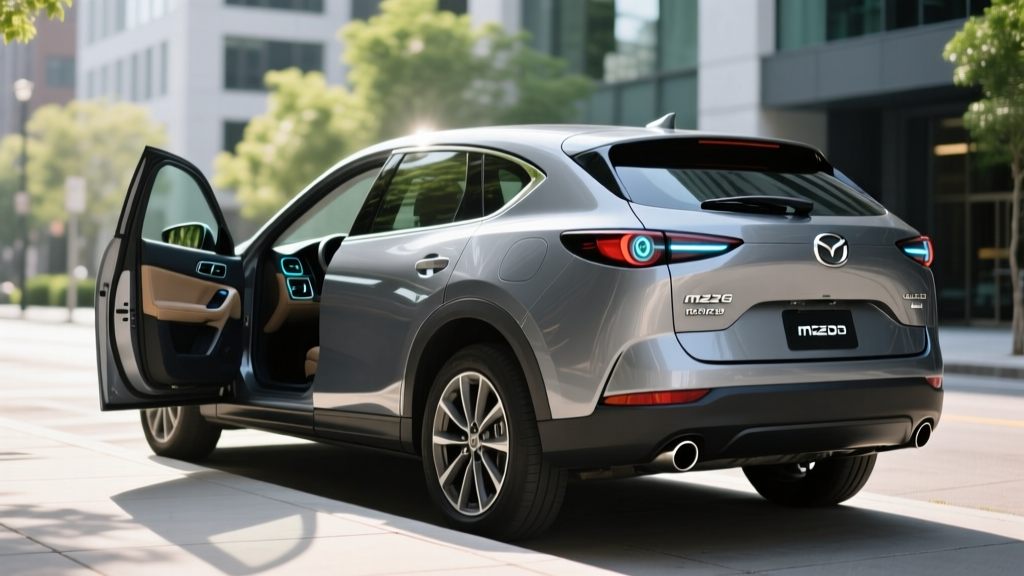
If you are researching a Mazda CX-50 Hybrid lease, you are likely weighing fuel savings against monthly cost, cargo practicality, and long-term reliability. The CX-50 Hybrid pairs Mazda's rugged crossover styling with Toyota's proven hybrid powertrain, delivering compact-SUV utility without a charging cable. For 2026, Mazda continues the CX-50 Hybrid across Select, Preferred, and Premium trims, making it one of the more compelling lease propositions in the hybrid crossover segment.
This guide covers everything a prospective lessee needs: EPA fuel economy, real-world MPG expectations, powertrain details, battery warranty, tax-credit eligibility, and how the CX-50 Hybrid stacks up against plug-in hybrids and full battery-electric alternatives.
Conventional Hybrid vs Plug-In Hybrid: What the CX-50 Actually Is
HEV vs PHEV — Know the Difference Before You Lease
| Feature | Conventional Hybrid (HEV) | Plug-In Hybrid (PHEV) |
|---|---|---|
| Plug-in charging? | No — self-charging via regenerative braking and engine | Yes — plugs into Level 1 or Level 2 outlet |
| Electric-only range | Very short (under 1 mile at low speed) | Typically 20–45 miles on battery alone |
| Battery size | Small (~1.0–1.6 kWh) | Larger (13–20+ kWh) |
| Federal tax credit (§30D) | Not eligible | Up to $7,500 (subject to sourcing, MSRP, and income caps) |
| Best for | Drivers without home charging; want simplicity | Drivers with home/work charging and short commutes |
The Mazda CX-50 Hybrid is a conventional hybrid (HEV), not a plug-in. It uses a small battery that charges itself through regenerative braking and the gasoline engine. You never plug it in. This distinction matters for lease shoppers: because it's an HEV, the CX-50 Hybrid does not qualify for the federal §30D new clean vehicle tax credit, which is reserved for plug-in hybrids and battery-electric vehicles. If a tax credit is central to your math, you'll need to look at PHEVs or BEVs instead.
EPA Fuel Economy and Real-World MPG
| Driving Cycle | EPA Estimate | Real-World Expectation |
|---|---|---|
| City | 39 MPG | 40–44 MPG (hybrids often beat EPA in stop-and-go) |
| Highway | 37 MPG | 33–36 MPG (aerodynamic drag reduces hybrid advantage at speed) |
| Combined | 38 MPG | 36–40 MPG depending on driving mix |
Source: fueleconomy.gov — EPA estimates for 2025/2026 Mazda CX-50 Hybrid AWD. Your results will vary based on driving style, terrain, temperature, and tire condition.
One of the most counterintuitive things about hybrid fuel economy is that city MPG often exceeds highway MPG. The CX-50 Hybrid's electric motor handles low-speed acceleration — the most fuel-thirsty phase — while regenerative braking recaptures energy at every stoplight. On the highway, the 2.5-liter four-cylinder engine does most of the work, and the boxy crossover shape creates aerodynamic drag that limits efficiency.
In mixed real-world driving, owners typically report 36–40 MPG combined. Short-trip city commuters in mild climates can see the low 40s. Cold-weather drivers in northern states should expect a 5–10% reduction in winter due to cabin heating demands and reduced battery efficiency at low temperatures.
Powertrain Specs: Toyota Hybrid Meets Mazda Design
| Specification | Detail |
|---|---|
| Engine | 2.5L 4-cylinder DOHC (Atkinson cycle) |
| Electric Motor | Permanent-magnet synchronous (front + rear) |
| Combined Net Horsepower | 219 hp |
| Transmission | eCVT (electronically controlled continuously variable) |
| Drivetrain | Electronic AWD (rear motor-driven, no mechanical driveshaft) |
| 0–60 mph | ~7.4 seconds (est.) |
| Towing Capacity | Up to 1,500 lbs (hybrid trims; non-hybrid turbo tows 3,500 lbs) |
| Hybrid Battery | ~1.6 kWh (sealed NiMH/Li-ion, self-charging) |
| Fuel Tank | 14.8 gallons |
| Total Driving Range | ~562 miles (at combined 38 MPG) |
The CX-50 Hybrid's powertrain is sourced from Toyota's fourth-generation hybrid system — the same architecture underpinning the RAV4 Hybrid and Highlander Hybrid, with over a decade of proven reliability. Mazda pairs it with their own chassis tuning, steering calibration, and interior design. The 219 hp combined output is adequate for merging and passing, and the eCVT delivers seamless, shift-free acceleration without the rubber-band feel that older CVTs suffered.
The electronic AWD system uses a dedicated rear-axle electric motor rather than a mechanical driveshaft from the engine. This means AWD engagement is instant and independent, improving traction on wet or snowy roads without the parasitic loss of a traditional drivetrain.
2026 Mazda CX-50 Hybrid Lease Pricing and Monthly Costs
Lease pricing fluctuates by region, dealer, and current Mazda incentive programs, but here is a realistic framework for the 2026 CX-50 Hybrid:
| Trim Level | Approx. MSRP | Estimated Monthly Lease (36 mo / 10k mi) |
|---|---|---|
| Select Hybrid | ~$35,500 | $380–$440 |
| Preferred Hybrid | ~$38,200 | $420–$480 |
| Premium Hybrid | ~$42,000 | $470–$540 |
| Premium Plus Hybrid | ~$45,500 | $520–$590 |
Note: Lease estimates assume $3,000–$4,000 due at signing and tier-1 credit. Actual offers depend on money factor, residual value (typically 55–60% for 36-month Mazda leases), and local market conditions. Always get a detailed lease quote from the dealer before signing.
Compared to leasing a fully electric compact SUV like the Tesla Model Y or Hyundai Ioniq 5, the CX-50 Hybrid lease payments are generally competitive or slightly lower at equivalent trim levels, and you eliminate any concern about charging infrastructure. The trade-off is that you will spend roughly $1,400–$1,800 per year on gasoline (at 38 MPG, 12,000 miles/year, and $3.50/gallon), whereas a comparable EV charging at home might cost $400–$700 per year depending on local electricity rates.
Tax Credits and Incentives: What You Can (and Can't) Claim
Federal Tax Credit (§30D): Not Available for the CX-50 Hybrid
Because the CX-50 Hybrid is a conventional hybrid (HEV) with no plug-in capability, it does not qualify for the IRS §30D New Clean Vehicle Credit. That credit — up to $7,500 — applies only to plug-in hybrids (PHEVs) and battery-electric vehicles (BEVs) that meet battery-sourcing, critical-mineral, MSRP cap, and buyer income requirements. See current rules at irs.gov.
However, there are other potential savings to investigate:
- State hybrid incentives: A handful of states offer rebates or HOV-lane access for hybrids (availability varies widely — check your state's energy office).
- Mazda loyalty/conquest rebates: Mazda periodically offers $500–$1,500 lease cash on CX-50 models, which can reduce your capitalized cost.
- Insurance discounts: Some insurers offer hybrid-specific discounts for safety features or reduced mileage; ask your agent.
- Employer commuter benefits: If your employer offers pre-tax commuter benefits, hybrid fuel costs aren't eligible, but this matters if you're comparing against a PHEV.
Reliability, Battery Warranty, and Long-Term Ownership
Reliability is where the CX-50 Hybrid's Toyota-sourced powertrain shines. Toyota's hybrid system has been in continuous production since the 1997 Prius, with millions of units on the road. The hybrid battery pack in vehicles like the RAV4 Hybrid routinely lasts 150,000–200,000+ miles with minimal degradation, because the system's software keeps the battery in a narrow state-of-charge window (typically 40–80%) to minimize wear.
Hybrid Battery Warranty
| Hybrid Battery Coverage | 8 years / 100,000 miles (10 years / 150,000 miles in CARB states including CA, NY, MA, WA, OR, and others) |
| Hybrid System Components | 8 years / 100,000 miles (inverter, eCVT, control modules) |
| Powertrain Warranty | 5 years / 60,000 miles |
| Bumper-to-Bumper | 3 years / 36,000 miles |
| Estimated Battery Replacement Cost | $2,500–$4,000 (out of warranty, aftermarket or dealer) |
Check your specific state's CARB adoption status at your local Mazda dealer, as warranty terms differ between federal- and California-emissions states.
For a typical 36-month lease, you will not come anywhere close to the hybrid battery warranty limit. The battery is essentially a non-concern during the lease term. If you plan to buy out the lease and keep the vehicle long-term, the Toyota-derived hybrid system is one of the lowest-risk electrified powertrains on the market.
CX-50 Hybrid vs PHEV vs Full EV: Which Fits Your Garage?
Choose the CX-50 Hybrid (HEV) If:
- You don't have access to home or workplace Level 2 charging
- You want electrified efficiency with zero behavior change — just fill up and drive
- You regularly take road trips exceeding 300 miles and don't want to plan charging stops
- You live in an apartment or condo where installing a charger isn't feasible
- You want proven Toyota hybrid reliability in a Mazda-designed package
Look at a PHEV or Full EV Instead If:
- You have home Level 2 charging and a commute under 30–40 miles (PHEV can run electric-only daily)
- You want to qualify for the up-to-$7,500 federal tax credit (PHEV/BEV only)
- You want the lowest possible fuel/energy cost per mile (EV wins at ~$0.04–$0.06/mi vs hybrid at ~$0.09–$0.12/mi)
- You want one-pedal driving and instant electric torque (BEV experience)
- You drive under 12,000 miles/year and can charge overnight (BEV total-cost advantage grows)
The decision framework is straightforward: charging access determines your optimal powertrain. If you can charge at home, a PHEV like the Toyota RAV4 Prime (42 miles electric-only range) or a BEV like the Hyundai Ioniq 5 (300+ miles EPA range) will deliver lower operating costs and tax-credit savings. If you can't charge at home, the CX-50 Hybrid is the smartest way to get meaningful fuel savings without infrastructure dependency.
From a lease perspective, the financial calculus narrows further. A 36-month lease means you won't capture the long-term fuel savings that make BEVs compelling over 7–10 years of ownership. The CX-50 Hybrid's monthly lease cost is often comparable to EV leases in this segment, and you avoid range-planning on road trips entirely.
Frequently Asked Questions
How many MPG does the Mazda CX-50 Hybrid get?
The EPA rates the 2026 CX-50 Hybrid at 39 city / 37 highway / 38 combined MPG. In real-world driving, most owners see 36–40 MPG combined, with city-heavy commutes occasionally pushing into the low 40s. Highway-only driving at 75+ MPH may dip to 33–35 MPG due to aerodynamic drag.
Does the CX-50 Hybrid need to be plugged in?
No. The CX-50 Hybrid is a conventional hybrid (HEV). It charges its own small battery through regenerative braking and the gasoline engine. You never plug it in. This is fundamentally different from a plug-in hybrid (PHEV), which requires regular plug-in charging to access its electric-only range.
Does the Mazda CX-50 Hybrid qualify for any tax credit?
The CX-50 Hybrid does not qualify for the federal §30D New Clean Vehicle Credit because it is not a plug-in vehicle. That credit (up to $7,500) is reserved for PHEVs and BEVs meeting battery-sourcing, MSRP, and income requirements. Some states may offer minor incentives for hybrids — check your state's energy office for current programs.
How reliable is the CX-50 Hybrid's powertrain?
Very reliable. The hybrid system is sourced from Toyota's fourth-generation hybrid architecture, which has been in production across millions of vehicles since the early 2000s. Hybrid battery failure before 150,000 miles is rare, and the battery is warranted for 8 years/100,000 miles (or 10 years/150,000 miles in CARB states).
What does a hybrid battery replacement cost?
Out of warranty, a CX-50 Hybrid battery replacement runs approximately $2,500–$4,000 depending on whether you use a dealer or aftermarket supplier. However, Toyota-derived hybrid batteries rarely need replacement before 150,000–200,000 miles, and most lessees will never face this cost.
Is it better to lease or buy the CX-50 Hybrid?
Leasing makes sense if you want lower monthly payments, plan to drive 10,000–12,000 miles/year, and want to upgrade in 3 years. Buying makes sense if you drive high annual mileage (avoiding lease penalties), plan to keep the vehicle 7+ years to maximize fuel savings, or want to build equity. The hybrid powertrain's proven reliability favors long-term ownership, but the low risk of major repairs in years 1–3 also makes leasing relatively safe.
How does the CX-50 Hybrid compare to the RAV4 Hybrid?
Both use Toyota's hybrid system, but the CX-50 Hybrid offers Mazda's premium interior materials, more aggressive exterior styling, and slightly sportier steering calibration. The RAV4 Hybrid has marginally higher cargo volume and a longer track record under the Toyota badge. EPA MPG is similar (RAV4 Hybrid: 41/38/40 vs CX-50 Hybrid: 39/37/38). If interior quality and design matter most, the CX-50 wins. If maximum cargo space and Toyota's resale-value reputation matter most, the RAV4 Hybrid has the edge.
Editorial note: Pricing, incentives, and tax-credit rules referenced in this article reflect information available as of early 2026 and are subject to change. Always confirm current MSRP, lease terms, and incentive eligibility with your local Mazda dealer and a qualified tax professional. Safety ratings can be verified at NHTSA.gov and IIHS.org.