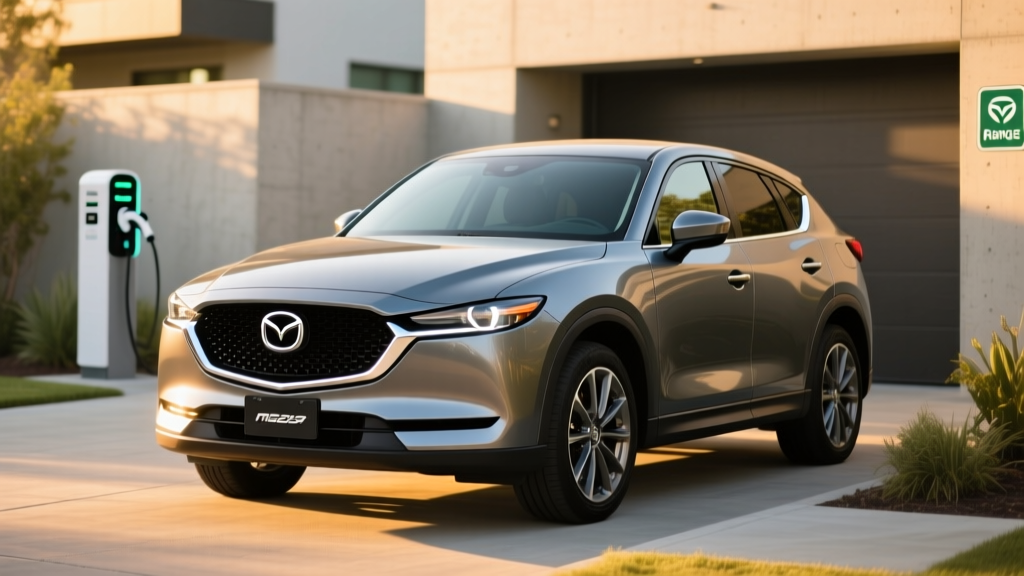
Mazda's best-selling compact crossover finally gets an electrified option. The 2026 Mazda CX-5 Hybrid pairs Mazda's premium interior and driving dynamics with Toyota's proven hybrid system — a collaboration that yields meaningful fuel savings without requiring a plug or a lifestyle change. For shoppers searching for a CX-5 hybrid, this guide covers every spec that matters: EPA MPG, real-world efficiency, powertrain details, battery longevity, pricing, and how it stacks up against plug-in and full-electric alternatives.
Conventional Hybrid, Not Plug-In: What CX-5 Hybrid Buyers Must Understand
The 2026 CX-5 Hybrid is a conventional hybrid electric vehicle (HEV), not a plug-in hybrid (PHEV). That distinction drives every ownership decision:
HEV vs. PHEV at a Glance
| Feature | CX-5 Hybrid (HEV) | Typical PHEV SUV |
|---|---|---|
| Plug-in charging required? | No — self-charging via regen + engine | Yes — for electric-only range |
| Electric-only driving | Very short, low-speed only (~1 mi) | 25–40 miles typical |
| Battery size | ~1.6 kWh (small buffer) | 13–20 kWh |
| Federal tax credit (§30D) | Not eligible | Up to $7,500 if eligible |
| Fuel economy improvement | 30–40% over gas-only | Variable; depends on plug-in frequency |
The CX-5 Hybrid does not have a charge port. You fuel it like any other car, and the hybrid system recaptures braking energy and optimizes engine load behind the scenes. If you want electric-only commuting range, you'll need to look at a PHEV like the Toyota RAV4 Prime or a full BEV. If you simply want better MPG with zero behavior change, the HEV format is the right call.
EPA Fuel Economy: City, Highway, and Combined MPG
The headline number for any hybrid is fuel economy. Here's how the 2026 CX-5 Hybrid rates according to fueleconomy.gov and Mazda's published specifications:
| Drivetrain | City MPG | Highway MPG | Combined MPG |
|---|---|---|---|
| CX-5 Hybrid AWD | 39 | 37 | 38 |
| CX-5 Gas AWD (2.5T baseline) | 23 | 29 | 25 |
That 38 MPG combined represents a 52% improvement over the turbocharged gas CX-5 AWD. The city figure (39 MPG) is particularly strong because the hybrid system relies heavily on electric motor assist at low speeds, where gas engines are least efficient.
Real-World MPG vs. EPA Sticker
Conventional hybrids frequently exceed their EPA city rating in real-world stop-and-go driving because regenerative braking recaptures more energy in heavy traffic. Expect:
- City commuting: 38–42 MPG (regen-rich driving favors the hybrid)
- Highway cruising at 70–75 mph: 34–37 MPG (less regen benefit, more aerodynamic drag)
- Cold weather (below 30°F): 32–35 MPG combined (engine runs more to heat cabin and warm the catalytic converter)
- Mountain/towing: 26–30 MPG (heavy load reduces hybrid advantage)
For a driver covering 15,000 miles per year at $3.40/gallon, the CX-5 Hybrid saves approximately $680 annually in fuel costs compared to the 2.5T gas model — and roughly $3,400 over a five-year ownership period.
Powertrain: Toyota Hybrid Muscle in a Mazda Chassis
Mazda partnered with Toyota for the CX-5 Hybrid's powertrain, leveraging the same hybrid synergy drive architecture found in the RAV4 Hybrid. The result is a smooth, responsive system that doesn't sacrifice Mazda's trademark driving feel.
| Specification | 2026 CX-5 Hybrid AWD |
|---|---|
| Engine | 2.5L inline-4 Atkinson-cycle |
| Electric motors | Front + rear (e-AWD) |
| Combined system output | 219 hp |
| Transmission | eCVT (planetary gearset, no belt) |
| 0–60 mph | ~7.4 seconds |
| Drivetrain | Electronic AWD (rear motor engages on demand) |
| Towing capacity | 1,500 lbs |
| Battery type | Nickel-metal hydride (NiMH), ~1.6 kWh |
The 219 hp combined output slots between the gas CX-5's naturally aspirated 187 hp base engine and the 256 hp turbo. The eCVT is Toyota's proven planetary-gear design — not a traditional belt-driven CVT — so it avoids the rubber-band feel and reliability concerns associated with older CVT designs. Throttle response is immediate at low speeds thanks to electric motor torque, and the engine only fires up when demand exceeds what the battery buffer can supply.
The electronic AWD system uses a dedicated rear-axle motor that engages during acceleration, low-traction conditions, or when the system detects front-wheel slip. Unlike mechanical AWD, there's no driveshaft or rear differential to maintain — reducing weight and parasitic loss.
Battery Warranty, Lifespan, and Replacement Cost
Battery longevity is the single biggest concern hybrid shoppers raise. Here's the data:
CX-5 Hybrid Battery Coverage
- Hybrid battery warranty: 10 years / 150,000 miles (in CARB states including CA, NY, MA, NJ, and others adopting California emissions standards); 8 years / 100,000 miles in remaining states
- Hybrid system components warranty: 8 years / 100,000 miles nationwide
- Capacity retention threshold: Battery must maintain sufficient capacity for hybrid system operation — no specific percentage published by Mazda
Because the CX-5 Hybrid uses a small ~1.6 kWh NiMH buffer that never deeply discharges (the system keeps state of charge between roughly 40% and 80%), degradation is minimal. Toyota's hybrid battery track record — the Prius has been on sale since 1997 in Japan and 2000 in the US — shows that most hybrid batteries last 150,000–200,000+ miles before needing replacement.
Battery Replacement Cost
If the hybrid battery does fail outside warranty:
- New OEM replacement: $3,000–$4,500 (parts and labor)
- Refurbished/remanufactured: $1,500–$2,500
- Individual cell module replacement: $500–$1,200 (only failed modules replaced, offered by independent hybrid specialists)
For context, a conventional gas CX-5 will spend $2,000–$4,000 on transmission fluid services, timing chain inspections, and other powertrain maintenance over the same mileage that a hybrid battery covers. The hybrid system also eliminates the traditional starter motor and alternator — both common failure points on gas vehicles — because the motor-generators handle those functions.
Pricing, Trims, and Tax Credit Eligibility
The 2026 CX-5 Hybrid is available across multiple trim levels. Pricing reflects Mazda's positioning as a near-premium brand:
| Trim | MSRP (est.) | Key Features |
|---|---|---|
| Preferred | $35,500 | 10.25" display, heated seats, power liftgate |
| Carbon Edition | $37,200 | Red leather, black mirrors, Bose audio |
| Premium | $39,500 | Nappa leather, ventilated front seats, HUD |
| Premium Plus | $42,000 | 360° camera, wireless CarPlay, heated steering wheel |
Note: Pricing is estimated based on Mazda's announced positioning. Final MSRP confirmed at dealer launch. Destination charge (~$1,350) additional.
Federal Tax Credit Status
The CX-5 Hybrid does not qualify for the federal §30D clean vehicle tax credit. Under current IRS rules, the §30D credit applies only to plug-in electric vehicles (BEVs and PHEVs) with sufficient battery capacity and qualifying battery sourcing. Conventional hybrids are excluded regardless of fuel economy.
Some states offer their own hybrid incentives — for example, certain utility companies provide rebates for hybrid purchases. Check your state energy office or local utility for programs. These vary by jurisdiction and change frequently, so consult official state sources rather than relying on dealer information.
Who Should Choose the CX-5 Hybrid vs. a PHEV or Full EV?
The right electrified vehicle depends on your driving pattern, charging access, and budget. Here's a practical decision framework:
Choose the CX-5 Hybrid (HEV) If:
- You lack access to home or workplace charging (apartment, street parking)
- You want zero behavior change — no plugging in, no route planning
- Your driving is a mix of city and highway with no single dominant pattern
- You want a premium interior at a mainstream price point
- You plan to own the vehicle 8–12 years (long-term reliability matters)
Look at a PHEV or Full EV Instead If:
- You have reliable Level 2 home charging and a short commute (PHEV covers it on electric)
- You want the $7,500 federal tax credit (PHEV/BEV only)
- You want silent, zero-emission city driving with no engine start
- Your daily driving is under 30 miles round-trip (PHEV electric range covers this)
- You want maximum fuel-cost savings ($0.04–0.06/mile on electricity vs. $0.12–0.16/mile on gas)
The CX-5 Hybrid occupies a specific niche: buyers who want meaningful MPG gains without the infrastructure dependency of a plug-in. It's the pragmatic electrification choice for the roughly 40% of US drivers who cannot reliably charge at home.
How It Stacks Up: CX-5 Hybrid vs. Key Rivals
| Spec | Mazda CX-5 Hybrid | Toyota RAV4 Hybrid | Honda CR-V Hybrid |
|---|---|---|---|
| Combined MPG | 38 | 39 | 37 |
| Combined HP | 219 | 219 | 204 |
| 0–60 mph | ~7.4s | ~7.4s | ~7.6s |
| Cargo (behind rear seats) | 30.8 cu ft | 37.5 cu ft | 36.3 cu ft |
| Starting MSRP (est.) | $35,500 | $33,500 | $35,400 |
| Interior materials | Premium soft-touch | Functional hard plastics | Mixed quality |
The CX-5 Hybrid trades a small cargo-volume disadvantage for a notably more upscale cabin, standard AWD across all trims, and Mazda's tuned chassis that delivers more engaging handling than either rival. The RAV4 Hybrid wins on pure practicality; the CX-5 Hybrid wins on refinement.
Reliability Outlook and Safety
The Toyota hybrid system powering the CX-5 Hybrid has decades of real-world validation across millions of vehicles globally. Mazda's own reliability ratings have trended upward in recent model years, with IIHS consistently awarding the CX-5 top safety marks.
The hybrid system introduces no new failure modes compared to the gas CX-5. In fact, it eliminates several: the eCVT has no clutch packs, bands, or torque converter to wear; regenerative braking extends pad and rotor life significantly (many hybrid owners report original brake pads at 80,000+ miles); and the engine runs fewer total hours because the electric motor handles low-load driving.
For reliability data, consult owner forums and long-term test fleet reports as they accumulate through the 2026 model year. Mazda's standard 3-year/36,000-mile bumper-to-bumper and 5-year/60,000-mile powertrain warranty applies, with the hybrid-specific battery coverage detailed above.
Frequently Asked Questions
How many MPG does the 2026 Mazda CX-5 Hybrid get?
The CX-5 Hybrid AWD is EPA-rated at 39 city / 37 highway / 38 combined MPG. Real-world city driving often yields 38–42 MPG thanks to regenerative braking, while sustained highway driving at 75 mph typically returns 34–37 MPG.
Does the CX-5 Hybrid need to be plugged in?
No. The CX-5 Hybrid is a conventional HEV with no charge port. The battery charges itself through regenerative braking and the gasoline engine. You simply fill it with regular unleaded fuel.
Does the CX-5 Hybrid qualify for any tax credit?
The federal §30D clean vehicle credit does not apply to conventional hybrids — only to plug-in vehicles (PHEVs and BEVs). Some state utility programs or local incentives may offer hybrid rebates; check your state energy office for current programs.
How long will the CX-5 Hybrid battery last?
Based on Toyota's hybrid battery track record, expect 150,000–200,000+ miles before potential replacement. Mazda covers the hybrid battery for 10 years/150,000 miles in CARB states and 8 years/100,000 miles elsewhere. Replacement costs range from $1,500 (refurbished) to $4,500 (new OEM).
Is the CX-5 Hybrid better than a full EV?
It depends on your situation. The CX-5 Hybrid is better if you lack home charging, drive long distances frequently, or want a lower purchase price. A full EV is better if you have home Level 2 charging, want maximum operating-cost savings, and qualify for the $7,500 federal credit.
What's the difference between the CX-5 Hybrid and a PHEV like the RAV4 Prime?
A PHEV has a larger battery (typically 13–20 kWh) that provides 25–40 miles of electric-only driving before the gas engine engages. It requires plugging in to realize those benefits and qualifies for the federal tax credit. The CX-5 Hybrid has a small ~1.6 kWh battery, cannot drive on electricity alone for meaningful distances, needs no plug, and does not qualify for the federal credit.