Ford Maverick Hybrid Towing Capacity: The Quick Numbers
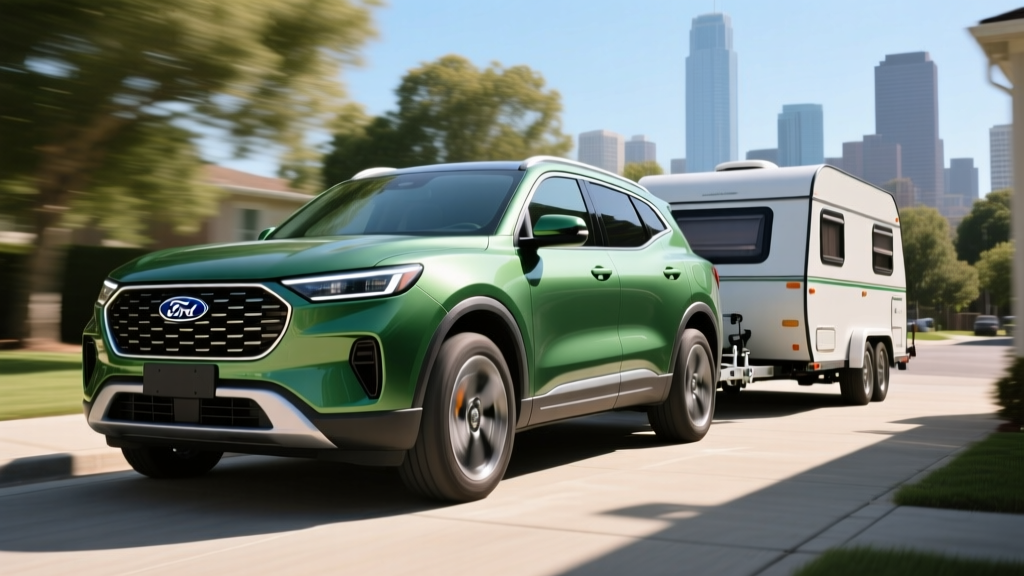
If you're researching the maverick hybrid towing capacity, here's the headline figure: the Ford Maverick Hybrid (HEV) is rated to tow 2,000 pounds when properly equipped. That's a hard ceiling set by Ford for every hybrid trim — XL, XLT, and Lariat — and it applies whether you choose front-wheel drive or the available all-wheel-drive system introduced for the 2025 refresh.
For context, the turbocharged 2.0L EcoBoost Maverick with the optional 4K Tow Package can pull up to 4,000 pounds. So the hybrid gives up half the maximum tow rating in exchange for dramatically better fuel economy and a lower starting price. Whether that trade-off works for you depends entirely on what you plan to tow and how often.
| Spec | Value |
|---|---|
| Max Towing Capacity | 2,000 lbs (all trims) |
| Max Payload Capacity | 1,500 lbs (FWD XL) |
| Powertrain | 2.5L Atkinson-cycle I-4 + electric motor |
| Combined Horsepower | 191 hp |
| Transmission | eCVT (power-split device) |
| EPA MPG (FWD) | 42 city / 33 highway / 38 combined |
| EPA MPG (AWD) | 38 city / 31 highway / 34 combined |
| Fuel Tank | 16.5 gallons |
| Total Range (FWD) | ~627 miles (EPA est.) |
| Base MSRP (XL FWD) | $26,990 (incl. destination) |
| Hybrid Battery Warranty | 8 years / 100,000 miles |
Understanding the Maverick's Hybrid Powertrain
The Maverick uses Ford's fourth-generation 2.5L Atkinson-cycle hybrid system — the same architecture found in the Escape Hybrid and closely related to the Toyota-derived power-split design Ford has refined over two decades. This is a conventional hybrid (HEV), not a plug-in hybrid (PHEV). You never plug it in. The 1.1 kWh lithium-ion battery recharges exclusively through regenerative braking and the gasoline engine.
HEV vs. PHEV — Where the Maverick Fits
| Feature | Maverick Hybrid (HEV) | Typical PHEV Truck/SUV |
|---|---|---|
| Plug-in Charging | No — self-charging | Yes — Level 1 or Level 2 |
| Electric-Only Range | N/A (motor assists at all speeds) | 25–45 miles typical |
| Battery Size | 1.1 kWh | 12–25 kWh typical |
| Federal Tax Credit (§30D) | Not eligible | Up to $7,500 if eligible |
| Best For | Buyers who want MPG gains without behavior change | Buyers with home charging who want short EV commutes |
The combined output of 191 horsepower comes from the 162-hp gasoline engine and a 131-hp electric motor working through the power-split device. Torque delivery is immediate from the electric motor at low speeds, which helps the Maverick hybrid feel more responsive off the line than its EPA numbers suggest. However, that eCVT design means there's no traditional gear reduction for heavy-load pulling — a key reason the tow rating stays at 2,000 lbs.
Real-World Towing: What 2,000 Pounds Actually Gets You
A 2,000-pound tow rating covers a meaningful slice of light-duty needs. Here's what fits within the Maverick hybrid's envelope:
- Small utility trailer (loaded): 800–1,500 lbs — landscaping supplies, motorcycle, ATV
- Pop-up camper: 1,200–1,800 lbs — most lightweight folding trailers
- Jet ski on single-axle trailer: 1,000–1,600 lbs
- Small boat (14–16 ft) on trailer: 1,500–2,000 lbs — at the upper limit
What won't work: most travel trailers (3,000+ lbs), enclosed car haulers, dual-axle boat trailers, or any fifth-wheel setup. If your regular towing exceeds 2,000 lbs, you need the EcoBoost engine with the 4K Tow Package ($745 option on non-hybrid trims), or you should look at a mid-size truck like the Ford Ranger or Toyota Tacoma.
Towing MPG: Expect a Significant Drop
The EPA rates the Maverick Hybrid FWD at 42 city / 33 highway / 38 combined — numbers that hold up well in real-world driving. Owners consistently report 38–44 MPG in mixed commuting, with city driving often exceeding the EPA estimate thanks to the hybrid system's regenerative braking advantage in stop-and-go traffic. According to fueleconomy.gov, the Maverick Hybrid FWD achieves 38 MPG combined.
Once you hitch a trailer, those numbers change sharply. Based on owner-reported data and independent testing:
- Light trailer (1,000 lbs): Expect 24–28 MPG combined
- Max-capacity trailer (2,000 lbs): Expect 18–23 MPG combined
- Highway towing at 70 mph: Expect 20–25 MPG (aerodynamic drag dominates)
That's roughly a 40–50% fuel economy penalty under heavy tow — typical for any small truck. The hybrid system still provides an advantage over the EcoBoost in stop-and-go towing scenarios (think boat ramps, campground check-in lines), but on sustained highway pulls, the efficiency gap narrows.
What You Need to Tow with the Maverick Hybrid
The Maverick Hybrid doesn't come with a hitch from the factory. You'll need to add equipment:
- Class III receiver hitch: Available through Ford accessories (~$250 installed) or aftermarket (Curt, Draw-Tite, ~$150–$200 plus installation)
- 4-pin wiring harness: Standard trailer lighting connector (~$50–$80)
- Trailer brake controller: Not factory-integrated on the hybrid. For trailers with electric brakes (typically those over 1,500 lbs), you'll need an aftermarket controller like the Curt Echo or Redarc Tow-Pro. Budget $200–$350.
Ford recommends using the integrated trailer sway control (included on all Mavericks with the factory tow prep) and staying within the Gross Combined Weight Rating (GCWR). For the Maverick Hybrid FWD, that GCWR is approximately 5,680 lbs — the truck's curb weight (~3,674 lbs) plus passengers, cargo, and trailer combined.
Maverick Hybrid vs. EcoBoost: Towing and Ownership Trade-Offs
Maverick Hybrid — Pros
- 38–42 MPG daily driving without towing
- Lowest starting price in the Maverick lineup ($26,990)
- No plug-in charging required — works like a gas truck
- Strong city MPG advantage from regenerative braking
- Proven power-split hybrid reliability (Ford's 4th-gen system)
Maverick Hybrid — Cons
- 2,000-lb tow ceiling — half the EcoBoost's 4,000-lb rating
- No 4K Tow Package available on hybrid trims
- eCVT can feel strained on long, steep grades under load
- AWD hybrid drops to 34 MPG combined
- No federal tax credit eligibility (HEV, not PHEV)
| Attribute | Hybrid (HEV) | 2.0L EcoBoost |
|---|---|---|
| Max Tow Rating | 2,000 lbs | 4,000 lbs (w/ 4K Tow Pkg) |
| Horsepower | 191 hp combined | 250 hp |
| EPA Combined MPG (FWD) | 38 MPG | 26 MPG |
| Starting MSRP | $26,990 | $28,335 |
| Federal Tax Credit | None | None |
| Best For | Daily commuting + light towing | Heavier towing + performance |
Pricing, Tax Credits, and Total Cost of Ownership
The 2025 Maverick Hybrid starts at $26,990 for the XL FWD, including destination charges. Key trim pricing:
- XL FWD: $26,990
- XLT FWD: $28,995
- Lariat FWD: $32,630
- AWD (any trim): Add ~$1,500
Tax Credit Status
Because the Maverick Hybrid is a conventional HEV — not a plug-in hybrid or battery-electric vehicle — it does not qualify for the federal §30D Clean Vehicle Credit (up to $7,500). That credit is reserved for PHEVs and BEVs meeting battery-sourcing and MSRP requirements under current IRS rules. Some states offer modest hybrid rebates (check your state energy office), but there's no federal incentive for choosing the HEV over the EcoBoost.
Where the hybrid earns its keep is at the fuel pump. At 38 MPG combined versus the EcoBoost's 26 MPG, and with gas at $3.30/gallon (national average), the hybrid saves roughly $850 per year over 15,000 miles of driving. Over a typical 5-year ownership period, that's approximately $4,250 in fuel savings — more than offsetting any trim-level price premium and partially compensating for the lack of a tax credit.
Battery Longevity, Warranty, and Replacement Costs
Hybrid battery anxiety is the number-one concern buyers raise, and it's worth addressing with data. The Maverick Hybrid's 1.1 kWh lithium-ion pack is small, lightly stressed, and managed by Ford's thermal control system to stay within a narrow state-of-charge window — typically between 40% and 80%. This shallow cycling dramatically extends cell life compared to a full EV battery that regularly sees 0–100% swings.
Warranty Coverage
- Hybrid battery: 8 years / 100,000 miles (whichever comes first), covering defects and capacity loss below a defined threshold
- Hybrid-specific components (inverter, eCVT, electric motor): 8 years / 100,000 miles
- Bumper-to-bumper: 3 years / 36,000 miles
- Powertrain (engine): 5 years / 60,000 miles
If the battery does fail outside warranty, replacement costs for the Maverick Hybrid's pack typically range from $2,500 to $4,000 (parts and labor) at a Ford dealer. Independent hybrid specialists may offer refurbished packs for $1,500–$2,500. For context, Ford's Escape Hybrid — which uses a closely related system — has demonstrated battery longevity well beyond 150,000 miles in fleet service. The Maverick's smaller battery and lighter duty cycle suggest similar or better longevity, though long-term data specific to the Maverick (introduced for 2022) is still accumulating.
Who Should Choose the Maverick Hybrid?
Choose the Maverick Hybrid If:
- Your towing needs stay under 2,000 lbs (small trailers, jet skis, pop-up campers)
- You commute 30+ miles daily and want 38–42 MPG
- You don't have access to plug-in charging at home or work
- You want the lowest-cost entry into a new pickup
- You prioritize city and suburban driving efficiency
Choose the EcoBoost (or a Different Truck) If:
- You regularly tow over 2,000 lbs (travel trailers, car haulers, large boats)
- You need the 4K Tow Package for integrated brake control
- You drive predominantly highway with heavy loads
- You want AWD with maximum towing (EcoBoost AWD: 4,000 lbs)
- You're considering a full EV truck (Rivian R1T, Ford F-150 Lightning) for heavier towing + zero tailpipe emissions
Frequently Asked Questions
How many MPG does the Maverick Hybrid get?
The EPA rates the 2025 Maverick Hybrid FWD at 42 city / 33 highway / 38 combined. The AWD hybrid drops to 38 city / 31 highway / 34 combined. Real-world owners frequently report exceeding the city estimate (44–46 MPG) in stop-and-go traffic, while highway-only driving at 75+ mph can dip to 30–32 MPG for FWD.
Can the Maverick Hybrid tow a camper trailer?
Yes, but only lightweight ones. Pop-up campers and teardrop trailers typically weigh 1,200–1,800 lbs, which fits within the 2,000-lb rating. Most hard-sided travel trailers start at 3,000+ lbs and exceed the hybrid's capacity. Always check your specific trailer's Gross Vehicle Weight Rating (GVWR), not just its dry weight.
Is the Maverick Hybrid reliable?
Ford's 2.5L power-split hybrid system is in its fourth generation and has been used across millions of vehicles (Escape Hybrid, Fusion Hybrid, Lincoln Corsair). The system is mechanically simpler than a traditional automatic transmission — no gear shifts, no torque converter, no clutch packs. Long-term hybrid battery data from the Escape Hybrid fleet suggests 150,000+ mile longevity is typical. The Maverick itself has been on sale since 2022, so model-specific data is still maturing, but the underlying powertrain is well-proven.
Does the Maverick Hybrid qualify for any tax credit?
No. The Maverick Hybrid is a conventional HEV and does not qualify for the federal §30D Clean Vehicle Credit, which is limited to plug-in hybrids (PHEVs) and battery-electric vehicles (BEVs). There is no federal tax advantage to choosing the hybrid over the EcoBoost. Check your state energy office for any local hybrid incentives, though these are increasingly rare.
What does the hybrid battery cost to replace?
Out-of-warranty replacement for the Maverick Hybrid's 1.1 kWh battery pack runs approximately $2,500–$4,000 at a Ford dealership. The battery is covered under warranty for 8 years or 100,000 miles. Given the shallow cycling and thermal management, most owners will never need a replacement.
Hybrid vs. PHEV vs. EV — which Maverick should I consider?
The Maverick is only available as a conventional hybrid (HEV) or a gasoline-only EcoBoost. Ford does not currently offer a Maverick PHEV or BEV. If you want a plug-in truck, you'd need to look at the Ford F-150 Lightning (BEV, 230–320 mi range, up to 10,000 lbs towing), the Rivian R1T (BEV), or the upcoming Ram 1500 Ramcharger (EREV). For a PHEV truck option, the list remains very short — watch for the Toyota Tacoma PHEV, expected to arrive in the coming model years.
Does the Maverick Hybrid have a tow mode?
The Maverick Hybrid includes a Tow/Haul drive mode accessible through the drive-mode selector. This adjusts throttle response, transmission behavior (holding the engine at higher RPM for more power), and stability control tuning for trailer dynamics. It does not increase the 2,000-lb rating — that's a structural and powertrain limitation.