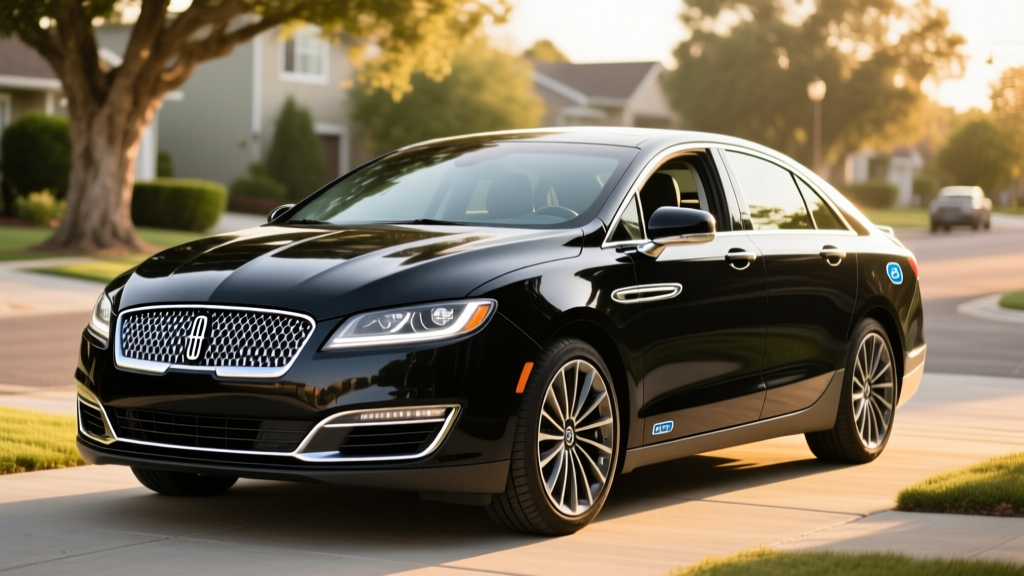
The Lincoln MKZ Hybrid FWD occupies a specific niche in the electrified sedan market: a luxury-badged conventional hybrid that never required a plug, never demanded a lifestyle change, and delivered genuinely impressive fuel economy for its class. Discontinued after the 2020 model year as Lincoln pivoted to SUVs, the MKZ Hybrid remains one of the most compelling used hybrid sedans available in 2026 — particularly for buyers who want premium comfort without the complexity of plug-in charging or the range limitations of a full battery-electric vehicle.
This guide covers everything a prospective used buyer needs to know: EPA and real-world MPG, the powertrain's engineering, battery longevity and replacement costs, tax-credit eligibility (or the lack thereof on the used market), and how the MKZ Hybrid FWD stacks up against the alternatives you'll cross-shop it against.
What Is the Lincoln MKZ Hybrid FWD?
The Lincoln MKZ Hybrid is a conventional hybrid electric vehicle (HEV) — not a plug-in hybrid (PHEV) and not a battery-electric vehicle (BEV). It pairs a 2.0-liter Atkinson-cycle four-cylinder gasoline engine with an electric motor and a small lithium-ion battery pack. The system captures energy during braking and deceleration to recharge the battery; you never plug it in. It refuels at any gas station like a conventional car.
Lincoln offered the MKZ Hybrid exclusively with front-wheel drive (FWD) across all model years. The AWD option available on the gas-only MKZ was never paired with the hybrid powertrain. The hybrid was sold alongside the 2.0L EcoBoost (gas turbo) and 3.0L V6 twin-turbo variants, but only the hybrid carried the efficiency story.
A conventional hybrid (HEV) like the MKZ Hybrid has a small battery (1.4 kWh usable) that recharges only through regenerative braking and the engine. A plug-in hybrid (PHEV) carries a much larger battery (typically 12–20 kWh) that can be charged from a wall outlet and provides 20–40 miles of electric-only driving before the gas engine engages. The MKZ was never offered as a PHEV. If plug-in capability is a priority, you'll need to look at competitors like the now-discontinued BMW 330e or the Hyundai Sonata PHEV.
EPA Fuel Economy and Real-World MPG
The Lincoln MKZ Hybrid FWD's headline number is its EPA rating, which remained consistent across the 2017–2020 model years after the mid-cycle refresh:
| Metric | Value |
|---|---|
| City MPG | 42 MPG |
| Highway MPG | 39 MPG |
| Combined MPG | 41 MPG |
| Fuel Tank Capacity | 16.5 gallons |
| Total Range (estimated) | ~676 miles |
Source: fueleconomy.gov — Lincoln MKZ Hybrid FWD
Real-World MPG: What Owners Actually See
The MKZ Hybrid's Atkinson-cycle engine and electric-motor assist deliver their best efficiency in stop-and-go city driving, where regenerative braking constantly recaptures energy. In real-world use:
- City driving: Many owners report 42–45 MPG in urban commuting, sometimes exceeding the EPA city estimate thanks to frequent regen opportunities.
- Highway cruising: Expect 36–39 MPG at 70–75 mph. Hybrid advantages diminish at sustained high speeds where aerodynamic drag dominates and the electric motor contributes less.
- Cold weather: Battery efficiency drops and the engine runs more often for cabin heat. Expect a 5–10% reduction in winter, bringing combined figures to roughly 37–39 MPG in freezing conditions.
- Combined real-world average: Most owners land between 38–43 MPG combined, closely tracking the EPA estimate of 41 MPG.
This is a genuine strength. Unlike some luxury hybrids that sacrifice efficiency for performance, the MKZ Hybrid delivers on its EPA promise in everyday driving.
Powertrain, Performance, and Driving Dynamics
| Specification | Value |
|---|---|
| Engine | 2.0L Atkinson-cycle I4 |
| Engine Power | 141 HP @ 6,000 RPM |
| Electric Motor Power | 88 kW (118 HP) |
| Combined System Output | 188 HP |
| Transmission | eCVT (planetary gearset) |
| Drivetrain | Front-Wheel Drive (FWD) |
| Hybrid Battery | 1.4 kWh lithium-ion |
| 0–60 MPH | ~8.4 seconds |
| Plug-In Charging | No — self-charging HEV |
The 188 HP combined output is adequate for daily commuting and highway merging but won't satisfy anyone seeking sport-sedan acceleration. The eCVT (Ford's power-split device, not a traditional belt-and-cone CVT) provides smooth, gearless power delivery. There's no rubber-band effect typical of older CVTs — the planetary gearset manages engine and motor power seamlessly.
Electric-only driving is possible at low speeds (typically under 25 mph in light-throttle situations), but the 1.4 kWh battery provides only brief electric-only bursts — perhaps a quarter to half a mile. This is normal for conventional hybrids; the system's value lies in blending electric and gas power continuously, not in sustained EV mode.
Hybrid Battery Longevity, Warranty, and Replacement Cost
Lincoln covered the MKZ Hybrid's lithium-ion battery with an 8-year / 100,000-mile warranty (10 years / 150,000 miles in California Air Resources Board states: CA, CT, ME, MA, NJ, NY, OR, RI, VT, WA, and others adopting CARB rules). The warranty guarantees the battery will retain sufficient capacity to support normal hybrid operation. If capacity drops below a defined threshold (typically 60–70% of original), Lincoln replaces or refurbishes the pack at no cost during the warranty period.
Real-World Battery Lifespan
The MKZ Hybrid shares its powertrain architecture with the Ford Fusion Hybrid, which has accumulated enormous real-world mileage data. Key observations:
- Degradation pattern: The 1.4 kWh battery is small and conservatively managed. Ford/Lincoln limits the usable state-of-charge window (roughly 40–60% SoC in daily operation), which dramatically reduces stress on the cells.
- Expected lifespan: Most MKZ and Fusion Hybrid batteries last 150,000–200,000+ miles before significant degradation. Taxi fleets using the Fusion Hybrid have reported batteries lasting 250,000+ miles.
- Failure rate: Catastrophic hybrid battery failure in the MKZ is rare. More common is gradual capacity loss that slightly reduces electric-only assist but doesn't strand the vehicle.
Battery Replacement Cost
If you're buying a used MKZ Hybrid outside its warranty window, budget for the possibility:
- OEM replacement battery: $2,500–$4,000 (parts + labor at a Lincoln dealer)
- Refurbished/remanufactured pack: $1,500–$2,500 from independent hybrid specialists
- Individual cell module replacement: $500–$1,200 if only one or two modules have degraded (a qualified hybrid technician can diagnose this)
For context, a 2018 MKZ Hybrid with 120,000 miles is statistically unlikely to need a battery replacement in the near term. The risk is low but not zero — and the replacement cost is manageable compared to the vehicle's used-market price.
Used Pricing and Tax Credit Eligibility
Lincoln discontinued the MKZ after the 2020 model year. There is no new MKZ Hybrid for sale in 2026. All purchases will be on the used market.
| Model Year Range | Typical Price Range | Mileage Range |
|---|---|---|
| 2017–2018 | $14,000–$18,500 | 70,000–110,000 mi |
| 2019–2020 | $18,000–$24,000 | 35,000–75,000 mi |
Federal Tax Credit: The Used EV Credit (§25E)
The MKZ Hybrid does not qualify for the federal used clean vehicle credit (IRS §25E). That credit applies only to used battery-electric vehicles (BEVs) and plug-in hybrids (PHEVs) — conventional hybrids (HEVs) are excluded from both the new-vehicle §30D credit and the used-vehicle §25E credit.
When the MKZ Hybrid was sold new, it also did not qualify for the federal §30D new EV tax credit, as that credit requires plug-in capability with a minimum battery capacity of 4 kWh (the MKZ's 1.4 kWh battery falls well short).
- New-vehicle §30D credit: Not eligible (HEV, not PHEV/BEV)
- Used-vehicle §25E credit: Not eligible (HEV, not PHEV/BEV)
- State incentives: Some states offer registration-fee reductions or HOV-lane access for hybrids, but these vary by jurisdiction. Check your state's DMV or energy office for current programs.
For current federal credit rules, consult the IRS clean vehicle credits page.
MKZ Hybrid vs. Alternatives: What Should You Cross-Shop?
The MKZ Hybrid competes in a narrow lane: luxury-badged midsize hybrid sedans. Here's how it compares to the models you'll realistically consider:
| Model | Combined MPG | HP | Drivetrain | Type |
|---|---|---|---|---|
| Lincoln MKZ Hybrid | 41 | 188 | FWD | HEV |
| Lexus ES 300h | 44 | 215 | FWD | HEV |
| BMW 530e (PHEV) | 29 + 21 mi EV | 288 | RWD/AWD | PHEV |
| Audi A6 TFSI e (PHEV) | 29 + 22 mi EV | 362 | AWD | PHEV |
| Ford Fusion Hybrid | 42 | 188 | FWD | HEV |
The Lexus ES 300h is the MKZ Hybrid's closest rival and outperforms it on both MPG and horsepower, with Toyota/Lexus's legendary hybrid reliability. The MKZ's advantages are lower used pricing and a more cushioned, quiet ride tuned for comfort over engagement.
The BMW 530e and Audi A6 PHEVs offer plug-in electric-only range but at significantly higher used prices, higher maintenance costs, and worse highway fuel economy once the battery is depleted. They serve a different use case: short commutes on electric power with occasional long trips on gas.
The Ford Fusion Hybrid is mechanically identical to the MKZ Hybrid — same powertrain, same battery, same eCVT — but in a non-luxury package at a lower price. If you don't need the Lincoln badge, upgraded interior materials, or Lincoln's standard luxury features, the Fusion Hybrid is the value play.
- 41 MPG combined — excellent for a luxury sedan
- No plug-in charging required
- Quiet, comfortable highway cruiser
- Strong standard feature content (heated/cooled seats, premium audio)
- Proven hybrid powertrain with deep reliability data
- Affordable used pricing vs. Lexus ES 300h
- Discontinued — no new models available
- FWD only, no AWD option
- Modest 188 HP — not a performance sedan
- No federal tax credit eligibility
- Infotainment system (SYNC 3) feels dated in 2026
- Smaller trunk than gas MKZ (battery eats cargo space)
Who Should Buy the MKZ Hybrid FWD — and Who Shouldn't?
- You want 40+ MPG without changing your fueling habits (no plug, no charger install)
- Your budget is $14,000–$24,000 for a luxury sedan with low running costs
- You prioritize ride comfort and cabin quietness over sport handling
- You commute in mixed city/highway driving where hybrid efficiency shines
- You want Lincoln's luxury features (standard leather, heated/cooled seats, Revel audio) at a mainstream price
Look elsewhere if:
- You need AWD for snow-belt winters (the MKZ Hybrid is FWD-only)
- You want electric-only commuting range (consider a PHEV like the Toyota RAV4 Prime or a full EV)
- You want the latest infotainment and driver-assistance tech (2020 was the MKZ's final year)
- Performance driving matters — the Lexus ES 300h or BMW 530e are quicker
- You want a new vehicle with a full factory warranty
Hybrid vs. PHEV vs. EV: Which Electrified Sedan Fits You?
If you're researching the MKZ Hybrid, you're likely weighing it against plug-in and fully electric alternatives. Here's a practical framework:
| Factor | HEV (MKZ Hybrid) | PHEV | BEV |
|---|---|---|---|
| Plug-in charging needed? | No | Optional (but recommended) | Yes, required |
| Electric-only range | ~0.5 mi | 20–42 mi | 200–350+ mi |
| Home charger install | Not needed | Level 2 recommended | Level 2 essential |
| Federal tax credit | None | Up to $7,500 (new) | Up to $7,500 (new) |
| Best for | No home charging access | Short commute + long trips | Home charging + daily driving |
| Fuel/energy cost per mile | ~$0.09 | ~$0.04–$0.09 | ~$0.03–$0.05 |
The MKZ Hybrid's strongest argument in 2026 is simplicity. No charging infrastructure to install, no range planning, no dependency on public charging networks, no tax-credit paperwork. You buy it, you fill it with regular unleaded, and you drive past gas stations half as often as your non-hybrid neighbors.
Frequently Asked Questions
How many MPG does the Lincoln MKZ Hybrid FWD get?
The EPA rates the MKZ Hybrid FWD at 42 MPG city, 39 MPG highway, and 41 MPG combined. Real-world results typically fall between 38–45 MPG depending on driving conditions, with city driving often exceeding the EPA estimate due to regenerative braking.
Can you plug in the Lincoln MKZ Hybrid?
No. The MKZ Hybrid is a conventional hybrid (HEV), not a plug-in hybrid (PHEV). It charges its 1.4 kWh battery exclusively through regenerative braking and the gasoline engine. There is no charging port.
How far can the MKZ Hybrid drive on electric only?
Only about a quarter to half a mile at low speeds (under 25 mph) with light throttle. The battery is too small for meaningful electric-only range. This is normal for conventional hybrids — the system blends electric assist with the gas engine continuously rather than providing EV-only driving.
Is the Lincoln MKZ Hybrid reliable?
Yes. The MKZ Hybrid shares its powertrain with the Ford Fusion Hybrid, which has an extensive track record of reliability in both personal and fleet use. The eCVT transmission has no belts or friction clutches to wear out. The hybrid battery typically lasts 150,000–200,000+ miles. Lincoln's hybrid battery warranty covers 8 years/100,000 miles (10 years/150,000 miles in CARB states).
What does it cost to replace the MKZ Hybrid battery?
An OEM replacement costs approximately $2,500–$4,000 at a Lincoln dealer. Refurbished packs from independent hybrid specialists run $1,500–$2,500. Individual module repairs can cost $500–$1,200. Battery failure before 150,000 miles is uncommon.
Does the Lincoln MKZ Hybrid qualify for any tax credit?
No. As a conventional hybrid (HEV), the MKZ Hybrid does not qualify for the federal §30D new-vehicle credit or the §25E used-vehicle credit. These credits require plug-in capability (PHEV or BEV). Some states may offer minor incentives for hybrids — check your state's energy office or DMV.
Is the MKZ Hybrid the same as the Ford Fusion Hybrid?
Mechanically, yes. Both use the same 2.0L Atkinson-cycle engine, electric motor, 1.4 kWh battery, and eCVT. The MKZ adds Lincoln-specific luxury features (standard leather, upgraded sound insulation, available Revel audio, heated/cooled front seats standard). If luxury content matters, the MKZ is the better value used; if you want the lowest cost, the Fusion Hybrid is identical underneath.
Should I buy an MKZ Hybrid or a full EV?
Choose the MKZ Hybrid if you lack reliable home charging access, frequently drive long distances where EV charging stops would be inconvenient, or want the lowest upfront cost with no infrastructure investment. Choose a full EV (like a used Tesla Model 3 or Chevrolet Bolt) if you can install a Level 2 home charger, want the lowest per-mile energy cost, and are eligible for the used-vehicle §25E tax credit (up to $4,000 on qualifying used EVs).