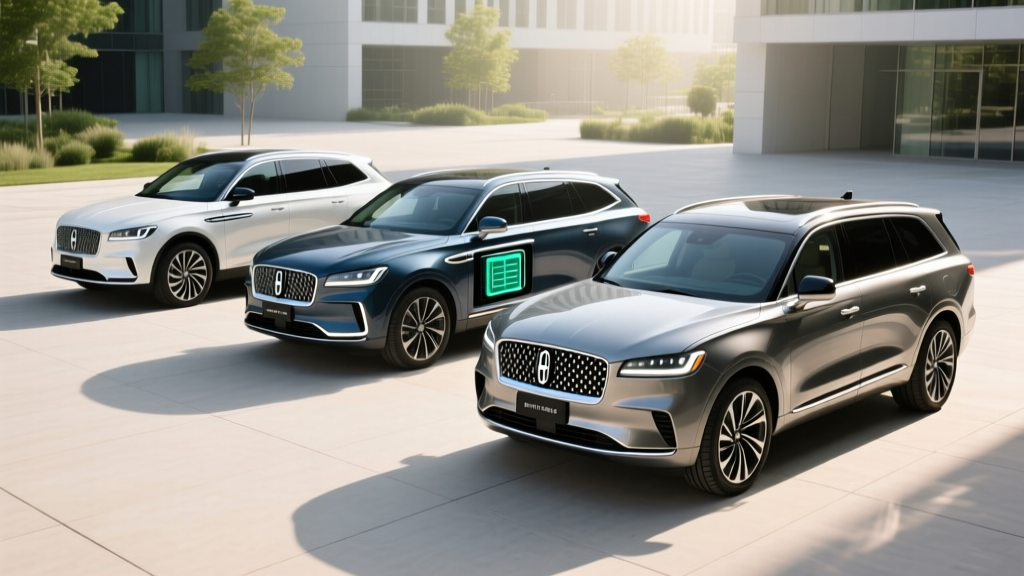
Lincoln takes a deliberate approach to electrification. Rather than chasing full battery-electric models across its lineup, the luxury brand offers two distinct hybrid strategies for 2026: a plug-in hybrid (PHEV) compact SUV in the Corsair Grand Touring, and a conventional hybrid (HEV) in the three-row Aviator. Neither requires a lifestyle overhaul — but they serve very different buyers.
This guide breaks down exact EPA figures, powertrain specs, real-world efficiency expectations, battery warranties, and tax-credit eligibility for every Lincoln hybrid currently on sale, so you can match the right powertrain to your driving pattern.
HEV vs PHEV: Understanding Lincoln's Two Hybrid Approaches
Lincoln's hybrid offerings split cleanly along the conventional-versus-plug-in divide. The distinction matters because it determines whether you need home charging infrastructure and how much of your daily driving can be zero-emission.
Conventional Hybrid (HEV) — Lincoln Aviator Hybrid
- How it works: A gasoline engine and electric motor share propulsion duties. The battery recharges through regenerative braking and the engine — you never plug it in.
- Best for: Drivers who want better fuel economy without changing any habits or installing a charger.
- Electric-only driving: Brief, low-speed assist only. Not designed for sustained electric-only operation.
Plug-In Hybrid (PHEV) — Lincoln Corsair Grand Touring
- How it works: A larger battery pack powers an electric motor for full EV driving at highway speeds. When the battery depletes, the gasoline engine takes over seamlessly.
- Best for: Drivers with home or workplace charging who want EV-like daily commuting with gas-engine range for road trips.
- Electric-only driving: EPA-rated 27 miles on battery alone — enough for most round-trip commutes.
Lincoln Corsair Grand Touring PHEV: Range, MPG, and Powertrain
The Corsair Grand Touring is Lincoln's sole plug-in hybrid and the most electrified vehicle in the current lineup. It pairs a 2.5-liter Atkinson-cycle four-cylinder engine with an electric motor and a 14.4 kWh lithium-ion battery pack (usable capacity approximately 11.2 kWh).
| Attribute | Value |
|---|---|
| Combined Horsepower | 266 hp |
| Engine | 2.5L I-4 Atkinson + electric motor |
| Battery Capacity | 14.4 kWh total / ~11.2 kWh usable |
| EPA Electric-Only Range | 27 miles |
| EPA Combined Range (EV + Gas) | 430 miles |
| EPA MPGe (EV Mode) | 80 MPGe |
| EPA MPG (Hybrid Mode, Combined) | 33 MPG |
| EPA MPG City / Highway | 34 city / 32 highway |
| Level 2 Charge Time (0–100%) | ~3.5 hours at 240V / 32A |
| DC Fast Charging | Not supported |
| Drivetrain | eAWD (electric rear axle) |
| Base MSRP (Reserve trim) | $52,690 |
Real-World Electric Range and Efficiency
EPA sticker: 27 miles electric-only | Real-world expectation: 22–25 miles in mixed driving; 18–20 miles in sustained cold weather (below 35°F) due to cabin heating demands and reduced battery efficiency. In mild conditions with conservative throttle use, some owners report 28–30 miles before the engine engages.
Once the battery depletes, the Corsair operates as a conventional hybrid at an EPA-estimated 33 MPG combined. In city-heavy driving, expect this number to climb — hybrids recapture energy through regenerative braking, and real-world city MPG often reaches 35–37. Highway-only driving at 75+ mph tends to drop to 29–31 MPG, which is typical for a luxury compact SUV with all-wheel drive.
Charging the Corsair PHEV
The Corsair Grand Touring accepts up to 7.2 kW on Level 2 AC charging. A full charge from empty takes roughly 3.5 hours on a 240V / 32A home charger. On a standard 120V household outlet (Level 1), expect approximately 10–12 hours for a full charge — feasible for overnight replenishment if your daily electric-only need is under 20 miles.
There is no DC fast-charging capability. This is standard for most PHEVs in this price segment; the battery is small enough that Level 2 covers overnight and workplace needs adequately.
Lincoln Aviator Hybrid: MPG and Powertrain Breakdown
The Aviator hybrid uses a conventional (non-plug-in) hybrid system built around a twin-turbocharged 3.0-liter V6 paired with an electric motor integrated into the 10-speed automatic transmission. Total system output is a substantial 400 horsepower and 563 lb-ft of torque — making it one of the most powerful hybrid SUVs in its class.
| Attribute | Value |
|---|---|
| Combined Horsepower | 400 hp |
| Combined Torque | 563 lb-ft |
| Engine | 3.0L Twin-Turbo V6 + electric motor |
| EPA MPG Combined | 25 MPG |
| EPA MPG City / Highway | 23 city / 26 highway |
| Drivetrain | AWD |
| Towing Capacity | 5,600 lbs |
| Battery Type | ~1.8 kWh lithium-ion (self-charging) |
| Plug-In Required | No — charges via regen and engine |
| Base MSRP (Reserve Hybrid) | $70,090 |
Real-World MPG: What to Expect
The Aviator hybrid's 25 MPG combined EPA rating represents a meaningful improvement over the non-hybrid twin-turbo V6 Aviator, which returns approximately 20–21 MPG combined. In real-world suburban and city driving with frequent stops, owners commonly report 26–28 MPG — the hybrid system's regenerative braking and electric assist shine in stop-and-go traffic.
On extended highway trips at 70–80 mph, expect 24–25 MPG. The aerodynamic drag and 4,900+ lb curb weight work against highway efficiency, but the hybrid system still outperforms the gas-only variant by 3–4 MPG in nearly all conditions.
Federal Tax Credits and Incentives: What Lincoln Hybrid Buyers Should Know
Tax-credit eligibility is one of the most common questions from hybrid shoppers. The rules differ sharply between HEV and PHEV under current IRS §30D regulations.
Federal §30D Clean Vehicle Credit — Key Requirements (2026)
- Vehicle type: Only plug-in hybrids (PHEVs) and full EVs qualify. Conventional hybrids (HEVs) like the Aviator Hybrid do NOT qualify for §30D.
- Maximum credit: Up to $7,500 for eligible new PHEVs/EVs.
- MSRP cap: SUVs must have an MSRP at or below $80,000; sedans at or below $55,000.
- Buyer income cap: Modified AGI must not exceed $150,000 (single), $225,000 (head of household), or $300,000 (joint filers).
- Battery sourcing: Critical minerals and battery components must meet phased-in domestic/free-trade-agreement sourcing thresholds that tighten annually.
- Point-of-sale transfer: Eligible buyers can transfer the credit to the dealer at purchase, reducing the purchase price directly rather than waiting for a tax refund.
Corsair Grand Touring PHEV: At an MSRP of $52,690 (Reserve trim), the Corsair falls well under the $80,000 SUV cap. However, the battery-sourcing requirements under §30D have tightened significantly since the Inflation Reduction Act took effect. As of 2026, vehicles with battery components from foreign entities of concern (FEOC) are disqualified. Lincoln's PHEV powertrain sourcing has been in flux — check the latest fueleconomy.gov tax credit listings and confirm with your dealer before assuming the full $7,500 applies. A partial credit (e.g., $3,750 for meeting the critical-minerals requirement but not the component requirement) is possible.
Aviator Hybrid (HEV): As a conventional hybrid with no plug, the Aviator Hybrid does not qualify for the §30D federal credit. Some state or utility incentives may apply to HEVs — check your local energy provider and IRS guidelines for current programs.
Battery Warranty, Reliability, and Replacement Costs
Hybrid battery longevity is a top concern for buyers transitioning from conventional vehicles. Lincoln backs both its hybrid systems with robust warranties that align with industry standards.
Lincoln Hybrid Battery Warranty Coverage
Hybrid/EV battery component warranty: 8 years / 100,000 miles (whichever comes first), as mandated for emissions-related components under federal law. In California Air Resources Board (CARB) states, coverage extends to 10 years / 150,000 miles.
Powertrain warranty: 6 years / 70,000 miles on the engine, transmission, and related drivetrain components.
What triggers a warranty claim: Battery capacity degradation below approximately 60–70% of original capacity, or any cell/module failure that impairs hybrid-system function.
Battery Replacement Cost Estimates
Out-of-warranty hybrid battery replacement is uncommon within the first 150,000 miles for modern lithium-ion packs, but it is a legitimate long-term ownership cost:
- Corsair PHEV (14.4 kWh pack): Estimated $6,000–$9,000 for battery replacement (parts and labor), based on comparable Ford/Lincoln PHEV architectures.
- Aviator HEV (~1.8 kWh pack): Estimated $2,500–$4,500, reflecting the much smaller battery capacity.
For context, Lincoln's hybrid system shares engineering DNA with Ford's hybrid platforms (the Corsair PHEV uses a derivative of the Escape PHEV powertrain; the Aviator hybrid shares its architecture with the Ford Explorer Hybrid). These systems have accumulated millions of real-world miles, and large-scale failure patterns have not emerged in NHTSA complaint databases. The twin-turbo V6 in the Aviator, however, adds mechanical complexity that may incur higher maintenance costs outside the hybrid system itself.
Lincoln Hybrid vs Full EV vs Gas: Which Powertrain Fits You?
Choosing between Lincoln's hybrids, a full battery-electric vehicle (BEV), or a conventional gas model depends on your charging access, daily mileage, and road-trip habits.
Choose the Corsair Grand Touring PHEV if:
- You have Level 2 charging at home or work and a round-trip commute under 25 miles.
- You want zero-emission daily driving but need 400+ miles of total range for road trips without route-planning around chargers.
- You live in a region with extreme cold, where full-EV range loss (20–35%) is a practical concern.
Choose the Aviator Hybrid (HEV) if:
- You need three rows and 5,600-lb towing capacity but want better fuel economy than a gas-only luxury SUV.
- You have no access to home or workplace charging and do not want to install a Level 2 circuit.
- Your priority is powertrain performance (400 hp, 563 lb-ft) with a modest efficiency bonus.
Consider a full EV (BEV) instead if:
- You have reliable home Level 2 charging and your daily driving rarely exceeds 200 miles.
- You want to eliminate oil changes, spark plugs, and transmission fluid entirely.
- You want access to the full $7,500 federal tax credit (subject to §30D sourcing rules) and lower per-mile fuel costs.
| Vehicle Type | Example | Economy | Annual Fuel Cost (15k mi) |
|---|---|---|---|
| PHEV (Corsair) | Corsair Grand Touring | 33 MPG / 80 MPGe | $1,200–$1,600* |
| HEV (Aviator) | Aviator Hybrid | 25 MPG | $2,100 |
| Gas (Aviator) | Aviator Twin-Turbo V6 | 21 MPG | $2,500 |
| Full EV | e.g., Cadillac Lyriq | 89 MPGe | $600–$900** |
*Assumes 60% of Corsair driving on electricity at $0.16/kWh, 40% on gasoline at $3.50/gal. **Varies significantly by electricity rate and charging mix.
Pros and Cons: Lincoln's Hybrid Strategy
Pros
- Corsair PHEV delivers genuine 22–25 mile real-world EV range — practical for daily commutes
- Aviator Hybrid offers 400 hp and 5,600-lb towing with a meaningful MPG improvement over gas-only
- No range anxiety on either model — gas engine provides 400+ miles total range
- 8-year/100,000-mile hybrid battery warranty (10yr/150k in CARB states)
- eAWD on Corsair provides confident all-weather traction without a mechanical driveshaft
- Lincoln luxury amenities (massage seats, Revel audio, phone-as-a-key) standard on hybrid trims
Cons
- No DC fast charging on Corsair PHEV — limits electric driving on road trips
- Aviator Hybrid is HEV only — no plug-in variant, no electric-only commuting
- Neither model guaranteed to qualify for full $7,500 federal tax credit due to battery-sourcing rules
- Corsair PHEV cargo space reduced by battery packaging (approximately 3–4 cu ft loss vs gas Corsair)
- Hybrid trims carry a $5,000–$8,000 premium over equivalent gas-only Lincoln models
- Lincoln has no full BEV in its current lineup — buyers seeking pure electric must look elsewhere
Frequently Asked Questions
How many MPG does the Lincoln Corsair hybrid get?
The 2026 Lincoln Corsair Grand Touring PHEV achieves an EPA-estimated 33 MPG combined (34 city / 32 highway) once the battery is depleted and it operates as a conventional hybrid. In electric-only mode, it earns 80 MPGe. Real-world city driving often yields 35–37 MPG thanks to regenerative braking, while sustained highway driving at 75+ mph drops to approximately 29–31 MPG.
How far can the Lincoln Corsair PHEV go on electric only?
The EPA rates the Corsair Grand Touring at 27 miles of electric-only range. In real-world mixed driving, expect 22–25 miles before the gasoline engine engages. Cold weather (below 35°F) can reduce this to 18–20 miles due to battery chemistry limitations and electric cabin-heating demands.
Does the Lincoln Aviator hybrid need to be plugged in?
No. The Aviator Hybrid is a conventional hybrid (HEV). Its small lithium-ion battery recharges automatically through regenerative braking and the gasoline engine. You fuel it like any other vehicle — no plug, no charger, no change to your routine.
Does any Lincoln hybrid qualify for the $7,500 federal tax credit?
Only the Corsair Grand Touring PHEV is potentially eligible for the federal §30D Clean Vehicle Credit, since conventional hybrids do not qualify. The Corsair's MSRP falls under the $80,000 SUV cap, but full credit eligibility depends on meeting 2026 battery-sourcing and critical-minerals thresholds, which tighten annually. Buyers should verify current eligibility on fueleconomy.gov and consult a tax professional. The Aviator Hybrid (HEV) does not qualify for §30D.
Is the Lincoln hybrid battery reliable, and what does replacement cost?
Lincoln's hybrid systems share proven Ford engineering and are covered by an 8-year/100,000-mile battery warranty (10 years/150,000 miles in CARB states). Large-scale battery failures have not been a pattern in NHTSA data for these architectures. If replacement is needed out of warranty, expect approximately $6,000–$9,000 for the Corsair PHEV pack and $2,500–$4,500 for the Aviator HEV pack. Most hybrid batteries outlast 150,000 miles with normal use.
Hybrid vs PHEV vs EV — which Lincoln should I buy?
If you have home charging and a short commute, the Corsair PHEV gives you EV-like daily driving with gas-engine flexibility. If you need three rows, towing, and zero charging hassle, the Aviator HEV adds efficiency without lifestyle changes. If you want zero tailpipe emissions, lower fuel costs, and have reliable Level 2 charging, a full EV from another luxury brand may serve you better — Lincoln does not currently offer a battery-electric model.