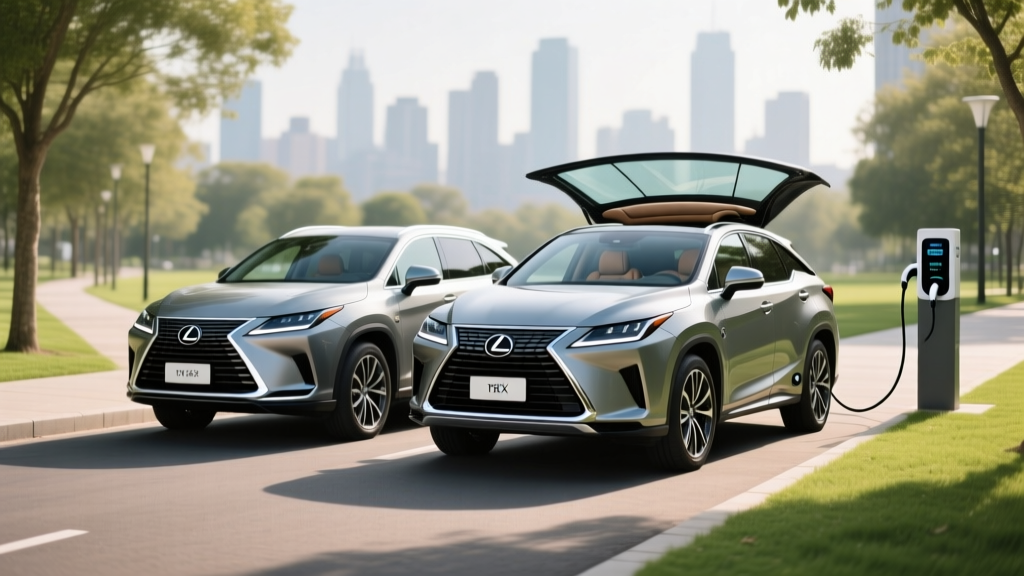
If you need three rows, Toyota reliability, and hybrid efficiency without going full electric, the Lexus 7 seater SUV hybrid lineup narrows down to one model: the Lexus TX. Introduced for the 2024 model year and now in its 2026 iteration, the TX replaced the aging RX L as Lexus's dedicated three-row family hauler — and it offers two distinct electrified flavors: a conventional hybrid (HEV) and a plug-in hybrid (PHEV).
This guide breaks down both powertrains with exact EPA figures, real-world expectations, pricing, battery longevity, and whether either qualifies for federal tax credits. Whether you're cross-shopping the BMW X5 xDrive50e, Volvo XC90 Recharge, or a fully electric Kia EV9, the data below will help you decide.
Lexus TX Lineup: Which Models Seat Seven?
The Lexus TX comes in three powertrain variants for 2026:
- TX 350 — Turbocharged gas-only inline-four (275 hp). Not electrified. Seats 6 or 7 depending on second-row configuration.
- TX 500h — Turbocharged hybrid inline-four with direct-drive hybrid system (366 hp combined). Standard third row, seats up to 6 (captain's chairs) or 7 (bench). This is a conventional HEV — no plug required.
- TX 550h+ — Plug-in hybrid V6 (406 hp combined). Standard third row, seats up to 6 or 7. This is the PHEV — it has a larger battery and can drive on electricity alone.
For buyers specifically searching for a Lexus 7 seater SUV hybrid, the TX 500h and TX 550h+ are the two electrified options. The critical distinction: the TX 500h is a self-charging hybrid (HEV), while the TX 550h+ is a plug-in hybrid (PHEV) that you charge from a wall outlet or public charger for electric-only driving.
HEV vs. PHEV: What's the Real Difference?
Before comparing specs, it's essential to understand how these two hybrid architectures differ in daily use:
| Feature | TX 500h (HEV) | TX 550h+ (PHEV) |
|---|---|---|
| Plug-in charging required? | No — regenerative braking + engine charge the battery | Yes — plug in to get electric-only range |
| Battery size | ~1.4 kWh (small buffer) | 18.1 kWh usable |
| Electric-only driving | Brief low-speed assist only (~1 mile max) | EPA-est. 33 miles electric-only |
| DC fast charging | N/A | No — AC Level 2 only |
| Home charging | None needed | ~4 hours on Level 2 (240V, 6.6 kW) |
| Best for | Drivers without home charging access | Drivers with home charging + short commutes |
Neither system requires you to change your driving habits. The TX 500h operates like a conventional car — you fuel it and go. The TX 550h+ rewards you with electric-only commuting if you plug in, but if you forget, it simply operates as a conventional hybrid using the gasoline engine.
Fuel Economy: EPA MPG and Real-World Numbers
Here are the official EPA ratings for both hybrid powertrains, based on fueleconomy.gov data:
| Model | City MPG | Highway MPG | Combined MPG | MPGe (PHEV EV mode) |
|---|---|---|---|---|
| TX 500h (HEV, AWD) | 27 | 28 | 27 | N/A |
| TX 550h+ (PHEV, AWD) | 29 (hybrid mode) | 28 (hybrid mode) | 29 (hybrid mode) | 56 MPGe |
Real-world MPG note: Toyota/Lexus hybrids consistently exceed their EPA city ratings in stop-and-go traffic because regenerative braking recovers energy that gas cars waste as heat. Owners frequently report 29-31 MPG combined in the TX 500h during city-heavy driving. Highway-only trips at 75+ mph tend to drop to 24-26 MPG due to the TX's boxy aerodynamics and 5,000+ lb curb weight. For the TX 550h+, real-world electric-only range in mild weather is typically 30-35 miles; expect 22-25 miles in freezing temperatures when the battery is less efficient and cabin heating draws power.
Total Range: How Far Can You Go?
For the TX 550h+ PHEV, total combined range (electric + gasoline) exceeds 420 miles — 33 miles electric plus roughly 390+ miles on the 17.2-gallon fuel tank in hybrid mode. The TX 500h HEV delivers approximately 480 miles of total range on a tank, making it an excellent road-trip vehicle with zero charging logistics.
Powertrain Specs: Horsepower, Acceleration, and Drivetrain
| Specification | TX 500h (HEV) | TX 550h+ (PHEV) |
|---|---|---|
| Engine | 2.4L turbo inline-4 + hybrid motor | 3.5L V6 + hybrid motors |
| Combined horsepower | 366 hp | 406 hp |
| Combined torque | 406 lb-ft | 400 lb-ft |
| 0-60 mph | 5.9 seconds | 5.7 seconds |
| Drivetrain | DIRECT4 AWD (standard) | E-Four AWD (standard) |
| Transmission | 6-speed automatic | e-CVT |
| Towing capacity | 5,000 lbs | 5,000 lbs |
| Curb weight | ~5,100 lbs | ~5,350 lbs |
The TX 500h uses Lexus's DIRECT4 all-wheel-drive system with a rear electric motor that can vary torque distribution front-to-rear. The TX 550h+ uses the E-Four system with a rear axle motor for AWD without a mechanical driveshaft. Both provide confident acceleration for merging and passing, though neither is a performance SUV — the emphasis is on smooth, quiet, efficient family transport.
Pricing, Trims, and Tax Credit Eligibility
Here's where the math gets interesting — and where many buyers get confused about incentives.
2026 Lexus TX Hybrid MSRP
- TX 500h Premium: ~$64,000
- TX 500h Luxury: ~$70,000
- TX 550h+ Luxury: ~$76,000
- TX 550h+ Executive: ~$81,000
(Prices are approximate base MSRP including destination. Options and packages add $2,000-$8,000+.)
Federal Tax Credit: What Actually Applies
TX 500h (HEV): Does NOT qualify for the §30D federal EV tax credit. Conventional hybrids are excluded — this credit applies only to plug-in vehicles with ≥7 kWh battery capacity. Some state-level incentives may apply for hybrids, but these vary by jurisdiction.
TX 550h+ (PHEV): Eligibility for the up-to-$7,500 federal tax credit under IRS §30D depends on several factors that shift annually:
- MSRP cap: SUVs must be under $80,000 MSRP. The TX 550h+ Luxury qualifies; the Executive trim may exceed the cap depending on options.
- Buyer income cap: Modified AGI must not exceed $300,000 (joint), $225,000 (head of household), or $150,000 (single).
- Battery sourcing: Critical minerals and battery components must meet phased-in domestic/free-trade-partner requirements. As of 2026, these rules are strict — check the fueleconomy.gov tax credit lookup for the specific model-year eligibility.
- Point-of-sale transfer: You can transfer the credit to the dealer at purchase for an immediate price reduction, rather than waiting until tax filing.
Bottom line: Do not assume the TX 550h+ qualifies for the full $7,500. Battery sourcing rules have disqualified several PHEVs in recent years. Verify on fueleconomy.gov before purchase, and consult a tax professional for your specific situation.
Battery Warranty, Longevity, and Replacement Cost
Lexus Hybrid Battery Warranty: All Lexus hybrids (HEV and PHEV) carry a hybrid battery warranty of 10 years / 150,000 miles (whichever comes first) in all 50 states. This is among the best in the industry and matches Toyota's hybrid warranty coverage.
What it covers: If the hybrid battery pack drops below a specified capacity threshold or fails, Lexus replaces it at no cost. This includes the hybrid battery control module and related components.
Real-World Battery Lifespan
Toyota and Lexus have the longest track record in hybrid battery durability, dating back to the 2001 Prius. Data from fleet operators and long-term owners consistently shows:
- HEV batteries (TX 500h): The small ~1.4 kWh nickel-metal hydride or lithium-ion pack rarely needs replacement. The battery is shallow-cycled (never fully charged or discharged), which dramatically extends cycle life. Failures before 200,000 miles are uncommon.
- PHEV batteries (TX 550h+): The 18.1 kWh lithium-ion pack has a larger buffer and active thermal management. Expect 10-15% degradation over 10 years based on similar Toyota/Lexus PHEV systems (RAV4 Prime, NX 450h+). Full replacement is rare within the warranty period.
Battery Replacement Cost (Out of Warranty)
If you plan to keep the vehicle well beyond 150,000 miles:
- TX 500h HEV battery: ~$3,000-$5,000 for a refurbished or new pack installed
- TX 550h+ PHEV battery: ~$8,000-$12,000 for a new pack installed
These are estimates based on current Lexus/Toyota hybrid battery pricing and may vary by dealer and region. Third-party refurbished options are increasingly available at lower cost.
Who Should Choose the TX Hybrid vs. a Full EV or Gas SUV?
Choose the TX 500h (HEV) if:
- You don't have access to home or workplace charging
- You take frequent long road trips and don't want to plan around charging stops
- You want better fuel economy than a gas SUV without any behavioral changes
- You prioritize lower purchase price over electric-only commuting
Choose the TX 550h+ (PHEV) if:
- You can charge at home (Level 2, 240V) and your daily commute is under 30 miles
- You want electric-only weekday driving but gas flexibility for weekend road trips
- You want the smooth, instant-torque feel of electric propulsion around town
- You're in a state with HOV lane access for PHEVs or additional state incentives
Consider a full EV (e.g., Kia EV9, Rivian R1S) instead if:
- You have reliable home charging and rarely drive more than 250 miles between stops
- You want zero tailpipe emissions and lower per-mile "fuel" cost
- You want to eliminate oil changes and engine maintenance entirely
- You qualify for the full $7,500 federal credit on a qualifying BEV
Pros and Cons: Lexus TX Hybrid at a Glance
Pros
- Genuine three-row seating for 7 with usable third row (adults for short trips)
- Class-leading hybrid fuel economy for a luxury 3-row SUV
- 10-year/150,000-mile hybrid battery warranty
- Lexus reliability reputation and strong resale value
- TX 550h+ offers 33 miles of silent, electric-only commuting
- 5,000-lb towing capacity on both hybrid trims
- No range anxiety — gas stations everywhere as backup
Cons
- TX 550h+ PHEV starts at ~$76K; Executive trim exceeds $80K MSRP credit cap
- PHEV battery adds ~250 lbs, reducing efficiency slightly in hybrid mode
- No DC fast charging on the PHEV (Level 2 AC only)
- Third row still tighter than a minivan or body-on-frame SUV
- Tax credit eligibility for PHEV uncertain due to battery sourcing rules
- Infotainment learning curve if upgrading from older Lexus models
Frequently Asked Questions
How many MPG does the Lexus TX hybrid get?
The TX 500h HEV gets an EPA-estimated 27 MPG combined (27 city / 28 highway). The TX 550h+ PHEV gets 29 MPG combined in hybrid mode and 56 MPGe when operating on electricity. In real-world city driving, owners often see 29-31 MPG in the TX 500h thanks to aggressive regenerative braking.
How far can the Lexus TX 550h+ go on electric only?
The EPA rates the TX 550h+ at 33 miles of electric-only range. In mild weather with conservative driving, expect 30-35 miles. In freezing temperatures or at highway speeds, that drops to 22-25 miles. Once the battery depletes, the gasoline engine seamlessly engages and the vehicle operates as a conventional hybrid.
Does the Lexus TX hybrid need to be plugged in?
The TX 500h (HEV) does NOT need to be plugged in — it charges its small battery through regenerative braking and the gasoline engine. The TX 550h+ (PHEV) should be plugged in to take advantage of its 33-mile electric range, but if you don't plug it in, it still functions normally as a hybrid.
Is the Lexus TX hybrid reliable? What about battery replacement?
Lexus (and parent company Toyota) has the deepest hybrid experience in the industry, with over 25 years of hybrid production. The hybrid battery is covered for 10 years / 150,000 miles. Out-of-warranty replacement runs roughly $3,000-$5,000 for the HEV and $8,000-$12,000 for the PHEV, though replacements before 200,000 miles are rare based on historical Toyota/Lexus data.
Does the Lexus TX hybrid qualify for a federal tax credit?
The TX 500h HEV does not qualify for the §30D federal tax credit (conventional hybrids are excluded). The TX 550h+ PHEV may qualify for up to $7,500, but eligibility depends on the buyer's income, the vehicle's MSRP (must be under $80,000 for SUVs), and battery component/mineral sourcing requirements that change annually. Check fueleconomy.gov and consult a tax professional before relying on the credit.
How long does it take to charge the TX 550h+ PHEV?
On a Level 2 home charger (240V, 32A), the TX 550h+ charges from empty to full in approximately 4 hours using its 6.6 kW onboard charger. On a standard 120V household outlet (Level 1), expect 10-12 hours — feasible for overnight top-ups. The TX 550h+ does not support DC fast charging, which is typical for PHEVs in this class.
Is the Lexus TX bigger than the RX?
Yes. The TX is 8.2 inches longer than the RX, with 4.6 inches more wheelbase, giving it a genuinely usable third row. The RX L's third row was widely criticized as too small for adults; the TX resolves that complaint with adequate headroom and legroom for average-sized adults on trips under two hours.
Final Verdict: Is the Lexus TX the Right 7-Seater Hybrid for You?
The 2026 Lexus TX fills a specific niche: luxury three-row family transport with proven hybrid efficiency and no charging dependency (HEV) or optional electric commuting (PHEV). If you need seven seats, want Lexus build quality and resale value, and aren't ready for a full EV, the TX 500h at ~$64,000 is the pragmatic choice with 27+ MPG and zero lifestyle changes.
The TX 550h+ PHEV makes sense if you have home charging, a sub-30-mile commute, and want to drive on electricity most weekdays while keeping gas flexibility for road trips — just verify tax credit eligibility before committing to the ~$76,000+ price tag.
For buyers who can charge at home and rarely exceed 250 miles between stops, a full electric three-row SUV like the Kia EV9 (EPA 300+ mi range) may offer lower operating costs. But for those who need go-anywhere flexibility with luxury refinement and hybrid efficiency, the Lexus TX remains the segment benchmark.