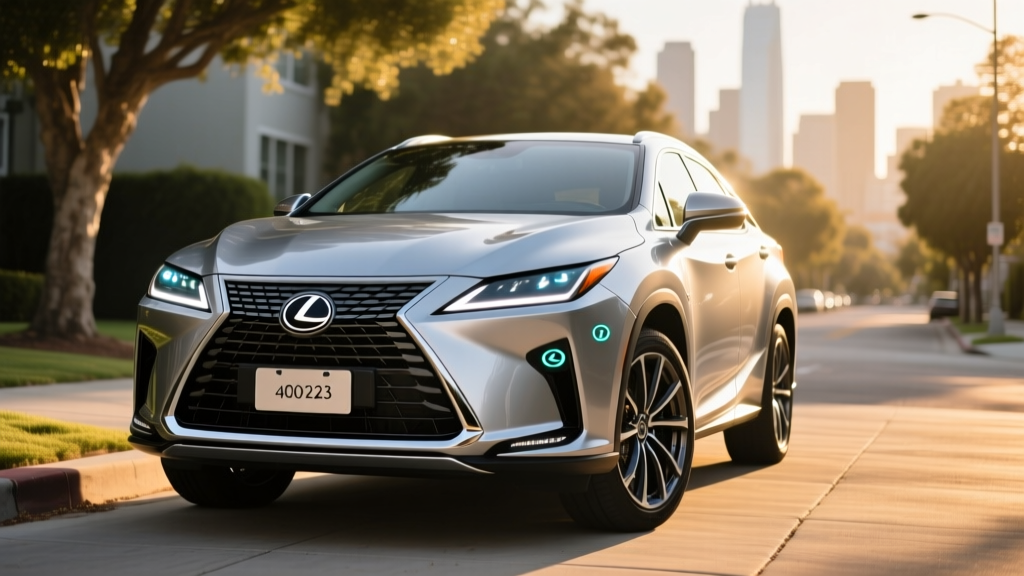
The Lexus RX 400h holds a unique place in automotive history. When it launched for the 2006 model year, it became one of the first luxury hybrid SUVs sold in the United States, proving that electrification could pair with premium comfort rather than economy-car compromises. Production ended after the 2008 model year, but thousands of RX 400h models remain on the road, and they continue to surface in the used-car market at attractive prices. For buyers researching a hybrid Lexus RX 400h, the key questions are different from those surrounding a new EV: How does real-world fuel economy hold up? What does battery replacement cost? And how does this pioneering HEV compare to modern hybrid, plug-in hybrid, and battery-electric alternatives?
This guide covers every figure that matters — EPA MPG, powertrain output, battery warranty, replacement cost, and ownership economics — so you can evaluate the RX 400h on data, not nostalgia.
HEV vs PHEV vs EV: Where the RX 400h Fits
Before diving into specs, it is essential to clarify what the RX 400h is — and what it is not. The RX 400h is a conventional hybrid electric vehicle (HEV). It cannot be plugged in. It has no electric-only driving range of practical length. It recovers energy through regenerative braking and uses a small nickel-metal hydride (NiMH) battery to assist the gasoline engine during acceleration, enabling engine-off coasting at very low speeds, and improving city fuel economy.
| Attribute | HEV (RX 400h) | PHEV (e.g., 2026 RX 500h+) | BEV (e.g., 2026 RZ 450e) |
|---|---|---|---|
| Plugs in? | No | Yes (Level 1/2) | Yes (Level 1/2/DC) |
| Electric-only range | ~1 mi at low speed | ~37 mi (EPA) | 220+ mi (EPA) |
| Gas engine? | Yes (always available) | Yes (hybrid mode) | No |
| Home charging needed? | No | Recommended | Required for daily use |
| Federal tax credit (new)? | No | Up to $3,750* | Up to $7,500* |
* §30D credit eligibility depends on MSRP caps, buyer income limits, battery-sourcing requirements, and point-of-sale transfer. See IRS.gov for current rules.
The RX 400h's HEV architecture means ownership is mechanically simple: you fuel it with gasoline and never think about charging. That simplicity is precisely what draws many buyers to it on the used market, especially those without access to home or workplace charging.
EPA Fuel Economy and Real-World MPG
The EPA rated the Lexus RX 400h at 31 MPG city / 27 MPG highway / 29 MPG combined for the AWD variant, which represents the vast majority of models sold. The FWD variant received a marginally higher rating of 33/28/31 MPG combined.
| Configuration | City MPG | Highway MPG | Combined MPG |
|---|---|---|---|
| RX 400h AWD | 31 | 27 | 29 |
| RX 400h FWD | 33 | 28 | 31 |
Source: fueleconomy.gov
Real-World MPG vs. EPA Sticker
Like most Toyota/Lexus hybrids of this era, the RX 400h tends to meet or slightly exceed its EPA city rating in stop-and-go driving because regenerative braking is most effective at low speeds. Owners frequently report 30-33 MPG in suburban and urban use. Highway driving at 75+ MPH, however, often drops to 24-26 MPG — below the EPA highway sticker — because aerodynamic drag dominates and the hybrid system provides less benefit at sustained high speed. Cold weather (below 35°F) can reduce combined MPG by 2-4 MPG due to extended engine warm-up cycles and reduced battery efficiency in the NiMH pack.
For context, the non-hybrid 2006-2008 Lexus RX 350 with AWD was EPA-rated at 18 city / 24 highway / 20 combined. The RX 400h's hybrid system delivers roughly a 45% improvement in city fuel economy over its gasoline-only sibling — a gap you will notice at every fill-up in urban driving.
Powertrain: Engine, Motors, and Combined Output
The RX 400h pairs a 3.3-liter V6 gasoline engine (3MZ-FE) with two electric motor-generators and a continuously variable transmission (CVT). The front electric motor handles primary propulsion assist and regeneration, while a smaller rear motor provides on-demand AWD traction. Combined system output is 208 horsepower.
| Component | Specification |
|---|---|
| Engine | 3.3L V6 (3MZ-FE), 208 hp combined system |
| Front electric motor | Permanent magnet, ~123 kW peak |
| Rear electric motor | Permanent magnet, ~50 kW peak (AWD models) |
| Transmission | eCVT (planetary gearset, no fixed gears) |
| Drivetrain | AWD (standard) or FWD |
| 0-60 MPH | ~7.3 seconds (AWD) |
| Towing capacity | 3,500 lbs |
The eCVT uses a planetary gearset rather than a belt or chain, which eliminates the slushy, rubber-band feel common in conventional CVTs. Acceleration is smooth and linear, and the transition between electric and gasoline propulsion is among the most seamless of any hybrid from this era. The 208 hp combined output was competitive with the V6 RX 350 (230 hp), and the instant torque from the electric motors makes the RX 400h feel quicker in city driving than the raw horsepower figure suggests.
Hybrid Battery: Chemistry, Lifespan, and Replacement Cost
The RX 400h uses a nickel-metal hydride (NiMH) traction battery pack rated at approximately 6.5 Ah and 288 volts nominal. This is a mature, well-understood chemistry that Toyota/Lexus deployed across millions of hybrids (Prius, Camry Hybrid, Highlander Hybrid) during the same period.
Battery Warranty and Expected Lifespan
When new, Lexus warranted the hybrid battery for 8 years / 100,000 miles (10 years / 150,000 miles in CARB states including California, New York, Massachusetts, and others that adopted California emissions standards). Because the newest RX 400h models are now from the 2008 model year, all original factory battery warranties have expired as of 2018 at the latest.
Expected lifespan: NiMH packs in Toyota/Lexus hybrids of this generation typically last 150,000-200,000 miles before significant degradation. Many exceed 200,000 miles with gradual capacity loss rather than sudden failure. Unlike NMC lithium-ion packs in modern EVs, NiMH degrades slowly and predictably.
When a battery does need replacement, you have several options:
- New OEM battery (Lexus dealer): $3,000-$4,500 installed. This is the most expensive route but provides a fresh pack with a new warranty.
- Remanufactured battery: $1,500-$2,500 installed from specialists like Green Bean Battery or similar shops. These replace degraded cells with tested modules and typically carry a 1-3 year warranty.
- Used/salvage battery: $500-$1,200 from a salvage yard. Least expensive but highest risk — remaining lifespan is unknown.
- Individual cell replacement: A qualified technician can identify and replace only the failed modules within the pack for $200-$600 in parts, though this requires specialized diagnostic equipment.
The RX 400h battery pack is located under the rear cargo floor, and replacement typically takes 2-3 hours of labor. It is a well-documented procedure that most independent hybrid specialists can perform.
Pricing: What Does a Used RX 400h Cost in 2026?
As a discontinued model (final year: 2008), the RX 400h is available exclusively on the used market. Pricing in early 2026 reflects age, mileage, and condition:
| Condition / Mileage | Approximate Price Range |
|---|---|
| Under 100k miles, excellent | $8,500 - $12,000 |
| 100k-150k miles, good | $6,000 - $9,000 |
| 150k+ miles, fair | $4,000 - $6,500 |
These prices make the RX 400h one of the most affordable entry points into a luxury hybrid SUV. However, buyers should budget an additional $1,500-$3,000 for potential battery replacement if the vehicle has over 150,000 miles and the battery has not been replaced previously. Always request a hybrid battery health report (many dealers and specialists can read state-of-charge and internal resistance data via OBD-II) before purchasing.
Does the RX 400h Qualify for Any Tax Credit?
No. The federal §30D clean vehicle credit applies only to new plug-in vehicles (PHEVs and BEVs) that meet current battery-sourcing, MSRP cap, and buyer income requirements. The RX 400h, as a conventional HEV that cannot be plugged in, never qualified for the federal EV tax credit, and it is ineligible for the current used-EV credit (§25E) as well, which is limited to used BEVs and PHEVs priced under $25,000. Some states historically offered hybrid purchase rebates, but most of these programs have been discontinued or converted to plug-in-only incentives. Check your state energy office for any remaining programs.
Reliability and Long-Term Ownership Costs
The RX 400h inherits the reputation of the third-generation Lexus RX platform, which is widely regarded as one of the most reliable luxury SUVs ever built. The 3MZ-FE V6 engine is a proven design shared with the Toyota Camry and Highlander, and parts availability remains strong. Common non-hybrid maintenance items include:
- Brake wear: Significantly reduced compared to non-hybrids. Regenerative braking handles most deceleration, and original brake pads often last 80,000-100,000+ miles.
- Transmission: The eCVT planetary gearset has no belts, clutches, or torque converter to wear out. Failures are extremely rare when fluid is changed per schedule.
- Inverter coolant pump: A known wear item on this generation. Listen for unusual humming or check for inverter-related diagnostic codes. Replacement is ~$400-$700.
- Power steering: Electric power steering (no fluid), minimal maintenance.
- 12V auxiliary battery: Located in the rear cargo area. Standard replacement every 4-5 years, ~$200.
Insurance costs are moderate for a luxury SUV of this age — typically $900-$1,400 annually depending on your profile and location. Depreciation has largely plateaued; well-maintained examples hold value well among buyers seeking a reliable, fuel-efficient used luxury crossover.
Who Should Buy the RX 400h — and Who Should Look Elsewhere?
Reasons to Buy
- Proven reliability with massive parts availability
- 31 MPG combined (AWD) — 45% better city MPG than the gas RX 350
- No charging infrastructure needed — ideal for apartment dwellers
- Luxury ride quality, strong cargo space (~40 cu ft behind rear seats)
- Low entry price ($6k-$12k) for a premium hybrid SUV
- Minimal brake wear thanks to regen
Reasons to Look Elsewhere
- No electric-only range — cannot run emissions-free
- NiMH battery is aging technology; replacement is a real cost
- No federal tax credit available (new or used)
- Infotainment and safety tech are outdated by 2026 standards
- Highway MPG (24-27 real-world) trails modern hybrids like the 2026 RX 500h
- No DC fast charging, no plug-in capability
The Verdict: Choose the RX 400h If…
Buy it if: You want an affordable, proven luxury hybrid SUV for city and suburban driving, you lack home charging access, and you are comfortable with a 15-20 year old vehicle that may need a battery replacement.
Look at a newer HEV (2024+ RX 500h, 36 MPG combined) if: You want modern safety tech, a fresh battery warranty, and better highway efficiency.
Consider a PHEV (2026 RX 500h+, ~37 mi electric) if: You have home Level 2 charging and want to do most daily driving on electricity while keeping gas for road trips.
Go full BEV (2026 RZ 450e, 220+ mi EPA) if: You want zero tailpipe emissions, have reliable home charging, and are ready to eliminate gasoline entirely.
Frequently Asked Questions
How many MPG does the Lexus RX 400h hybrid get?
The EPA rates the AWD RX 400h at 31 city / 27 highway / 29 combined MPG. Real-world city driving often yields 30-33 MPG, while sustained highway driving at 75+ MPH typically drops to 24-26 MPG.
Can you plug in the Lexus RX 400h?
No. The RX 400h is a conventional hybrid (HEV), not a plug-in hybrid. It charges its battery entirely through regenerative braking and the gasoline engine. You never plug it in.
How much does it cost to replace the RX 400h hybrid battery?
A new OEM battery from a Lexus dealer runs $3,000-$4,500 installed. Remanufactured batteries from specialists cost $1,500-$2,500. Individual cell module replacement is possible for $200-$600 in parts. Most NiMH packs last 150,000-200,000 miles.
Is the Lexus RX 400h reliable after 150,000 miles?
Yes, with proper maintenance. The 3MZ-FE V6 and eCVT are among the most durable powertrains Toyota/Lexus has produced. The main age-related concern is hybrid battery degradation, which is a known and budgetable cost. Brake, transmission, and engine longevity typically exceed 200,000 miles.
Does the RX 400h qualify for any federal or state tax credit?
No. The RX 400h is a conventional hybrid, not a plug-in vehicle. It does not qualify for the federal §30D new vehicle credit or the §25E used EV credit. Some states may offer minimal hybrid incentives, but most have shifted to plug-in-only programs.
How does the RX 400h compare to the current Lexus RX 500h?
The 2026 RX 500h achieves an EPA-estimated 36 MPG combined (a 24% improvement), produces 366 hp from a turbocharged 2.4L hybrid powertrain, includes modern ADAS (Lexus Safety System+ 3.0), and comes with a fresh 10-year/150,000-mile hybrid battery warranty. The trade-off is price: a new RX 500h starts around $55,000, roughly 5-8x the cost of a used RX 400h.