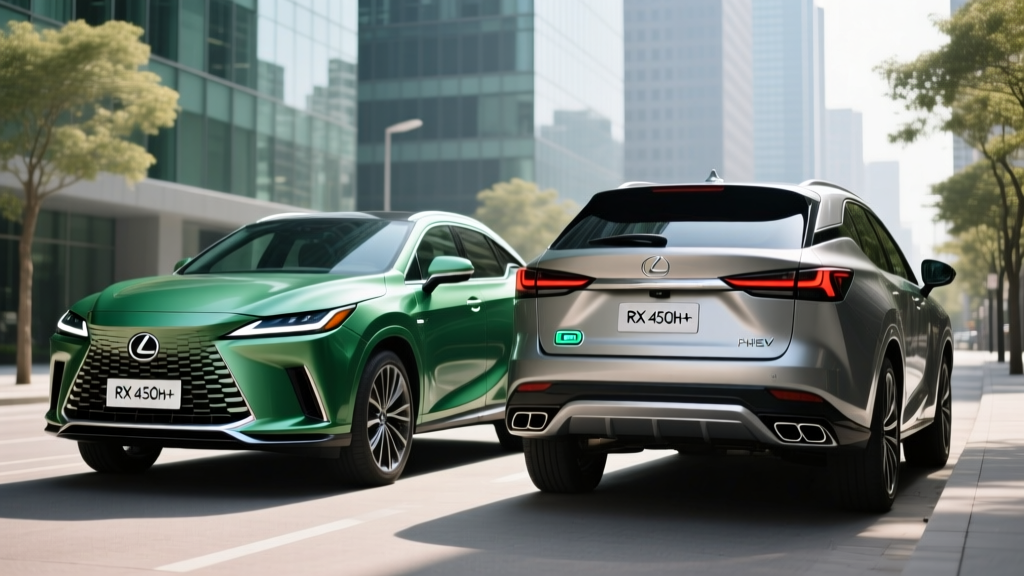
The Lexus RX has been the best-selling luxury SUV in America for over a decade, and its electrified variants now account for a growing share of that volume. For the 2026 model year, buyers choosing an RX hybrid Lexus face a decision that didn't exist just a few years ago: do you go with the conventional RX 350h hybrid (HEV) that never needs plugging in, or the RX 450h+ plug-in hybrid (PHEV) that delivers meaningful electric-only driving before the gas engine takes over?
Both share the same refined cabin, Lexus Safety System+ 3.0 suite, and available all-wheel drive — but the powertrain math, fuel economics, and tax-credit eligibility diverge sharply. This guide breaks down every number you need to decide which RX hybrid fits your commute, budget, and charging situation.
HEV vs PHEV: How the Two RX Hybrids Differ
Before comparing specs, it's critical to understand the fundamental architecture difference — because it determines whether you'll ever plug in, how far you can drive on electricity, and whether you qualify for federal incentives.
| Feature | RX 350h (HEV) | RX 450h+ (PHEV) |
|---|---|---|
| Plug-in required? | No — self-charging via regenerative braking and engine | Yes — plug in to access electric-only range |
| Battery size | ~1.6 kWh (nickel-metal hydride) | 18.1 kWh usable (lithium-ion) |
| Electric-only driving | Brief low-speed assists only | EPA-est. 37 miles |
| DC fast charging | N/A | Not supported (Level 2 AC only) |
| Federal tax credit (§30D) | Not eligible | Up to $3,750 (see eligibility below) |
| Best for | No home charging access; want simplicity | Home charging available; short daily commute |
The conventional RX 350h uses Toyota's fourth-generation hybrid system: a small battery buffers energy recovered from braking and deceleration, then deploys it to assist the gas engine during acceleration. You never plug it in, and there's no electric-only mode beyond creeping through a parking lot. The RX 450h+ carries a substantially larger 18.1 kWh lithium-ion pack that powers the vehicle for roughly 37 miles on electricity alone before the 2.5-liter four-cylinder engine seamlessly engages, turning it into a conventional hybrid for the remaining ~390 miles of total range.
Fuel Economy: EPA MPG and Real-World Numbers
| Model | City MPG | Highway MPG | Combined MPG | MPGe (PHEV EV mode) |
|---|---|---|---|---|
| RX 350h AWD | 37 | 34 | 36 | N/A |
| RX 350h FWD | 37 | 34 | 36 | N/A |
| RX 450h+ (gas only, battery depleted) | 35 | 33 | 34 | 84 MPGe (combined EV+gas) |
Source: fueleconomy.gov — EPA estimates. Your mileage will vary.
Real-World MPG: What Owners Actually See
Hybrids almost always exceed their EPA city estimate in stop-and-go traffic because regenerative braking recovers energy that a gas car wastes as heat. RX 350h owners regularly report 38–41 MPG on suburban commutes with frequent stops. Highway driving tells a different story: at 75+ mph, the aerodynamic drag of a mid-size luxury SUV overwhelms the hybrid system's advantages, and 31–33 MPG is common on flat interstate runs.
For the RX 450h+, real-world economics depend entirely on your charging discipline. If you plug in nightly and your round-trip commute is under 35 miles, you may use a tank of gas once a month. Owners with 20-mile daily commutes report averaging 60–80 MPG equivalent over a fill-up cycle. If you never plug in, the 450h+ functions as a slightly less efficient RX 350h — you're hauling 400+ pounds of battery you never use.
Powertrain and Performance Specs
| Specification | RX 350h | RX 450h+ |
|---|---|---|
| Engine | 2.5L inline-4 + 2 electric motors | 2.5L inline-4 + 2 electric motors (higher output) |
| Combined horsepower | 246 hp | 302 hp |
| 0–60 mph | 7.4 seconds | 6.2 seconds |
| Drivetrain | FWD or AWD (e-AWD with rear motor) | AWD standard (e-AWD) |
| Transmission | eCVT | eCVT |
| Towing capacity | Not rated | Not rated |
| EV-only range (PHEV) | N/A | 37 miles (EPA) |
| Total range (PHEV) | ~570 miles | ~430 miles (EV + gas) |
The RX 450h+ isn't just more efficient in the right conditions — it's meaningfully quicker. The 56-hp advantage shows up in highway merging and passing, where the electric motors deliver instant torque before the four-cylinder wakes up. The eCVT in both models avoids the rubber-band feel of older Toyota hybrids; Lexus has tuned the powertrain to simulate stepped gear ratios under hard acceleration.
PHEV Charging: What RX 450h+ Owners Need to Know
The RX 450h+ accepts Level 1 (120V household outlet) and Level 2 (240V) AC charging. It does not support DC fast charging — a deliberate engineering choice shared with the Toyota RAV4 Prime. Lexus prioritized packaging and cost over rapid-charging capability, reasoning that PHEV batteries are small enough to refill overnight.
| Charging Level | Power | Time to Full (0–100%) | Practical Use |
|---|---|---|---|
| Level 1 (120V, 12A) | ~1.4 kW | ~12–13 hours | Emergency / occasional top-up |
| Level 2 (240V, 16A) | ~3.3 kW (vehicle-limited) | ~5.5 hours | Overnight home charging |
| Level 2 (240V, 32A+) | ~3.3 kW (vehicle-limited) | ~5.5 hours | No speed benefit — onboard charger caps at 3.3 kW |
The 3.3 kW onboard charger is the bottleneck. Even if you connect to a 48-amp Level 2 station capable of 11.5 kW, the RX 450h+ will only draw 3.3 kW. That means a full recharge takes roughly 5.5 hours regardless of your Level 2 hardware. For most owners, this is fine — plug in at 10 PM, full by 6 AM. But if you hoped to top up during a midday errand at a public charger, the slow rate limits practicality.
Hybrid Battery Warranty and Replacement Cost
Both the RX 350h and RX 450h+ carry Lexus's hybrid battery warranty: 10 years or 150,000 miles (whichever comes first), covering defects and capacity loss below a defined threshold. This applies in all 50 states — California's previous 10-year/150,000-mile standard is now the national baseline for Lexus.
If replacement is needed out of warranty, current costs run approximately:
- RX 350h NiMH battery pack: $3,000–$4,500 (parts + labor)
- RX 450h+ lithium-ion pack: $8,000–$12,000 (parts + labor)
In practice, Toyota/Lexus hybrid batteries have demonstrated exceptional longevity. Taxi fleets using the same hybrid architecture have logged 300,000+ miles on original packs. The larger lithium-ion pack in the 450h+ is newer technology, but benefits from conservative charge management — Lexus buffers the top and bottom of the pack to prevent the deep cycles that accelerate degradation.
Pricing, Trims, and Tax Credit Eligibility
| Trim | RX 350h MSRP | RX 450h+ MSRP |
|---|---|---|
| Premium (base) | $52,950 | $63,350 |
| Premium+ | $55,450 | $65,850 |
| Luxury | $59,950 | $70,350 |
| F SPORT Handling | N/A | $67,350 |
Prices include destination charge. Source: Lexus USA
Federal Tax Credit: RX 450h+ Only
The RX 450h+ is the only variant eligible for the IRS §30D clean vehicle credit. However, the credit is not a flat $7,500. Under current 2026 rules:
- Maximum potential credit: $3,750 (the RX 450h+ meets critical-minerals requirements but does not meet the battery-component sourcing threshold for the full $7,500)
- MSRP cap: SUVs must be under $80,000 — all RX 450h+ trims qualify
- Buyer income cap: Modified AGI must not exceed $150,000 (single), $225,000 (head of household), or $300,000 (joint)
- Point-of-sale transfer: You can transfer the credit to the dealer at purchase, reducing your out-of-pocket cost immediately rather than waiting for tax filing
- Assembly requirement: Final assembly must occur in North America — the RX is assembled in Cambridge, Ontario, Canada, which qualifies
The RX 350h does not qualify for any federal tax credit because it is a conventional hybrid, not a plug-in vehicle. Some states and utilities offer rebates for HEVs, but these vary by jurisdiction — check your state energy office or IRS §30D guidance for current rules.
Who Should Buy Which RX Hybrid?
Choose the RX 350h (HEV) if:
- You rent or live where home charging installation isn't feasible
- You want hybrid fuel savings with zero behavioral change
- Your budget is under $55,000
- You drive mostly highway miles (where the PHEV's electric range provides less benefit)
- You plan to own the vehicle 12+ years and want the simplest long-term maintenance profile
Choose the RX 450h+ (PHEV) if:
- You have a garage or driveway where you can install a Level 2 charger
- Your daily round-trip commute is under 35 miles
- You want electric-car refinement (silent, instant torque) for daily driving with gas-car road-trip flexibility
- You qualify for the $3,750 federal credit and your state offers additional PHEV incentives
- The 56-hp performance advantage matters to you
The Full-EV Alternative: Should You Consider the Lexus RZ Instead?
If you're cross-shopping the RX 450h+, the all-electric Lexus RZ 450e enters the conversation at a similar price point (~$54,000–$59,000) with 220 miles of EPA range. The RZ eliminates gas-engine maintenance entirely and qualifies for the full $7,500 federal credit. However, its smaller cargo area, limited towing, and range that drops to ~170 miles in cold weather or at sustained highway speeds make it a different vehicle, not a direct RX replacement. The RX 450h+ exists for buyers who want RX practicality with electric commuting — not for buyers ready to go fully electric.
Reliability and Long-Term Ownership
Lexus consistently ranks at or near the top of J.D. Power and Consumer Reports reliability studies, and the RX is a cornerstone of that reputation. The hybrid powertrain adds complexity in one sense (electric motors, power electronics, high-voltage battery) but eliminates it in others: the eCVT has no traditional transmission bands or clutches to wear, regenerative braking dramatically extends pad and rotor life, and the engine runs fewer hours because the electric motors share the load.
The RX 350h's nickel-metal hydride battery is arguably the most proven hybrid battery chemistry on the road — Toyota has used NiMH packs in the Prius since 1997, with documented examples exceeding 250,000 miles without replacement. The RX 450h+'s lithium-ion pack is newer to the Lexus lineup but uses conservative thermal management and state-of-charge buffering to maximize cycle life.
Frequently Asked Questions
How many MPG does the Lexus RX hybrid get?
The RX 350h achieves an EPA-estimated 36 MPG combined (37 city / 34 highway). In real-world suburban driving with frequent stops, owners commonly see 38–41 MPG. Highway-only driving at 75+ mph typically yields 31–33 MPG.
How far can the RX 450h+ drive on electric only?
The EPA rates the RX 450h+ at 37 miles of electric-only range. In mild weather at city speeds, some owners report 40+ miles. At highway speeds or in cold temperatures (below 35°F), expect 28–32 miles before the gas engine engages.
Does the Lexus RX 350h qualify for a federal tax credit?
No. The §30D federal clean vehicle credit applies only to plug-in electric vehicles. The RX 350h is a conventional (self-charging) hybrid and is not eligible. The RX 450h+ PHEV qualifies for up to $3,750, subject to buyer income limits and point-of-sale transfer rules.
How long does the Lexus RX hybrid battery last, and what does replacement cost?
Lexus warranties the hybrid battery for 10 years or 150,000 miles. Real-world data from Toyota/Lexus hybrid systems shows many packs lasting 200,000+ miles. Out-of-warranty replacement runs $3,000–$4,500 for the RX 350h (NiMH) and $8,000–$12,000 for the RX 450h+ (lithium-ion).
Do I need to plug in the RX 350h?
No. The RX 350h is a conventional hybrid that charges its small battery through regenerative braking and the gas engine. You fuel it exactly like a gas car. Only the RX 450h+ requires (and benefits from) plugging in.
Hybrid vs PHEV vs EV — which RX is right for me?
If you can charge at home and commute under 35 miles daily, the RX 450h+ PHEV gives you electric-car daily driving with gas-car road-trip range. If you can't charge at home or want maximum simplicity, the RX 350h HEV delivers strong fuel economy with no plug required. If you're ready to eliminate gas entirely and your trips stay under 200 miles, consider the all-electric Lexus RZ instead — but it's a smaller vehicle, not a direct RX substitute.