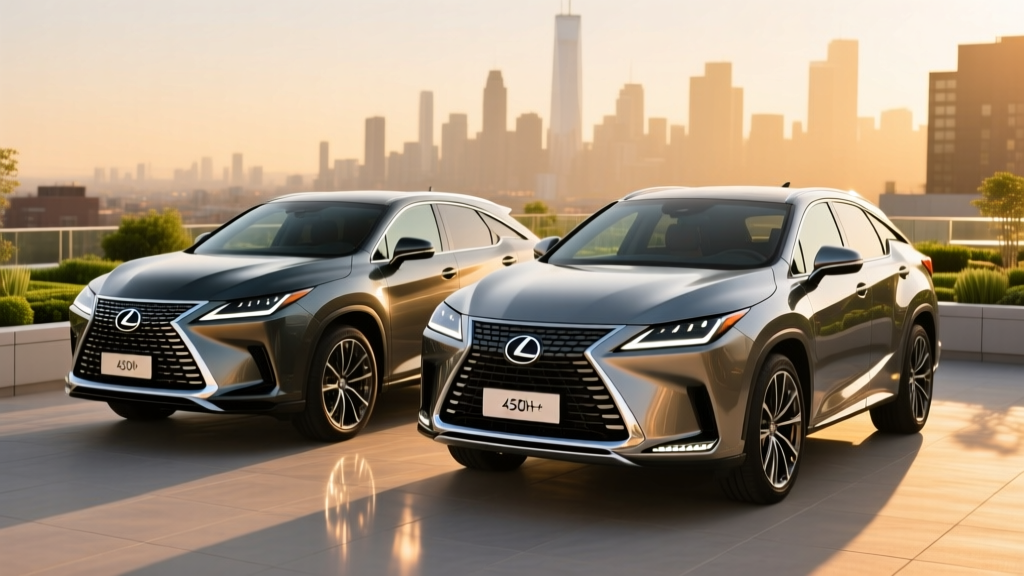
If you're shopping for a luxury hybrid SUV that balances prestige, comfort, and genuine fuel savings without committing fully to battery-electric life, the Lexus RX lineup presents two distinct paths. The conventional RX 500h hybrid needs no plug and sips fuel in stop-and-go traffic. The plug-in RX 450h+ offers a usable 37-mile electric-only commute before its gas engine ever fires up. Both wear the same refined sheet metal and share Lexus's reputation for long-term reliability, but they serve fundamentally different daily routines.
This guide breaks down the exact numbers—EPA MPG, electric-only range, battery kWh, charging times, powertrain output, and pricing—so you can match the right RX variant to your driving life in 2026.
HEV vs PHEV: Which Luxury Hybrid SUV Architecture Fits You?
Before comparing trims, it's essential to separate the two powertrain philosophies Lexus offers in the RX:
Conventional Hybrid (HEV) — RX 500h
- No plug required. The battery recharges via regenerative braking and the gas engine.
- Best for: Drivers without home charging access, frequent long road-trippers, and those who want simplicity.
- Trade-off: Cannot drive on electricity alone at highway speeds; always burns some fuel.
Plug-In Hybrid (PHEV) — RX 450h+
- Plugs in. A larger battery provides 37 miles of pure electric driving before the engine engages.
- Best for: Commuters with home Level 2 charging who want an EV daily driver that can also road-trip without range anxiety.
- Trade-off: Higher purchase price; heavier due to larger battery; requires a charging setup to maximize value.
The distinction matters because a PHEV you never plug in is simply a heavy, expensive hybrid. If you lack reliable access to a 240V outlet at home or work, the RX 500h delivers better economics.
EPA Fuel Economy and Real-World MPG
Lexus publishes separate EPA ratings for each powertrain. Here's how they break down for the 2026 model year:
| Metric | RX 500h (HEV) | RX 450h+ (PHEV) |
|---|---|---|
| City MPG (gas) | 27 mpg | 27 mpg (charge-depleted) |
| Highway MPG (gas) | 28 mpg | 28 mpg (charge-depleted) |
| Combined MPG (gas) | 27 mpg | 27 mpg (charge-depleted) |
| Combined MPGe (electric + gas) | N/A | 65 MPGe |
| Electric-Only Range | N/A | 37 miles |
| Total Combined Range | ~540 miles | ~430 miles (EV + gas) |
Real-world MPG reality check: Toyota's hybrid system historically overdelivers in city driving, where regenerative braking recovers the most energy. Owners of the previous-generation RX hybrid routinely report 29–31 mpg in urban commuting, exceeding the EPA city sticker. On sustained highway runs at 75+ mph, expect the RX 500h to return closer to 25–26 mpg—aerodynamic drag and the turbocharged engine's load reduce the hybrid advantage at speed. Source: fueleconomy.gov.
For the RX 450h+, the 65 MPGe figure only applies when you begin trips with a full charge and stay within the electric range. Once the battery depletes, it operates as a conventional hybrid at 27 mpg combined—the same as the 500h.
Powertrain and Performance Specs
| Specification | RX 500h F SPORT Performance | RX 450h+ Luxury |
|---|---|---|
| Engine | 2.4L turbocharged 4-cyl | 2.5L naturally aspirated 4-cyl |
| Electric Motors | Front + rear (eAxle) | Front + rear (eAxle) |
| Combined Horsepower | 366 hp | 302 hp |
| 0–60 mph | 5.5 seconds | 7.4 seconds |
| Drivetrain | AWD (DIRECT4) | AWD (E-Four) |
| Transmission | 6-speed automatic | eCVT |
| Towing Capacity | 3,500 lbs | 3,500 lbs |
The RX 500h is the performance-oriented choice: its turbo-four and hybrid boost deliver confident passing power and a sportier character. The RX 450h+ prioritizes efficiency and smoothness—the eCVT keeps the engine at optimal RPM, and the electric motors provide instant torque off the line, though the naturally aspirated engine lacks the 500h's punch when the battery is depleted.
PHEV Battery, Charging, and Electric-Only Range
The RX 450h+ packs an 18.1 kWh lithium-ion battery (usable capacity approximately 15.4 kWh, with the remainder reserved as a buffer to protect long-term health). That's enough for 37 miles of zero-emission driving at moderate speeds.
| Charging Level | Power | 0–100% Time | Notes |
|---|---|---|---|
| Level 1 (120V household) | 1.4 kW | ~11 hours | Overnight trickle; adequate for short commutes |
| Level 2 (240V home/work) | 6.6 kW | ~2.5 hours | Recommended; full charge while you work or sleep |
| DC Fast Charge | Not supported | N/A | CCS port is AC-only on this model |
Key limitation: The RX 450h+ does not support DC fast charging. This is typical for most PHEVs in 2026—the battery is small enough that Level 2 replenishes it quickly, and automakers avoid the added weight and cost of DC hardware. If your daily commute exceeds 37 miles each way, you'll burn gas on the return leg unless you can plug in at your destination.
Preconditioning note: The RX 450h+ allows you to precondition the cabin while plugged in, warming or cooling the interior using grid electricity rather than battery power—a meaningful efficiency gain in extreme temperatures.
Pricing, Trims, and Federal Tax Credit Eligibility
| Model & Trim | 2026 MSRP | Federal §30D Credit Eligible? |
|---|---|---|
| RX 500h F SPORT Performance | $62,850 | No — HEV, not a plug-in |
| RX 450h+ Premium | $65,250 | Potentially $3,750* |
| RX 450h+ Luxury | $70,250 | Potentially $3,750* |
*The RX 450h+ qualifies as a new clean vehicle under IRS §30D, but the credit amount depends on critical-mineral and battery-component sourcing requirements, which shift annually. As of 2026, the maximum credit for qualifying PHEVs is $3,750 if the vehicle meets only one of the two sourcing thresholds (critical minerals OR battery components), or $7,500 if it meets both. Lexus's supply chain has historically met the critical-minerals threshold but not always the battery-components requirement, making $3,750 the realistic expectation. Additionally:
- MSRP cap: SUVs must be priced at or below $80,000 (both RX 450h+ trims qualify).
- Buyer income cap: Modified AGI must not exceed $300,000 (joint), $225,000 (head of household), or $150,000 (single).
- Point-of-sale transfer: You can apply the credit as an immediate dealer discount rather than waiting for tax filing.
Always verify current eligibility on IRS.gov before purchasing, as sourcing certifications update quarterly.
Battery Warranty, Reliability, and Replacement Cost
Lexus Hybrid Battery Warranty
Coverage: 10 years / 150,000 miles (whichever comes first) for the hybrid battery in both the RX 500h and RX 450h+.
Capacity retention threshold: Lexus replaces the battery under warranty if capacity drops below approximately 60% of original, though degradation to that level is exceptionally rare within the warranty period.
Toyota/Lexus hybrid systems have the strongest reliability track record in the industry. The RX hybrid lineage dates back to the 2006 RX 400h, and the brand's hybrid batteries routinely last 150,000–200,000+ miles before meaningful degradation. The larger PHEV battery in the 450h+ uses a more conservative state-of-charge buffer (top and bottom), which reduces cycle stress.
Out-of-warranty replacement cost: If the hybrid battery fails after 10 years/150k miles, expect a dealer replacement to cost between $4,500 and $6,500 for the RX 500h, and $7,000–$9,500 for the RX 450h+ (larger pack). Independent hybrid specialists and refurbished packs can reduce that figure by 30–40%. Given the proven longevity, most owners sell or trade before facing this expense.
General reliability: The current-generation RX platform earned a Top Safety Pick+ rating from IIHS and carries Lexus's typical above-average predicted reliability scores.
Who Should Choose Which — Hybrid, PHEV, or Full EV?
Choose the RX 500h (HEV) if:
- You lack home or workplace charging access
- You frequently take long road trips and don't want to plan around charge stops
- You want hybrid fuel savings with zero behavioral change
- Performance (366 hp, 5.5s 0–60) matters more than electric commuting
Choose the RX 450h+ (PHEV) if:
- Your daily round-trip commute is under 37 miles and you can charge at home
- You want to drive electric most days but need gas flexibility for weekend trips
- You want to reduce fuel costs significantly without range anxiety
- You can capture the $3,750 federal tax credit at point of sale
Still deciding between Hybrid, PHEV, or Full EV?
Full EV (e.g., Lexus RZ 450e, BMW iX): Best if you have reliable home charging, commute under 250 miles daily, and want the lowest operating cost and zero tailpipe emissions. Trade-off: road-trip charging logistics and higher upfront cost.
PHEV (RX 450h+): Best if you want electric commuting but can't commit to full EV due to long trips, cold-climate range loss concerns, or limited charging infrastructure in your area.
HEV (RX 500h): Best if charging access is unavailable or you simply want better MPG without plugging in, changing habits, or paying a PHEV premium.
Frequently Asked Questions
How many MPG does the Lexus RX hybrid get?
The RX 500h is EPA-rated at 27 mpg combined (27 city / 28 highway). Real-world city driving often yields 29–31 mpg thanks to regenerative braking; highway cruising at 75+ mph typically returns 25–26 mpg.
How far can the RX 450h+ drive on electric only?
The EPA rates it at 37 miles of electric-only range. In moderate temperatures at speeds under 45 mph, some drivers report 39–41 miles. In cold weather (below 30°F) or at sustained highway speeds, expect 28–32 miles before the engine starts.
Does the Lexus RX hybrid qualify for a tax credit?
The RX 500h (conventional hybrid) does not qualify for any federal tax credit. The RX 450h+ (plug-in hybrid) may qualify for up to $3,750 under IRS §30D, subject to buyer income limits, MSRP caps, and battery-sourcing requirements. Verify current eligibility at IRS.gov before purchase.
Is the Lexus RX hybrid reliable, and what does battery replacement cost?
Lexus hybrid systems are among the most reliable in the industry, backed by a 10-year/150,000-mile hybrid battery warranty. Out-of-warranty replacement runs $4,500–$6,500 (HEV) or $7,000–$9,500 (PHEV), though most batteries last well beyond 150,000 miles.
Do I need to plug in the RX 500h?
No. The RX 500h is a conventional hybrid—it charges its small battery through regenerative braking and the gas engine. You fuel it like any other car. Only the RX 450h+ requires (and benefits from) plugging in.
How long does it take to charge the RX 450h+ at home?
On a 240V Level 2 charger (recommended), a full charge takes approximately 2.5 hours. On a standard 120V household outlet (Level 1), expect around 11 hours—adequate for overnight replenishment if your daily electric driving is under 20 miles.