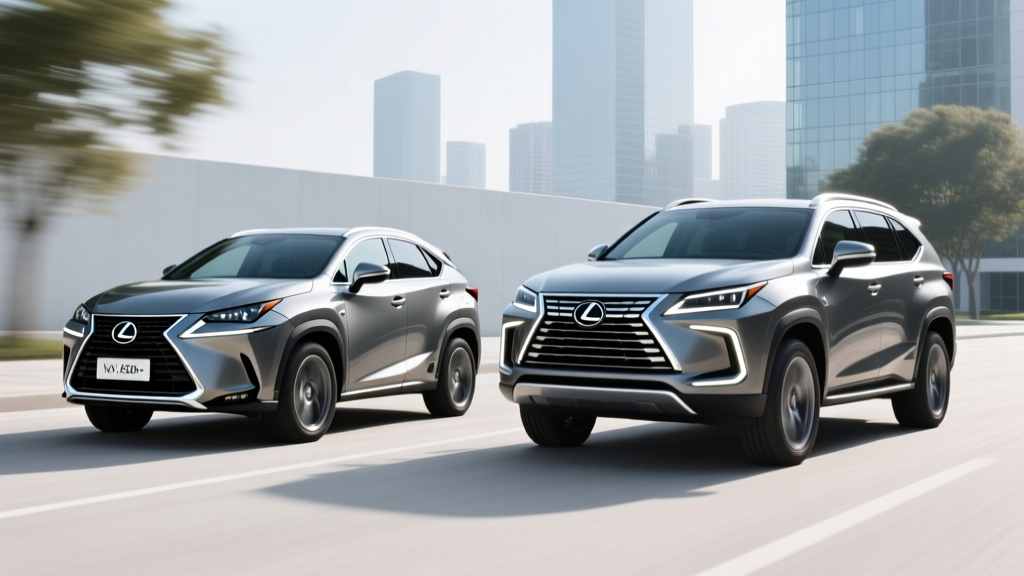
If you've been searching for a Lexus plug in hybrid, the luxury brand's PHEV lineup has quietly expanded into one of the most practical electrified offerings in the premium segment. For 2026, Lexus sells two plug-in hybrid models in the United States: the compact NX 450h+ and the three-row TX 550h+. Both pair a gasoline engine with a sizable lithium-ion battery you can recharge from a wall outlet, giving you a meaningful electric-only commute buffer before the hybrid powertrain takes over.
This guide breaks down exactly what each Lexus plug-in delivers — EPA range and MPG figures, battery capacity, charging times, pricing, tax credit status, and long-term battery reliability — so you can decide whether a Lexus PHEV fits your garage or whether a full BEV or conventional hybrid makes more sense.
HEV vs PHEV: What Lexus Actually Sells
Lexus has built its reputation on conventional hybrids (HEVs) — vehicles like the ES 300h, RX 350h, and UX 250h that recharge their small batteries entirely through regenerative braking and the gasoline engine. You never plug them in. They deliver strong fuel economy but zero electric-only driving range.
A plug-in hybrid (PHEV) is fundamentally different. It carries a much larger battery — typically 18+ kWh usable — that you charge from an external power source (a standard 120V outlet, a 240V Level 2 home charger, or in some cases a public DC fast charger). That larger battery enables 30+ miles of pure electric driving at highway speeds before the gasoline engine seamlessly engages.
Lexus HEV vs PHEV at a Glance
| Feature | Lexus HEV (e.g., RX 350h) | Lexus PHEV (e.g., NX 450h+) |
|---|---|---|
| Plug in to charge? | No | Yes |
| Battery size | ~1.6 kWh | 18.1 kWh usable |
| Electric-only range | 0 miles (motor assist only) | 37 miles (EPA) |
| EPA combined MPG | 36 MPG | 36 MPG (hybrid mode) / 84 MPGe (EV+hybrid) |
| Federal tax credit | Not eligible (§30D is BEV/PHEV only) | Eligibility varies — see below |
Source: fueleconomy.gov, Lexus USA specifications.
2026 Lexus NX 450h+: The Compact Plug-In
The NX 450h+ has been the cornerstone of the Lexus plug-in strategy since its introduction. Built on the TNGA-K platform shared with the Toyota RAV4 Prime, it offers a compelling combination of electric commuting range and luxury refinement.
| Spec | Value |
|---|---|
| Powertrain | 2.5L inline-4 + front/rear electric motors (AWD) |
| Combined horsepower | 304 hp |
| 0–60 mph | 6.0 seconds |
| Battery (usable) | 18.1 kWh lithium-ion |
| EPA electric-only range | 37 miles |
| EPA combined (hybrid mode) | 36 MPG |
| MPGe (EV + hybrid combined) | 84 MPGe |
| Total range (EPA) | ~510 miles |
| Level 2 charge time (0–100%) | ~4.5 hours at 3.3 kW |
| DC fast charging | Not available |
| Drivetrain | Electronic AWD (eAWD) |
| Base MSRP | $59,900 |
Real-World Range vs EPA Sticker
The EPA rates the NX 450h+ at 37 miles electric-only. In real-world driving, expect 32–38 miles depending on conditions. Highway-only driving at 75+ mph in warm weather typically yields 30–33 miles. Cold-weather commuters (below 30°F) may see the battery range drop to 25–28 miles due to cabin heating demand and reduced battery efficiency. In mild city driving under 45 mph, some owners report exceeding the EPA estimate, reaching 39–41 miles on a full charge.
The hybrid-mode 36 MPG combined rating is realistic year-round — Lexus's hybrid system is well-proven and consistent across temperature ranges.
Charging the NX 450h+ at Home
The NX 450h+ uses a standard J1772 connector for AC charging. Its onboard charger is rated at 3.3 kW, which is the limiting factor — even if you have a 48-amp Level 2 home charger capable of 11.5 kW, the NX will only accept 3.3 kW. This means a full 0–100% charge takes roughly 4.5 hours on a 240V Level 2 circuit, or about 12–14 hours on a standard 120V household outlet (Level 1).
For most PHEV owners, overnight Level 2 charging is more than adequate. You plug in when you get home, and the battery is full by morning. The absence of DC fast charging is standard for PHEVs in this class — the battery is small enough that Level 2 replenishes it quickly without the cost and complexity of DC hardware.
2026 Lexus TX 550h+: The Three-Row Plug-In
The TX 550h+ is the larger, more recent addition to the Lexus plug-in family. It shares its platform with the Toyota Grand Highlander Hybrid Max and targets families who need three rows and a usable electric commute.
| Spec | Value |
|---|---|
| Powertrain | 2.4L turbocharged inline-4 + electric motors (AWD) |
| Combined horsepower | 406 hp |
| 0–60 mph | 5.9 seconds |
| Battery (usable) | 20.5 kWh lithium-ion |
| EPA electric-only range | 33 miles |
| EPA combined (hybrid mode) | 29 MPG |
| MPGe (EV + hybrid combined) | 65 MPGe |
| Total range (EPA) | ~480 miles |
| Level 2 charge time (0–100%) | ~5.5 hours at 3.3 kW (est.) |
| DC fast charging | Not available |
| Drivetrain | DIRECT4 AWD |
| Base MSRP | $75,400 |
The TX 550h+ trades some electric range compared to the NX due to its larger mass (nearly 5,200 lbs curb weight) and less aerodynamic three-row profile. The 33-mile EPA electric rating is still competitive for the segment — it covers the average American one-way commute of 16 miles with room to spare. In hybrid mode, the 29 MPG combined figure is respectable for a 406-hp, three-row luxury SUV, though it trails the smaller NX by a meaningful margin on longer road trips.
Fuel Economy Deep Dive: EPA vs Real World
| Model | City (hybrid) | Highway (hybrid) | Combined (hybrid) | MPGe (EV+hybrid) | Electric range |
|---|---|---|---|---|---|
| NX 450h+ | 38 | 33 | 36 | 84 | 37 mi |
| TX 550h+ | 30 | 28 | 29 | 65 | 33 mi |
Source: fueleconomy.gov — EPA estimates. Your mileage will vary.
Real-World MPG Observations
Hybrid fuel economy behaves differently from conventional cars. The city MPG advantage is real: regenerative braking recaptures energy that gas cars waste as heat at every stoplight. Many NX 450h+ owners report 38–42 MPG in city driving, exceeding the EPA city rating. Highway driving, by contrast, relies more on the gasoline engine with less regen opportunity, so real-world highway figures tend to land 1–3 MPG below the EPA estimate, particularly above 70 mph.
For the TX 550h+, the larger turbocharged 2.4L engine and heavier body mean real-world highway driving can dip to 25–27 MPG at sustained 75–80 mph speeds. City driving with frequent stops still yields results close to or slightly above the EPA 30 MPG city rating.
The key insight for PHEV owners: your blended fuel economy depends entirely on how often you charge. If you plug in nightly and your daily driving stays under 35 miles, you may use gasoline only on weekend road trips. Owners who never plug in will see only the hybrid-mode MPG — which is still efficient, but you're carrying 400+ lbs of battery weight you never utilize.
Battery Warranty, Reliability, and Replacement Costs
Lexus Hybrid Battery Warranty
Coverage: 10 years or 150,000 miles (whichever comes first), applicable in all 50 states.
What's covered: Defects in materials/workmanship and capacity loss below a defined threshold (typically 70% of original capacity, though Lexus does not publish an exact retention floor publicly).
Transferable? Yes — the warranty transfers to subsequent owners, which supports strong resale values for Lexus hybrids.
Lexus (and parent company Toyota) has the deepest track record in hybrid reliability of any automaker, with over 25 years of hybrid production since the original Prius. The hybrid battery packs in the NX 450h+ and TX 550h+ use proven lithium-ion chemistry with conservative thermal management — Lexus prioritizes longevity over maximum energy density.
Battery Replacement Cost
Should the traction battery fail outside warranty, current replacement costs for the NX 450h+ battery pack are estimated at $8,000–$12,000 including labor. The TX 550h+, with its larger pack, would likely cost $10,000–$15,000. However, individual module replacement (rather than the full pack) may be possible at significantly lower cost, and Lexus dealers have increasingly adopted module-level diagnostics.
For context, Toyota/Lexus hybrid batteries have demonstrated excellent longevity in fleet data. First-generation RAV4 Hybrid and Prius Prime batteries routinely exceed 200,000 miles with less than 15% capacity degradation. The PHEV packs, which are larger and less stressed per cycle, are expected to perform at least as well.
Tax Credit Eligibility: Does a Lexus Plug-In Qualify?
The federal EV tax credit under IRS §30D applies to both battery-electric vehicles and plug-in hybrids, but qualifying has become significantly more restrictive since the Inflation Reduction Act's sourcing requirements took full effect. Here's where the Lexus plug-in models stand:
- MSRP cap: SUVs must have an MSRP at or below $80,000. The NX 450h+ at ~$59,900 and TX 550h+ at ~$75,400 both clear this threshold on base trims, though heavily optioned TX models can exceed it.
- Buyer income cap: Modified adjusted gross income must not exceed $150,000 (single), $225,000 (head of household), or $300,000 (joint filers).
- Battery sourcing requirements: A percentage of critical minerals and battery components must be sourced from the U.S. or free-trade-agreement partners. These percentages increase annually, and Lexus PHEVs have historically struggled to meet these thresholds because Toyota/Lexus sources significant battery materials from supply chains outside FTA countries.
- Point-of-sale transfer: If eligible, the credit can be transferred to the dealer at purchase, reducing your out-of-pocket cost immediately rather than waiting for a tax refund.
Bottom line: As of early 2026, the NX 450h+ and TX 550h+ are unlikely to qualify for the full $7,500 federal credit due to battery sourcing requirements. Always verify current eligibility on the IRS Clean Vehicle credit page at irs.gov before purchasing, as sourcing compliance can change with new model-year battery suppliers. Some states offer additional hybrid/PHEV incentives independent of federal rules — check your state's energy office for details.
Pros and Cons: Lexus Plug-In Hybrids
Pros
- 33–37 miles of electric-only range covers most daily commutes
- 304–406 hp with smooth electric torque delivery
- Class-leading hybrid reliability and 10-year/150k-mile battery warranty
- Strong resale value — Lexus hybrids depreciate less than most EVs
- No range anxiety — 480–510 miles total range with gas tank
- Standard AWD on both models
- Luxury interior quality and quiet cabin
Cons
- Only 3.3 kW onboard charger — slow Level 2 charging for the segment
- No DC fast charging capability
- Unlikely to qualify for $7,500 federal tax credit (sourcing rules)
- TX 550h+ is heavy — highway MPG drops noticeably above 70 mph
- EV-only top speed limited to ~84 mph
- Premium price vs non-luxury PHEV competitors (RAV4 Prime, Tucson PHEV)
- Lexus infotainment improving but still trails German rivals in UX polish
Who Should Buy a Lexus Plug-In Hybrid?
Decision Framework
Choose a Lexus PHEV if:
- Your daily commute is under 35 miles round-trip and you can charge at home overnight
- You want electric commuting but frequently take road trips where charging infrastructure is sparse
- You value long-term reliability and plan to keep the vehicle 8+ years
- You want a luxury badge without the depreciation hit of some European PHEVs
- You're not ready to commit to a full BEV but want meaningful electric miles
Choose a full EV (BEV) instead if:
- You have reliable home Level 2 charging and rarely drive more than 250 miles in a day
- You want zero tailpipe emissions and lower per-mile "fuel" costs
- You want access to the full $7,500 federal tax credit (more BEV models qualify)
- You want DC fast charging for road trips at 150–250 kW
Choose a conventional Lexus HEV instead if:
- You cannot charge at home (apartment, street parking, no garage outlet)
- You want lower upfront cost — HEV trims are $5,000–$10,000 less than PHEV equivalents
- Your daily driving exceeds 50 miles, making the PHEV battery dead weight most of the time
Frequently Asked Questions
How many MPG does the Lexus NX 450h+ get?
The EPA rates the NX 450h+ at 38 city / 33 highway / 36 combined MPG in hybrid mode. When factoring in electric-only driving, the combined rating is 84 MPGe. Real-world city driving often exceeds the EPA city estimate, while highway driving above 70 mph may yield 30–33 MPG.
How far can the Lexus TX 550h+ go on electric only?
The EPA rates the TX 550h+ at 33 miles of electric-only range. Real-world results range from about 28 miles (cold weather, highway speeds) to 35+ miles (mild weather, city driving under 50 mph).
Does the Lexus plug-in hybrid qualify for the $7,500 federal tax credit?
As of 2026, Lexus PHEVs are unlikely to qualify for the full §30D credit due to battery component and critical mineral sourcing requirements. Always check the IRS Clean Vehicle page for the most current eligibility list before purchasing.
Is the Lexus hybrid battery reliable, and what does replacement cost?
Lexus/Toyota hybrid batteries have an outstanding reliability record spanning 25+ years. The battery is covered by a 10-year/150,000-mile warranty. Out-of-warranty replacement is estimated at $8,000–$12,000 for the NX 450h+ and $10,000–$15,000 for the TX 550h+, though module-level repair may cost significantly less.
Can I charge a Lexus PHEV at a DC fast charger?
No. Neither the NX 450h+ nor the TX 550h+ supports DC fast charging. Both use a J1772 connector for Level 1 (120V) and Level 2 (240V) AC charging only. The onboard charger is limited to 3.3 kW, so a full charge takes about 4.5–5.5 hours on Level 2.
Hybrid vs PHEV vs EV — which Lexus should I buy?
If you can charge at home and your commute is under 35 miles, the PHEV gives you the best of both worlds — electric daily driving with gas-engine range for trips. If you can't charge at home, a conventional HEV (like the RX 350h) is simpler and cheaper. If you have home charging, rarely drive over 250 miles daily, and want the lowest operating cost, consider a full BEV like the Lexus RZ 450e.