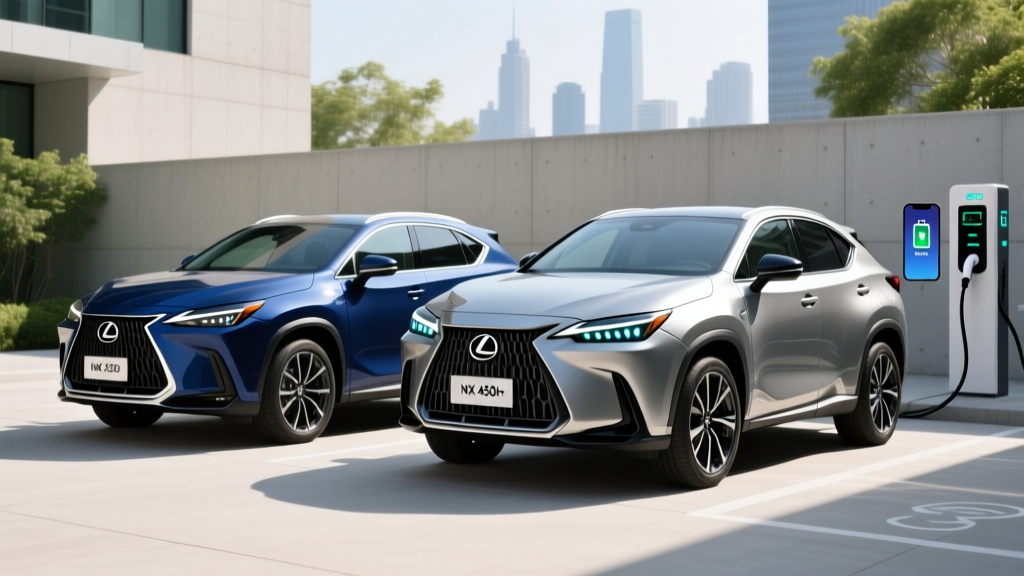
If you're researching a Lexus compact SUV hybrid, you're looking at one of two vehicles: the conventional hybrid NX 350h or the plug-in hybrid NX 450h+. Both share the NX platform, Lexus Safety System+ 3.0, and Toyota's proven hybrid architecture — but they serve very different ownership patterns. One never plugs in and sips fuel at 39 MPG combined. The other delivers 37 miles of pure electric driving before the gas engine wakes up. This guide breaks down the exact specs, real-world efficiency, pricing, and tax-credit math so you can pick the right one.
HEV vs PHEV: What's the Difference in the NX Lineup?
NX 350h — Conventional Hybrid (HEV)
The NX 350h uses a 2.5-liter four-cylinder engine paired with electric motors and a small 1.6 kWh nickel-metal hydride battery. You never plug it in. The system recovers energy through regenerative braking and engine optimization. It functions exactly like a gas car at the pump — you just visit the pump far less often.
NX 450h+ — Plug-In Hybrid (PHEV)
The NX 450h+ pairs the same 2.5L engine with more powerful electric motors and a significantly larger 18.1 kWh lithium-ion battery. You can plug it in (Level 1 or Level 2 AC charging) to unlock 37 miles of electric-only range. When the battery depletes, it reverts to hybrid mode and operates like the NX 350h — no range anxiety, no stranded scenarios.
The critical distinction: the NX 350h cannot be plugged in and has no electric-only mode. The NX 450h+ can be plugged in for daily electric commuting but never requires it. Both vehicles always have a gas-engine fallback.
Fuel Economy: EPA MPG and Real-World Numbers
| Model | City MPG | Highway MPG | Combined MPG | Electric Range (PHEV) | Combined MPGe (PHEV) |
|---|---|---|---|---|---|
| NX 350h (HEV) | 41 | 37 | 39 | N/A | N/A |
| Nx 450h+ (PHEV) | 38* | 33* | 36* | 37 miles | 84 MPGe |
*NX 450h+ gas-only MPG after battery depletion. Source: fueleconomy.gov
Real-World MPG: What Owners Actually See
Toyota's hybrid system is famous for exceeding EPA city estimates in stop-and-go traffic, where regenerative braking recaptures the most energy. NX 350h owners routinely report 42-44 MPG in urban driving. Highway efficiency is the trade-off: at 75+ mph sustained, expect 33-35 MPG, slightly below the EPA sticker. Aerodynamic drag simply overwhelms the hybrid system's advantages at speed.
For the NX 450h+, real-world electric range depends heavily on conditions. In mild weather (55-75°F) with city driving, 37 miles is achievable. In winter at 30°F with cabin heating, expect 28-31 miles of electric range before the engine engages. Highway driving at 70 mph reduces electric range to roughly 30 miles regardless of temperature.
Powertrain Specs: Horsepower, Acceleration, and Drivetrain
| Specification | NX 350h (HEV) | NX 450h+ (PHEV) |
|---|---|---|
| Engine | 2.5L inline-4 | 2.5L inline-4 |
| Combined System HP | 240 hp | 304 hp |
| 0-60 mph | 7.2 seconds | 6.0 seconds |
| Drivetrain | AWD (e-AWD rear motor) | AWD (e-AWD rear motor) |
| Transmission | eCVT | eCVT |
| Towing Capacity | 2,000 lbs | 2,000 lbs |
| Battery Type | 1.6 kWh NiMH | 18.1 kWh Lithium-Ion |
| Drive Modes | EV (low-speed), Eco, Normal, Sport | EV, Auto EV/HV, HV, Eco, Normal, Sport |
The NX 450h+ is substantially quicker — its 304 combined horsepower and 6.0-second 0-60 time rival many sport compacts. The additional electric motor output is immediately noticeable in passing maneuvers and highway merging. The NX 350h's 240 hp is adequate but not thrilling; its strength is seamless, quiet efficiency rather than urgency.
NX 450h+ Charging: Times, Connectors, and the DC Fast-Charging Gap
| Charging Method | Power (kW) | 0-100% Time | Connector |
|---|---|---|---|
| Level 1 (120V household) | ~1.4 kW | ~12 hours | J1772 (included cable) |
| Level 2 (240V home/public) | 3.3 kW | ~5.5 hours | J1772 |
| DC Fast Charging | N/A — Not supported | N/A | N/A |
The NX 450h+ has an onboard charger rated at 3.3 kW. This is the bottleneck — even if you plug into a 7.2 kW or 11.5 kW Level 2 station, the car can only accept 3.3 kW. A full charge from empty takes about 5.5 hours on Level 2, which works well for overnight charging but means a midday top-up won't fully replenish the battery.
No DC fast charging. This is the NX 450h+'s most significant limitation. You cannot use CCS or CHAdeMO rapid chargers. For a PHEV with 37 miles of range, this is less critical than it would be for a full EV — the gas engine eliminates range anxiety entirely. But if your daily commute exceeds 37 miles each way and you lack home charging, the electric-only benefit diminishes quickly.
Pricing, Trims, and Federal Tax Credit Eligibility
| Model / Trim | 2026 MSRP (est.) | §30D Federal Tax Credit | Effective Price After Credit |
|---|---|---|---|
| NX 350h Premium | $42,415 | $0 (HEV not eligible) | $42,415 |
| NX 350h Luxury | $47,615 | $0 | $47,615 |
| NX 450h+ Premium | $59,905 | Up to $3,751* | ~$56,154 |
| NX 450h+ Luxury | $63,005 | Up to $3,751* | ~$59,254 |
*PHEV credit amount depends on battery sourcing and critical-mineral requirements under IRS §30D. Verify current-year eligibility before purchase.
Tax Credit Details: What You Need to Know
The NX 350h, as a conventional hybrid, qualifies for no federal EV tax credit. It's an efficient gas vehicle, not an electrified vehicle under §30D definitions.
The NX 450h+ may qualify for a partial federal tax credit (up to $3,751 based on recent battery-component and critical-mineral sourcing compliance). However, eligibility is subject to several constraints:
- MSRP cap: SUVs must have an MSRP at or below $80,000 — both NX 450h+ trims qualify.
- Buyer income cap: Modified AGI must not exceed $150,000 (single), $225,000 (head of household), or $300,000 (joint).
- Battery sourcing: Credit amount depends on whether battery components and critical minerals meet North American sourcing thresholds, which tighten annually through 2029.
- Point-of-sale transfer: You can transfer the credit to the dealer at purchase for an immediate price reduction, rather than waiting to claim it on your tax return.
Because sourcing rules change and are model-year specific, always confirm credit eligibility on fueleconomy.gov or consult a tax professional before finalizing your purchase.
Battery Warranty, Reliability, and Replacement Costs
Lexus Hybrid Battery Warranty
- Hybrid battery: 10 years / 150,000 miles (whichever comes first)
- Powertrain: 6 years / 70,000 miles
- Basic: 4 years / 50,000 miles
Lexus (via Toyota) has one of the longest hybrid-battery warranties in the industry. The 10-year/150,000-mile coverage applies in all 50 states and covers battery capacity loss below a defined threshold.
How Long Do Lexus Hybrid Batteries Actually Last?
Toyota and Lexus hybrid systems have an exceptional longevity track record. The Prius taxi fleet demonstrated that NiMH hybrid batteries routinely exceed 200,000 miles with minimal degradation. The NX 350h's 1.6 kWh NiMH pack is small, lightly stressed, and benefits from Toyota's conservative charge-window management (the system never fully charges or fully depletes the battery, which dramatically extends cycle life).
The NX 450h+'s 18.1 kWh lithium-ion pack is larger and sees deeper cycling when used in EV mode. Even so, Toyota's thermal management and buffer strategy (roughly 15-20% top and bottom buffer) protect the cells. Real-world data from earlier Toyota PHEVs (Prime models) shows minimal degradation over 5-7 years of use.
Battery Replacement Cost
If replacement is needed outside warranty:
- NX 350h NiMH battery: $2,000–$3,500 (parts + labor at dealer)
- NX 450h+ lithium-ion battery: $8,000–$12,000 (parts + labor at dealer)
These are worst-case figures. Independent hybrid shops often replace individual modules or cells for significantly less. And with the 10-year warranty, most original owners will never face this cost.
Toyota/Lexus hybrid reliability is among the best-documented in the industry. IIHS typically rates the NX highly for safety, and Consumer Reports consistently places Lexus at or near the top of brand reliability rankings.
Who Should Buy the NX 350h, the NX 450h+, or a Full EV Instead?
Choose the NX 350h (HEV) If:
- You have no access to home or workplace charging
- You want zero behavior change — just drive and refuel like normal
- Your priority is low fuel cost without a price premium (saves ~$600-800/year vs. a comparable gas NX 250)
- You drive primarily in city/stop-and-go traffic where hybrids shine (41+ MPG real-world)
- You want the lowest upfront cost in the hybrid NX lineup
Choose the NX 450h+ (PHEV) If:
- You have reliable Level 2 home charging (a 240V outlet or wallbox)
- Your daily commute is under 37 miles round-trip (you could drive months without visiting a gas station)
- You want EV-like quietness and torque for daily driving but need gas-engine flexibility for road trips
- You value the 304 hp performance upgrade over the 350h's adequate 240 hp
- The ~$17,500 price premium over the 350h is acceptable given your fuel savings and tax-credit offset
Choose a Full EV (e.g., Lexus RZ 450e, Tesla Model Y, Hyundai Ioniq 5) If:
- You have home charging AND your daily driving rarely exceeds 200 miles
- You want to eliminate oil changes, gas-engine maintenance, and emissions inspections entirely
- You qualify for the full $7,500 federal EV tax credit (which the NX 450h+ does not match)
- You're willing to plan around DC fast-charging for longer road trips
NX 350h Pros & Cons
Pros:
- 39 MPG combined, 41+ in real city driving
- No charging required — zero infrastructure dependency
- Lower MSRP, strong resale value
- Proven Toyota hybrid reliability, 10-yr battery warranty
- Comfortable, quiet cabin with Lexus refinement
Cons:
- No federal tax credit
- No electric-only driving mode at meaningful speeds
- 7.2-second 0-60 is adequate, not quick
- Highway MPG drops to low 30s at 75+ mph
NX 450h+ Pros & Cons
Pros:
- 37 miles electric-only covers most commutes gas-free
- 304 hp / 6.0-sec 0-60 — genuinely quick for the segment
- Partial federal tax credit (~$3,751)
- 84 MPGe when charged regularly
- Gas-engine backup eliminates all range anxiety
Cons:
- $59,905 starting price — $17,490 more than NX 350h
- 3.3 kW onboard charger — slow Level 2 fill
- No DC fast charging at all
- Cargo space reduced slightly vs. 350h (battery under floor)
- Break-even vs. 350h takes 8-10+ years on fuel savings alone
Frequently Asked Questions
How many MPG does the Lexus NX hybrid get?
The NX 350h achieves an EPA-rated 41 city / 37 highway / 39 combined MPG. Real-world city driving often yields 42-44 MPG, while sustained highway driving at 75+ mph drops to 33-35 MPG. The NX 450h+ returns 36 MPG combined (38 city / 33 highway) after the battery is depleted, plus 37 miles of electric-only range when charged.
How far can the NX 450h+ go on electric only?
The EPA rates the NX 450h+ at 37 miles of electric-only range. In mild weather with city driving, 37 miles is realistic. In winter or at highway speeds, expect 28-31 miles. Once the battery depletes, the gas engine starts seamlessly and the car operates as a conventional hybrid — total combined range exceeds 550 miles.
Does the Lexus NX 350h need to be plugged in?
No. The NX 350h is a conventional hybrid (HEV). It charges its small battery through regenerative braking and the gas engine. You never plug it in — you simply refuel at a gas station like any other car.
Does the Lexus NX hybrid qualify for a tax credit?
The NX 350h (HEV) does not qualify for any federal EV tax credit. The NX 450h+ (PHEV) may qualify for up to $3,751 under IRS §30D, depending on battery sourcing requirements and your income. Check IRS guidelines for current-year eligibility.
Is the Lexus NX hybrid reliable, and what does battery replacement cost?
Lexus hybrid systems have an outstanding reliability record, backed by Toyota's decades of hybrid engineering. The hybrid battery is warranted for 10 years / 150,000 miles. Out-of-warranty replacement costs approximately $2,000–$3,500 for the NX 350h (NiMH) and $8,000–$12,000 for the NX 450h+ (lithium-ion), though most owners never need a replacement.
Can the NX 450h+ use DC fast chargers?
No. The NX 450h+ only supports AC charging via a J1772 connector — Level 1 (120V, ~12 hours for a full charge) or Level 2 (240V at 3.3 kW, ~5.5 hours). It does not have a CCS or CHAdeMO port for DC fast charging. For a PHEV with 37 miles of range and a gas-engine backup, this is manageable for most owners who charge at home overnight.
How long does it take to charge the NX 450h+?
On a standard 120V household outlet (Level 1), a full charge takes approximately 12 hours. On a 240V Level 2 charger, it takes about 5.5 hours — limited by the car's 3.3 kW onboard charger, not the station's output.