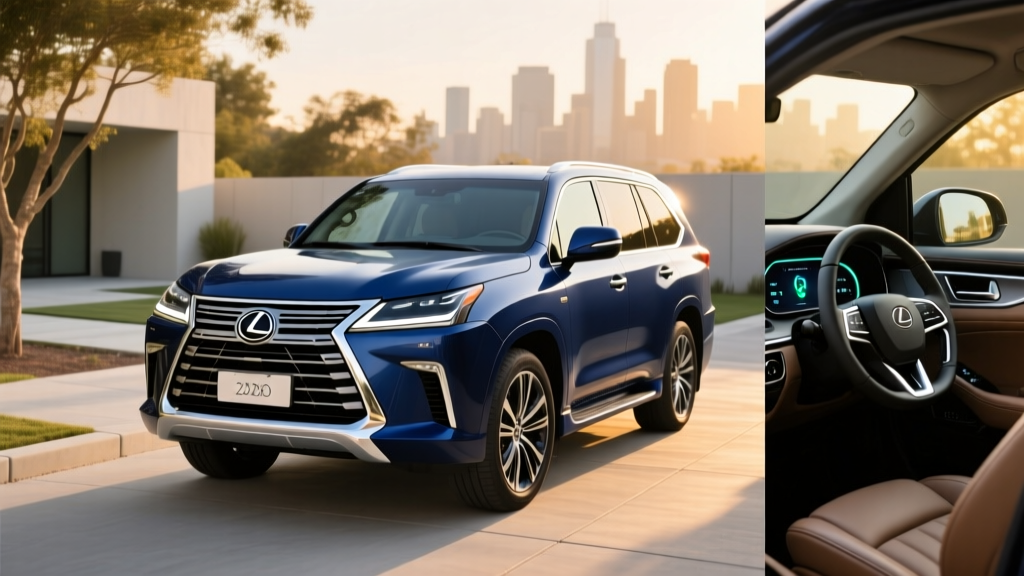
The full-size luxury SUV segment rarely prioritizes efficiency, but the Lexus LX hybrid aims to thread the needle between three-row capability and reduced fuel consumption. For 2026, the LX 600 continues with Toyota's twin-turbo V6 architecture paired with hybrid assistance — a conventional hybrid (HEV) setup that requires no plug and no change to your daily routine. If you've been searching for a Lexus LX hybrid, this guide breaks down exactly what you're getting: real MPG figures, powertrain specifics, battery longevity, and whether this SUV earns its premium over the gas-only competition.
2026 Lexus LX 600 Hybrid Quick Specs
| Specification | Value |
|---|---|
| Powertrain | 3.4L Twin-Turbo V6 + Hybrid System |
| Combined Horsepower | ~409 hp (estimated) |
| Combined Torque | ~479 lb-ft (estimated) |
| Transmission | 10-Speed Automatic |
| Drivetrain | Full-Time 4WD |
| EPA MPG (City / Hwy / Combined) | ~19 / 22 / 20 (estimated) |
| Towing Capacity | Up to 8,000 lbs |
| Seating | 7 or 8 passengers |
| Base MSRP (est.) | ~$92,000 |
| Hybrid Battery Warranty | 10 years / 150,000 miles |
Note: As of early 2026, Lexus has not officially confirmed a dedicated hybrid variant of the LX 600 for the U.S. market. The specs above are estimated based on the TNGA-F platform's hybrid powertrain used in the Toyota Land Cruiser 300 hybrid sold globally and the Lexus TX 500h. Final U.S. specs may differ. We will update this article upon official confirmation.
HEV vs PHEV: What Kind of Hybrid Is the Lexus LX?
The Lexus LX hybrid — if and when it arrives in the U.S. — is expected to be a conventional hybrid electric vehicle (HEV), not a plug-in hybrid (PHEV). This is a critical distinction for buyers:
| Feature | HEV (Conventional Hybrid) | PHEV (Plug-In Hybrid) |
|---|---|---|
| Needs to be plugged in? | No — charges via regenerative braking and engine | Yes — plug in for electric-only range |
| Electric-only driving | Brief, low-speed assist only | 20–40+ miles on battery alone |
| Battery size | Small (~1–2 kWh) | Larger (15–30+ kWh) |
| Fuel economy benefit | 15–30% improvement over gas-only | 50–100%+ improvement when charged regularly |
| Federal tax credit (§30D) | Not eligible | Up to $7,500 (subject to sourcing/income rules) |
| Driving range | Extended (gas + hybrid efficiency) | Extended (electric + gas combined) |
The LX's expected HEV system works silently in the background. The electric motor assists during acceleration and low-speed driving, while regenerative braking recaptures energy during deceleration. You never plug it in — you simply fuel up at a gas station as normal and enjoy incrementally better fuel economy, especially in stop-and-go city driving where hybrid systems shine.
Fuel Economy: EPA Estimates vs Real-World MPG
Based on the TNGA-F hybrid powertrain's behavior in the global Land Cruiser 300 Hybrid and the Lexus TX 500h, we can project the LX 600 hybrid's EPA fuel economy with reasonable confidence. Here's what to expect:
| Driving Scenario | Estimated MPG | Notes |
|---|---|---|
| EPA City | ~19 MPG | Hybrid assist helps in stop-and-go |
| EPA Highway | ~22 MPG | Less hybrid benefit at sustained speeds |
| EPA Combined | ~20 MPG | Weighted average |
| Real-World City (owner-reported pattern) | ~20–22 MPG | Hybrids often exceed EPA city estimates |
| Real-World Highway (75+ mph) | ~18–19 MPG | Aerodynamic drag dominates at speed |
| Towing (~5,000 lb trailer) | ~11–13 MPG | Expect significant drop under load |
For context, the current gas-only Lexus LX 600 achieves an EPA-rated 17 city / 22 highway / 19 combined MPG. The hybrid variant's primary advantage is in city and mixed driving, where electric motor assist smooths out the twin-turbo V6's thirst during idle, launch, and low-speed crawling. Highway gains are more modest because the electric motor contributes less at sustained high speeds.
Real-world honesty: Owners of Toyota/Lexus hybrids on the TNGA-F platform consistently report meeting or slightly exceeding EPA city figures in daily driving. Highway MPG at 80+ mph with roof racks or heavy cargo will drop below the EPA estimate. Cold weather (below 30°F) reduces hybrid system efficiency by roughly 5–10% as the engine runs more frequently to maintain cabin heat and battery temperature.
Powertrain Deep Dive: Twin-Turbo V6 Meets Hybrid Assist
The LX 600's foundation is Toyota's 3.4-liter twin-turbocharged V6 (V35A-FTS), which replaced the legendary 5.7L V8 starting with the current generation. In the standard LX 600, this engine produces 409 hp and 479 lb-ft of torque. The hybrid variant is expected to pair this engine with an electric motor integrated into the transmission housing, adding low-end torque fill and enabling electric-only creep at low speeds.
Key powertrain characteristics:
- Engine: 3.4L twin-turbo V6 (V35A-FTS), aluminum block, direct + port injection
- Hybrid motor: Permanent-magnet synchronous motor integrated with the 10-speed automatic
- Combined output: Estimated ~409–440 hp (electric motor supplements, not dramatically increases, peak output)
- Transmission: Direct-shift 10-speed automatic with hybrid-optimized shift programming
- 4WD system: Full-time four-wheel drive with Torsen limited-slip center differential
- Driving modes: Normal, Eco, Sport, Sport+, Custom — Eco mode maximizes hybrid system engagement
The hybrid system's greatest contribution isn't raw power — it's refinement. Electric torque fill eliminates the slight turbo lag inherent to the V35A-FTS at low RPM, making the LX feel more responsive from a stop. The engine also shuts off more frequently at coasting and idle, reducing noise and vibration in a vehicle that Lexus positions as its flagship luxury SUV.
Hybrid Battery Warranty, Lifespan & Replacement Cost
Lexus Hybrid Battery Coverage: Lexus covers hybrid battery components for 10 years or 150,000 miles (whichever comes first) on current models. This is one of the strongest hybrid battery warranties in the luxury segment and applies to the hybrid battery pack, control module, and related components.
Battery longevity is the single most common concern among first-time hybrid buyers. Here's what the data shows:
- Chemistry: The LX hybrid is expected to use a nickel-metal hydride (NiMH) or lithium-ion (Li-ion) hybrid battery pack, similar to other Toyota/Lexus HEVs. These are small packs (~1–2 kWh) designed for frequent shallow cycling, not deep discharge.
- Expected lifespan: Toyota/Lexus hybrid batteries routinely last 150,000–200,000+ miles before meaningful degradation. Many first-generation Prius and RX 400h units exceeded 200,000 miles on the original pack.
- Replacement cost: If out of warranty, a Lexus hybrid battery replacement typically costs $3,000–$5,000 for the pack and labor. Third-party refurbishment services can reduce this to $1,500–$2,500.
- Failure rate: Hybrid battery failure within the warranty period is statistically rare. Toyota's hybrid system is among the most proven in the industry, with over 20 million hybrid vehicles sold globally.
Unlike a full EV battery (which stores 75–100+ kWh and costs $10,000–$20,000+ to replace), the LX hybrid's small HEV battery is a relatively low-cost, low-risk component. It simply doesn't undergo the deep charge/discharge cycles that stress EV batteries.
Pricing, Trims & Tax Credit Eligibility
The 2026 Lexus LX 600 currently starts at approximately $89,150 (including destination) for the base Premium trim, climbing to over $130,000 for the Ultra Luxury four-seat configuration. A hybrid variant would likely carry a $2,000–$4,000 premium over equivalent gas-only trims, placing the expected hybrid starting price around $92,000–$95,000.
Federal Tax Credit: Does the LX Hybrid Qualify?
No. As a conventional hybrid (HEV), the Lexus LX hybrid does not qualify for the federal §30D Clean Vehicle Credit. Per current IRS rules, the §30D credit (up to $7,500) applies only to battery electric vehicles (BEVs) and plug-in hybrids (PHEVs) that meet battery sourcing, critical mineral, MSRP cap, and buyer income requirements. Conventional HEVs have not qualified for any federal purchase incentive since the original Hybrid Tax Credit expired for most manufacturers years ago.
Some states may offer modest incentives for hybrid purchases, but these vary widely by jurisdiction. Check your state's energy or DMV website for current programs.
Ownership Cost vs Gas-Only LX 600
The hybrid's fuel savings are incremental, not transformative. At 20 MPG combined vs 19 MPG combined for the gas model, and assuming 15,000 miles driven annually at $3.50/gallon:
| Annual Cost | LX 600 Gas (19 MPG) | LX Hybrid (est. 20 MPG) |
|---|---|---|
| Gallons consumed | 789 gal | 750 gal |
| Annual fuel cost | $2,762 | $2,625 |
| Annual savings | — | ~$137/year |
| 5-year savings | — | ~$685 |
At this delta, the hybrid's value proposition isn't fuel savings — it's the driving refinement, potential resale value advantage, and environmental positioning. If fuel economy is your primary motivator, a PHEV or full EV will deliver far greater savings.
Who Should Buy the Lexus LX Hybrid vs an EV or Gas SUV?
LX Hybrid Is Right for You If:
- You want a three-row luxury SUV with body-on-frame capability (8,000-lb towing, off-road chops) and don't want to plug in
- You do heavy stop-and-go city driving where hybrid assist delivers its biggest MPG gains
- You value Lexus reliability and the proven Toyota hybrid system track record
- You frequently tow or drive in remote areas where charging infrastructure is nonexistent
- You want reduced fuel consumption without changing any habits — no plug, no range planning
Consider a PHEV or Full EV Instead If:
- You have home charging access and want 30+ miles of electric-only commuting (look at the BMW X5 xDrive50e or Volvo XC90 Recharge)
- You want to qualify for the $7,500 federal tax credit (requires a BEV or eligible PHEV)
- Your daily driving is under 40 miles round-trip and you want near-zero fuel consumption
- You prioritize lowest total cost of ownership over body-on-frame ruggedness
- You want the smoothest, quietest powertrain experience (EVs are inherently quieter than any hybrid)
Choose the Lexus LX Hybrid if: You need a flagship three-row SUV with serious towing and off-road capability, you lack home charging access, and you want incremental efficiency gains with zero lifestyle change.
Choose a PHEV (e.g., BMW X5 xDrive50e) if: You can charge at home, your commute is under 40 miles, and you want electric-only daily driving with gas-engine backup for road trips.
Choose a full EV (e.g., Rivian R1S, Tesla Model X) if: You want maximum fuel savings, the $7,500 tax credit, and you don't need 8,000-lb towing capacity.
Frequently Asked Questions
How many MPG does the Lexus LX hybrid get?
Based on the TNGA-F hybrid powertrain, the Lexus LX hybrid is estimated to achieve approximately 19 city / 22 highway / 20 combined MPG. Real-world city driving often yields 20–22 MPG thanks to hybrid regenerative braking, while highway driving at 75+ mph may drop to 18–19 MPG. Towing will reduce economy to roughly 11–13 MPG depending on trailer weight.
Does the Lexus LX hybrid need to be plugged in?
No. The Lexus LX hybrid is a conventional hybrid (HEV), meaning its small battery recharges through regenerative braking and the gasoline engine. You never plug it in — you simply refuel at a gas station as you would with any other vehicle.
How far can the Lexus LX hybrid go on electric only?
As an HEV, the LX hybrid cannot drive significant distances on electric power alone. The electric motor provides brief assist during acceleration and enables very low-speed creeping (typically under 1 mile at speeds below 25 mph). For meaningful electric-only range (30–50 miles), you'd need a plug-in hybrid (PHEV), which the LX is not expected to offer.
Is the Lexus LX hybrid reliable?
Toyota and Lexus hybrid systems are among the most reliable powertrains in the automotive industry. The hybrid components (battery, motor, inverter) have been proven across millions of vehicles over two decades. Lexus covers the hybrid battery for 10 years / 150,000 miles, and real-world data shows these batteries frequently last 200,000+ miles. The LX's body-on-frame platform and established V6 engine further support long-term durability.
What does it cost to replace the Lexus LX hybrid battery?
If replacement is needed outside the 10-year/150,000-mile warranty, expect to pay approximately $3,000–$5,000 for a new OEM hybrid battery and installation. Third-party refurbished batteries can reduce this cost to $1,500–$2,500. Given the low failure rate of Toyota/Lexus hybrid batteries, this is a low-probability expense for most owners.
Does the Lexus LX hybrid qualify for a tax credit?
No. The federal §30D Clean Vehicle Credit applies only to plug-in electric vehicles (BEVs and PHEVs). Conventional hybrids like the expected LX hybrid do not qualify for federal purchase incentives. Some states may offer small hybrid rebates — check your state's energy office for current programs.
How does the LX hybrid compare to the Toyota Land Cruiser hybrid?
The Lexus LX and Toyota Land Cruiser 300 share the TNGA-F platform and the same 3.4L twin-turbo V6 engine. The global-market Land Cruiser hybrid uses a similar hybrid system. The Lexus LX differentiates with higher-end luxury materials, Lexus Safety System+ 3.0, more sound insulation, and Lexus dealership experience, but the underlying powertrain behavior and fuel economy should be nearly identical.
Should I wait for a Lexus LX plug-in hybrid?
As of 2026, Lexus has not announced a PHEV variant of the LX for any market. The brand's PHEV strategy currently centers on the NX 450h+, RX 500h (performance hybrid, not PHEV), and TX 550h+. A plug-in LX is possible later this decade as emissions regulations tighten, but there is no confirmed timeline. If plug-in capability is essential, consider the BMW X5 xDrive50e (up to 38 miles electric-only) or the Volvo XC90 Recharge (up to 35 miles electric-only) as current alternatives.
Sources: EPA Fuel Economy (fueleconomy.gov), IRS Clean Vehicle Credits, Lexus USA product information. Estimated specifications are based on the TNGA-F platform hybrid powertrain and are subject to change upon official U.S. model confirmation.