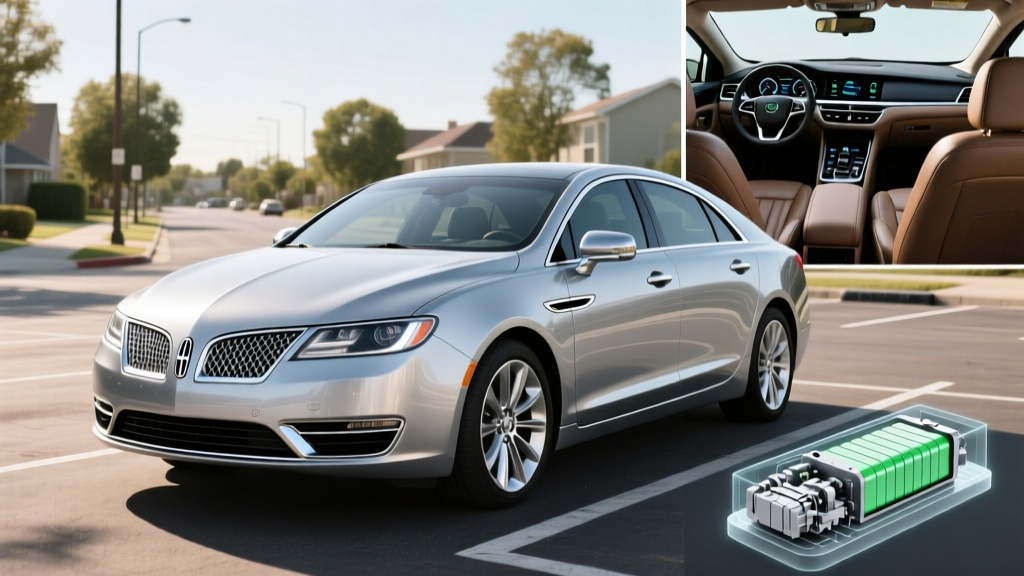
The 2012 Lincoln MKZ Hybrid FWD occupies a specific niche in the used-car market: a midsize luxury sedan that delivers genuinely impressive fuel economy without requiring a plug, a charging routine, or any change in driving habits. Built on Ford's Fusion Hybrid platform but wrapped in Lincoln's more refined interior and softer ride tuning, this conventional hybrid (HEV) remains relevant for buyers who want luxury-badge comfort with hybrid-level efficiency at a fraction of its original MSRP.
This guide breaks down the exact EPA figures, real-world MPG expectations, powertrain specs, battery longevity data, and ownership economics you need to evaluate whether a 14-year-old hybrid luxury sedan is a smart buy — or a looming maintenance liability.
HEV vs PHEV: What the 2012 MKZ Hybrid Actually Is
Before evaluating this car, it's essential to distinguish between hybrid types, because the terminology gets misused constantly in listings and forums.
| Feature | Conventional Hybrid (HEV) | Plug-in Hybrid (PHEV) | Battery Electric (BEV) |
|---|---|---|---|
| Plug-in charging? | No — charges via regenerative braking and engine | Yes — external charging required for EV range | Yes — sole energy source |
| Electric-only driving | Limited (low speeds, short distances) | 20-50 miles typical | Full range (200-400+ mi) |
| Battery size | 1.4 kWh (MKZ Hybrid) | 10-25 kWh typical | 60-120+ kWh |
| Gas engine? | Yes — primary power source | Yes — backup/generator | No |
| Fueling | Gas station only | Gas station + plug | Charger only |
The 2012 Lincoln MKZ Hybrid FWD is a conventional hybrid (HEV). It has no plug, no electric-only range to speak of in practical terms, and no EV mode you can select. The small 1.4 kWh nickel-metal-hydride (NiMH) battery assists the gasoline engine and captures energy during braking. You fuel it exclusively at gas stations — exactly like a conventional car. There is no PHEV variant of the 2012 MKZ; Lincoln did not offer a plug-in version of this generation.
Fuel Economy: EPA Ratings vs Real-World MPG
The 2012 MKZ Hybrid's headline number is its city MPG, which actually exceeds its highway rating — a hallmark of conventional hybrids that leverage regenerative braking and electric-motor assist most heavily in stop-and-go driving.
| Metric | EPA Rating | Real-World Expectation |
|---|---|---|
| City MPG | 41 MPG | 38-43 MPG (hybrids often beat EPA in city) |
| Highway MPG | 36 MPG | 32-36 MPG (hybrid advantage diminishes at sustained speed) |
| Combined MPG | 39 MPG | 35-40 MPG |
| Fuel tank capacity | 16.5 gallons | — |
| Total driving range | ~644 miles | ~575-660 miles |
According to fueleconomy.gov, the 2012 MKZ Hybrid achieves 41 city / 36 highway / 39 combined. In practice, owners who drive predominantly in urban environments often report matching or slightly exceeding the 41 MPG city figure, because the hybrid system recaptures braking energy that a gas-only car wastes as heat. Highway driving, however, is where the hybrid advantage narrows — at 70+ MPH, the gasoline engine does nearly all the work, and the car's weight (approximately 3,750 lbs) works against efficiency.
Cold-weather caveat: Expect a 5-10% MPG reduction in winter months. The engine runs more frequently to maintain cabin heat and battery temperature, reducing the electric-motor assist windows. In sub-freezing conditions, 35-37 MPG combined is realistic.
Powertrain Specs: Engine, Motor, and Combined Output
| Specification | Detail |
|---|---|
| Engine | 2.5L Atkinson-cycle inline-4 |
| Engine horsepower | 156 HP @ 6,000 RPM |
| Electric motor output | ~35 HP (permanent-magnet synchronous) |
| Combined net horsepower | 191 HP |
| Transmission | eCVT (electronically controlled continuously variable) |
| Drivetrain | Front-wheel drive (FWD) |
| 0-60 MPH | ~8.5 seconds |
| Hybrid battery | 1.4 kWh NiMH (nickel-metal hydride) |
| Curb weight | ~3,752 lbs |
The Atkinson-cycle 2.5L four-cylinder is the same engine family Ford used across the Fusion Hybrid and Escape Hybrid of this era. It sacrifices some low-end torque for greater thermal efficiency, and the electric motor fills in the torque gap during acceleration. The eCVT is not a belt-driven CVT like those in some Nissan or Subaru products — it's a planetary gearset that blends engine and motor power seamlessly, and it has proven to be one of the most durable hybrid transmissions in the industry.
The 191 combined HP is adequate for merging and passing but won't feel quick by modern luxury-sedan standards. This is a car optimized for efficiency and comfort, not performance.
Hybrid Battery Longevity, Warranty, and Replacement Cost
For any used hybrid purchase, battery health is the single largest financial risk. Here's what the data shows for this generation of Ford/Lincoln hybrid batteries.
Original Battery Warranty
- Coverage: 8 years / 100,000 miles (whichever comes first)
- Capacity threshold: Ford warranted the battery to retain sufficient capacity to deliver rated performance — not a specific percentage
- Transferable: Yes, the warranty transfers to subsequent owners
- Status in 2026: The original warranty has expired for all 2012 model-year vehicles unless mileage is still under 100,000 and a certified warranty extension was purchased
Real-world degradation data: The NiMH battery in the 2012 MKZ Hybrid has proven to be one of the more durable hybrid batteries from this era. Ford's hybrid system from the 2010-2012 generation has widespread reports of original batteries lasting 150,000-200,000+ miles before requiring replacement. The battery management system keeps the NiMH pack in a conservative state-of-charge window (roughly 40-60%), which significantly extends cycle life compared to batteries that are regularly cycled to extremes.
Replacement cost (2026 estimates):
- New OEM battery (Ford/Lincoln dealer): $2,500 - $3,500 installed
- Refurbished/remanufactured battery: $1,200 - $2,000 installed
- Individual cell/module repair: $500 - $1,000 (specialist shops can replace failed modules rather than the entire pack)
Before purchasing, request a hybrid battery health check. Any competent Ford/Lincoln dealer or hybrid specialist can read the battery's state-of-health (SoH) via OBD-II. Look for a pack showing less than 15% degradation from original capacity. Also watch for dashboard warnings — a "Check Hybrid System" light or reduced power mode indicates imminent battery issues.
Pricing in 2026: Used Market Value and Tax Credit Eligibility
The 2012 Lincoln MKZ Hybrid originally carried an MSRP of approximately $41,470 (including destination). In 2026, used examples trade significantly lower:
- High mileage (120,000+ mi), fair condition: $5,000 - $7,000
- Average mileage (80,000-120,000 mi), good condition: $7,000 - $9,500
- Low mileage (under 80,000 mi), excellent condition: $9,500 - $12,000
Tax Credit Eligibility
The 2012 MKZ Hybrid does not qualify for any current federal tax credit. Here's why:
- New vehicle credit (§30D): Not applicable — the car is not new, and the original credit for this model expired years ago.
- Used EV credit (§25E): This credit applies only to used battery-electric vehicles (BEVs) and plug-in hybrids (PHEVs) with at least 4 kWh of battery capacity. The MKZ Hybrid's 1.4 kWh NiMH pack does not meet the minimum threshold, and as a conventional HEV, it is categorically ineligible.
- State incentives: Most state-level hybrid incentives expired years ago. Check your state's current programs at afdc.energy.gov, but expect no incentive for this vehicle.
The financial case for the 2012 MKZ Hybrid rests entirely on fuel savings and low acquisition cost — not tax incentives.
Reliability Assessment: What Breaks and What Doesn't
The 2012 MKZ Hybrid benefits from Ford's extensive hybrid experience — the Blue Oval had been building hybrids since the 2005 Escape Hybrid, and by 2012, the powertrain was in its second generation with most early bugs resolved.
Strong reliability areas:
- The eCVT planetary gearset has an excellent longevity record with minimal failure reports
- The 2.5L Atkinson-cycle engine is under-stressed and durable, often reaching 200,000+ miles with basic maintenance
- Hybrid battery longevity exceeds most owner expectations (see above)
- Brake pads last significantly longer than gas-only vehicles due to regenerative braking — 80,000-100,000+ miles on original pads is common
Watch-out areas:
- 12V auxiliary battery: Like all hybrids, the MKZ has a standard 12V battery that powers electronics. If it dies, the car won't start — even though the hybrid battery is fine. Replace proactively every 4-5 years.
- Electric power steering (EPS): Some Ford/Lincoln vehicles of this era had EPS module failures. Check for steering assist warnings or heavy steering feel.
- SYNC infotainment: The 2012-era SYNC system is dated and can be glitchy. Functional but not competitive with modern systems.
- Coolant system: The hybrid system has its own coolant loop for the inverter and motor. Ensure coolant has been flushed per schedule; inverter coolant pump failures can be expensive.
According to NHTSA records, the 2012 MKZ Hybrid has a relatively low number of recalls and complaints for its class. Check the VIN against NHTSA's database for open recalls before purchase.
Hybrid vs PHEV vs EV: Which Fits Your Situation?
The 2012 MKZ Hybrid makes sense for a specific buyer profile. Here's a decision framework:
Choose the 2012 MKZ Hybrid (HEV) if:
- You don't have access to home or workplace charging
- You want better MPG without changing any fueling habits
- Your budget is under $10,000 for a luxury sedan
- You drive a mix of city and highway and want real 38-40 MPG combined
- You want to avoid battery-degradation anxiety associated with large EV/PHEV packs
Choose a PHEV instead if:
- You have reliable home Level 2 charging
- Your daily commute is under 30 miles (most PHEVs cover this on electric alone)
- You want to minimize gas purchases while keeping a gas engine for road trips
- You qualify for the used-PHEV tax credit (§25E — up to $4,000 for eligible models)
Choose a full EV (BEV) instead if:
- You have home charging and a predictable daily range need
- You want the lowest per-mile fuel cost (electricity at ~$0.04-0.06/mile vs gas at ~$0.10-0.14/mile for the MKZ Hybrid)
- You want to eliminate oil changes, transmission fluid, and exhaust-system maintenance
- You're willing to spend $25,000+ for a newer used EV with meaningful range
Pros and Cons at a Glance
Pros
- 41 MPG city is exceptional for a luxury midsize sedan
- No plug-in charging required — zero lifestyle adjustment
- Proven, durable hybrid powertrain with 15+ years of real-world data
- Lincoln-level ride comfort and cabin insulation
- Very low acquisition cost in 2026 ($5K-$12K)
- eCVT is among the most reliable transmissions available
- Extended brake pad life from regenerative braking
Cons
- No tax credit eligibility (HEV, not PHEV/BEV)
- Dated interior technology (SYNC, no Apple CarPlay/Android Auto)
- Original battery warranty has expired on all examples
- Modest 191 HP — not a performance sedan
- Highway MPG (36) is unremarkable for a modern hybrid
- Hybrid battery replacement ($1,200-$3,500) is a looming cost
- FWD only — no AWD option for snow-belt buyers
Frequently Asked Questions
How many MPG does the 2012 Lincoln MKZ Hybrid get?
The EPA rates the 2012 MKZ Hybrid FWD at 41 city / 36 highway / 39 combined MPG. Real-world city driving often matches or slightly exceeds 41 MPG, while sustained highway driving at 70+ MPH typically yields 32-36 MPG. Expect 35-40 MPG combined in mixed driving.
Can the 2012 MKZ Hybrid drive on electric power only?
Only in very limited circumstances — at low speeds (typically under 25 MPH) for short distances (a few hundred yards) when the battery is sufficiently charged. There is no EV mode button and no meaningful electric-only range. This is a conventional hybrid, not a plug-in.
Is the 2012 MKZ Hybrid reliable, and what does battery replacement cost?
The powertrain has a strong reliability record. The NiMH hybrid battery commonly lasts 150,000-200,000+ miles. Replacement costs range from $1,200 (refurbished) to $3,500 (new OEM). The original 8-year/100,000-mile warranty has expired on all 2012 examples. Get a pre-purchase hybrid battery health check before buying.
Does the 2012 Lincoln MKZ Hybrid qualify for any tax credit?
No. The federal used-EV credit (§25E) applies only to plug-in vehicles (PHEVs and BEVs) with at least 4 kWh of battery capacity. The MKZ Hybrid's 1.4 kWh NiMH pack and conventional HEV powertrain make it ineligible for all current federal and most state incentives.
Hybrid vs PHEV vs EV — which should I buy?
Choose a conventional hybrid (like the MKZ) if you have no charging access and want better MPG with zero lifestyle change. Choose a PHEV if you have home charging and a short commute (under 30 miles) — you'll drive mostly on electricity daily with gas backup for trips. Choose a full EV if you want the lowest operating cost, have charging access, and can accommodate a higher purchase price.
What maintenance does the MKZ Hybrid need that a gas car doesn't?
Very little additional maintenance. The hybrid system adds an inverter coolant loop that needs periodic flushing, and the hybrid battery may eventually need replacement. However, brake pads last far longer (80,000-100,000+ miles) due to regenerative braking, and the engine runs less often, potentially extending oil life. Standard maintenance (oil changes, tire rotations, cabin air filters) applies as with any car.
Is the 2012 MKZ Hybrid the same as the Ford Fusion Hybrid?
They share the same platform, powertrain, and hybrid system. The MKZ Hybrid adds Lincoln-specific exterior styling, a more luxurious interior with higher-grade materials, standard features that were optional on the Fusion (like heated leather seats and THX audio), and a slightly softer suspension tune. Mechanically, they are nearly identical — and that's a positive, because Fusion Hybrid parts are widely available and affordable.
The 2012 Lincoln MKZ Hybrid FWD is not a car that generates excitement. It's a rational, data-driven choice: a luxury sedan that returns nearly 40 MPG, costs under $10,000, and requires nothing more exotic than regular gas and routine maintenance. For buyers who want efficiency without infrastructure changes — no charger installation, no app management, no range planning — this aging but capable hybrid still delivers on its core promise.