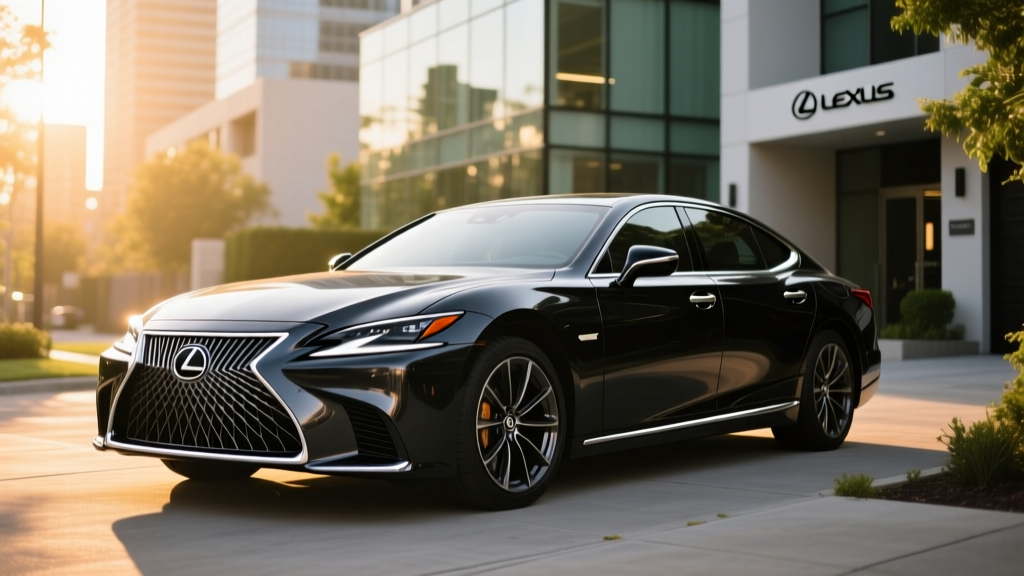
Quick Verdict: The Lexus LS 500h Hybrid at a Glance
The Lexus LS 500h occupies a specific niche: a full-size luxury sedan that uses hybrid technology not to maximize fuel savings at all costs, but to deliver smooth, quiet powertrain performance befitting a flagship while trimming fuel consumption versus its turbocharged sibling. For 2026, the LS 500h continues with Lexus's Multi-Stage Hybrid System pairing a 3.5-liter V6 with a two-motor electric drive, producing 354 combined horsepower and returning an EPA-estimated 25 MPG combined.
This is a conventional hybrid (HEV) — not a plug-in hybrid (PHEV). You never plug it in. The battery recharges through regenerative braking and the gasoline engine. If you're searching for an "LS hybrid" expecting 30 miles of electric-only commuting, you won't find it here. The LS 500h's electric motors assist the engine and enable brief low-speed EV-mode driving, but the system prioritizes seamless power delivery over all-electric range.
| Spec | 2026 Lexus LS 500h |
|---|---|
| Powertrain | 3.5L V6 + 2 electric motors (Multi-Stage Hybrid) |
| Combined Horsepower | 354 hp |
| Transmission | 4-speed automatic + e-CVT (simulated 10-speed) |
| Drivetrain | RWD (AWD available) |
| EPA MPG (combined) | 25 MPG (RWD) |
| EPA City / Highway | 25 city / 26 highway (RWD) |
| Fuel Tank | 17.4 gallons |
| Total Range | ~435 miles |
| Hybrid Battery | 1.1 kWh lithium-ion (not plug-in) |
| 0-60 mph | 5.2 seconds |
| Base MSRP (RWD) | $82,050 |
| AWD MSRP | $85,550 |
| Battery Warranty | 10 years / 150,000 miles |
How Many MPG Does the Lexus LS Hybrid Actually Get?
The EPA rates the 2026 LS 500h at 25 MPG city, 26 highway, and 25 combined for rear-wheel-drive models, with AWD variants dropping to 23 city / 24 highway / 23 combined. These numbers come from fueleconomy.gov.
| Driving Scenario | EPA Estimate | Real-World Expectation |
|---|---|---|
| City (RWD) | 25 MPG | 24–27 MPG (hybrids often exceed EPA in stop-and-go) |
| Highway (RWD) | 26 MPG | 23–25 MPG (aerodynamic drag reduces hybrid advantage) |
| Combined (RWD) | 25 MPG | 23–26 MPG depending on driving mix |
| Combined (AWD) | 23 MPG | 21–24 MPG |
| Cold Weather (combined) | — | 20–22 MPG (engine runs more for cabin heat) |
The LS 500h's Multi-Stage Hybrid System uses regenerative braking heavily in city driving, which is where hybrids shine. Expect real-world city figures to meet or slightly exceed the EPA estimate. Highway driving, however, tells a different story: at sustained 70–80 mph speeds, the electric motors contribute less, the V6 does most of the work, and the heavy sedan's aerodynamic penalty becomes apparent. On a 300-mile highway trip, plan for roughly 24 MPG in mild conditions and potentially 21–22 MPG in winter with the heater running.
For context, the non-hybrid LS 500 with its twin-turbo V6 returns 18 city / 29 highway / 22 combined. The hybrid's advantage is most pronounced in city and mixed driving, where the 3 MPG combined improvement translates to roughly 50–60 fewer gallons per year at 12,000 annual miles.
HEV vs PHEV: Understanding What the LS Hybrid Is — and Isn't
A common search confusion around "LS hybrid" stems from buyers assuming all hybrids plug in. Let's clarify the distinction:
| Feature | HEV (LS 500h) | PHEV (e.g., BMW 750e xDrive) | Full BEV (e.g., Mercedes EQS) |
|---|---|---|---|
| Plugs in? | No | Yes | Yes |
| Electric-only range | ~1 mile at low speed | 30–40 miles | 300–400 miles |
| Battery size | ~1.1 kWh | 15–25 kWh | 90–120 kWh |
| DC fast charging | N/A | Usually no (Level 2 only) | Yes (150–200+ kW) |
| Federal tax credit | Not eligible (§30D) | Up to $7,500 (if eligible) | Up to $7,500 (if eligible) |
| Home charging needed | No | Recommended (Level 2) | Required |
| Total range | ~435 miles | ~400+ miles combined | 300–400 miles |
The LS 500h's 1.1 kWh battery is roughly 1/100th the size of a full EV battery. It exists to buffer regenerative energy and provide torque-fill from the electric motors — not to enable meaningful electric-only driving. You'll get perhaps a mile of EV-mode crawling in a parking lot or residential street below 25 mph, but the engine fires up under any real acceleration demand.
Lexus does not currently offer an LS plug-in hybrid in the US market. The closest competitor offering PHEV technology in this segment is the BMW 750e xDrive, which provides roughly 33 miles of electric-only range from an 18.7 kWh battery. If plug-in capability is a priority, the LS lineup won't meet that need.
Powertrain Deep Dive: How the Multi-Stage Hybrid Works
Lexus's Multi-Stage Hybrid System in the LS 500h is mechanically complex and distinct from the simpler hybrid setups found in the ES 300h or RX 350h. Here's what's under the hood:
- Engine: 3.5-liter V6 (2GR-FXS) producing 295 hp and 267 lb-ft of torque on its own
- Electric Motors: Two motor-generators integrated into the hybrid transaxle
- Transmission: A unique combination of an e-CVT paired with a physical 4-speed automatic gearbox, creating simulated 10-speed ratios
- Combined Output: 354 hp (system net)
- 0-60 mph: 5.2 seconds (RWD), approximately 5.4 seconds (AWD)
The 4-speed automatic bolted behind the e-CVT is the system's defining feature. Most Toyota/Lexus hybrids use an e-CVT alone, which can feel rubbery under hard acceleration. The physical gears in the LS 500h provide more direct engine response and a more traditional shift feel. In practice, this means the LS 500h accelerates with the linear authority expected of a luxury flagship, without the drone typical of CVTs.
The AWD variant adds a rear electric motor that powers the rear axle independently — there's no mechanical driveshaft connecting front to back. This is an on-demand system that engages the rear motor when slip is detected or under hard acceleration, rather than providing continuous all-wheel drive.
Pricing, Trims, and Tax Credit Eligibility
The 2026 Lexus LS 500h starts at $82,050 for RWD and $85,550 for AWD, both in base Luxury trim. The Sport and Executive trims push pricing to $89,000–$97,000+ depending on options.
Pros
- Smooth, quiet V6 hybrid powertrain with no plug-in hassle
- Real-world city MPG often exceeds EPA estimate
- Flagship luxury interior with exceptional ride quality
- 10-year/150,000-mile hybrid battery warranty
- No range anxiety — refuel at any gas station in 3 minutes
Cons
- 25 MPG combined is modest for a hybrid at this price point
- Not eligible for the federal §30D EV/PHEV tax credit
- No plug-in option available in the LS lineup
- Heavy curb weight (~5,100 lbs) limits efficiency gains
- Depreciation steeper than ES or RX hybrids
Does the LS 500h Qualify for Any Tax Credit?
No. The federal §30D Clean Vehicle Credit applies only to battery electric vehicles (BEVs) and plug-in hybrids (PHEVs) that meet battery capacity, critical-mineral sourcing, MSRP, and buyer income thresholds. The LS 500h is a conventional hybrid (HEV) with a battery far too small to qualify. There is no federal tax incentive for purchasing a conventional hybrid as of 2026.
Some states offer minor incentives for hybrid vehicles — typically reduced registration fees or HOV lane access — but these vary by jurisdiction and change frequently. Check your state's DMV or energy office for current programs. Do not count on any tax credit to offset the LS 500h's purchase price.
Battery Warranty, Reliability, and Replacement Costs
Hybrid battery longevity is the single most common concern among hybrid shoppers, and Lexus has one of the strongest track records in the industry.
2026 LS 500h Hybrid Battery Warranty
- Coverage: 10 years or 150,000 miles (whichever comes first)
- Capacity threshold: Warranty covers defects and abnormal capacity loss
- Powertrain warranty: 6 years / 70,000 miles (engine, transmission, hybrid components)
- Basic warranty: 4 years / 50,000 miles
Lexus has used hybrid systems in the LS since the LS 600h L debuted for the 2008 model year. Real-world data from owners and repair networks shows that Toyota/Lexus hybrid batteries routinely last 150,000–200,000+ miles before significant degradation. The 1.1 kWh battery in the LS 500h is small and operates within a narrow state-of-charge window (typically 40–80%), which dramatically reduces stress on the cells compared to a full EV battery that cycles from 10–90%.
If replacement is needed out of warranty, a new OEM hybrid battery pack for the LS 500h runs approximately $3,500–$5,500 including labor at a dealership. Third-party reconditioned packs are available for $2,000–$3,500. This is far less than a full EV battery replacement ($10,000–$25,000) because the hybrid battery is small and the labor is straightforward.
For reliability ratings, the IIHS has evaluated the LS sedan platform, and Lexus consistently ranks at or near the top of J.D. Power and Consumer Reports reliability surveys for luxury brands. The Multi-Stage Hybrid system adds complexity, but its core components (V6 engine, e-CVT, motor-generators) are proven across millions of Toyota/Lexus hybrid vehicles.
Who Should Buy the LS 500h — and Who Should Look Elsewhere
Choose the LS 500h Hybrid If:
- You want flagship luxury sedan comfort without plugging in
- Your driving is mostly city and suburban, where hybrid efficiency shines
- You value powertrain smoothness and quietness over maximum MPG
- You don't have reliable access to home or workplace charging
- You want a proven hybrid system with a 10-year battery warranty
Look at a PHEV or Full EV If:
- You want electric-only commuting (look at the BMW 750e xDrive or Mercedes S 580e)
- You want to qualify for the $7,500 federal tax credit (requires a BEV or PHEV)
- Your daily commute is under 30 miles and you can charge at home
- You want to minimize fuel costs as much as possible
Stick with the Gas LS 500 If:
- Most of your driving is highway, where the hybrid's advantage narrows
- You prefer the twin-turbo V6's stronger low-end torque (415 hp, 442 lb-ft)
- The $5,000+ hybrid premium doesn't justify the 3 MPG improvement for your mileage
The LS 500h makes the most sense for buyers who see the hybrid system as a refinement upgrade rather than a fuel-cost strategy. The electric motors eliminate turbo lag, fill in torque at low RPMs, and enable eerily quiet low-speed maneuvers. The fuel savings versus the LS 500 are real but modest — roughly $350–$450 per year at 12,000 miles and $3.50/gallon. Over five years, that's $1,750–$2,250 in savings, which does not fully offset the hybrid's higher MSRP.
If fuel economy is your primary motivation, the Lexus ES 300h delivers 44 MPG combined starting under $45,000. The LS 500h is about luxury experience first, with efficiency as a bonus.
LS 500h vs the Competition: Hybrid Luxury Sedans Compared
| Vehicle | Type | EPA Combined | HP | 0-60 | Starting MSRP |
|---|---|---|---|---|---|
| Lexus LS 500h | HEV | 25 MPG | 354 | 5.2s | $82,050 |
| BMW 750e xDrive | PHEV | 26 MPG + 33 mi EV | 483 | 4.2s | $107,000 |
| Mercedes S 580e | PHEV | TBD (est. 27 MPG) | 449 | 4.9s | $120,000+ |
| Lexus ES 300h | HEV | 44 MPG | 215 | 8.1s | $44,490 |
| Genesis G90 (gas) | Gas | 20 MPG | 409 | 5.1s | $89,150 |
The LS 500h sits in an unusual competitive position. European rivals have moved to PHEV architectures with meaningful electric-only range, but at significantly higher prices. The LS 500h undercuts them by $25,000–$40,000 while offering comparable interior quality and ride comfort, though without plug-in capability or equivalent straight-line performance.
Frequently Asked Questions
Does the Lexus LS hybrid need to be plugged in?
No. The LS 500h is a conventional hybrid (HEV). Its small 1.1 kWh battery recharges automatically through regenerative braking and the gasoline engine. You fuel it like any other car at a gas station. There is no plug, no charging cable, and no home charger required.
How far can the LS 500h drive on electric power alone?
Approximately one mile at speeds below 25 mph in EV mode. This is useful for creeping through a parking garage or residential street, but the engine engages under normal acceleration. The electric motors primarily assist the engine rather than replace it.
Is the LS 500h more reliable than the gas LS 500?
Lexus's hybrid systems have demonstrated exceptional long-term reliability, often exceeding 200,000 miles without major hybrid component failure. The V6 engine in the 500h is naturally aspirated (no turbochargers), which historically reduces long-term maintenance compared to the twin-turbo V6 in the LS 500. However, the hybrid transaxle is more complex than a conventional automatic.
What does a Lexus LS hybrid battery replacement cost?
An OEM replacement hybrid battery pack costs approximately $3,500–$5,500 installed at a dealership. Reconditioned third-party packs range from $2,000–$3,500. Given the 10-year/150,000-mile warranty and typical Toyota/Lexus hybrid battery lifespan of 150,000–200,000+ miles, most owners will never need a replacement under normal ownership.
How does the LS 500h compare to a full EV like the Mercedes EQS?
The EQS offers 350+ miles of EPA range, zero tailpipe emissions, and lower per-mile fuel costs — but requires reliable charging access and carries a starting price above $105,000. The LS 500h requires no charging infrastructure, refuels in 3 minutes, costs $20,000+ less, and still delivers 25 MPG combined. If you can charge at home and want to eliminate gasoline, the EQS is the better efficiency play. If you lack charging access or want the flexibility of gas-station refueling, the LS 500h is the pragmatic choice.
Does the LS 500h qualify for any federal or state incentives?
Not at the federal level. The §30D Clean Vehicle Credit requires a plug-in vehicle (BEV or PHEV) with a battery of at least 7 kWh. The LS 500h's 1.1 kWh battery disqualifies it entirely. Some states offer minor hybrid incentives (HOV lane stickers, reduced registration fees), but these vary and should not factor heavily into the purchase decision. Consult your state's energy office or DMV for current programs.