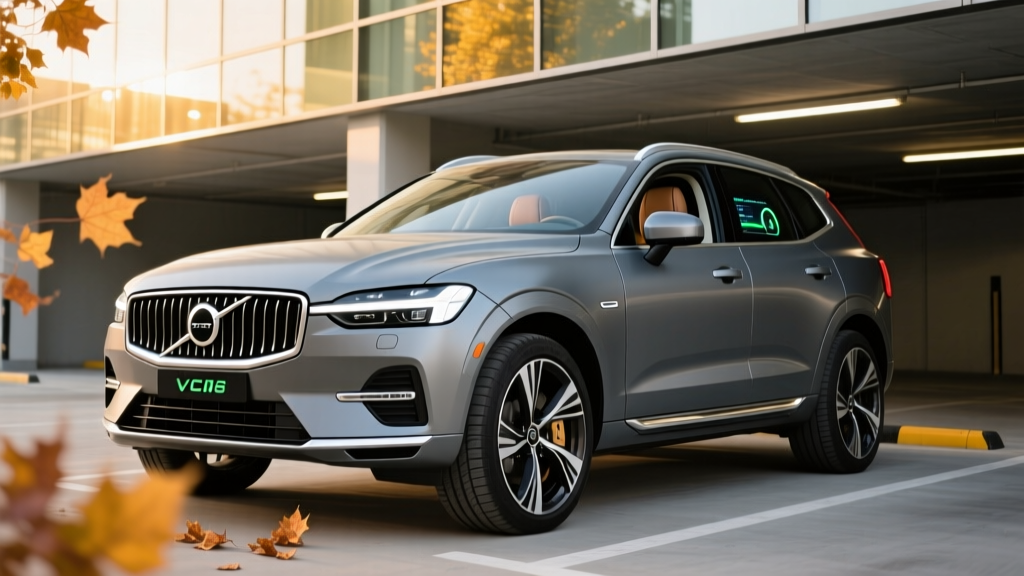
The Volvo XC60 Recharge plug-in hybrid occupies a specific niche: luxury compact SUV buyers who want electric commuting without committing to a full battery-electric vehicle. For 2026, Volvo continues to equip the XC60 Recharge with its T8 powertrain, pairing a turbocharged and supercharged 2.0-liter engine with a rear-mounted electric motor for all-wheel drive and a combined 455 horsepower.
This guide covers exactly what you get — EPA-rated efficiency, real-world electric range, home charging requirements, battery longevity, and whether the XC60 Recharge qualifies for any federal or state incentives in 2026.
HEV vs PHEV: How the XC60 Lineup Works
Volvo currently offers the XC60 exclusively as a plug-in hybrid (PHEV) in the United States under the "Recharge" badge. Volvo discontinued the conventional mild-hybrid B5 powertrain for the US market, meaning every new XC60 you can buy stateside has a charge port and a meaningful electric-only range.
| Feature | Conventional Hybrid (HEV) | Volvo XC60 Recharge (PHEV) |
|---|---|---|
| Plug-in charging | No — self-charging via regen and engine | Yes — charges via plug and regen |
| Electric-only range | Typically <2 miles at low speed | EPA-rated 35 miles |
| Battery size | ~1-2 kWh | 18.8 kWh (usable) |
| Fuel economy (hybrid mode) | Higher combined MPG generally | 28 MPG combined (gas only after battery depletes) |
| Tax credit eligible | No | Potentially — see tax credit section below |
If you're cross-shopping and want a conventional hybrid that never needs plugging in, you'll need to look at competitors like the Lexus NX 350h or the Toyota RAV4 Hybrid. The XC60 Recharge demands a different ownership pattern — one where regular plug-in charging unlocks its efficiency advantage.
Fuel Economy and Electric Range: The Numbers
The EPA rates the 2026 Volvo XC60 Recharge at 63 MPGe combined when operating in hybrid mode with a charged battery, and 28 MPG combined once the battery is depleted and the vehicle runs solely on gasoline. Here's the full breakdown from fueleconomy.gov:
| Mode | City | Highway | Combined |
|---|---|---|---|
| Charge-sustaining (gas only) | 26 MPG | 30 MPG | 28 MPG |
| Charge-depleting (MPGe) | 67 MPGe | 59 MPGe | 63 MPGe |
| Electric-only range | 35 miles (EPA) | ||
| Total range (electric + gas) | ~440 miles (18.5-gal tank + battery) | ||
Real-World MPG vs. EPA
PHEVs reward a specific driving pattern. If you plug in nightly and commute under 35 miles round-trip, you may use gasoline only on weekend road trips — effectively achieving triple-digit MPGe over months of ownership. However, if you rarely charge and rely on the gasoline engine, expect fuel economy to settle around 26–30 MPG combined, which is merely average for a luxury compact SUV and worse than a purpose-built hybrid like the Lexus NX 350h (39 MPG combined).
The XC60 Recharge's charge-sustaining MPG is limited by its weight — at approximately 4,700 pounds, the vehicle carries a heavier drivetrain than a conventional hybrid. This is the inherent PHEV trade-off: outstanding efficiency when charged, mediocre efficiency when not.
Powertrain Specs: 455 Horsepower, Standard AWD
| Specification | 2026 Volvo XC60 Recharge (T8) |
|---|---|
| Engine | 2.0L turbocharged + supercharged 4-cylinder |
| Electric motor | Rear-axle permanent magnet (143 hp / 177 lb-ft) |
| Combined output | 455 hp / 523 lb-ft torque |
| Drivetrain | eAWD (engine drives front, motor drives rear) |
| Transmission | 8-speed automatic |
| 0–60 mph | 4.5 seconds |
| Towing capacity | 3,500 lbs (braked) |
| Battery (usable) | 18.8 kWh, lithium-ion NMC |
| Onboard charger | 3.7 kW (Level 2 AC only) |
| DC fast charging | Not supported |
The T8 powertrain's defining characteristic is its electric rear axle. The gasoline engine powers the front wheels while the 143-hp electric motor drives the rear, providing all-wheel drive without a mechanical driveshaft. This layout delivers confident traction and enables the 35-mile electric-only range using the rear motor alone.
One limitation worth noting: the onboard charger tops out at 3.7 kW. That means a full Level 2 charge from empty takes approximately 5 hours (18.8 kWh ÷ 3.7 kW). The XC60 Recharge does not support DC fast charging — a notable gap as some competitors (like the Mitsubishi Outlander PHEV) offer DC capability. For a PHEV with a small battery, this isn't a dealbreaker since overnight Level 2 or even 120V Level 1 charging covers most daily needs, but it eliminates the option for quick top-ups on road trips.
Charging at Home: What You Need
The XC60 Recharge uses a standard J1772 connector for AC charging. Here's what to expect at each charging level:
| Charging Level | Power | Time (0–100%) | Setup |
|---|---|---|---|
| Level 1 (120V household outlet) | ~1.4 kW | ~13 hours | No installation needed; use included cable |
| Level 2 (240V home charger) | 3.7 kW (vehicle-limited) | ~5 hours | Requires 240V outlet or hardwired charger |
| DC Fast Charging | N/A | N/A | Not supported on XC60 Recharge |
For most PHEV owners, Level 1 charging is sufficient. If you drive 35 electric miles per day and plug in when you get home, 13 hours of overnight charging on a standard 120V outlet replenishes the battery fully. A Level 2 installation provides faster turnaround if you make multiple short trips throughout the day and want to recharge between them.
A basic Level 2 home charger installation (240V, 40-amp circuit) typically costs $500–$2,000 depending on your electrical panel's proximity to the parking spot and whether a panel upgrade is needed. Since the XC60's onboard charger is limited to 3.7 kW, you don't need an expensive 48-amp charger — a basic 16-amp or 32-amp Level 2 unit (like the Emporia Vue or ChargePoint Home Flex configured to 16A) will max out the vehicle's capability.
Pricing and Tax Credit Eligibility
The 2026 Volvo XC60 Recharge starts at approximately $59,950 (Core trim) and ranges up to $72,000+ for the Ultra trim with optional packages. Pricing positions it firmly in the luxury compact PHEV segment.
Under current IRS rules for 2026, PHEVs must meet the same stringent requirements as full EVs to qualify for the federal plug-in vehicle credit. Key hurdles for the XC60 Recharge:
- MSRP cap: SUVs must be under $80,000 — the XC60 Recharge qualifies on most trims.
- Buyer income cap: AGI must not exceed $150,000 (single) / $300,000 (joint).
- Battery sourcing requirements: Critical minerals and battery components must meet escalating domestic-content thresholds. As of 2026, these requirements have tightened significantly, and the XC60 Recharge's supply chain has historically relied on non-qualifying sources.
- Minimum battery capacity: Must be ≥7 kWh — the XC60's 18.8 kWh battery qualifies.
- Point-of-sale transfer: If eligible, the credit can be transferred to the dealer at purchase for an immediate price reduction.
Bottom line: Due to battery component and critical mineral sourcing rules, the XC60 Recharge has not consistently qualified for the full $7,500 credit in recent years. Always verify current eligibility on the fueleconomy.gov tax credit page and consult a tax professional before relying on this credit in your purchase decision.
Some states offer additional PHEV incentives. California's Clean Vehicle Rebate, Colorado's innovative motor vehicle credit, and various utility company rebates may apply. Check your state's energy office and local utility for current programs.
Battery Warranty, Reliability, and Replacement Costs
- Coverage: 8 years / 100,000 miles (whichever comes first)
- Capacity threshold: Volvo warrants the high-voltage battery against defects and excessive capacity loss, typically defined as dropping below ~70% of original capacity during the warranty period
- What's covered: Battery cell defects, battery management system failures, thermal management system issues
Volvo's hybrid battery warranty aligns with the industry standard of 8 years and 100,000 miles, matching competitors like BMW, Audi, and Mercedes-Benz in the luxury PHEV segment.
Long-Term Reliability
Volvo's T8 powertrain has been in production since 2016 (with the current-generation battery arriving for 2022), providing a substantial track record. The larger 18.8 kWh battery introduced in 2022 addressed earlier complaints about insufficient electric range. Common reliability concerns reported by owners include:
- Software integration: Occasional infotainment glitches on the Google-based system (improved via OTA updates)
- Charge port door: Some reports of latch mechanism wear in cold climates
- Brake feel: The transition between regenerative and friction braking can feel abrupt — a common PHEV trait, not unique to Volvo
The high-voltage battery itself has proven durable. PHEV batteries experience shallower discharge cycles than full EVs (you're using 18.8 kWh instead of 80+ kWh), which generally translates to slower degradation. Most owners report minimal range loss over the first 3–5 years of ownership.
Battery Replacement Cost
If the high-voltage battery requires replacement outside of warranty, expect a cost in the range of $8,000–$12,000 for the battery pack plus labor. This is a significant expense, though the 8-year/100,000-mile warranty and the inherent durability of PHEV batteries (shallow cycles, active thermal management) mean most owners will never face this cost. Volvo's battery is also modular — individual cell groups can sometimes be replaced rather than the entire pack, potentially reducing out-of-warranty repair bills.
XC60 Recharge vs. Full EV vs. Gas: Which Is Right for You?
- Your daily commute is under 35 miles round-trip and you can charge at home
- You take regular road trips where charging infrastructure is sparse or unreliable
- You want a luxury compact SUV but aren't ready to commit to a full EV
- You value the 455-hp performance and standard AWD
- You lack access to reliable public DC fast charging for longer trips
- You have reliable home Level 2 charging and your daily driving is under 200 miles
- You want the lowest per-mile fuel cost and minimal maintenance
- You're eligible for the full federal EV tax credit (more full EVs qualify than PHEVs)
- You want to eliminate gasoline entirely
- You cannot charge at home (apartment, street parking, no garage outlet)
- You want maximum fuel economy without changing your habits
- Lower purchase price is a priority (NX 350h starts ~$42,000)
- You don't need 455 hp or luxury-brand cachet
The PHEV ownership equation is simple: if you plug in regularly, you save substantially; if you don't, you're carrying dead battery weight for worse fuel economy than a simpler hybrid. Be honest about your charging habits before purchasing.
Pros and Cons at a Glance
- 35 miles of electric-only range covers most commutes
- 455 hp with 4.5-second 0–60 — genuinely quick
- Standard AWD via electric rear axle
- Premium interior with Google-based infotainment
- 3,500-lb towing capacity exceeds most PHEV competitors
- No range anxiety — gas engine provides 440+ total miles
- No DC fast charging support
- 3.7 kW onboard charger is slow for Level 2
- 28 MPG gas-only is mediocre for a hybrid
- $59,950+ starting price is steep
- Unlikely to qualify for full $7,500 federal tax credit
- Rear cargo space reduced vs. non-hybrid XC60 (battery placement)
Frequently Asked Questions
How many MPG does the Volvo XC60 hybrid get?
The 2026 XC60 Recharge achieves 63 MPGe combined when using both battery and gasoline, and 28 MPG combined (26 city / 30 highway) in charge-sustaining mode after the battery is depleted. Real-world results vary significantly based on charging habits — owners who plug in daily may use gasoline only a few times per month.
How far can the XC60 Recharge go on electric only?
The EPA rates the XC60 Recharge at 35 miles of electric-only range. In real-world driving, expect 28–32 miles on the highway and 22–25 miles in cold weather (below 32°F). City driving with regenerative braking can achieve the full 35 miles or slightly more.
Does the XC60 Recharge qualify for the federal tax credit?
As of 2026, the XC60 Recharge faces challenges meeting the battery component and critical mineral sourcing requirements under IRS §30D. It has not consistently qualified for the full $7,500 credit. Check fueleconomy.gov for the most current eligibility list and consult a tax professional. State and utility incentives may still apply.
Can I charge the XC60 Recharge at a DC fast charger?
No. The XC60 Recharge supports only AC charging — Level 1 (120V) and Level 2 (240V) via a J1772 connector. The maximum charge rate is 3.7 kW, meaning a full charge takes about 5 hours on Level 2 or 13 hours on Level 1. This is typical for PHEVs with smaller batteries.
Is the Volvo XC60 hybrid reliable, and what does a battery replacement cost?
The T8 powertrain has been in production since 2016 with generally solid reliability. The high-voltage battery is warranted for 8 years / 100,000 miles. Out-of-warranty battery replacement costs approximately $8,000–$12,000, though the shallow charge cycles of PHEV use typically result in minimal degradation over the vehicle's lifespan.
Do I need to plug in the XC60 Recharge every night?
You don't need to — the vehicle operates as a conventional hybrid if you never plug it in. However, you'll get only 28 MPG combined and lose the efficiency advantage of the PHEV system. To maximize value, plug in whenever possible. Even a standard 120V outlet provides enough charge overnight for a full battery by morning.
How does the XC60 Recharge compare to the Volvo EX40 (full EV)?
The EX40 (formerly XC40 Recharge pure electric) offers 223–293 miles of EPA range depending on battery size, qualifies more reliably for the federal tax credit, and has lower per-mile operating costs. However, it requires commitment to public charging on road trips. The XC60 Recharge is the better choice if you frequently drive beyond the EX40's range or lack reliable charging on your regular routes.
The 2026 Volvo XC60 Recharge is a compelling option for luxury buyers who want electrified daily driving without abandoning the gasoline safety net. Its 455-hp powertrain, 35-mile electric range, and premium cabin make it one of the most capable PHEVs in its class — provided you have access to home charging and understand that its gas-only efficiency won't match a purpose-built hybrid.