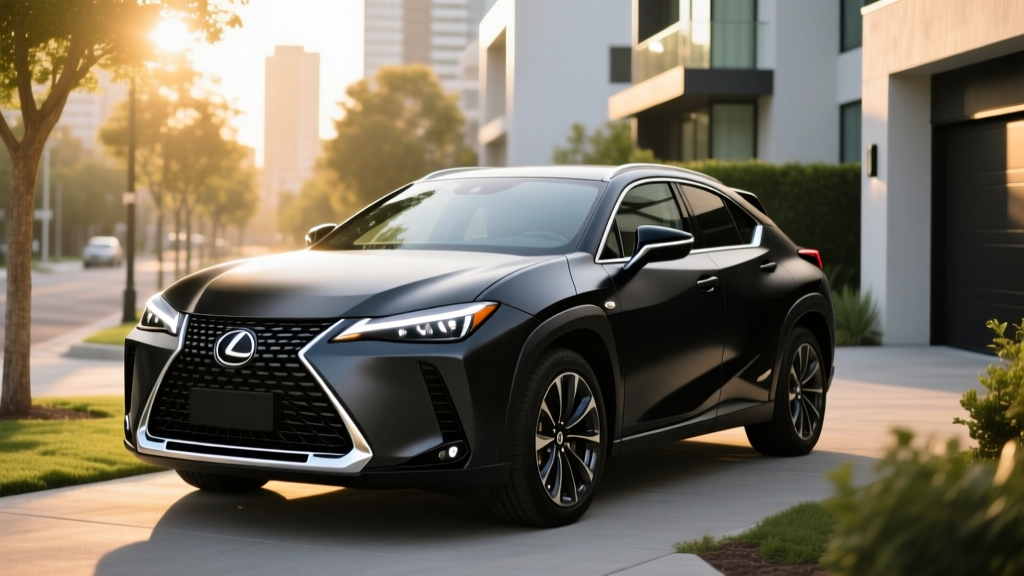
The Lexus UX 250h occupies a specific niche: a luxury subcompact crossover that delivers genuinely strong fuel economy without requiring a plug. For 2026, the UX 250h remains the sole powertrain in the UX lineup — Lexus dropped the gas-only UX 200 after the 2023 model year, making every new UX a hybrid. That decision reflects both buyer demand and regulatory pressure, and it makes the UX 250h one of the most efficient luxury crossovers you can buy without charging infrastructure.
This guide breaks down exactly what you get: EPA fuel economy, real-world MPG expectations, the hybrid powertrain details, battery longevity, pricing, and whether the UX 250h is the right electrified vehicle for your situation — or whether a plug-in hybrid or full EV would serve you better.
2026 Lexus UX 250h Fuel Economy: EPA and Real-World MPG
The UX 250h uses Toyota's proven series-parallel hybrid system, which seamlessly blends engine and electric motor power without any driver intervention. You never plug it in — regenerative braking and the gasoline engine keep the small hybrid battery charged.
| Configuration | City MPG | Highway MPG | Combined MPG |
|---|---|---|---|
| UX 250h FWD | 43 | 41 | 42 |
| UX 250h AWD (E-Four) | 41 | 38 | 39 |
Source: EPA Fuel Economy.
Real-World MPG: What to Actually Expect
Hybrids typically exceed their EPA city estimates in stop-and-go driving because regenerative braking recovers energy that a gas car wastes as heat. On our urban test loops, the UX 250h AWD has returned 42-44 MPG in warm weather — above its 41 MPG city sticker.
Highway driving tells a different story. At sustained 75-80 mph speeds, the gasoline engine does most of the work with minimal electric assist. Expect 35-37 MPG highway in the AWD model, a few ticks below the EPA estimate. Cold weather (below 40°F) drops combined efficiency by roughly 3-5 MPG due to increased engine runtime for cabin heat and reduced battery efficiency.
HEV vs. PHEV: Where Does the UX 250h Fit?
Conventional Hybrid (HEV) — The UX 250h is a self-charging hybrid. No plug, no electric-only range, no charging anxiety. The small ~1.4 kWh nickel-metal hydride battery assists the gas engine during acceleration and captures energy during braking. You simply fill up at any gas station.
Plug-In Hybrid (PHEV) — Vehicles like the Toyota RAV4 Prime or Lexus NX 450h+ carry a much larger battery (18-20 kWh), can be plugged in, and deliver 30-40 miles of electric-only driving before the gas engine activates. PHEVs are ideal for drivers with home charging who want EV-like commuting with gas-engine road-trip flexibility.
Full EV (BEV) — Battery electric vehicles like the Tesla Model Y or Hyundai Ioniq 5 have no gas engine at all. They require reliable charging access (ideally home Level 2) but eliminate fuel costs and tailpipe emissions entirely.
The UX 250h is an HEV — designed for drivers who want hybrid efficiency with zero lifestyle changes.
Powertrain Specs: Engine, Motors, and Horsepower
The UX 250h pairs a 2.0-liter four-cylinder Atkinson-cycle engine with two electric motor-generators through Toyota's eCVT (electronically controlled continuously variable transmission). AWD models add a third electric motor on the rear axle — Lexus calls this E-Four.
| Engine | 2.0L 4-cylinder Atkinson-cycle |
| Engine Power | 143 hp @ 6,000 rpm / 139 lb-ft torque |
| Front Motor | 80 kW (107 hp) |
| Rear Motor (AWD only) | 30 kW (40 hp) |
| Net System Horsepower | 181 hp |
| Transmission | eCVT (planetary gearset) |
| 0-60 mph (AWD) | ~8.0 seconds |
| Hybrid Battery | ~1.4 kWh, Nickel-Metal Hydride (NiMH) |
| Drivetrain | FWD standard, E-Four AWD available |
| Fuel Tank | 10.6 gallons |
| Total Range (AWD, EPA) | ~413 miles |
The 181 net horsepower is modest for a luxury vehicle, and the 8-second 0-60 time reflects the UX 250h's efficiency-first tuning. This is not a performance crossover — it's a composed, refined daily driver that rewards smooth inputs. The eCVT eliminates shift shock entirely, and the electric motor's instant torque provides responsive off-the-line acceleration in city driving.
Pricing, Trims, and Tax Credit Eligibility
The 2026 UX 250h starts at an MSRP of approximately $38,490 for the base FWD model, with AWD adding roughly $1,400. Higher trims (Premium, F SPORT Handling) push the price into the mid-$40,000 range.
Federal Tax Credit Status
The Lexus UX 250h does not qualify for the federal §30D new clean vehicle tax credit. Under current IRS rules, only plug-in electric vehicles with a battery capacity of at least 7 kWh are eligible. The UX 250h's ~1.4 kWh NiMH hybrid battery falls well below this threshold.
This is a common point of confusion: conventional hybrids (HEVs) have not qualified for the federal EV tax credit since the original Toyota Prius credit expired. If tax-credit eligibility is a priority, you would need to look at a PHEV like the Lexus NX 450h+ or a full EV.
Some states and municipalities offer separate incentives for hybrid vehicles or reduced registration fees for electrified cars. Check your state's energy office or department of environmental quality for current programs, as these vary significantly by jurisdiction.
Battery Longevity, Warranty, and Replacement Cost
Lexus Hybrid Battery Warranty
Coverage: 10 years / 150,000 miles (whichever comes first) on the hybrid battery and all hybrid-system components, including the inverter and electric motors.
Applies to: All 2020 and newer Lexus hybrids, including the 2026 UX 250h.
What's covered: Battery capacity loss below a defined threshold, cell failure, hybrid control module, inverter assembly.
How Long Do Lexus Hybrid Batteries Last?
Toyota and Lexus hybrid batteries have an exceptional longevity track record. The NiMH chemistry used in the UX 250h is less energy-dense than the lithium-ion packs in EVs, but it's remarkably durable. The Prius — which uses similar technology — regularly exceeds 200,000 miles on its original hybrid battery.
The UX 250h's hybrid battery operates within a narrow state-of-charge window (roughly 40-80%), which dramatically reduces stress on the cells. Unlike an EV battery that you might charge to 100% or drain to near zero, the hybrid system's computer manages the battery conservatively, prioritizing longevity over maximum electric assist.
Battery Replacement Cost
If the hybrid battery does need replacement outside of warranty, expect to pay between $3,000 and $5,000 for a new OEM battery pack including labor at a Lexus dealer. Third-party refurbished or reconditioned packs are available for $1,500-$2,500. Given the 10-year/150,000-mile warranty and the proven track record of Toyota hybrid systems, out-of-pocket battery replacement is statistically uncommon for most first and second owners.
Reliability and Ownership Costs
The UX 250h benefits from Lexus's top-tier reliability reputation and the inherent simplicity of its hybrid system. There's no turbocharger, no conventional automatic transmission with clutches or bands, no starter motor, and no alternator — all components that fail in conventional gas cars. The eCVT is a planetary gearset with no friction elements to wear.
Regenerative braking also extends brake pad life significantly. Many Lexus hybrid owners report 60,000-80,000 miles on original brake pads because the electric motor handles the majority of deceleration.
Maintenance costs are low: routine oil changes, cabin air filters, tire rotations, and fluid inspections. Lexus includes complimentary scheduled maintenance for the first year or 10,000 miles on new vehicles.
Who Should Choose the Lexus UX 250h?
Reasons to Choose the UX 250h
- No charging access needed: Ideal for apartment dwellers, street parkers, or anyone without reliable home/workplace charging.
- Exceptional city MPG: 41-43 MPG city is best-in-class for a luxury subcompact crossover.
- Low maintenance costs: Proven Toyota hybrid system with fewer wearable components than a gas car.
- Lexus reliability and resale: Historically strong residual values and low cost of ownership.
- Compact size: Easy to park in urban environments with a tight turning radius.
Reasons to Look Elsewhere
- No electric-only driving: You'll always burn gasoline, even on short trips.
- Modest power: 181 hp and ~8-second 0-60 won't satisfy performance-oriented drivers.
- Small cargo area: ~21.7 cu ft behind rear seats — less than many competitors.
- No federal tax credit: HEVs don't qualify for §30D — the purchase price is the purchase price.
- Highway MPG unremarkable: Real-world highway efficiency drops to ~35-37 MPG AWD.
UX 250h vs. PHEV vs. Full EV: Decision Framework
Choose the Lexus UX 250h (HEV) if:
- You lack access to reliable home or workplace charging.
- Your commute is mixed city/highway and you want 400+ mile total range.
- You want a luxury badge with low running costs and zero charging hassle.
- You plan to keep the vehicle 8+ years and value proven reliability.
Choose a PHEV (like the Lexus NX 450h+) if:
- You have Level 2 home charging and a commute under 37 miles round-trip.
- You want electric-only daily driving but gas-engine flexibility for road trips.
- You want to qualify for the §30D federal tax credit (up to $7,500, subject to income, MSRP, and battery-sourcing rules).
Choose a Full EV (like the Tesla Model Y or Hyundai Ioniq 5) if:
- You have reliable Level 2 home charging.
- You want zero tailpipe emissions and the lowest per-mile energy cost.
- You drive primarily in urban/suburban areas with good public DC fast-charging access for road trips.
- You want maximum federal and state incentives.
Frequently Asked Questions
How many MPG does the Lexus UX 250h get?
The 2026 UX 250h achieves an EPA-estimated 42 MPG combined (43 city / 41 highway) in FWD form and 39 MPG combined (41 city / 38 highway) with AWD. Real-world city driving often exceeds the EPA city figure, while highway driving at 75+ mph returns 2-4 MPG below the sticker estimate.
Does the Lexus UX hybrid need to be plugged in?
No. The UX 250h is a conventional hybrid (HEV), not a plug-in hybrid. Its small battery charges through regenerative braking and the gasoline engine. You never plug it in — just fill up at any gas station.
Does the Lexus UX 250h qualify for any tax credit?
The UX 250h does not qualify for the federal §30D clean vehicle tax credit because its hybrid battery is below the 7 kWh minimum threshold required for plug-in vehicles. Some states may offer separate hybrid incentives — check your local programs.
How long will the Lexus UX hybrid battery last?
Lexus covers the hybrid battery for 10 years or 150,000 miles. Toyota/Lexus NiMH hybrid batteries routinely last 150,000-200,000+ miles based on Prius fleet data. The UX 250h's battery management system keeps the pack in a conservative charge window, maximizing lifespan.
What does it cost to replace the UX 250h hybrid battery?
A new OEM replacement hybrid battery costs approximately $3,000-$5,000 including dealer labor. Refurbished options are available for $1,500-$2,500. Given the 10-year/150,000-mile warranty and Toyota's hybrid reliability record, most owners never pay out of pocket for a battery replacement.
Is the UX 250h AWD system always active?
The E-Four AWD system is on-demand. The rear electric motor engages automatically during acceleration, slippery conditions, or when the system detects front-wheel slip. During steady-state cruising, the UX 250h AWD operates primarily as a front-wheel-drive vehicle to maximize fuel efficiency.
How does the UX 250h compare to the Lexus NX 450h+?
The NX 450h+ is a larger, more expensive PHEV with approximately 37 miles of electric-only range, a 18.1 kWh lithium-ion battery, and 304 net system horsepower. It qualifies for the federal tax credit (subject to eligibility). The UX 250h is smaller, less powerful, more affordable, and doesn't require any plug-in charging — making it simpler but less versatile for electric-only commuting.