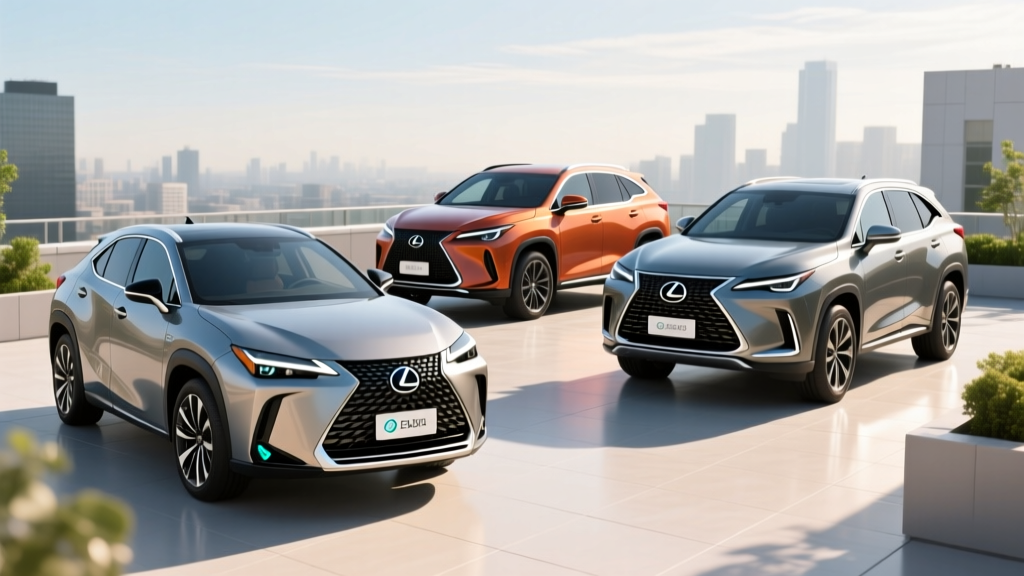
If you are shopping for a Lexus hybrid SUV in 2026, the lineup is the broadest it has ever been: six distinct electrified nameplates spanning a subcompact crossover to a three-row family hauler. Lexus splits them into two camps — conventional hybrids (HEVs) that never need a plug, and plug-in hybrids (PHEVs) that offer 30+ miles of electric-only driving before the gas engine takes over. Choosing the right one depends less on badge loyalty and more on your daily mileage, charging access, and whether you want a tax credit.
This guide breaks down every current Lexus hybrid SUV with exact EPA figures, real-world expectations, powertrain specs, pricing, and federal credit eligibility — so you can match the model to your driving pattern without guessing.
HEV vs PHEV: Which Lexus Hybrid SUV Type Fits You?
Conventional Hybrid (HEV)
Models: UX 300h, NX 350h, RX 350h, TX 550h+
How it works: A small battery (1–2 kWh) recharges through regenerative braking and the gas engine. You never plug in.
Best for: Drivers without home charging, apartment dwellers, high-mileage commuters who want set-and-forget efficiency.
Plug-In Hybrid (PHEV)
Models: NX 450h+, RX 500h (performance hybrid — not a PHEV), RX 550h+ (PHEV variant)
How it works: A larger battery (18+ kWh) provides 30–40 miles of electric-only range. You plug in at home or at public Level 2 chargers to unlock full efficiency.
Best for: Home-charging owners whose daily commute falls within the electric range — effectively an EV on weekdays, a hybrid on road trips.
The critical distinction: if you cannot charge at home or at work, a PHEV's electric range goes unused and you are carrying dead battery weight. In that scenario, a conventional HEV delivers better real-world value.
2026 Lexus Hybrid SUV Spec & MPG Table
| Model | Type | Combined HP | EPA City / Hwy / Combined MPG | EV-Only Range (PHEV) | Battery (kWh usable) | Base MSRP |
|---|---|---|---|---|---|---|
| UX 300h | HEV | 196 hp | 43 / 41 / 42 | — | ~1.4 kWh (NiMH) | $38,950 |
| NX 350h | HEV | 240 hp | 41 / 37 / 39 | — | ~1.6 kWh (NiMH) | $44,350 |
| NX 450h+ | PHEV | 304 hp | 84 MPGe combined / 36 mpg gas-only | 37 mi | 18.1 kWh (Li-ion) | $60,450 |
| RX 350h | HEV | 250 hp | 37 / 34 / 36 | — | ~1.6 kWh (NiMH) | $52,750 |
| RX 550h+ | PHEV | 366 hp | 79 MPGe combined / 32 mpg gas-only | 37 mi | 18.1 kWh (Li-ion) | $72,500 |
| TX 550h+ | PHEV | 406 hp | 76 MPGe combined / 29 mpg gas-only | 33 mi | 18.1 kWh (Li-ion) | $78,500 |
Source: fueleconomy.gov and Lexus USA official specifications for 2026 model year. MPGe reflects combined electric + gas operation; gas-only MPG applies once the battery is depleted.
Fuel Economy Deep Dive: Real-World MPG vs EPA Sticker
Lexus hybrids consistently match or exceed their EPA city ratings in real-world stop-and-go driving — the opposite of most gas-only vehicles. Here is what to expect:
| Model | EPA Combined | Real-World City | Real-World Highway (75 mph) | Cold-Weather Penalty |
|---|---|---|---|---|
| UX 300h | 42 mpg | 44–47 mpg | 36–38 mpg | -3 to -5 mpg |
| NX 350h | 39 mpg | 40–43 mpg | 33–35 mpg | -3 to -4 mpg |
| RX 350h | 36 mpg | 37–39 mpg | 30–32 mpg | -2 to -4 mpg |
| TX 550h+ | 29 mpg (gas) | 30–32 mpg | 26–28 mpg | -2 to -3 mpg |
Highway driving is where hybrids lose their advantage. At sustained 75+ mph speeds, the electric motor assists less and the 2.5-liter four-cylinder engine does most of the work. If your commute is 90% freeway, expect MPG numbers closer to the EPA highway figure. If your commute is city-heavy with lots of stoplights, you will beat the EPA combined number.
For PHEV models (NX 450h+, RX 550h+, TX 550h+), the 33–37 mile electric-only range covers most round-trip commutes under 35 miles. Beyond that range, the engine engages and you are operating as a conventional hybrid at the gas-only MPG listed above.
PHEV Charging: Battery Specs, Charge Times & DC Fast-Charge Reality
All three Lexus PHEVs share an 18.1 kWh lithium-ion battery pack. Here is what charging looks like in practice:
- Level 1 (120V household outlet): ~12 hours for a full charge — adequate only if you drive very few electric miles daily.
- Level 2 (240V, 3.3 kW onboard charger): ~5.5 hours from empty to full. This is the practical home-charging standard.
- DC fast charging: Lexus PHEVs do not support DC fast charging. The onboard charger maxes out at 3.3 kW AC. You will not find a CCS or NACS port on any current Lexus PHEV.
The 3.3 kW onboard charger is the limiting factor. If you charge at a public 7 kW or 11 kW Level 2 station, the vehicle still draws only 3.3 kW. Plan accordingly: a full charge requires roughly 5.5 hours regardless of the station's rated output.
Lexus Hybrid Battery Warranty
All 2026 Lexus hybrids and PHEVs carry a 10-year / 150,000-mile hybrid battery warranty (whichever comes first), up from the previous 8-year/100,000-mile standard. This covers battery capacity loss below a manufacturer-defined threshold and any cell or module failure. The rest of the hybrid system — inverter, electric motors, control unit — is covered under the same 10-year/150,000-mile hybrid-component warranty.
Battery replacement cost if out of warranty: $3,000–$5,000 for HEV NiMH packs; $8,000–$12,000 for PHEV lithium-ion packs. In practice, Toyota/Lexus hybrid batteries regularly exceed 200,000 miles with minimal degradation, and individual cell modules can often be replaced rather than the entire pack.
Powertrain Breakdown: Engine + Motor Specs
Lexus uses a variation of Toyota's Hybrid Synergy Drive across the lineup, pairing Atkinson-cycle four-cylinder engines with front and rear electric motors for standard all-wheel drive.
UX 300h (196 hp)
2.0L inline-4 + two electric motors. The lightest Lexus hybrid, and the most fuel-efficient. Acceleration is adequate (0–60 in ~8.0 seconds) but not quick — this is an efficiency-first powertrain.
NX 350h (240 hp) & RX 350h (250 hp)
2.5L inline-4 + front/rear electric motors. The volume sellers. The NX hits 0–60 in ~7.2 seconds; the heavier RX in ~7.4 seconds. Both deliver smooth, linear torque from the electric motors at low speeds.
NX 450h+ PHEV (304 hp)
2.5L inline-4 + higher-output electric motors + 18.1 kWh battery. 0–60 in ~6.0 seconds. The extra battery mass is offset by substantially more electric torque.
RX 550h+ PHEV (366 hp)
2.4L turbocharged inline-4 + electric motors + 18.1 kWh battery. 0–60 in ~5.2 seconds. This is the performance-oriented RX — noticeably quicker than the 350h, with a firmer ride to match.
TX 550h+ PHEV (406 hp)
2.4L turbocharged inline-4 + high-output electric motors + 18.1 kWh battery. 0–60 in ~5.4 seconds despite its 5,000+ lb curb weight. The most powerful Lexus hybrid SUV, built for three-row family hauling with passing confidence.
Pricing, Trims & Federal Tax Credit Eligibility
| Model | Base MSRP | Federal §30D PHEV Credit | Effective Price After Credit |
|---|---|---|---|
| UX 300h | $38,950 | Not eligible (HEV) | $38,950 |
| NX 350h | $44,350 | Not eligible (HEV) | $44,350 |
| NX 450h+ | $60,450 | Up to $3,750* | ~$56,700* |
| RX 350h | $52,750 | Not eligible (HEV) | $52,750 |
| RX 550h+ | $72,500 | Up to $3,750* | ~$68,750* |
| TX 550h+ | $78,500 | Up to $3,750* | ~$74,750* |
*Per IRS §30D guidelines, PHEV eligibility depends on the buyer's modified adjusted gross income (MAGI caps: $150K single / $300K joint), battery critical-mineral and component sourcing requirements, and MSRP caps ($80,000 for SUVs). The credit can be transferred to the dealer as a point-of-sale rebate. Conventional HEVs do not qualify for the federal clean-vehicle credit. Confirm eligibility with your tax professional before purchase — sourcing rules tighten annually.
Well-equipped PHEVs (Premium or Luxury trims) can push past $80,000 MSRP, which would disqualify them from the §30D credit. If the credit matters to your budget, verify the final negotiated MSRP stays at or below the $80,000 SUV cap.
Reliability Track Record & Long-Term Ownership Costs
Lexus consistently ranks at or near the top of J.D. Power and Consumer Reports reliability surveys, and the hybrid powertrain is a major reason. Toyota's hybrid system has been in continuous production since 1997 with incremental refinement — there are no first-generation unknowns here.
Key ownership-cost factors:
- Maintenance: Hybrids have no conventional starter, alternator, or accessory belt to replace. Regenerative braking extends brake pad life significantly — many owners report 80,000+ miles on original pads.
- Insurance: Typically 5–10% higher than equivalent gas-only Lexus models due to higher repair costs for hybrid-specific components after a collision.
- Depreciation: Lexus hybrids hold value well. The UX 300h and NX 350h retain roughly 55–60% of MSRP after three years, per industry estimates. PHEVs depreciate slightly faster due to rapid battery-tech advancement.
- Fuel savings vs gas-only: A UX 300h owner driving 15,000 miles/year at $3.50/gallon spends ~$1,250 annually on fuel. An equivalent gas-only luxury subcompact at 28 mpg combined would cost ~$1,875 — a $625/year savings.
Who Should Buy a Lexus Hybrid SUV — and Who Should Consider a Full EV?
Choose a Lexus HEV (UX 300h, NX 350h, RX 350h) if:
- You cannot charge at home or at work
- You want premium-crossover comfort with zero behavior change
- Your priority is reliability and low maintenance over maximum efficiency
- You frequently take long road trips and do not want to plan charging stops
Choose a Lexus PHEV (NX 450h+, RX 550h+, TX 550h+) if:
- You have Level 2 home charging and your daily commute is under 35 miles round-trip
- You want electric-only weekday driving with gas-engine flexibility for weekend road trips
- You want to reduce fuel consumption dramatically without range anxiety
- You qualify for the §30D tax credit and can keep MSRP under $80K
Choose a full EV (e.g., Tesla Model Y, Hyundai Ioniq 5, BMW iX) if:
- You have reliable home charging and your trips rarely exceed 250 miles without a stop
- You want to eliminate gasoline entirely and minimize moving parts
- You qualify for the full $7,500 federal EV credit
- You are comfortable with DC fast-charging logistics on road trips
Frequently Asked Questions
How many MPG does the Lexus hybrid SUV lineup get?
The UX 300h leads at 42 mpg combined (43 city / 41 highway). The NX 350h achieves 39 combined, and the RX 350h gets 36 combined. PHEV models use MPGe ratings when operating on battery power — the NX 450h+ is rated at 84 MPGe combined — and revert to 29–36 mpg on gasoline alone once the battery is depleted.
How far can a Lexus PHEV go on electric only?
The NX 450h+ and RX 550h+ each deliver an EPA-rated 37 miles of electric-only range. The three-row TX 550h+ provides 33 miles. In mild weather with conservative driving, expect to add 2–4 miles to those figures. In cold weather (below 32°F), subtract 5–8 miles due to cabin heating demands and reduced battery efficiency.
Does a Lexus hybrid qualify for a federal tax credit?
Conventional Lexus hybrids (HEVs) do not qualify for the federal §30D clean-vehicle credit. PHEV models may qualify for up to $3,750, depending on battery-sourcing compliance, your income level, and the vehicle's final MSRP. Rules change annually — verify current eligibility at irs.gov before purchasing.
Is the Lexus hybrid battery reliable and what does replacement cost?
Lexus hybrid batteries are among the most proven in the industry, with millions of units in service over 25+ years. The 2026 warranty covers 10 years or 150,000 miles. Out-of-pocket replacement runs $3,000–$5,000 for HEV packs and $8,000–$12,000 for PHEV packs, though full replacements are rare — individual module repair is often possible at lower cost.
Do I need to plug in a Lexus hybrid?
No. The UX 300h, NX 350h, and RX 350h are conventional hybrids that recharge their small batteries through regenerative braking and the gas engine. You fuel them like any other car. Only the PHEV models (NX 450h+, RX 550h+, TX 550h+) benefit from plugging in — and if you do not plug them in, they simply operate as conventional hybrids with slightly lower MPG due to the extra battery weight.
Which Lexus hybrid SUV is best for a family of five?
The TX 550h+ is the only three-row option, seating up to seven. For a family of five that does not need a third row, the RX 550h+ offers the best combination of interior space, power (366 hp), and electric-only commuting range. Budget-conscious families should consider the RX 350h, which delivers strong efficiency at $20,000 less than the PHEV variant.