The Short Answer: Lexus Has Seven Hybrid SUVs for 2026
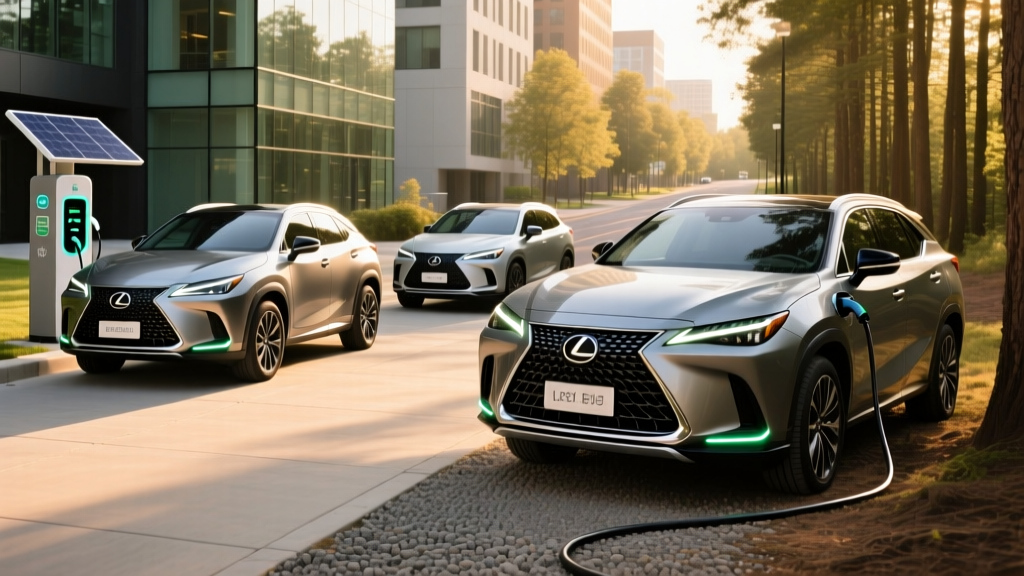
If you're asking "does Lexus make a hybrid SUV," the answer is an emphatic yes. In fact, Lexus offers more hybrid SUVs than almost any other luxury brand. For the 2026 model year, the lineup includes five conventional hybrids (HEVs) and two plug-in hybrids (PHEVs), spanning from the compact UX to the full-size, three-row TX. Every Lexus hybrid SUV pairs a gasoline engine with one or more electric motors and a lithium-ion battery pack, but the driving experience, fuel economy, and ownership economics differ sharply between HEV and PHEV models.
This guide breaks down every 2026 Lexus hybrid SUV with exact EPA MPG figures, electric-only range, powertrain specs, pricing, tax-credit eligibility, and battery-warranty terms — the data you need before visiting a dealer.
HEV vs PHEV: What's the Difference in a Lexus?
Before diving into specific models, it's critical to understand the two hybrid architectures Lexus uses. Confusing them is the most common mistake buyers make.
| Feature | Conventional Hybrid (HEV) | Plug-In Hybrid (PHEV) |
|---|---|---|
| Plug in to charge? | No — regenerative braking & engine charge the battery | Yes — plug into a Level 1 or Level 2 outlet |
| Battery size | 1.0–2.0 kWh (small) | 18.1 kWh (larger) |
| Electric-only driving | Very short, low-speed only (~1 mi) | 33–37 miles at highway speeds |
| Primary benefit | Better MPG without changing habits | Short commutes on electricity alone, gas engine for longer trips |
| Tax credit eligible? | No | Potentially — up to $3,750 under §30D (see rules below) |
Lexus HEVs like the RX 350h and NX 350h never need a plug. You fuel them with gasoline and they self-charge. Lexus PHEVs — the NX 450h+ and RX 450h+ — have a charge port and a substantially larger battery, enabling genuine electric-only commutes before the gas engine takes over.
2026 Lexus Hybrid SUV Lineup: MPG, Range, and Powertrain Specs
Here is every 2026 Lexus hybrid SUV with the numbers that matter. All MPG figures are EPA estimates sourced from fueleconomy.gov. Real-world results follow below.
| Model | Type | Powertrain | Combined HP | EPA MPG (City/Hwy/Combined) | EV Range (PHEV) | Battery | 0–60 mph | Base MSRP |
|---|---|---|---|---|---|---|---|---|
| UX 300h | HEV | 2.0L I4 + 2 motors (AWD) | 196 hp | 43 / 41 / 42 | — | ~1.4 kWh Li-ion | 8.0 sec | $39,750 |
| NX 350h | HEV | 2.5L I4 + 3 motors (AWD) | 244 hp | 41 / 37 / 39 | — | ~1.6 kWh NiMH | 7.2 sec | $44,950 |
| NX 450h+ | PHEV | 2.5L I4 + 3 motors (AWD) | 304 hp | 84 MPGe / 36 MPG gas | 37 mi | 18.1 kWh Li-ion | 6.0 sec | $56,350 |
| TX 500h | HEV | 2.4L turbo I4 + hybrid (AWD) | 371 hp | 27 / 28 / 27 | — | ~1.7 kWh NiMH | 5.9 sec | $64,800 |
| RX 350h | HEV | 2.5L I4 + 3 motors (AWD) | 250 hp | 37 / 34 / 36 | — | ~1.6 kWh NiMH | 7.4 sec | $53,900 |
| RX 450h+ | PHEV | 2.5L I4 + 3 motors (AWD) | 304 hp | 83 MPGe / 35 MPG gas | 37 mi | 18.1 kWh Li-ion | 6.2 sec | $65,150 |
| LX 700h | HEV | 3.4L twin-turbo V6 + hybrid | 457 hp | 19 / 22 / 20 | — | ~1.5 kWh NiMH | 6.5 sec | $104,000 |
How Many MPG Does a Lexus Hybrid SUV Get?
The most fuel-efficient model is the UX 300h at 42 MPG combined, making it one of the thirstiest luxury crossovers on the market. The NX 350h follows at 39 MPG combined, and the RX 350h delivers 36 MPG combined — impressive for a mid-size luxury SUV weighing over 4,400 pounds. The three-row TX 500h achieves 27 MPG combined, which is strong for its size and 371-hp output.
For the PHEVs, the NX 450h+ and RX 450h+ are rated at 84 and 83 MPGe respectively when operating in combined electric-plus-gas mode. Once the battery depletes and the gas engine takes over, expect 36 and 35 MPG — still better than their non-hybrid siblings.
Real-World MPG vs EPA: What Owners Actually See
Toyota's hybrid synergy drive system — which underpins all Lexus hybrids — is one of the few powertrains where real-world city MPG often exceeds the EPA city estimate. In stop-and-go traffic, regenerative braking recaptures energy constantly, and the engine shuts off at stops. Owners of the NX 350h routinely report 42–44 MPG in city driving against the 41 MPG EPA city figure. Highway driving is the opposite: at sustained 75+ mph speeds, expect 2–4 MPG below the EPA highway number due to aerodynamic drag and the engine carrying the full load.
Cold weather (below 30°F) reduces hybrid fuel economy by roughly 10–15% across the board because the engine runs more often to provide cabin heat and the battery operates less efficiently at low temperatures.
PHEV Deep Dive: Electric-Only Range and Charging
If you're considering the NX 450h+ or RX 450h+, the key advantage is the 37 miles of EPA-rated electric-only range. That covers the average American one-way commute of 16 miles with room to spare, meaning many owners drive weeks between fill-ups.
Charging the NX 450h+ and RX 450h+
| Charging Method | Power | 0–100% Time | Notes |
|---|---|---|---|
| Level 1 (120V household outlet) | ~1.4 kW | ~12 hours | Overnight top-up; slow for full depletion recovery |
| Level 2 (240V home or public) | ~3.3 kW (onboard charger limit) | ~5.5 hours | Best daily charging method |
| DC Fast Charge | Not supported | — | No CCS or NACS port |
A critical limitation: neither Lexus PHEV supports DC fast charging. The onboard charger caps at 3.3 kW, meaning even at a public Level 2 station, a full charge takes roughly 5.5 hours. This is typical for PHEVs (the Toyota RAV4 Prime shares this limitation) but worth knowing if you expected quick top-ups on road trips. For daily use, plugging in overnight at home on a standard 240V Level 2 charger is the intended workflow.
The 18.1 kWh lithium-ion battery pack uses a NMC (nickel-manganese-cobalt) chemistry. Lexus recommends charging to 100% on PHEVs (unlike full EVs, where 80% daily is often advised) because the battery management system already maintains a buffer.
Who Should Choose a Lexus Hybrid vs a Full EV or Gas SUV?
Choose a Lexus HEV (NX 350h, RX 350h, UX 300h, TX 500h, LX 700h) if:
- You don't have access to home or workplace charging
- You want better fuel economy without changing any habits
- You regularly take long road trips and don't want to plan around chargers
- You want the lowest-maintenance electrified option
Choose a Lexus PHEV (NX 450h+, RX 450h+) if:
- You can install a Level 2 charger at home (or have reliable workplace charging)
- Your daily round-trip commute is under 37 miles
- You want electric driving for errands but gas flexibility for weekend trips
- You want to reduce gasoline consumption without full EV range anxiety
Choose a full BEV (like the Lexus RZ 450e) if:
- You have reliable home Level 2 charging
- Your daily driving is under 220 miles and you're comfortable with DC fast-charging on road trips
- You want zero tailpipe emissions and minimal powertrain maintenance
- You qualify for the full $7,500 federal EV tax credit
Pricing, Tax Credits, and Total Cost
Does a Lexus Hybrid SUV Qualify for a Federal Tax Credit?
Conventional Lexus HEVs (NX 350h, RX 350h, UX 300h, TX 500h, LX 700h) do not qualify for any federal tax credit. The IRS §30D clean vehicle credit applies only to plug-in electric vehicles and PHEVs that meet battery-sourcing, critical-mineral, MSRP, and buyer-income requirements.
The Lexus PHEVs (NX 450h+ and RX 450h+) may qualify for up to $3,750 under current 2026 IRS rules — not the full $7,500. Here's why:
- MSRP cap: SUVs must be under $80,000 MSRP. Both PHEVs qualify at base, but loaded trims may exceed the cap.
- Buyer income cap: Modified AGI must not exceed $150,000 (single), $225,000 (head of household), or $300,000 (joint).
- Battery sourcing: The $3,750 battery-component requirement and the $3,750 critical-minerals requirement are evaluated separately. As of 2026, Toyota/Lexus PHEV battery sourcing meets the battery-component requirement but not the full critical-minerals threshold, yielding $3,750 — not $7,500.
- Point-of-sale transfer: Eligible buyers can transfer the credit to the dealer at purchase for an immediate price reduction, per IRS guidelines.
Always confirm eligibility with a tax professional before purchase — rules tighten annually, and battery-sourcing compliance can change model year to model year.
Five-Year Fuel Cost Comparison
Based on 15,000 miles/year and $3.50/gallon regular unleaded (the UX 300h and NX 350h use regular; the TX 500h and LX 700h require premium):
| Model | Combined MPG | Annual Fuel Cost | 5-Year Fuel Cost |
|---|---|---|---|
| UX 300h (42 MPG) | 42 | $1,250 | $6,250 |
| NX 350h (39 MPG) | 39 | $1,346 | $6,731 |
| RX 350h (36 MPG) | 36 | $1,458 | $7,292 |
| NX 450h+ (PHEV, 70% electric driving) | — | ~$620 | ~$3,100 |
| Comparable gas-only luxury SUV (24 MPG) | 24 | $2,188 | $10,938 |
The NX 350h saves roughly $4,200 in fuel over five years compared to a gas-only rival. The NX 450h+ PHEV, when charged daily, saves even more — approximately $7,800 over five years, though you must factor in home electricity costs (~$0.14/kWh national average, adding roughly $400/year in charging).
Reliability, Battery Warranty, and Replacement Cost
Lexus hybrid reliability is among the strongest in the industry. The hybrid synergy drive system has been in production since 1997 (Toyota Prius), and the current-generation systems in the NX and RX are fourth- and fifth-generation designs with extensive field data.
Lexus Hybrid Battery Warranty:
- HEV models: 10 years / 150,000 miles (whichever comes first) on the hybrid battery and all hybrid-system components, including the inverter and electric motors.
- PHEV models (NX 450h+, RX 450h+): 10 years / 150,000 miles on the traction battery, with a capacity-retention guarantee that the battery will not drop below 70% of original capacity during the warranty period.
Source: Lexus Hybrid Electric overview
Is the Lexus Hybrid Battery Reliable and What Does Replacement Cost?
Lexus hybrid batteries are among the longest-lasting in the industry. Independent data from fleet operators and consumer surveys indicate that Toyota/Lexus NiMH and Li-ion hybrid batteries routinely exceed 150,000 miles before significant degradation. Failures within the 10-year warranty window are uncommon but covered in full.
If you do need an out-of-warranty replacement:
- HEV battery (NX 350h, RX 350h, etc.): $2,500–$4,000 for a new OEM pack, plus ~$500 labor. Refurbished packs from authorized recyclers run $1,500–$2,500.
- PHEV battery (NX 450h+, RX 450h+): $8,000–$12,000 for the 18.1 kWh pack, given its larger capacity and Li-ion chemistry. This is a significant cost, though it's unlikely to be needed within the typical ownership cycle.
For context, Consumer Reports consistently ranks Lexus among the top three brands for long-term hybrid reliability, and the hybrid system adds minimal maintenance — no transmission fluid changes at the intervals a conventional automatic requires, and regenerative braking extends brake pad life significantly.
Pros and Cons of Lexus Hybrid SUVs
Pros
- Class-leading fuel economy (UX 300h: 42 MPG combined)
- No plug-in required for HEVs — zero lifestyle change
- 10-year/150,000-mile hybrid battery warranty
- Strong resale value; Lexus hybrids depreciate less than gas counterparts
- Smooth, quiet electric assist in city driving
- AWD standard on most trims via rear electric motor
- PHEV models offer genuine 37-mile electric commutes
Cons
- PHEVs do not support DC fast charging (3.3 kW onboard limit)
- HEVs qualify for no federal tax credit
- PHEV tax credit is limited to $3,750, not the full $7,500
- Premium pricing vs non-hybrid rivals ($3,000–$7,000 more than gas trims)
- TX 500h and LX 700h MPG gains are modest (27 and 20 combined) due to size and weight
- Infotainment learning curve in older model years (improved for 2026)
Frequently Asked Questions
Does Lexus make a fully electric SUV?
Yes. The Lexus RZ 450e is the brand's first dedicated battery-electric SUV, with an EPA-estimated 220 miles of range on the standard trim (19-inch wheels) and 196 miles on the Luxury trim with 20-inch wheels. It uses a 72.8 kWh battery and supports DC fast charging at up to 150 kW. However, if range or charging access is a concern, a Lexus PHEV like the NX 450h+ may be a better fit.
Which Lexus hybrid SUV gets the best gas mileage?
The 2026 UX 300h leads the lineup at 43 city / 41 highway / 42 combined MPG. It's also the most affordable Lexus hybrid at $39,750 MSRP. For a larger SUV, the NX 350h achieves 39 MPG combined.
Can I plug in a Lexus NX 350h or RX 350h to charge?
No. The NX 350h, RX 350h, UX 300h, TX 500h, and LX 700h are conventional hybrids (HEVs). They charge their small batteries through regenerative braking and the gasoline engine. Only the NX 450h+ and RX 450h+ have a charge port and require plugging in to access their electric-only range.
How long does a Lexus hybrid battery last?
Based on fleet data and owner reports, Lexus hybrid batteries routinely last 150,000+ miles and 10–15 years. Lexus backs them with a 10-year/150,000-mile warranty. Out-of-warranty replacement for an HEV pack costs $2,500–$4,000; for the larger PHEV pack, $8,000–$12,000.
Is a Lexus hybrid SUV worth it over a gas model?
For most buyers, yes. The fuel savings alone ($4,000–$8,000 over five years) offset the hybrid premium, and you gain smoother acceleration, quieter city driving, and stronger resale value. The hybrid system adds virtually no maintenance burden. The main exception is the LX 700h, where the $10,000+ hybrid premium takes longer to recoup at 20 MPG combined.
Do Lexus PHEVs qualify for the $7,500 federal tax credit?
Not the full amount. Under 2026 IRS §30D rules, the NX 450h+ and RX 450h+ qualify for up to $3,750 because their battery meets the component-sourcing requirement but not the full critical-minerals threshold. You must also meet income caps ($150K single / $300K joint) and the SUV MSRP must remain under $80,000. Confirm current eligibility at IRS.gov before purchasing.