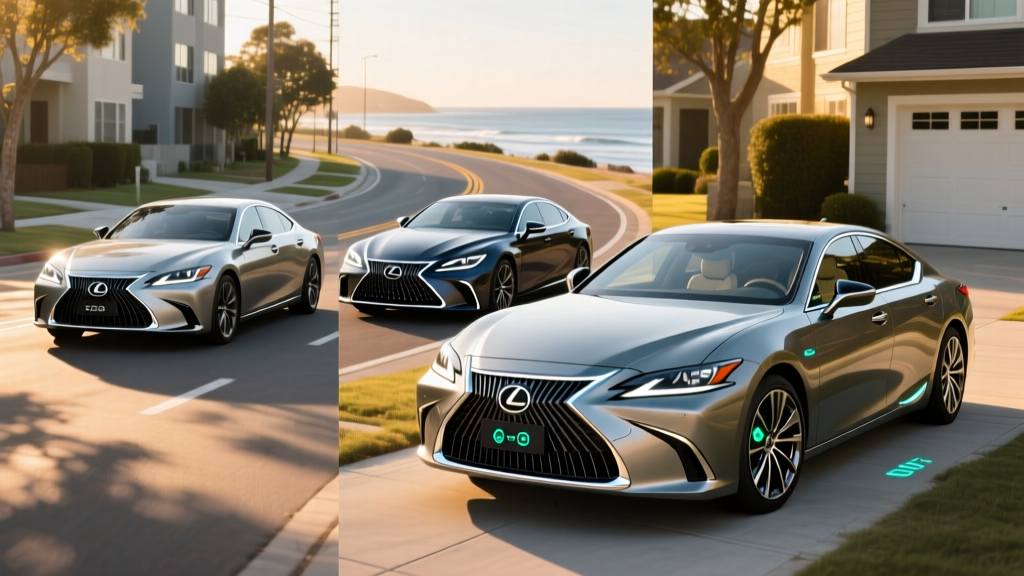
Lexus has built its hybrid sedan lineup around a clear formula: pair proven Toyota Hybrid System powertrains with luxury refinement, and let the driver decide whether to plug in or simply fill up. For 2026, the brand's core hybrid sedans span from the mid-size ES 350h to the flagship LS 500h, with the performance-oriented IS line continuing without a hybrid option. If you're researching Lexus hybrid sedans, this guide breaks down every current model with the exact EPA fuel economy figures, powertrain specs, real-world efficiency expectations, battery warranty coverage, and pricing you need to make a decision.
2026 Lexus Hybrid Sedan Lineup at a Glance
Lexus currently offers two hybrid sedan nameplates in the U.S. market. The ES 350h serves as the volume seller — a mid-size luxury sedan competing with the BMW 5 Series and Mercedes E-Class on comfort and efficiency. The LS 500h anchors the flagship tier with a more complex multi-stage hybrid system and all-wheel drive. Neither is a plug-in hybrid; both are conventional self-charging hybrids (HEVs) that require no plug-in charging.
| Specification | ES 350h | LS 500h |
|---|---|---|
| Powertrain | 2.5L I-4 + 2 electric motors | 3.5L V6 + Multi-Stage Hybrid |
| Combined Horsepower | 215 hp | 354 hp |
| Drivetrain | FWD or AWD | AWD (standard) |
| EPA City MPG | 43 mpg | 25 mpg |
| EPA Highway MPG | 44 mpg | 23 mpg |
| EPA Combined MPG | 44 mpg | 24 mpg |
| 0–60 mph | ~8.1 sec | ~5.2 sec |
| Starting MSRP | $44,590 | $84,590 |
| Hybrid Battery Warranty | 10 yr / 150,000 mi | 10 yr / 150,000 mi |
| Plug-In Required? | No | No |
HEV vs. PHEV: Understanding What Lexus Offers
Conventional Hybrid (HEV): Both the ES 350h and LS 500h are HEVs. They generate all electricity internally through regenerative braking and the gasoline engine. You never plug them in. The battery is small (typically 1.0–1.6 kWh), and electric-only driving is limited to very low speeds for short distances — usually under 1 mile. The primary benefit is dramatically improved fuel economy versus a gas-only equivalent.
Plug-In Hybrid (PHEV): A PHEV carries a larger battery (typically 10–20 kWh), can be plugged into a Level 2 charger, and offers 25–50 miles of electric-only range before the gas engine engages. Lexus currently offers PHEV powertrains on the NX 450h+ and RX 450h+ SUVs, but no Lexus sedan is currently available as a plug-in hybrid in the U.S. market for 2026. If you want electric-only commuting in a sedan, you'll need to look at a full EV like the Tesla Model 3 or a PHEV sedan from another brand.
Fuel Economy: EPA Numbers and Real-World MPG
The ES 350h is the efficiency star of the lineup. Its EPA rating of 44 mpg combined is exceptional for a mid-size luxury sedan — roughly double what a comparable gas-only luxury sedan achieves. According to fueleconomy.gov, the FWD ES 350h earns 43 city / 44 highway / 44 combined.
| Model | City | Highway | Combined | Annual Fuel Cost (est.) |
|---|---|---|---|---|
| ES 350h FWD | 43 mpg | 44 mpg | 44 mpg | ~$1,350 |
| ES 350h AWD | 41 mpg | 42 mpg | 42 mpg | ~$1,400 |
| LS 500h AWD | 25 mpg | 23 mpg | 24 mpg | ~$2,500 |
Real-world MPG expectations: Toyota's hybrid system historically performs as well as or better than its EPA sticker in city driving, where regenerative braking and electric motor assist are maximized. Expect the ES 350h to deliver 44–48 mpg in mixed city driving with moderate acceleration. Highway cruising at 75+ mph will reduce that to approximately 38–41 mpg. In cold weather (below 30°F), plan on a 10–15% efficiency reduction during warm-up cycles as the engine runs more frequently to heat the cabin and bring the catalytic converter to operating temperature.
The LS 500h tells a different story. Its multi-stage hybrid system prioritizes smoothness and performance over maximum efficiency. Real-world driving typically yields 22–26 mpg combined — close to the EPA rating but far below the ES. This is a flagship luxury sedan that happens to have hybrid assist, not an efficiency-first vehicle.
Powertrain Details: What's Under the Hood
ES 350h: The fourth-generation Toyota Hybrid System pairs a 2.5-liter Atkinson-cycle four-cylinder engine with two motor-generators through a planetary gearset (eCVT). Net system output is 215 horsepower. The AWD version adds a rear-mounted electric motor (no mechanical driveshaft) for rear-wheel torque distribution. The engine produces 176 hp and 163 lb-ft of torque on its own, supplemented by a 134-hp front electric motor. The result is seamless, quiet acceleration with no gear-shift interruptions.
LS 500h: Lexus uses its Multi-Stage Hybrid System here, combining a 3.5-liter V6 (295 hp) with a two-motor hybrid transaxle and an additional four-speed automatic gearbox mounted to the output. This creates 10 simulated gear ratios and delivers 354 combined system horsepower. The result is more engaging acceleration and better highway passing response than a typical hybrid CVT, at the cost of some efficiency. Standard all-wheel drive uses a rear electric motor.
Pricing, Trims, and Tax Credit Eligibility
The 2026 ES 350h starts at approximately $44,590 (FWD base), with AWD adding roughly $1,500. Loaded Ultra Luxury and F Sport Handling trims push the price into the low $50,000s. The LS 500h begins around $84,590 and can exceed $95,000 with Executive Package options.
Federal Tax Credit Status: Under current IRS §30D rules, the federal clean vehicle credit of up to $7,500 applies exclusively to plug-in electric vehicles (BEVs and PHEVs) meeting specific battery sourcing, critical mineral, MSRP cap ($55,000 for sedans), and buyer income requirements. Because the ES 350h and LS 500h are conventional hybrids — not plug-in vehicles — neither qualifies for the §30D federal tax credit. No federal incentive currently targets conventional HEVs. Check your state's energy office for any local hybrid rebates, though these are uncommon.
For buyers specifically seeking a tax-credited Lexus, the NX 450h+ and RX 450h+ plug-in hybrid SUVs may qualify for partial credits depending on battery sourcing compliance — but these are SUVs, not sedans. Consult IRS.gov's clean vehicle credit page for the latest sourcing requirements and a tax professional for personal eligibility.
Battery Warranty, Lifespan, and Replacement Costs
Lexus Hybrid Battery Warranty: All 2026 Lexus hybrids carry a hybrid battery warranty of 10 years or 150,000 miles, whichever comes first. This applies in all 50 states and is among the longest in the luxury segment. The warranty covers defects and capacity loss below a functional threshold (typically ~60% of original capacity).
How long do Lexus hybrid batteries actually last? Lexus (and parent company Toyota) have the longest track record in the hybrid industry, dating to the 1997 Prius. Real-world data from fleet operators and owner surveys consistently show Lexus/Toyota hybrid batteries lasting 150,000–200,000+ miles before significant degradation. Many original Prius and ES 300h batteries are still functional past 200,000 miles with gradual capacity loss rather than sudden failure.
Replacement cost if out of warranty: A new OEM hybrid battery for the ES 350h typically costs $3,000–$4,500 installed at a dealership. The LS 500h's more complex multi-stage system is pricier — expect $5,000–$7,000. Third-party remanufactured batteries are available for $1,500–$2,500 (ES) and can extend a vehicle's life cost-effectively. Individual cell module replacement (replacing only the degraded cells) is an emerging option at $800–$1,500 through specialized hybrid repair shops.
Who Should Choose a Lexus Hybrid Sedan?
Choose the ES 350h if:
- You want 40+ mpg without changing your fueling habits (no plug-in needed)
- Your commute is city-heavy, where hybrid efficiency peaks
- You value proven long-term reliability and low maintenance costs
- Your budget is $44,000–$55,000 for a luxury sedan
- You drive 15,000+ miles per year and want to minimize fuel spend
Choose the LS 500h if:
- You want flagship luxury with V6 smoothness and hybrid refinement
- Fuel economy is a secondary concern to ride quality and technology
- You value all-wheel drive as standard
- Budget is not a primary constraint ($85,000+)
Look at a full EV instead if:
- You have reliable home Level 2 charging access
- Your daily driving is under 250 miles and you want zero tailpipe emissions
- You want federal tax credit eligibility (up to $7,500 on qualifying BEVs)
- You want to eliminate oil changes and reduce brake wear through regen
Stick with a gas-only sedan if:
- Your annual mileage is under 8,000 miles (fuel savings won't offset the hybrid premium)
- You primarily drive long highway routes where hybrid advantages diminish
- Upfront purchase price is your overriding priority
Pros and Cons: Lexus Hybrid Sedans
Pros
- ES 350h achieves 44 mpg combined — best in its luxury class
- No plug-in required; fuel it like any gas car
- Industry-leading 10-year/150,000-mile hybrid battery warranty
- Proven Toyota Hybrid System reliability with 25+ years of data
- Quiet, seamless power delivery with no gear-shift shock
- Strong resale value; Lexus hybrids hold value well
- Lower maintenance costs than turbocharged European rivals (no turbo, simpler transmission)
Cons
- No PHEV sedan option — can't commute on electric-only power
- No federal tax credit eligibility for conventional hybrids
- ES 350h's 215 hp and ~8.1-second 0–60 feel modest for the price
- LS 500h's 24 mpg combined is underwhelming for a hybrid
- eCVT drone under hard acceleration (especially ES)
- Infotainment and driver-assist tech trails German competitors
- No DC fast charging capability (not applicable — these are HEVs)
Frequently Asked Questions
How many MPG does the Lexus ES 350h hybrid get?
The 2026 ES 350h FWD earns an EPA-estimated 43 city / 44 highway / 44 combined mpg. The AWD version drops slightly to 41/42/42 mpg. In real-world city driving, many owners report 45–48 mpg thanks to regenerative braking dominance in stop-and-go traffic.
Does Lexus make a plug-in hybrid sedan?
Not as of 2026. Lexus offers PHEV powertrains on the NX 450h+ and RX 450h+ SUVs, but no sedan in the U.S. lineup is a plug-in hybrid. If electric-only commuting is essential, you'll need to consider a PHEV sedan from another manufacturer or a full battery-electric vehicle.
Is the Lexus hybrid battery reliable and what does replacement cost?
Lexus hybrid batteries have an exceptional reliability record, routinely lasting 150,000–200,000+ miles. All 2026 models carry a 10-year/150,000-mile hybrid battery warranty. Out-of-warranty replacement runs $3,000–$4,500 for the ES 350h and $5,000–$7,000 for the LS 500h at a dealership, with remanufactured options available for less.
Does a Lexus hybrid sedan qualify for any tax credit?
No. The federal §30D clean vehicle credit applies only to plug-in electric vehicles (BEVs and PHEVs). Conventional hybrids like the ES 350h and LS 500h are not eligible. Some states offer minor incentives for hybrids, but these are increasingly rare. Check IRS.gov for current federal rules.
Hybrid vs. PHEV vs. full EV — which should I choose?
Choose a conventional hybrid (HEV) like the ES 350h if you want maximum fuel savings with zero lifestyle change — no charger installation, no range planning. Choose a PHEV if you can install a home charger and want 25–50 miles of electric-only commuting with a gas backup for road trips. Choose a full EV if you have home charging, drive under 250 miles daily, want the lowest per-mile fuel cost, and want federal tax credit eligibility. For most buyers without home charging access, the conventional hybrid remains the lowest-friction path to better efficiency.
How does the ES 350h compare to the non-hybrid ES?
The non-hybrid ES 350 (gas-only, 3.5L V6) delivers 26 mpg combined and 302 hp with a 0–60 time around 6.6 seconds. The ES 350h trades 87 horsepower for 18 additional combined mpg. If acceleration is a priority, the gas model wins. If fuel cost and refinement matter more, the hybrid is the stronger choice — and it's only marginally slower in everyday driving because electric torque fills in the low-end response.