The Short Answer: Two Motors, One Goal
A hybrid powertrain pairs a gasoline internal-combustion engine with one or more electric motors and a small battery pack. The electric motor handles low-speed driving, assists during acceleration, and recovers energy during braking — while the gas engine takes over at higher speeds or when the battery depletes. The result is significantly better fuel economy than a conventional gas car, especially in stop-and-go city driving, without any change to how you refuel.
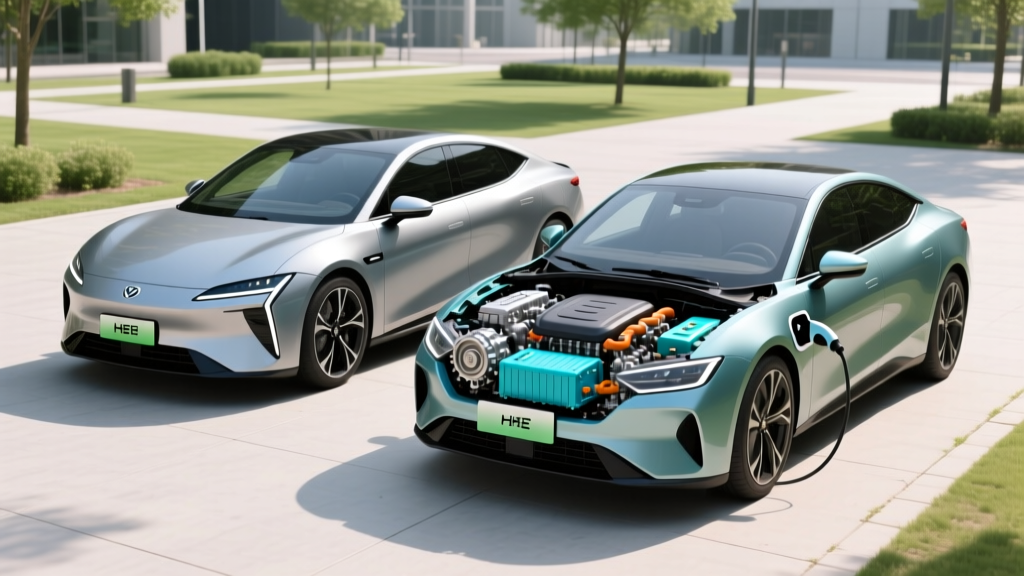
But "hybrid" now covers two very different architectures: the conventional hybrid (HEV), which you never plug in, and the plug-in hybrid (PHEV), which has a larger battery you charge from a wall outlet or public charger for a meaningful electric-only driving range. Understanding how each works — and which fits your life — is the key to making the right purchase.
HEV vs PHEV: The Fundamental Difference
Conventional Hybrid (HEV)
- Battery: 1–2 kWh (small, self-charging)
- Plug in? No — recharges via regenerative braking and the gas engine
- Electric-only driving: Very short distances at low speed (typically under 1 mile)
- Primary benefit: 30–50% better MPG than a comparable gas car
- Examples: Toyota Prius, Honda CR-V Hybrid, Toyota Camry Hybrid
Plug-In Hybrid (PHEV)
- Battery: 10–25+ kWh (much larger, externally chargeable)
- Plug in? Yes — Level 1 (120V) or Level 2 (240V) charging
- Electric-only driving: 20–50+ miles on a full charge at highway speeds
- Primary benefit: Daily EV commuting with a gas engine for road trips
- Examples: Toyota RAV4 Prime, Jeep Wrangler 4xe, Chrysler Pacifica Hybrid
If you cannot charge at home or work, a conventional HEV is almost always the better choice. If you have reliable Level 2 charging access and a commute under 40 miles round-trip, a PHEV can eliminate most of your gasoline consumption while removing any range anxiety on longer trips.
Inside the Powertrain: How Hybrid Components Work Together
Every hybrid — HEV or PHEV — contains the same core components, just at different scales:
- Gasoline engine: Typically a 1.5L–2.5L four-cylinder, tuned for efficiency over peak power. In many Toyota hybrids, it runs on the Atkinson cycle, which sacrifices some low-end torque for better thermal efficiency (often 40%+ vs ~35% for a conventional engine).
- Electric motor(s): One or two permanent-magnet synchronous motors, usually integrated into the transaxle. They provide instant torque from 0 RPM, fill in the torque gap during acceleration, and act as generators during deceleration (regenerative braking).
- Battery pack: Lithium-ion (or in older models, nickel-metal hydride). HEV batteries are 1–2 kWh; PHEV batteries are 10–25+ kWh. The battery management system (BMS) maintains state of charge within safe limits and manages thermal conditions.
- Power-control unit (inverter): Converts DC battery power to AC for the motor and back again during regen. This is the unsung hero of hybrid efficiency.
- Power-split device or clutch system: Toyota's Hybrid Synergy Drive uses a planetary gearset to seamlessly blend engine and motor power. Other manufacturers use clutch-based systems that can disconnect the engine entirely for electric-only driving (common in PHEVs).
Combined output is not simply engine HP + motor HP. Because peak engine and motor output occur at different RPMs, the combined system horsepower is lower than the arithmetic sum. For example, the 2026 Toyota RAV4 Prime pairs a 176-hp 2.5L engine with electric motors for a combined 302 hp — not the 350+ you might expect by adding individual peaks.
Real-World MPG: What EPA Numbers Actually Mean
Hybrids have a unique efficiency characteristic: they often exceed their EPA city rating in real-world stop-and-go traffic, because regenerative braking recovers more energy with more stops. Highway MPG tends to track closer to — or slightly below — the EPA estimate, since regen opportunities are limited at steady speed.
| Vehicle | Type | City MPG | Highway MPG | Combined MPG | Real-World Note |
|---|---|---|---|---|---|
| Toyota Prius (LE AWD) | HEV | 53 | 54 | 54 | Owners report 55–60 city in warm weather |
| Honda CR-V Hybrid (Sport-L) | HEV | 43 | 36 | 40 | City often exceeds 45; highway drops with roof cargo |
| Toyota Camry Hybrid (LE) | HEV | 53 | 50 | 52 | Consistent 50+ in mixed suburban driving |
| Toyota RAV4 Prime | PHEV | 40 (hybrid) | 36 (hybrid) | 38 (hybrid) / 94 MPGe (EV) | 42 mi electric-only; 38 MPG once battery depletes |
| Chrysler Pacifica Hybrid | PHEV | 30 (hybrid) | 30 (hybrid) | 30 (hybrid) / 82 MPGe (EV) | 32 mi electric-only; minivan efficiency leader |
Source: fueleconomy.gov, EPA 2026 model-year data.
PHEV Deep Dive: Electric-Only Range, Charging, and Battery Specs
The PHEV's electric-only range is its headline feature. Here is what the numbers look like for current top sellers, and what they mean practically:
| Vehicle | Battery (kWh) | EV Range (mi) | Total Range (mi) | Level 2 Charge Time | DC Fast Charge |
|---|---|---|---|---|---|
| Toyota RAV4 Prime | 18.1 kWh | 42 | ~600 | ~2.5 hrs (6.6 kW) | No |
| Jeep Wrangler 4xe | 17.3 kWh | 21 | ~370 | ~2 hrs (7.2 kW) | No |
| Chrysler Pacifica Hybrid | 16.0 kWh | 32 | ~520 | ~2 hrs (7.2 kW) | No |
| Toyota Prius Prime | 13.6 kWh | 44 | ~610 | ~4 hrs (3.3 kW) | No |
| BMW X5 xDrive50e | 25.7 kWh | 38 | ~460 | ~3 hrs (7.4 kW) | No |
Critical note on DC fast charging: As of 2026, the vast majority of PHEVs do not support DC fast charging. Their batteries are small enough that Level 2 charging fully replenishes them in 2–4 hours, which covers overnight home charging. The Mitsubishi Outlander PHEV is one of the few exceptions, offering DC fast charging capability (CCS connector, ~38 minutes to 80%).
kWh vs kW reminder: kWh (kilowatt-hours) measures battery energy capacity — how far you can drive on a full charge. kW (kilowatts) measures charging power — how quickly energy flows into the battery. A 18.1 kWh battery charged at 6.6 kW takes roughly 2.7 hours from empty (18.1 ÷ 6.6 = 2.74).
Hybrid Battery Life, Warranty, and Replacement Costs
Hybrid Battery Warranty: The Federal Minimum
By federal mandate, all hybrid and PHEV batteries carry a minimum warranty of 8 years / 100,000 miles (extended to 10 years / 150,000 miles in California Air Resources Board states: CA, CO, CT, ME, MD, MA, NJ, NY, OR, RI, VT, WA). Toyota extends this to 10 years / 150,000 miles nationwide on most 2020+ models.
The warranty typically covers battery capacity falling below 60–70% of original capacity, though exact thresholds vary by manufacturer. Check your owner's manual for the specific retention percentage.
How long do hybrid batteries actually last? Real-world data is encouraging. Toyota's hybrid battery packs — the most widely deployed in the world, with millions on the road — routinely last 150,000–200,000+ miles before significant degradation. The Prius taxi fleet data and Consumer Reports reliability surveys consistently show hybrid battery failure rates well under 5% within the warranty period.
Replacement cost if out of warranty:
- HEV battery (1–2 kWh): $2,000–$4,000 for OEM replacement (Toyota Prius: ~$2,500–$3,500 installed)
- PHEV battery (13–25 kWh): $5,000–$10,000+ (RAV4 Prime: ~$8,000–$10,000; larger luxury PHEV packs can exceed $12,000)
- Refurbished/reconditioned HEV batteries are available for $1,000–$2,000 from third-party suppliers and are a viable option for older vehicles
Reliability verdict: Hybrids are among the most reliable powertrains on the market. The e-CVT transaxles used by Toyota and Honda have no traditional transmission bands, clutches, or torque converters to wear out. According to J.D. Power dependability studies, Toyota and Lexus hybrids consistently rank at or near the top for long-term reliability.
Pricing, Tax Credits, and Total Cost of Ownership
| Vehicle | Base MSRP | Federal Tax Credit (§30D) | Key Eligibility Notes |
|---|---|---|---|
| Toyota Prius (HEV) | $29,445 | $0 (HEV not eligible) | Conventional hybrids do not qualify for §30D |
| Toyota Prius Prime (PHEV) | $34,045 | Up to $3,750 | Credit amount depends on battery sourcing; income caps apply |
| Toyota RAV4 Prime (PHEV) | $44,565 | Up to $3,750 | Subject to critical-mineral and battery-component rules |
| Jeep Wrangler 4xe (PHEV) | $51,795 | Up to $3,750 | Must meet MSRP cap ($80K SUVs); income limits apply |
| Chrysler Pacifica Hybrid (PHEV) | $51,095 | Up to $7,500 | Minivan MSRP cap is $80K; verify current sourcing rules on IRS.gov |
Federal tax credit rules (§30D) for 2026 — key caveats:
- Income caps: Modified AGI must not exceed $150,000 (single), $225,000 (head of household), or $300,000 (married filing jointly).
- MSRP caps: Vans/SUVs/pickups must be under $80,000; sedans under $55,000.
- Battery sourcing: The credit is split into two halves — $3,750 for critical-mineral sourcing and $3,750 for battery-component manufacturing. Sourcing rules tighten annually. Check the latest eligible-vehicle list on fueleconomy.gov before purchasing.
- Point-of-sale transfer: As of 2024+, you can transfer the credit to the dealer for an immediate price reduction at purchase, rather than waiting to claim it on your tax return.
- Conventional HEVs do NOT qualify. Only PHEVs and BEVs with sufficient battery capacity (≥7 kWh for some provisions) are eligible.
State incentives vary widely and change frequently. States like California, Colorado, and New York offer additional rebates or tax credits for PHEVs. Always check your state energy office or AFDC state incentive database for current programs.
Hybrid vs PHEV vs Full EV: Which Powertrain Fits You?
The Decision Framework
Choose a conventional hybrid (HEV) if:
- You cannot charge at home (apartment, street parking, no garage)
- You want maximum MPG without changing any habits
- You drive 10,000–15,000 miles/year and want lowest total cost
- Budget is a priority — HEVs start $3,000–$8,000 less than PHEV equivalents
Choose a plug-in hybrid (PHEV) if:
- You can install a Level 2 charger at home (240V outlet or hardwired)
- Your daily round-trip commute is under the vehicle's EV range (20–44 mi)
- You take road trips 4+ times per year and don't want to plan around chargers
- You want EV-like daily driving but aren't ready to commit to full electric
Choose a full battery EV (BEV) if:
- You have reliable home charging AND access to DC fast charging for road trips
- You want zero tailpipe emissions and the lowest per-mile fuel cost
- You want to maximize federal tax credit ($7,500 on eligible models)
- You're comfortable with 250–350+ miles of range and route planning on long trips
Pros and Cons of Hybrid Ownership
Pros
- 30–50% better fuel economy vs gas equivalent (HEV)
- No range anxiety — gas stations everywhere
- Lower maintenance than gas cars (less brake wear from regen, no alternator/starter)
- Proven long-term reliability (20+ years of Toyota hybrid data)
- PHEV: near-zero gas use for daily commuting under EV range
- Strong resale value, especially Toyota/Lexus hybrids
Cons
- Higher upfront cost vs gas-only equivalent ($1,500–$5,000 premium)
- HEV: no federal tax credit
- PHEV: requires home charging infrastructure for full benefit
- PHEV: heavier than HEV, so hybrid-mode MPG is lower once battery depletes
- Battery replacement cost ($2K–$10K) if it fails out of warranty
- Less cargo space in some models due to battery placement
Frequently Asked Questions
How many MPG does a hybrid get compared to a gas car?
A typical hybrid achieves 40–57 MPG combined, compared to 25–32 MPG for the equivalent gas-only model. The Toyota Prius leads at 54 MPG combined (EPA). City MPG often exceeds the EPA estimate in real-world driving because regenerative braking recovers more energy in stop-and-go traffic. Highway MPG is closer to or slightly below the EPA sticker.
How far can a PHEV go on electric power only?
Current PHEVs offer 21–44 miles of electric-only range on a full charge. The Toyota Prius Prime leads at 44 miles (EPA), the RAV4 Prime delivers 42 miles, and the Chrysler Pacifica Hybrid provides 32 miles. Once the battery depletes, the vehicle seamlessly switches to hybrid mode — you're never stranded. Total combined range (EV + hybrid) typically exceeds 500 miles.
Do I need to plug in a conventional hybrid?
No. Conventional hybrids (HEVs) charge their own battery through regenerative braking and the gas engine. You fuel them exactly like a regular gas car. Only plug-in hybrids (PHEVs) require external charging, and even PHEVs will operate in hybrid mode if you forget to plug them in — you simply lose the electric-only range benefit.
Is a hybrid reliable, and what does battery replacement cost?
Hybrids are among the most reliable vehicles on the road. Toyota hybrid batteries routinely last 150,000–200,000+ miles. Federal law mandates an 8-year/100,000-mile battery warranty (10/150,000 in CARB states). Out-of-warranty replacement costs $2,000–$4,000 for an HEV battery and $5,000–$10,000+ for a PHEV battery. Refurbished HEV batteries are available for $1,000–$2,000.
Does a hybrid qualify for any tax credit?
Conventional hybrids (HEVs) do not qualify for the federal §30D clean vehicle tax credit. Plug-in hybrids (PHEVs) may qualify for up to $7,500, but the actual amount depends on battery critical-mineral sourcing, battery-component manufacturing origin, your income, and the vehicle's MSRP. Rules tighten annually — verify eligibility on IRS.gov and fueleconomy.gov before purchasing. Some states offer additional incentives for both HEVs and PHEVs.
Hybrid vs PHEV vs EV — which should I buy?
Choose a hybrid (HEV) if you can't charge at home and want effortless MPG gains. Choose a PHEV if you can charge at home, commute under 40 miles round-trip, and still take road trips without planning charger stops. Choose a full EV if you have home and road-trip charging access, want the lowest per-mile fuel cost, and are ready to go fully electric. There is no universally "best" option — it depends on your charging access, commute, and driving patterns.