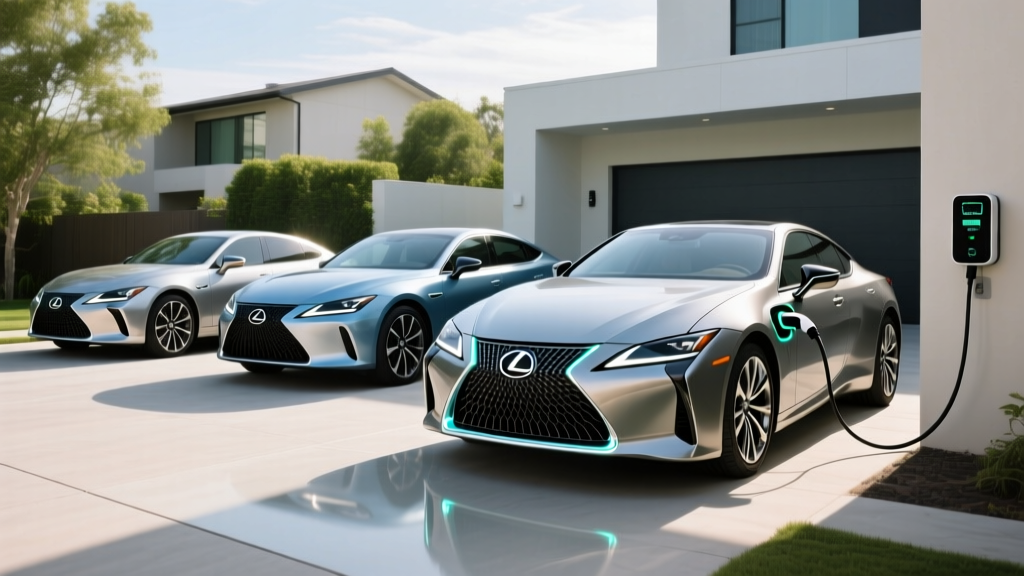
Lexus practically invented the luxury hybrid segment with the RX 400h back in 2005, and two decades later the brand's electrified lineup is one of the broadest in the industry. For 2026, Lexus offers hybrid powertrains across nearly every nameplate — from the subcompact UX 300h to the three-row TX 500h — plus a growing selection of plug-in hybrid (PHEV) models for buyers who want some electric-only driving without full range-anxiety. But with so many Lexus hybrid cars to choose from, and with HEV and PHEV variants sometimes sharing the same badge, picking the right one requires understanding exactly what you're getting under the hood, at the pump, and in the battery pack.
This guide breaks down the full 2026 Lexus hybrid car lineup with exact EPA fuel-economy figures, real-world efficiency expectations, battery specs, warranty coverage, pricing, and tax-credit eligibility — so you can match the right Lexus hybrid to your driving habits and budget.
HEV vs PHEV: What Lexus Hybrid Buyers Need to Know
Before diving into individual models, it's essential to separate Lexus's two hybrid categories, because they serve very different use cases and come with different price tags, battery sizes, and fueling routines.
| Feature | Lexus HEV (Conventional Hybrid) | Lexus PHEV (Plug-In Hybrid) |
|---|---|---|
| Plug-in charging required? | No — charges via engine & regenerative braking | Yes — plug in to access electric-only range |
| Electric-only range | None (motor assists engine at low speeds) | Typically 30–37 miles EPA |
| Battery size | ~1.0–1.7 kWh (small buffer) | ~18.1 kWh usable |
| Home charging | Not applicable | Level 2 (240V) in ~4 hours; no DC fast charge |
| Federal tax credit (§30D) | Not eligible | Up to $7,500 if sourcing & income rules met |
| Best for | Drivers who can't charge at home | Drivers with home charging & short commutes |
| Price premium over gas | ~$1,000–$2,500 | ~$7,000–$10,000 |
The distinction matters practically: a conventional Lexus HEV like the UX 300h never needs a plug and delivers strong city MPG automatically, while a PHEV like the NX 450h+ rewards home-chargers with daily electric-only commuting but reverts to hybrid operation once the battery depletes. Neither is universally better — the right choice depends on your garage outlet and your commute.
2026 Lexus Hybrid Lineup: MPG, Range, and Powertrain Specs
Below is the complete 2026 Lexus hybrid car lineup with EPA-rated fuel economy, powertrain output, battery specifications, and starting MSRP. All figures reflect the latest data available from fueleconomy.gov and Lexus's official specifications.
| Model | Type | Powertrain | Combined HP | EPA MPG (City/Hwy/Comb) | PHEV EV Range | Battery | Base MSRP |
|---|---|---|---|---|---|---|---|
| UX 300h | HEV | 2.0L I4 + 2 motors (AWD) | 196 hp | 43 / 41 / 42 | — | ~1.4 kWh NiMH | $39,890 |
| NX 350h | HEV | 2.5L I4 + 2 motors (AWD) | 240 hp | 41 / 37 / 39 | — | ~1.6 kWh NiMH | $44,315 |
| NX 450h+ | PHEV | 2.5L I4 + 2 motors (AWD) | 304 hp | 36 / 33 / 35 (hybrid) · 84 MPGe | 37 mi | 18.1 kWh Li-ion | $54,765 |
| RX 350h | HEV | 2.5L I4 + 2 motors (AWD) | 250 hp | 37 / 34 / 36 | — | ~1.7 kWh NiMH | $52,400 |
| RX 450h+ | PHEV | 2.5L I4 + 2 motors (AWD) | 304 hp | 35 / 32 / 34 (hybrid) · 83 MPGe | 35 mi | 18.1 kWh Li-ion | $62,950 |
| TX 500h | HEV | 2.4L turbo I4 + hybrid (AWD) | 371 hp | 27 / 28 / 27 | — | ~1.4 kWh NiMH | $62,500 |
| LC 500h | HEV | 3.5L V6 + electric motor (RWD) | 354 hp | 30 / 28 / 29 | — | ~1.1 kWh Li-ion | $101,000 |
Understanding the MPG Numbers
A few patterns emerge from this table. First, smaller Lexus hybrids like the UX 300h achieve the highest MPG because they're lighter and have less frontal area to push through the air. Second, the PHEV models (NX 450h+, RX 450h+) actually show lower MPG in hybrid-only mode than their HEV siblings because they carry an additional ~300 lbs of battery mass — but that's offset by 35–37 miles of electric-only driving that uses zero gasoline.
Third, the performance-oriented TX 500h and LC 500h sacrifice efficiency for output. The TX 500h's 371 hp turbocharged hybrid system is tuned for acceleration and towing (3,500 lb capacity), not hypermiling. Buyers cross-shopping these against the RX 350h should weigh the 121-hp advantage against a 9-MPG combined penalty.
Real-World MPG: What Owners Actually Report
EPA stickers are a starting point, but Lexus hybrids have a well-documented tendency to exceed their city ratings in stop-and-go traffic — the opposite of most gas cars. This is because regenerative braking recaptures energy that would otherwise be lost as heat, and the electric motor handles low-speed propulsion where internal-combustion engines are least efficient.
Real-World MPG Expectations (Lexus HEVs):
- UX 300h: EPA 42 combined. Expect 44–47 MPG in city-heavy commuting; 38–40 MPG on sustained highway trips above 70 mph.
- NX 350h: EPA 39 combined. Expect 40–43 MPG city; 35–37 MPG highway at 75+ mph.
- RX 350h: EPA 36 combined. Expect 37–39 MPG city; 33–35 MPG highway.
- TX 500h: EPA 27 combined. Expect 28–30 MPG city; 26–28 MPG highway. Cold weather drops this to ~25 combined.
For PHEV models, real-world electric-only range varies with temperature and driving style. The NX 450h+'s 37-mile EPA rating assumes moderate temperatures and mixed speeds. In winter (below 35°F), expect that range to drop to roughly 28–32 miles due to cabin-heating energy draw and reduced battery efficiency. In summer with gentle city driving, some owners report 39–42 miles before the engine engages.
Highway driving at 75+ mph also compresses PHEV electric range to around 25–28 miles, since the electric motor works harder at sustained high speeds. Once the battery depletes, both PHEV models seamlessly transition to hybrid mode with no driver intervention required.
PHEV Charging: What's Required and What It Costs
If you're considering the NX 450h+ or RX 450h+, you'll need access to a Level 2 (240V) home charger to make the PHEV premium worthwhile. Here's what the charging picture looks like:
| Charging Level | Power (kW) | Time to Full (18.1 kWh) | Miles of EV Range per Hour |
|---|---|---|---|
| Level 1 (120V standard outlet) | ~1.4 kW | ~13 hours | ~5 mi/hr |
| Level 2 (240V, 32A home charger) | ~6.6 kW (vehicle-limited) | ~4 hours | ~12 mi/hr |
| DC Fast Charging | Not supported | N/A | N/A |
An important limitation: neither Lexus PHEV supports DC fast charging. The onboard charger maxes out at 6.6 kW on Level 2, which is perfectly adequate for overnight replenishment of an 18.1 kWh pack but means you can't top up quickly on a road trip. This is typical for PHEVs — the smaller battery makes DC fast-charging hardware cost-prohibitive relative to the benefit.
Charging cost is minimal. At the US average electricity rate of ~$0.17/kWh, fully replenishing the 18.1 kWh battery costs roughly $3.08 — delivering 35–37 miles of range for about 8–9 cents per mile. Compare that to a 30-MPG gas car at $3.40/gallon, which costs ~11 cents per mile. The PHEV advantage widens further if your utility offers off-peak overnight rates below $0.10/kWh.
For home Level 2 installation, budget $800–$2,500 total depending on panel proximity and local permit requirements. If your home's electrical panel needs a 200A upgrade, add $1,500–$3,000. Consult a licensed electrician for a site-specific quote.
Battery Warranty, Lifespan, and Replacement Cost
Battery longevity is consistently a top concern for hybrid buyers, and Lexus has one of the strongest track records in the industry. Toyota/Lexus hybrid batteries have demonstrated exceptional durability in fleet data, with many original packs still operational past 150,000 and even 200,000 miles.
Lexus Hybrid Battery Warranty (2026 Models):
- HEV models (UX 300h, NX 350h, RX 350h, TX 500h, LC 500h): 10 years / 150,000 miles (whichever comes first), covering capacity below 60% of original.
- PHEV models (NX 450h+, RX 450h+): 10 years / 150,000 miles for the 18.1 kWh lithium-ion traction battery, with the same 60% capacity threshold.
- Hybrid system components (inverter, control module, electric motors): 8 years / 100,000 miles.
If replacement is needed out of warranty, here's what to budget:
- HEV NiMH battery replacement: $2,000–$3,500 at a Lexus dealer; refurbished packs from third-party suppliers run $1,200–$2,000.
- PHEV Li-ion battery replacement: $5,000–$8,000 at dealer pricing. No widespread refurbished market yet due to the newer platform.
For context, a conventional automatic transmission replacement on a gas car typically runs $3,500–$5,000 — and Lexus hybrid powertrains eliminate the traditional transmission entirely, using an e-CVT planetary gearset with no clutches or bands to wear out. This is a meaningful long-term reliability advantage that hybrid buyers often overlook.
Pricing, Trims, and Federal Tax Credit Eligibility
Here's where HEV and PHEV Lexus models diverge sharply on cost. Conventional hybrids carry a modest premium over their gas-only equivalents — typically $1,000 to $2,500 — and that premium is usually recouped through fuel savings within 3–5 years of average driving. PHEVs carry a much larger premium but offer the possibility of a federal tax credit that narrows the gap.
Federal §30D Tax Credit for Lexus PHEVs (2026 rules):
- Credit amount: Up to $7,500, split between a critical-minerals component ($3,750) and a battery-component component ($3,750).
- MSRP cap: SUVs/vans must be under $80,000; sedans under $55,000. The NX 450h+ and RX 450h+ qualify as SUVs and base trims fall under the $80K cap — but loaded trims can exceed it.
- Buyer income cap: Modified adjusted gross income must not exceed $150,000 (single), $225,000 (head of household), or $300,000 (joint).
- Battery sourcing: Critical minerals and battery components must meet phased-in domestic/Fta-partner sourcing thresholds. For 2026, these requirements are stringent and may reduce or eliminate the credit depending on the specific vehicle's supply chain. Always verify current eligibility on IRS.gov before purchasing.
- Point-of-sale transfer: Buyers can transfer the credit to the dealer at purchase, reducing the sale price directly rather than waiting for a tax refund.
Conventional Lexus HEVs (UX 300h, NX 350h, RX 350h, TX 500h, LC 500h) do not qualify for the §30D new-vehicle credit. They may be eligible for certain state or utility incentives — check your state energy office or local utility for rebates that sometimes cover hybrid purchases.
Who Should Buy a Lexus Hybrid vs a PHEV vs a Full EV?
The decision between HEV, PHEV, and a battery-electric vehicle (BEV) comes down to three factors: charging access, daily mileage, and willingness to adapt fueling habits.
Choose a Lexus HEV (UX 300h, NX 350h, RX 350h) if:
- You cannot charge at home (apartment, street parking, no garage outlet).
- You want maximum simplicity — no plugs, no apps, no charging networks.
- Your priority is lowering fuel costs without changing any habits.
- You regularly drive in extreme cold where EV range loss is a concern.
Choose a Lexus PHEV (NX 450h+, RX 450h+) if:
- You have reliable home Level 2 charging and a commute under 35 miles.
- You want daily electric-only driving but also need road-trip flexibility without charging-network dependence.
- You qualify for the §30D credit, which can offset the PHEV price premium.
- You're not ready to commit to a full BEV but want to reduce gasoline consumption significantly.
Choose a full BEV (e.g., Tesla Model Y, Hyundai Ioniq 5, BMW iX) if:
- You have home charging and your daily driving rarely exceeds 200 miles.
- You want the lowest per-mile fuel cost and minimal drivetrain maintenance.
- You're comfortable planning DC fast-charging stops on road trips.
- You want access to the full $7,500 federal credit on a broader selection of qualifying models.
For the majority of Lexus buyers — those without dedicated home charging or those who take frequent long road trips — a conventional Lexus HEV offers the best balance of efficiency, simplicity, and value. The UX 300h at 42 MPG combined and under $40,000 starting is arguably the most accessible luxury hybrid on the market. The RX 350h remains the midsize luxury hybrid benchmark for families who want three-across rear seating, a smooth ride, and fuel bills roughly 35% lower than the gas-only RX 350.
For buyers with a garage and a short commute, the NX 450h+ is a compelling bridge technology: you'll drive most weekdays without burning a drop of gas, yet the 2.5L hybrid system ensures you're never stranded searching for a charger on holiday road trips. Just verify your §30D eligibility before signing — the credit rules are complex and model-specific.
Lexus HEV Pros
- Best-in-class city MPG with zero behavior change
- Proven 20-year hybrid reliability track record
- Strong resale value; low depreciation
- No charging infrastructure needed
- 10-year/150,000-mile battery warranty
Lexus HEV Cons
- No electric-only driving capability
- No federal tax credit eligibility
- Highway MPG advantage over gas is smaller
- e-CVT can drone under hard acceleration
Lexus PHEV Pros
- 35–37 miles of silent, zero-gas commuting
- Potential $7,500 federal credit (subject to rules)
- 304 hp with smooth electric torque delivery
- No range anxiety — hybrid backup always available
- Preconditioning via plug keeps cabin comfortable
Lexus PHEV Cons
- Requires home charging to justify premium
- No DC fast-charging capability
- Heavy; less efficient than HEV once battery depletes
- $7,000–$10,000 premium over HEV equivalents
- Tax credit eligibility is complex and uncertain
Frequently Asked Questions
How many MPG does a Lexus hybrid get in real-world driving?
Lexus HEVs typically exceed their EPA city ratings in stop-and-go traffic thanks to regenerative braking. The UX 300h (EPA 42 combined) regularly achieves 44–47 MPG in urban commuting. Highway MPG tends to fall 2–4 MPG below the EPA sticker at sustained speeds above 70 mph. PHEV models achieve 35–37 MPG combined in hybrid mode after the battery depletes, plus 35–37 miles of zero-gas electric driving when charged.
How far can a Lexus PHEV go on electric only?
The 2026 NX 450h+ is EPA-rated for 37 miles of electric-only range; the RX 450h+ is rated for 35 miles. Real-world results range from about 28 miles in cold winter highway driving to 42 miles in mild-weather city conditions. Once depleted, both seamlessly switch to hybrid mode with no driver action needed.
Is a Lexus hybrid reliable, and what does battery replacement cost?
Lexus (parent company Toyota) has the deepest hybrid reliability data in the industry, with many original hybrid batteries lasting 150,000–200,000+ miles. The battery is warranted for 10 years / 150,000 miles. Out-of-warranty HEV battery replacement costs $2,000–$3,500; PHEV replacement runs $5,000–$8,000. The e-CVT transmission has no wearable clutches or bands, reducing long-term maintenance versus conventional automatics.
Does a Lexus hybrid qualify for a federal tax credit?
Conventional Lexus HEVs (UX 300h, NX 350h, RX 350h, TX 500h) do not qualify for the federal §30D new clean vehicle credit. PHEV models (NX 450h+, RX 450h+) may qualify for up to $7,500, but eligibility depends on the buyer's income, the vehicle's MSRP, and battery-sourcing requirements that change annually. Always check the current rules on IRS.gov and confirm with your tax professional before purchasing.
Do I need to plug in a Lexus hybrid to charge it?
No — conventional Lexus HEVs charge their small battery entirely through the gasoline engine and regenerative braking. You never plug them in. Only the PHEV models (NX 450h+, RX 450h+) benefit from plugging in, and they still operate perfectly as regular hybrids if you skip charging.
Hybrid vs PHEV vs full EV — which Lexus is right for me?
If you lack home charging, choose a Lexus HEV for effortless efficiency. If you have home charging and a sub-35-mile commute, a Lexus PHEV lets you drive on electricity daily while keeping gas-engine flexibility for road trips. If you have home charging, rarely drive over 200 miles daily, and want the lowest operating cost, consider a full BEV from another manufacturer (or wait for Lexus's upcoming battery-electric models). The right answer depends entirely on your charging access and driving patterns.