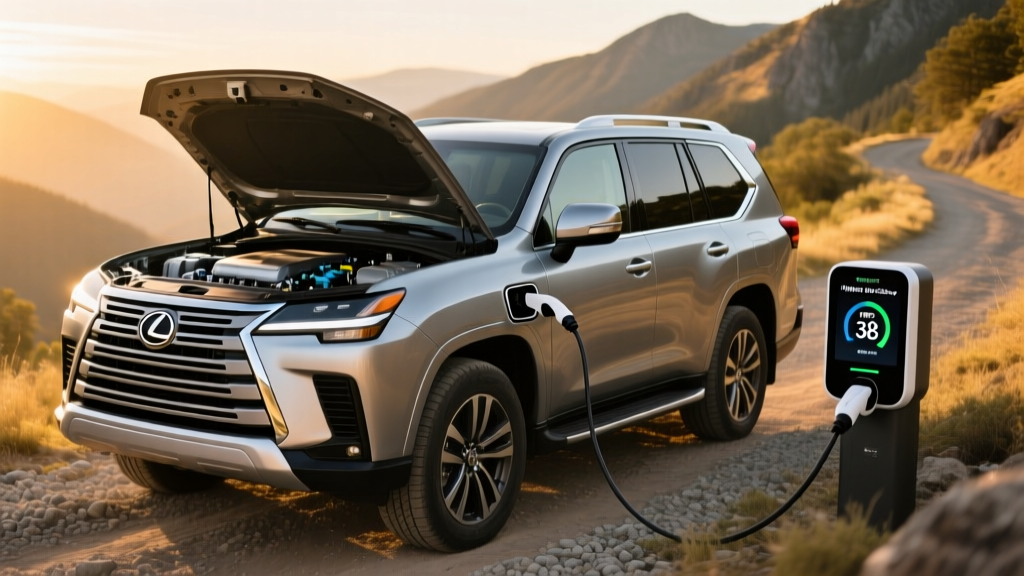
The full-size luxury SUV segment is overdue for an efficiency reckoning, and the Lexus GX hybrid aims to deliver it without sacrificing the body-on-frame capability that defines the nameplate. With the redesigned GX 550 (twin-turbo V6) already on sale for the 2024–2026 model years, Lexus has signaled that a hybrid variant will join the lineup — filling a gap between the gas-only GX 550 and the full-electric options emerging from competitors like BMW and Mercedes-Benz.
This guide breaks down everything confirmed and reasonably projected about the GX hybrid powertrain, fuel economy, battery warranty, and ownership economics — so you can decide whether to wait for the hybrid or buy the GX 550 now.
HEV vs PHEV: What Kind of Hybrid Will the GX Be?
Lexus has historically favored conventional hybrids (HEVs) for its body-on-frame SUVs. The LX 600, for example, has been offered in hybrid form in select markets as the LX 500h. The most likely path for the GX hybrid is a conventional HEV — meaning it charges its battery through regenerative braking and the engine, with no plug required.
Conventional Hybrid (HEV) vs Plug-In Hybrid (PHEV)
| Feature | HEV (Likely GX Hybrid) | PHEV (e.g., RAV4 Prime) |
|---|---|---|
| Plugs in to charge? | No | Yes (Level 1/2) |
| Electric-only range | ~1 mile at low speed | 20–42 miles typical |
| Battery size | 1–2 kWh | 13–22 kWh |
| Federal tax credit (§30D) | Not eligible | Up to $7,500 (if eligible) |
| DC fast charging | No | Rarely; most are Level 2 only |
| Best for | Drivers who can't plug in at home | Drivers with home charging + short commutes |
If Lexus eventually introduces a GX PHEV variant (similar to the TX 550h+), we'll update this guide. For now, all evidence points to a conventional HEV.
Projected GX Hybrid Powertrain & Horsepower
The current GX 550 uses a 3.4-liter twin-turbo V6 producing 349 horsepower and 479 lb-ft of torque, paired with a 10-speed automatic. The hybrid variant is widely expected to use Lexus's proven hybrid powertrain architecture — likely a version of the 3.5-liter V6 hybrid system found in other Toyota/Lexus products, paired with an electric motor integrated into the transmission.
| Spec | Projected Value |
|---|---|
| Engine | 3.5L V6 + electric motor (HEV) |
| Combined horsepower | ~370–400 hp (est.) |
| Transmission | Hybrid-optimized automatic |
| Drivetrain | Full-time 4WD |
| Battery capacity | ~1.5–2.0 kWh (NiMH or Li-ion, HEV) |
| Towing capacity | ~8,000 lbs (est.) |
| Seating | 6 or 7 passengers |
| Base MSRP (est.) | $68,000–$72,000 |
Note: Specs above are projected based on Lexus's hybrid platform history and industry reporting. Final figures will be confirmed at the official reveal. The GX 550 currently starts at $64,250 (2026 MSRP per Lexus).
How Many MPG Will the GX Hybrid Get?
The gas-only GX 550 is EPA-rated at approximately 15 city / 21 highway / 17 combined MPG — typical for a 5,000+ lb body-on-frame SUV with a twin-turbo V6. The hybrid variant should deliver a meaningful improvement, particularly in city driving where electric-motor assist and regenerative braking provide the biggest gains.
| Metric | GX 550 (EPA) | GX Hybrid (Projected) |
|---|---|---|
| City MPG | 15 | 20–22 |
| Highway MPG | 21 | 24–26 |
| Combined MPG | 17 | 22–24 |
Real-World MPG: What to Actually Expect
Hybrids tend to exceed their EPA city estimates in stop-and-go traffic because regenerative braking recaptures energy that a gas-only vehicle wastes as heat. Conversely, highway MPG may dip slightly below the sticker at sustained 75–80 mph speeds, especially with the GX's boxy aerodynamics and all-terrain tires.
Based on real-world patterns from the Lexus LX hybrid and Toyota Sequoia hybrid (which achieves ~22 combined in mixed driving), expect the GX hybrid to deliver ~21–23 MPG combined in real-world mixed use — a roughly 30–35% improvement over the GX 550.
Battery Warranty, Lifespan & Replacement Cost
Hybrid battery longevity is the single most common concern among first-time hybrid buyers. Lexus addresses this with one of the strongest warranties in the industry.
Lexus Hybrid Battery Warranty
- Coverage: 10 years / 150,000 miles (whichever comes first) for the hybrid battery and all hybrid-system components
- What's covered: Hybrid battery pack, inverter, electric motor, control modules
- Capacity threshold: Lexus warranty covers defects and failures, not gradual capacity loss (which is minimal on HEVs since the battery cycles within a narrow state-of-charge window)
Source: Lexus Warranty Information
For context, the GX hybrid's battery is small (~1.5–2.0 kWh) and operates within a tightly managed charge window — typically between 40% and 80% state of charge. This shallow cycling dramatically reduces degradation compared to full EVs or PHEVs that regularly charge to 100%. Toyota/Lexus hybrid batteries routinely last 150,000–200,000+ miles before needing replacement.
Replacement cost if out of warranty: Based on current Lexus hybrid battery pricing, a replacement pack runs approximately $3,000–$5,000 including labor. This is far less than a full EV battery replacement (which can exceed $15,000) because the HEV battery is much smaller.
Does the GX Hybrid Qualify for a Federal Tax Credit?
This is where the HEV vs PHEV distinction matters most for your wallet.
Tax Credit Eligibility: GX Hybrid (HEV)
The conventional GX hybrid will NOT qualify for the federal §30D clean vehicle tax credit. Under current IRS rules, only plug-in electric vehicles (BEVs and PHEVs with ≥7 kWh battery capacity) are eligible for the up-to-$7,500 credit.
Conventional hybrids that don't plug in — including the projected GX hybrid — are excluded entirely.
What about a future GX PHEV? If Lexus introduces a plug-in variant with a battery ≥7 kWh, it could qualify — but only if it meets all of the following §30D requirements (as of 2026):
- MSRP cap: SUVs must have an MSRP ≤ $80,000
- Buyer income cap: AGI ≤ $300,000 (joint) / $150,000 (single)
- Battery sourcing: Critical minerals and battery components must meet escalating domestic-sourcing thresholds
- Assembly: Final assembly must occur in North America
- Point-of-sale transfer: Eligible buyers can transfer the credit to the dealer for an upfront price reduction
Given the GX's likely $68,000–$75,000 starting price and U.S. assembly (at Toyota's Princeton, Indiana plant), a future GX PHEV could clear the MSRP and assembly hurdles — but battery-sourcing rules remain the wildcard. Always verify current-year eligibility on fueleconomy.gov before purchasing.
Who Should Choose the GX Hybrid vs a Full EV or Gas?
Choose the GX Hybrid If:
- You want 30%+ better fuel economy without changing your fueling habits
- You can't install a home charger (apartment, condo, street parking)
- You tow regularly (8,000+ lbs) and need body-on-frame capability
- You want three rows and genuine off-road chops
- You want Lexus reliability with minimal new-technology risk
Look at a Full EV Instead If:
- You have home Level 2 charging and want $0 tailpipe emissions
- You want the $7,500 federal tax credit (and qualify)
- Your daily driving is under 250 miles and you rarely tow
- You want instant torque and one-pedal driving
- You're considering the Rivian R1S, BMW iX, or Mercedes EQS SUV
Bottom Line
The Lexus GX hybrid occupies a specific niche: maximum fuel savings for drivers who need a truck-based SUV and can't plug in. If you have a garage with a 240V outlet and a commute under 30 miles, a PHEV or full EV will save you more money. But if you need the GX's towing, off-road capability, and three-row seating — and you want to cut your fuel bill from ~$3,200/year (GX 550) to ~$2,300/year (GX hybrid) — the HEV is the pragmatic choice.
Annual Fuel Cost: GX 550 vs GX Hybrid
Let's run the numbers at 15,000 miles/year with premium fuel at $4.10/gallon (national average for premium, early 2026):
| Metric | GX 550 (17 MPG) | GX Hybrid (22 MPG est.) |
|---|---|---|
| Gallons per year | 882 | 682 |
| Annual fuel cost | $3,616 | $2,796 |
| 5-year fuel cost | $18,080 | $13,980 |
| 5-year savings | — | ~$4,100 |
That ~$4,100 in five-year fuel savings partially offsets whatever price premium Lexus charges for the hybrid powertrain (typically $2,000–$4,000 on Lexus models). The hybrid essentially pays for itself within the first five years of ownership — and continues saving money for as long as you keep the vehicle.
Frequently Asked Questions
How many MPG does the Lexus GX hybrid get?
The gas-only GX 550 gets 15 city / 21 highway / 17 combined MPG. The hybrid variant is projected to achieve approximately 20–22 city / 24–26 highway / 22–24 combined — a 30–35% improvement driven primarily by city-driving gains from regenerative braking and electric-motor assist.
Does the GX hybrid need to be plugged in?
No. As a conventional hybrid (HEV), the GX hybrid charges its small battery through regenerative braking and the gasoline engine. You fuel it exactly like a gas-only vehicle — at any gas station. If you want plug-in capability with electric-only driving range, you'd need a PHEV or full EV.
How far can the GX hybrid drive on electric power alone?
Like all conventional hybrids, the GX hybrid can travel roughly 1 mile or less at very low speeds (under 25 mph) on electric power alone — such as creeping through a parking lot. This is not designed for meaningful electric-only commuting; the electric motor exists to assist the engine and improve overall efficiency, not to replace it.
Is the GX hybrid reliable, and what does a battery replacement cost?
Lexus consistently ranks at or near the top of J.D. Power and Consumer Reports reliability surveys. The hybrid system adds complexity but is proven across millions of Toyota/Lexus vehicles. The hybrid battery is warrantied for 10 years / 150,000 miles. Out-of-warranty replacement costs approximately $3,000–$5,000 — far less than a full EV battery, and these replacements are rarely needed before 150,000+ miles.
Does the Lexus GX hybrid qualify for any tax credit?
No. Conventional hybrids (HEVs) that do not plug in are not eligible for the federal §30D clean vehicle tax credit. Only plug-in hybrids (PHEVs) with ≥7 kWh batteries and full battery-electric vehicles (BEVs) can qualify for up to $7,500, subject to MSRP caps, buyer income limits, and battery-sourcing requirements. Some states offer their own hybrid incentives — check your state's energy office or DMV for current programs.
Should I wait for the GX hybrid or buy the GX 550 now?
If you plan to keep the vehicle 7+ years and drive 15,000+ miles annually, the hybrid's fuel savings (~$820/year) justify waiting. If you need the vehicle now, tow frequently at maximum capacity (where the gas engine's full torque curve may be preferable), or drive fewer than 10,000 miles per year, the GX 550's existing powertrain is capable and well-reviewed. The hybrid is a refinement, not a revolution.