Quick Verdict: The Lexus ES Hybrid AWD at a Glance
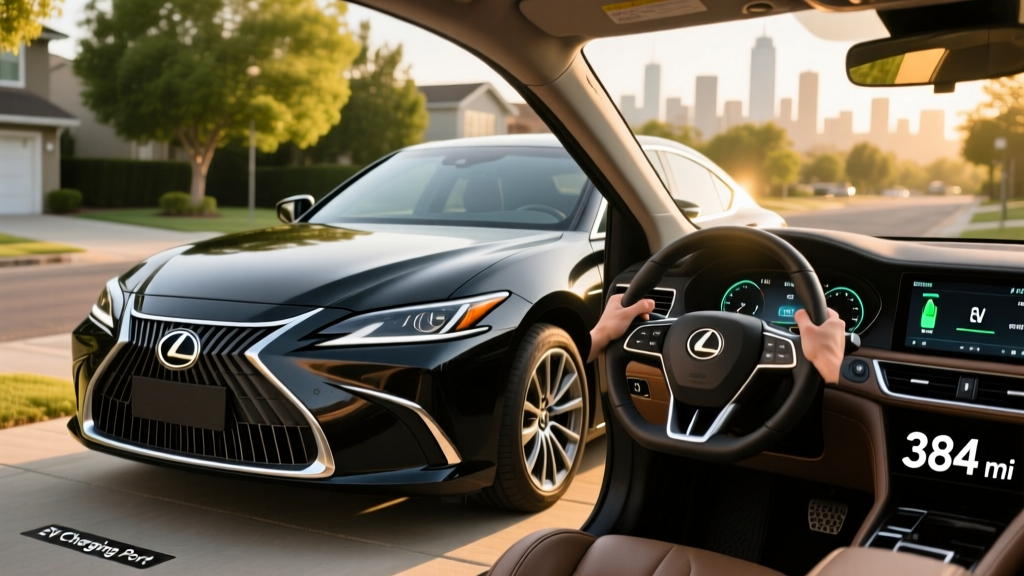
The 2026 Lexus ES 300h AWD occupies a narrow but appealing lane: a midsize luxury sedan that delivers all-weather traction, Lexus-grade reliability, and hybrid fuel economy without requiring a plug. With an EPA-estimated 44 MPG combined and a starting MSRP near $47,000, it undercuts German rivals on operating cost while offering a cabin refinement level that makes every commute feel composed. It is not a performance sedan, and it is not a plug-in hybrid — but for buyers who want premium comfort, low fuel bills, and zero charging hassle, the ES 300h AWD is a strong fit.
| Specification | 2026 Lexus ES 300h AWD |
|---|---|
| Powertrain Type | Conventional Hybrid (HEV) |
| Engine | 2.5L 4-cylinder + electric motor |
| Combined Horsepower | 215 hp |
| Drivetrain | AWD (electronic rear motor) |
| EPA MPG (City / Hwy / Combined) | 44 / 43 / 44 |
| 0–60 mph | ~7.9 seconds |
| Hybrid Battery | ~1.6 kWh NiMH (self-charging) |
| Plug-In Required? | No — regenerative braking charges battery |
| Base MSRP | ~$47,290 |
| Federal Tax Credit (§30D) | Not eligible (HEV, not PHEV/BEV) |
| Hybrid Battery Warranty | 10 years / 150,000 miles |
Fuel Economy: EPA Ratings vs. Real-World MPG
The EPA rates the 2026 Lexus ES 300h AWD at 44 MPG city, 43 MPG highway, and 44 MPG combined, according to fueleconomy.gov. These figures are nearly identical to the front-wheel-drive ES 300h, reflecting the modest efficiency penalty of the electronic AWD system — which uses a small rear-axle motor that only engages when traction is needed.
| Driving Scenario | EPA Estimate | Real-World Expectation |
|---|---|---|
| City (stop-and-go) | 44 MPG | 45–48 MPG (hybrids excel in city) |
| Highway (70 mph cruise) | 43 MPG | 39–42 MPG (aero drag, less regen) |
| Combined (mixed) | 44 MPG | 41–45 MPG |
| Cold Weather (below 32°F) | — | 36–40 MPG (engine runs more for heat) |
The real-world advantage of a conventional hybrid like the ES 300h is that city driving often exceeds the EPA sticker. Regenerative braking recovers energy at every stoplight, and the engine shuts off frequently at low speeds. Highway driving is where hybrids lose their edge — sustained high speeds mean the gasoline engine runs continuously and aerodynamic drag dominates. Expect roughly 39–42 MPG on a 70-mph interstate cruise, which is still excellent for a luxury sedan with AWD.
In cold weather, fuel economy drops noticeably. The engine must run more often to provide cabin heat (there is no heat pump as in a BEV), and the battery is less efficient at low temperatures. Plan for mid-to-upper 30s MPG in deep winter conditions.
Powertrain: How the AWD Hybrid System Works
The ES 300h AWD pairs a 2.5-liter inline-four gasoline engine with Toyota's fourth-generation hybrid system. The front axle is driven by a primary electric motor integrated into the transaxle, while a separate, smaller electric motor on the rear axle provides AWD capability. Combined system output is 215 horsepower.
The rear motor is not a full-time AWD system like a mechanical center differential. Instead, it engages automatically during acceleration from a stop, in slippery conditions, or when the vehicle detects front-wheel slip. During steady-state cruising on dry pavement, the car operates primarily as a front-wheel-drive vehicle, which preserves fuel economy. This electronic AWD approach adds roughly 100 pounds compared to the FWD ES 300h and costs about 1 MPG on the EPA combined cycle.
Acceleration is adequate but not thrilling: 0–60 mph takes approximately 7.9 seconds. The continuously variable transmission (eCVT) keeps the engine in its efficient range, which means smooth, linear power delivery but none of the stepped-gear feel that some drivers prefer. For a luxury sedan focused on comfort, this trade-off is appropriate.
HEV vs. PHEV: Where the ES 300h Fits
| Feature | Lexus ES 300h (HEV) | Typical PHEV Sedan |
|---|---|---|
| Plug-in charging | No — self-charging via regen | Yes — Level 1/2 charging |
| Electric-only range | ~1 mile at very low speed | 25–40 miles |
| Battery size | ~1.6 kWh (NiMH) | 12–20 kWh (lithium-ion) |
| Federal tax credit | Not eligible | Up to $7,500 (§30D, if eligible) |
| Complexity | Lower — no charger, no plug | Higher — charging equipment needed |
| Best for | No home charging access, simplicity | Home charging, short daily commutes |
The ES 300h is a conventional hybrid (HEV), not a plug-in hybrid (PHEV). It cannot be plugged in, has no meaningful electric-only driving range, and does not qualify for the federal §30D plug-in vehicle tax credit. If you want a Lexus sedan with plug-in capability, the lineup is currently limited — Lexus has focused PHEV efforts on SUVs like the NX 450h+ and RX 500h+. The ES remains HEV-only for 2026.
Pricing, Trims, and Tax Credit Eligibility
The 2026 Lexus ES 300h AWD starts at approximately $47,290 (including destination charge) in the base trim. The F Sport Design and Luxury trims push the price into the $52,000–$56,000 range with added features like upgraded leather, Mark Levinson audio, and adaptive suspension tuning.
Federal Tax Credit Status
The Lexus ES 300h does not qualify for the IRS §30D Clean Vehicle Credit (up to $7,500). That credit applies only to plug-in electric vehicles (BEVs and PHEVs) meeting battery-sourcing, MSRP, and buyer income requirements. The ES 300h is a conventional hybrid with no plug-in capability.
Some states and utilities offer rebates for conventional hybrids, but these vary widely by jurisdiction. Check your state energy office or utility provider for local programs. Consult a tax professional for eligibility specifics per IRS guidelines.
Without the federal credit, the ES 300h's value proposition rests on its low fuel cost, strong resale value, and Lexus reliability reputation. At 44 MPG combined and $3.25/gallon gas, annual fuel cost runs roughly $1,050 for 15,000 miles — compared to approximately $1,950 for a comparable 25-MPG AWD gas sedan. That's roughly $900 in annual fuel savings, which partially offsets the hybrid premium over the gas-only ES 250 AWD (which starts around $44,000).
Battery Longevity, Warranty, and Replacement Cost
Hybrid battery longevity is the single most common concern among first-time hybrid buyers. The ES 300h uses a nickel-metal hydride (NiMH) battery pack of approximately 1.6 kWh — a small, well-proven chemistry that Toyota and Lexus have refined over two decades of hybrid production.
Lexus covers the hybrid battery with a 10-year / 150,000-mile warranty (whichever comes first), which exceeds the standard 8-year/100,000-mile hybrid warranty that was common in earlier model years. This warranty covers battery capacity loss below a defined threshold and any manufacturing defects.
Hybrid Battery Replacement: What to Expect
- Warranty coverage: 10 years / 150,000 miles
- Expected lifespan: 150,000–200,000+ miles based on fleet data and Toyota/Lexus track record
- Replacement cost (out of warranty): $3,000–$5,000 for a new OEM pack; refurbished packs available for $1,500–$2,500
- Failure rate: Low — NiMH packs in Toyota/Lexus hybrids rarely fail before 150K miles under normal use
Real-world data from high-mileage Prius and Camry Hybrid fleets suggests that Toyota/Lexus NiMH battery packs routinely reach 150,000–200,000 miles before significant degradation. Unlike the large lithium-ion packs in BEVs, the ES 300h's small battery operates within a narrow state-of-charge window (roughly 40%–80%), which dramatically reduces stress and extends cycle life. The vehicle's computer manages this buffer automatically — you never interact with it directly.
If a replacement is eventually needed outside warranty, the cost is substantially lower than a BEV battery swap. A new OEM NiMH pack runs $3,000–$5,000 installed, and third-party refurbished packs are available for $1,500–$2,500. For context, a BEV battery replacement typically costs $10,000–$20,000+.
Reliability and Safety Ratings
The Lexus ES nameplate consistently ranks among the most reliable vehicles in its class. Lexus as a brand typically places first or second in J.D. Power Vehicle Dependability Studies, and the ES benefits from shared powertrain components with the Toyota Camry Hybrid — one of the most proven hybrid systems on the road.
The 2026 ES comes standard with Lexus Safety System+ 3.0, which includes:
- Pre-Collision System with Pedestrian Detection
- Lane Departure Alert with Steering Assist
- Dynamic Radar Cruise Control (full-speed adaptive cruise)
- Lane Tracing Assist (centering in lane)
- Road Sign Assist
- Proactive Driving Assist (gentle braking when approaching slower vehicles or curves)
These are SAE Level 2 driver-assistance features — the driver must remain fully engaged and hands on the wheel at all times. This is not autonomous driving. The system assists with steering, acceleration, and braking, but does not replace driver attention or judgment.
The ES has earned top marks from the Insurance Institute for Highway Safety (IIHS), including a Top Safety Pick+ designation in recent model years. NHTSA ratings for the 2026 model year should be confirmed at nhtsa.gov when published.
Who Should Choose the ES 300h AWD — and Who Shouldn't
Pros
- 44 MPG combined with AWD — exceptional for a luxury sedan
- No plug-in charging required — works with any lifestyle
- Lexus reliability and strong resale value
- 10-year/150K-mile hybrid battery warranty
- Quiet, refined cabin with excellent ride quality
- Strong city MPG — often exceeds EPA in stop-and-go traffic
Cons
- No federal tax credit (HEV, not PHEV/BEV)
- Modest 215 hp — not a performance sedan
- eCVT lacks the engagement of a geared transmission
- Highway MPG drops below EPA estimate at sustained 70+ mph
- No plug-in electric-only range option available
- Cold-weather fuel economy drops to mid-30s MPG
Decision Framework
Choose the Lexus ES 300h AWD if: You want a luxury sedan with low fuel costs, all-weather capability, and no charging infrastructure hassle. Ideal for apartment dwellers, street parkers, or anyone who can't install a home charger. Best for drivers covering 12,000–20,000 miles/year who value comfort and reliability over sporty handling.
Choose a PHEV instead if: You have home charging access, a commute under 30 miles, and want some electric-only driving to eliminate daily gas use. You may also qualify for the §30D federal tax credit (up to $7,500), which can offset a PHEV's higher sticker price.
Choose a full BEV if: You have reliable home or workplace charging, want zero tailpipe emissions, and are ready to plan around DC fast charging on road trips. A BEV like the Tesla Model 3 Long Range AWD or Hyundai Ioniq 6 offers lower per-mile energy costs and access to the full federal tax credit.
Five-Year Ownership Cost Estimate
| Cost Category | ES 300h AWD (5 years / 75K mi) | Comparable Gas AWD Sedan |
|---|---|---|
| Purchase Price (base) | ~$47,290 | ~$44,000 |
| Fuel (15K mi/yr) | ~$5,250 | ~$9,750 |
| Maintenance | ~$2,500 | ~$3,500 |
| Insurance (est. avg) | ~$7,500 | ~$7,000 |
| Federal Tax Credit | $0 | $0 |
| Estimated 5-Year Total | ~$62,540 | ~$64,250 |
The hybrid premium at purchase is recovered through fuel savings within roughly three to four years. Lexus vehicles also tend to depreciate more slowly than German competitors, which further improves total cost of ownership at resale. Insurance costs may run slightly higher than a non-hybrid equivalent due to the hybrid system's replacement value, but the difference is typically modest.
Frequently Asked Questions
How many MPG does the Lexus ES 300h AWD get?
The EPA rates the 2026 ES 300h AWD at 44 MPG city, 43 MPG highway, and 44 MPG combined. In real-world driving, city MPG often reaches 45–48 thanks to regenerative braking, while sustained highway driving at 70+ mph typically returns 39–42 MPG. Cold weather can reduce combined MPG to the mid-to-upper 30s.
Does the Lexus ES hybrid need to be plugged in?
No. The ES 300h is a conventional hybrid (HEV), not a plug-in hybrid (PHEV). Its small battery charges automatically through regenerative braking and the gasoline engine. You never plug it in — just fill up with gas as you would with any conventional car.
Is there a plug-in hybrid version of the Lexus ES?
As of the 2026 model year, Lexus does not offer a PHEV version of the ES sedan. The ES is available as the ES 250 (gas, AWD), ES 350 (gas V6, FWD), and ES 300h (hybrid, FWD or AWD). If you want a Lexus PHEV, the NX 450h+ and RX 500h+ SUVs are the current options.
Does the Lexus ES 300h qualify for any tax credit?
The ES 300h does not qualify for the federal §30D Clean Vehicle Credit, which is reserved for plug-in electric vehicles (BEVs and PHEVs). Some states or utilities may offer hybrid-specific rebates, but these vary by location. Check your state energy office for details.
How long will the hybrid battery last, and what does replacement cost?
Lexus covers the hybrid battery for 10 years or 150,000 miles. Based on Toyota/Lexus fleet data, NiMH hybrid batteries commonly last 150,000–200,000+ miles. Out-of-warranty replacement costs $3,000–$5,000 for a new OEM pack, or $1,500–$2,500 for a refurbished unit — far less than a BEV battery replacement.
Is the AWD system always active?
No. The ES 300h AWD uses an electronic rear motor that engages only when needed — during hard acceleration, slippery conditions, or detected front-wheel slip. During normal dry-roadway cruising, the car operates as front-wheel drive, which preserves fuel efficiency.
Hybrid vs. PHEV vs. EV — which is right for me?
Choose the ES 300h hybrid if you lack home charging access and want simplicity with strong MPG. Choose a PHEV if you have home charging and a short commute (under 30 miles) to maximize electric-only driving. Choose a full BEV if you have reliable charging, want the lowest per-mile energy cost, and are comfortable planning DC fast-charging stops on road trips.