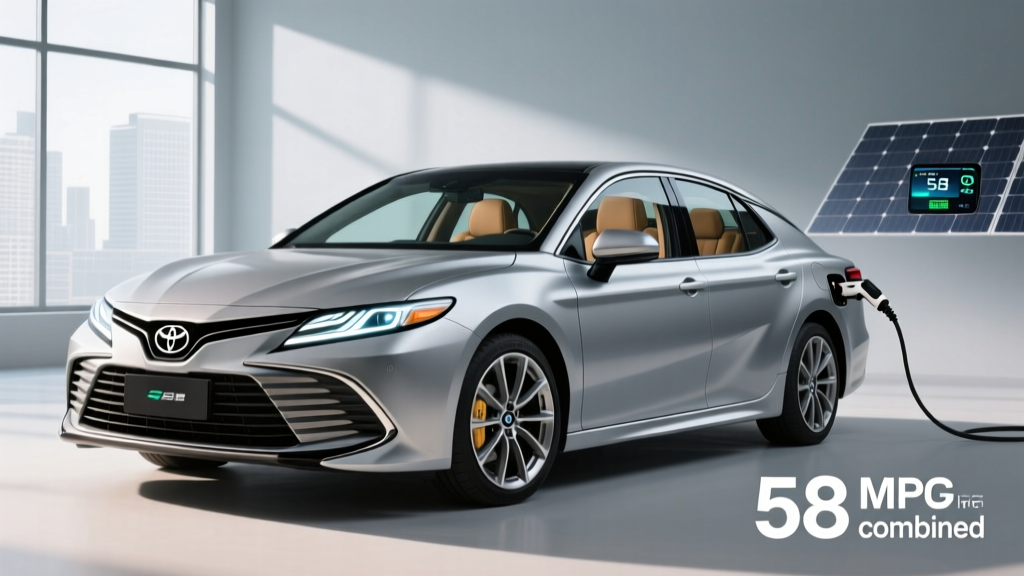
The Toyota Camry has been America's best-selling sedan for decades, and since the 2025 model year, every Camry sold in the U.S. is a hybrid. For 2026, the 2026 Camry Hybrid continues with the fifth-generation Toyota Hybrid System (THS 5), delivering up to 53 MPG combined in front-wheel-drive trims and offering optional electronic on-demand all-wheel drive. This guide covers every number buyers need — EPA MPG breakdowns, real-world fuel economy expectations, powertrain output, pricing by trim, battery warranty details, and how the Camry Hybrid stacks up against plug-in hybrids and full battery-electric vehicles.
2026 Camry Hybrid Powertrain and Performance Specs
Every 2026 Camry uses a 2.5-liter four-cylinder engine paired with Toyota's latest hybrid transaxle. The system combines a gasoline engine with one or two electric motor-generators depending on drivetrain configuration. Here are the core specifications:
| Specification | FWD Trims | AWD Trims |
|---|---|---|
| Engine | 2.5L 4-cyl Dynamic Force | 2.5L 4-cyl Dynamic Force |
| Combined System Horsepower | 225 hp | 232 hp |
| Electric Motors | 2 (MG1 + MG2 front) | 3 (front + rear motor) |
| Transmission | eCVT (power-split) | eCVT (power-split) |
| Drivetrain | Front-wheel drive | Electronic AWD (rear motor) |
| 0–60 mph (est.) | ~7.2 sec | ~6.9 sec |
| Hybrid Battery Type | Lithium-ion | Lithium-ion |
| Plug-In Required? | No (self-charging HEV) | No (self-charging HEV) |
The AWD model adds a rear-mounted electric motor that engages automatically during acceleration and low-traction conditions. Unlike mechanical AWD systems, there's no driveshaft — the rear motor operates independently up to approximately 43 mph for traction, then disengages for efficiency at highway cruise. The 232 hp AWD output makes this the most powerful Camry Hybrid configuration available.
EPA Fuel Economy: City, Highway, and Combined MPG
The 2026 Camry Hybrid's headline number is its fuel economy. The FWD LE trim achieves the highest EPA ratings, while AWD and sportier trims trade a few MPG for additional equipment and rear-axle traction.
| Trim | Drivetrain | City MPG | Highway MPG | Combined MPG |
|---|---|---|---|---|
| LE | FWD | 53 | 50 | 53 |
| SE / XLE | FWD | 48 | 47 | 47 |
| SE / XLE | AWD | 51 | 49 | 50 |
| XSE | AWD | 44 | 43 | 44 |
Source: EPA Fuel Economy — verify exact trim figures at fueleconomy.gov as mid-year adjustments can occur.
Real-World MPG vs. EPA Sticker
EPA Combined: 44–53 MPG depending on trim
Real-World City: Hybrids often exceed EPA city ratings in stop-and-go traffic due to heavy regenerative braking and electric-only low-speed operation. Expect 50–56 MPG city in an LE trim during warm weather.
Real-World Highway: Highway driving is where hybrids lose their advantage. Sustained 70+ mph speeds rely more on the gasoline engine. Expect 42–47 MPG highway in an LE, dropping to 38–42 in the XSE AWD.
Cold-Weather Impact: Below 40°F, hybrid fuel economy drops 10–20% as the engine runs more frequently to generate cabin heat and maintain battery temperature. Short-trip winter city driving may yield 35–40 MPG even in the LE.
The Camry Hybrid's city MPG advantage is significant. Because the electric motor handles low-speed acceleration and regenerative braking recaptures energy at every stop, urban commuters often see their best numbers in traffic — the opposite of a conventional gas car. On the highway, the 2.5L Atkinson-cycle engine does most of the work, and the aerodynamic and weight differences between trims (larger wheels on SE/XSE, AWD hardware) explain the spread from 53 down to 44 combined.
HEV vs. PHEV vs. EV: Which Electrified Sedan Fits You?
The 2026 Camry is a conventional hybrid (HEV). It does not plug in, has no electric-only range to speak of (roughly 1 mile at very low speeds), and operates as a self-charging system that recovers braking energy and optimizes engine operation. This is fundamentally different from a plug-in hybrid (PHEV) or a battery-electric vehicle (BEV).
| Factor | HEV (Camry Hybrid) | PHEV (e.g., Hyundai Sonata PHEV) | BEV (e.g., Tesla Model 3, Hyundai Ioniq 6) |
|---|---|---|---|
| Plugs In? | No | Yes (Level 1/2) | Yes (Level 1/2/DC fast) |
| Electric-Only Range | ~1 mi (low speed) | 25–45 mi typical | 250–400+ mi |
| Total Range | 550–620 mi (tank) | 400–550 mi combined | 250–400 mi (battery) |
| Home Charging Needed? | No | Recommended (120V works, 240V faster) | Essential (240V Level 2) |
| Fuel Cost per Mile | ~$0.08–$0.10 | ~$0.04 electric / $0.09 gas | ~$0.03–$0.06 |
| Federal Tax Credit (§30D) | Not eligible | Up to $7,500 (if eligible) | Up to $7,500 (if eligible) |
| Upfront Price Premium | Low (hybrid is standard) | Moderate ($5K–$8K over HEV) | Higher ($5K–$15K over HEV) |
| Best For | No home charging, long road trips, simplicity | Short commutes + long road trips | Home charging access, daily driving under 300 mi |
Choose the 2026 Camry Hybrid (HEV) if: You don't have access to home or workplace charging. You take frequent road trips and don't want to plan around charging stops. You want maximum simplicity — just fill up at any gas station and go. You want lower upfront cost and proven long-term reliability.
Choose a PHEV if: Your daily commute is under 30–40 miles round-trip and you can charge at home overnight. You want electric-only daily driving but need a gas engine for weekend road trips without range planning.
Choose a full EV (BEV) if: You have reliable Level 2 home charging. Your daily driving is under 250 miles. You want the lowest per-mile fuel cost and minimal maintenance. You're willing to plan DC fast-charging stops on road trips.
2026 Camry Hybrid Pricing by Trim
Toyota has made the hybrid system standard across all Camry trims, so there's no hybrid premium to pay — every Camry you see on the lot is a hybrid. Pricing for the 2026 model year (MSRP, excluding destination):
| Trim | Drivetrain | Starting MSRP (est.) |
|---|---|---|
| LE | FWD | $29,495 |
| SE | FWD | $31,090 |
| SE | AWD | $32,490 |
| XLE | FWD | $34,490 |
| XLE | AWD | $35,890 |
| XSE | AWD | $36,490 |
Destination charge adds approximately $1,095. Prices reflect estimated 2026 MSRP based on Toyota's pricing trajectory — confirm with your local dealer.
Tax Credit Eligibility
The 2026 Camry Hybrid is a conventional HEV and does not qualify for the federal §30D Clean Vehicle Credit. That credit — up to $7,500 for new vehicles — applies only to plug-in electric vehicles (PHEVs and BEVs) that meet battery sourcing, critical minerals, MSRP cap, and buyer income requirements as defined by the IRS.
However, the Camry Hybrid's lower starting price (under $30K for the LE) means many buyers will spend less out of pocket than they would on a PHEV or BEV even after applying a tax credit. The math: a $37,000 PHEV minus $7,500 credit = $29,500 effective cost — roughly the same as a Camry LE, but the PHEV requires home charging infrastructure and has a smaller gas tank for road trips.
Some states offer their own incentives for efficient hybrids, though these are increasingly targeted at plug-in vehicles. Check your state's energy office or Alternative Fuels Data Center for current local programs.
Hybrid Battery Warranty, Lifespan, and Replacement Cost
Hybrid Battery Coverage: 10 years / 150,000 miles (whichever comes first) in all 50 states.
Hybrid System Components: 8 years / 100,000 miles (inverter, control module, battery ECU).
Transferability: The hybrid battery warranty is fully transferable to subsequent owners — a strong resale-value factor.
California / PZEV States: 10 years / 150,000 miles for all hybrid-related emissions components.
How Long Will the Camry Hybrid Battery Last?
Toyota's hybrid battery track record is among the best in the industry. The Prius, which has used a similar nickel-metal hydride and now lithium-ion hybrid battery architecture, routinely sees original batteries lasting 150,000–200,000+ miles before significant capacity loss. The Camry Hybrid uses a relatively small lithium-ion pack (approximately 1.1 kWh total capacity) that cycles shallowly — it never fully charges or fully depletes, which dramatically extends cell life.
The battery management system keeps the pack between roughly 40% and 80% state of charge at all times, avoiding the stress that degrades larger EV batteries. In real-world ownership, hybrid battery failure before 150,000 miles is uncommon for Toyota.
Battery Replacement Cost
If the hybrid battery does need replacement outside of warranty:
- New OEM battery (Toyota dealer): $3,000–$4,500 including parts and labor
- Remanufactured battery: $1,500–$2,500 from third-party suppliers
- Individual cell/module replacement: $500–$1,200 if only specific modules have degraded (a specialist hybrid shop can diagnose and replace individual bad modules rather than the entire pack)
For context, this is far less than a full EV battery replacement ($8,000–$20,000+), because the Camry's hybrid battery is small and serves a different function — assisting the engine rather than solely propelling the vehicle.
Reliability, Safety, and Ownership Costs
Toyota's hybrid systems have been in mass production since 1997 (Prius), and the Camry Hybrid has been sold in the U.S. since 2007. The fifth-generation THS in the 2026 model is the most refined iteration yet. Toyota consistently ranks at or near the top of IIHS safety evaluations and J.D. Power dependability studies.
Maintenance Advantages Over Gas-Only Cars
Because the hybrid system handles low-speed driving and assists during acceleration, the gasoline engine operates less often and under less load. Real ownership benefits include:
- Brake pad life: Regenerative braking handles most deceleration, so friction brakes are used less. Many Camry Hybrid owners report original brake pads at 80,000–100,000 miles.
- Engine wear: The engine shuts off at stops and during low-speed coasting, reducing total engine run hours versus a conventional car.
- No transmission fluid changes: The eCVT power-split device has no traditional gears or clutch packs — just a planetary gearset that requires minimal maintenance.
- No starter motor: The hybrid motor-generators start the engine, eliminating a common failure point.
Estimated 5-Year Cost of Ownership
| Category | Estimated Cost |
|---|---|
| Fuel (53 MPG combined, $3.40/gal avg) | $4,811 |
| Insurance (national avg) | $7,200–$9,000 |
| Maintenance (oil, tires, filters, brakes) | $2,000–$2,800 |
| Depreciation (est.) | $10,500–$13,000 |
| Total (approx.) | $24,500–$29,600 |
For comparison, a similarly priced non-hybrid midsize sedan getting 30 MPG combined would spend approximately $8,500 on fuel over the same period — a $3,700 fuel savings with the Camry Hybrid.
2026 Camry Hybrid Pros and Cons
- Class-leading 53 MPG combined (LE FWD)
- No plug-in charging required — zero lifestyle change from a gas car
- Proven hybrid reliability with 10yr/150K battery warranty
- Strong resale value and transferable warranty
- AWD available on most trims (rare in hybrid sedans)
- Competitive starting price under $30K (LE)
- Spacious cabin with 15.1 cu ft trunk (hybrid battery under rear seat)
- No electric-only driving range (not a PHEV)
- No federal tax credit eligibility
- AWD XSE drops to 44 MPG combined (still good, but less headline-worthy)
- eCVT drone under hard acceleration (common to power-split hybrids)
- Not eligible for HOV/carpool lane stickers in most states (unlike PHEVs/BEVs)
- Cold-weather MPG drops are real — plan for 10–20% loss in winter
Frequently Asked Questions
How many MPG does the 2026 Camry Hybrid get?
The EPA rates the 2026 Camry Hybrid LE (FWD) at 53 city / 50 highway / 53 combined MPG. The SE and XLE FWD trims are rated at 48/47/47 MPG. AWD trims range from 50 combined (SE AWD) to 44 combined (XSE AWD). In real-world city driving, many owners exceed the EPA city number thanks to regenerative braking, while highway-only driving at 75+ mph may fall 5–8 MPG below the sticker.
Does the 2026 Camry Hybrid plug in?
No. The 2026 Camry Hybrid is a conventional self-charging hybrid (HEV). It recovers energy through regenerative braking and optimizes engine operation automatically. You never plug it in — you simply fill the 13.2-gallon gas tank at any station. Total range on a single tank is approximately 550–700 miles depending on trim and driving conditions.
Is the 2026 Camry Hybrid reliable?
Toyota's hybrid systems have a decades-long reliability track record. The hybrid battery is covered by a 10-year/150,000-mile warranty, and real-world data shows Toyota hybrid batteries frequently lasting 150,000–200,000+ miles. The eCVT power-split device has fewer moving parts than a conventional automatic transmission. Toyota's brand-wide dependability rankings consistently place it among the top three in J.D. Power and Consumer Reports surveys.
What does it cost to replace a Camry Hybrid battery?
Outside of warranty, a new OEM hybrid battery replacement at a Toyota dealer runs $3,000–$4,500. Remanufactured units are available for $1,500–$2,500, and specialist shops can sometimes replace individual degraded modules for $500–$1,200. Given the 10-year/150,000-mile warranty coverage and Toyota's track record, most owners will never face this cost.
Does the 2026 Camry Hybrid qualify for any tax credit?
No. The federal §30D Clean Vehicle Credit applies only to plug-in electric vehicles (PHEVs and BEVs). As a conventional hybrid, the Camry Hybrid does not qualify. However, its sub-$30K starting price for the LE trim means the effective out-of-pocket cost is competitive with many PHEVs and BEVs even after their tax credits. Some states or utilities may offer small rebates for high-efficiency vehicles — check your local programs.
Camry Hybrid vs. a full EV — which saves more money?
Over 5 years and 75,000 miles, a full EV with home charging will typically save $2,000–$4,000 more in fuel and maintenance compared to the Camry Hybrid. However, the EV's higher purchase price (often $5,000–$15,000 more), potential home charger installation ($500–$2,000), and higher insurance premiums can offset those savings. The Camry Hybrid wins on total cost for buyers who lack home charging access, drive over 300 miles daily, or take frequent long road trips where DC fast-charging logistics add time and cost.
How far can the Camry Hybrid drive on electric only?
Approximately 1 mile at very low speeds (under 25 mph) on flat ground with a fully charged hybrid battery. This is not meaningful electric-only range — the Camry Hybrid is designed to use its electric motor as an assist to the gasoline engine, not as a primary propulsion source. If electric-only commuting is your goal, you need a PHEV (25–45 miles electric) or a full BEV (250+ miles electric).