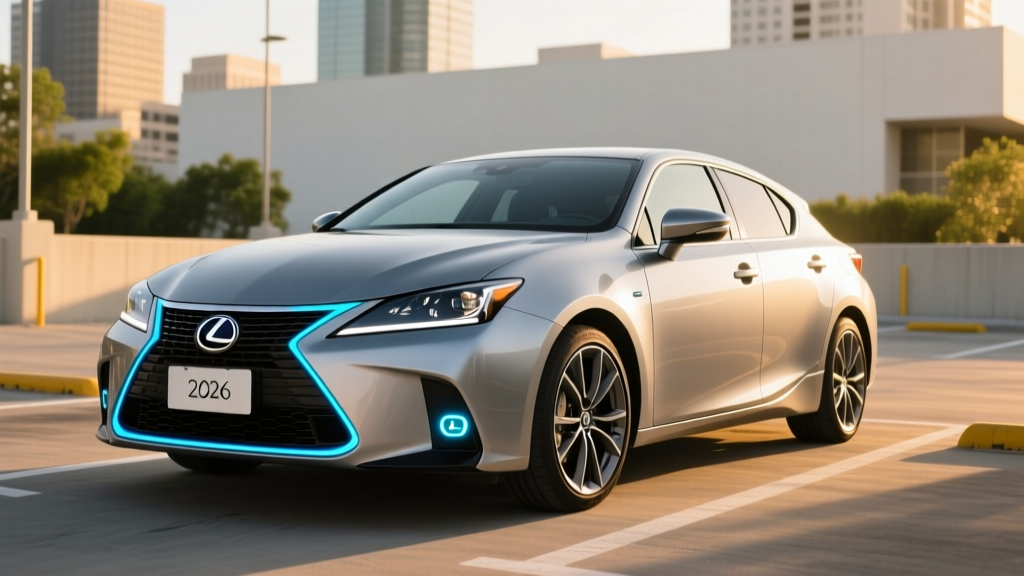
The Lexus CT 200h occupies a unique space in the electrified-vehicle landscape. Originally launched for the 2011 model year and discontinued in the U.S. after 2017, it remains one of the most sought-after used luxury hybrids on the market. With "hybrid ct" searches climbing as buyers seek reliable, fuel-sipping premium compacts, we're breaking down everything you need to know about owning this hybrid in 2026 — from real-world MPG to battery replacement economics, and how it stacks up against modern PHEVs and full EVs.
What Is the Lexus CT 200h? HEV Basics Explained
The Lexus CT 200h is a conventional hybrid electric vehicle (HEV) — not a plug-in hybrid (PHEV) and not a battery electric vehicle (BEV). This distinction matters enormously for ownership expectations:
HEV vs. PHEV — Critical Differences
HEV (Lexus CT 200h): Charges its small battery exclusively through regenerative braking and the gasoline engine. No plug. No electric-only range beyond ~1 mile at low speeds. You fuel it like a normal car and get dramatically better MPG.
PHEV (e.g., Toyota Prius Prime): Has a larger battery (typically 10–18 kWh) that you plug in to charge. Delivers 25–44 miles of electric-only driving before the gas engine kicks in. Requires access to charging to realize full efficiency benefits.
The CT 200h shares its powertrain architecture with the third-generation Toyota Prius — a proven, extensively validated system that has accumulated billions of real-world miles across Toyota and Lexus models globally.
Powertrain Specs: Engine, Motor, and Combined Output
| Specification | Lexus CT 200h (2011–2017) |
|---|---|
| Gasoline Engine | 1.8L 4-cylinder Atkinson-cycle (98 hp) |
| Electric Motor | Permanent-magnet AC synchronous (80 hp / 60 kW) |
| Combined Net Horsepower | 134 hp |
| Hybrid Battery | 1.3 kWh Nickel-Metal Hydride (NiMH) |
| Transmission | eCVT (planetary gearset) |
| 0–60 mph | 9.8 seconds |
| Drivetrain | Front-wheel drive |
Don't let the 134 hp figure alarm you. The electric motor delivers peak torque from 0 RPM, which makes the CT feel peppier in city driving than the number suggests. The eCVT isn't a belt-driven CVT like those in some competitors — it's a Toyota planetary gearset that's virtually bulletproof, with no belts or pulleys to fail.
Fuel Economy: EPA Ratings vs. Real-World MPG
| Cycle | EPA Estimate | Real-World Expectation |
|---|---|---|
| City | 43 MPG | 44–48 MPG |
| Highway | 40 MPG | 37–41 MPG |
| Combined | 42 MPG | 40–46 MPG |
Source: EPA Fuel Economy Guide
Hybrids like the CT 200h routinely exceed their EPA city ratings in real-world stop-and-go driving. That's because regenerative braking recaptures energy that conventional cars waste as heat, and the more braking events you have, the more energy you recover. In contrast, sustained highway speeds above 70 mph reduce the hybrid advantage — the electric motor assists less at high velocity, and aerodynamic drag dominates.
Expect 37–41 MPG on road trips at 75 mph, and 44+ MPG in urban commuting. Cold weather (below 35°F) typically costs 5–8 MPG as the engine runs longer to maintain cabin heat and battery temperature. Owners in mild climates like Southern California routinely report lifetime averages of 44–46 MPG.
Hybrid Battery Longevity, Warranty, and Replacement Cost
Battery Warranty (Original)
Lexus covered the CT 200h hybrid battery for 8 years / 100,000 miles in most states, and 10 years / 150,000 miles in California-emission states (CA, CT, ME, MA, NJ, NY, OR, RI, VT, WA). Since the newest CT 200h is a 2017 model, original factory warranty has expired for most examples as of 2025.
The NiMH battery in the CT 200h has proven exceptionally durable. Unlike early lithium-ion packs that showed more pronounced degradation, Toyota/Lexus NiMH modules routinely last 150,000–200,000 miles before needing attention. Many Prius and CT examples have exceeded 250,000 miles on the original hybrid battery.
When replacement is necessary, here's the cost breakdown:
- New OEM battery (Lexus dealer): $2,500–$3,500 installed
- Refurbished/remanufactured battery: $1,000–$1,800 installed
- Individual module replacement: $300–$600 (if only 1–2 of the 28 modules have failed — a common repair at independent hybrid shops)
The CT 200h uses the same battery pack architecture as the third-generation Prius, which means parts availability is excellent and independent hybrid specialists can service it affordably. This is a significant advantage over low-volume hybrids from other brands.
CT 200h vs. Modern PHEVs and Full EVs: Which Fits You?
With the used CT 200h priced between $12,000–$22,000 in 2026 (depending on year, mileage, and condition), it competes against both newer PHEVs and entry-level EVs. Here's how to decide:
| Factor | Lexus CT 200h (HEV) | Modern PHEV (e.g., Prius Prime) | Full EV (e.g., Chevy Bolt EV) |
|---|---|---|---|
| Upfront Cost (2026) | $12K–$22K (used) | $33K–$40K (new) | $27K–$39K (new/used) |
| Needs a Plug? | No | Recommended | Required |
| Fuel Cost per Mile | ~$0.08 (at $3.40/gal) | ~$0.04 (electric) / $0.08 (gas) | ~$0.04 (home charging) |
| Road Trip Ease | Excellent (gas stations) | Excellent (gas backup) | Good (requires DCFC planning) |
| Federal Tax Credit | None (used HEV) | Up to $3,750 (§30D) | Up to $7,500 (§30D, eligible models) |
| Maintenance Cost | Low (proven platform) | Low (new warranty) | Very low (no oil/filters) |
Tax Credit Eligibility: What the CT 200h Does and Doesn't Qualify For
The Lexus CT 200h does not qualify for the federal §30D new clean vehicle credit — it was never a plug-in vehicle with sufficient battery capacity, and it's no longer sold new. Here's the full picture:
- Federal new-vehicle EV credit (§30D): Not eligible. This credit requires a plug-in vehicle with at least 7 kWh of battery capacity and meeting critical-mineral/battery-sourcing requirements per current IRS rules.
- Federal used-EV credit (§25E): Not eligible. This credit (up to $4,000) applies only to used plug-in vehicles — BEVs and PHEVs — not conventional HEVs.
- State incentives: A handful of states have offered hybrid-specific rebates or HOV-lane access historically, but most have shifted focus to PHEVs and BEVs. Check your state's current energy office or DMV for any residual programs.
The CT 200h's value proposition is purely operational: you pay no premium for electrification, need no charging infrastructure, and save $800–$1,200 annually on fuel versus a comparable 25-MPG gas car (assuming 12,000 miles/year at $3.40/gallon).
Driving Modes, Features, and the Ownership Experience
The CT 200h offers four selectable drive modes that meaningfully change the car's behavior:
- EV Mode: Forces electric-only driving at speeds under 25 mph for roughly 0.5–1 mile (battery permitting). Useful for creeping through parking garages or residential streets at night.
- Eco Mode: Softens throttle response, reduces A/C compressor load, and maximizes regenerative braking. Best for daily commuting.
- Normal Mode: Balanced calibration — the default for most drivers.
- Sport Mode: Sharpens throttle mapping, increases steering weight, and adjusts the instrument cluster to a tachometer display. Genuinely changes the car's character on canyon roads.
The F Sport and later Premium trim levels added sport-tuned suspension, 17-inch wheels, and Lexus' Enform telematics. All trims include the Lexus Safety System in later model years (2015–2017), with pre-collision warning and lane-departure alert.
As a Lexus, the CT benefits from the brand's consistently top-ranked dealer experience, widely available OEM parts, and strong resale value. The CT 200h routinely appears on IIHS recommended lists for its crash-test performance in its era.
Pros
- 42+ MPG combined with zero plug-in requirement
- Lexus build quality and reliability at a used-car price
- NiMH battery proven to 200K+ miles
- Low maintenance: eCVT has no belts or friction wear items
- Strong parts availability (shared with Prius Gen 3)
- Premium interior materials for the price segment
Cons
- 9.8-second 0–60 — genuinely slow for highway merging
- Rear seat is tight for adults over 6 feet
- Cargo space limited (14.3 cu ft) by battery placement
- Infotainment uses Lexus' dated Remote Touch joystick (2011–2013)
- No DC fast charging capability (not applicable for HEV)
- Discontinued after 2017 — newest examples are 9+ years old
Who Should Buy the Lexus CT 200h Hybrid?
Choose the CT 200h if:
- You want a premium-brand car under $20,000 with sub-$1,200/year fuel costs
- You live in an apartment or lack access to home/work charging
- Your commute is stop-and-go city driving where the hybrid system shines
- You value proven reliability and low maintenance over acceleration and tech
- You want Lexus dealer support and strong parts availability
Look at a PHEV or EV instead if:
- You have reliable home charging and want to eliminate most gasoline use
- You want modern ADAS features (adaptive cruise, lane centering, blind-spot monitoring)
- You need current-model-year warranty coverage
- Acceleration and infotainment tech are priorities
- You want to capture the federal §30D tax credit (up to $7,500 for qualifying new EVs/PHEVs)
Frequently Asked Questions
How many MPG does the Lexus CT 200h hybrid get?
The EPA rates the CT 200h at 43 city / 40 highway / 42 combined MPG. In real-world driving, most owners average 40–46 MPG combined, with city-heavy commutes regularly yielding 44–48 MPG. Highway-only trips at 75+ mph may drop to 37–39 MPG.
Does the Lexus CT 200h need to be plugged in?
No. The CT 200h is a conventional hybrid (HEV), not a plug-in hybrid. It charges its 1.3 kWh NiMH battery through regenerative braking and the gasoline engine. You never plug it in — just fill it with regular unleaded gasoline.
Is the CT 200h hybrid battery expensive to replace?
A new OEM replacement battery costs $2,500–$3,500 at a Lexus dealer. However, most CT 200h batteries last 150,000–200,000+ miles. Refurbished packs run $1,000–$1,800, and individual module replacement (a common repair) costs $300–$600. Given the shared Prius architecture, independent hybrid shops handle these repairs routinely.
How does the CT 200h compare to a modern plug-in hybrid?
A 2026 PHEV like the Toyota Prius Prime offers 44 miles of electric-only range, 126 MPGe on electricity, and a combined 50 MPG on gas — but costs $33,000+ new. The CT 200h costs half as much, gets 42 MPG without plugging in, and requires no charging infrastructure. If you can charge at home and want to drive electric daily, the PHEV wins. If you want maximum simplicity and a lower entry price, the CT 200h is hard to beat.
Does the Lexus CT 200h qualify for any tax credit?
No federal tax credit applies to the CT 200h. It does not meet the §30D requirement for plug-in vehicles with at least 7 kWh of battery capacity, and the used-EV credit (§25E) also applies only to plug-in vehicles. Some states historically offered HOV-lane stickers for hybrids, but most of those programs have ended or shifted to zero-emission vehicles. Check your state's current policies for any remaining benefits.
Is the Lexus CT 200h reliable?
Yes — it's among the most reliable vehicles Lexus has produced. The powertrain is shared with the third-generation Prius, which has one of the best-documented longevity records in the industry. The eCVT transmission has no wear-prone belts or clutches. Common maintenance items are standard (brake pads last 60,000–80,000 miles thanks to regenerative braking, coolant changes at 100,000-mile intervals). The main watch-items on high-mileage examples are the 12V auxiliary battery, water pump, and brake actuator assembly.