The Lexus CT Hatchback Hybrid in 2026: Still Worth It?
The Lexus CT 200h was discontinued after the 2017 model year in the United States, but this compact luxury hybrid hatchback remains one of the most searched used hybrids on the market. With a proven Toyota-derived powertrain, exceptional reliability, and real-world fuel economy that often beats its EPA sticker in city driving, the CT 200h occupies a specific niche: affordable, dependable, premium-badged hybrid commuting. If you're researching the Lexus CT hatchback hybrid in 2026, this guide covers every number that matters — from MPG and battery lifespan to replacement costs and how it stacks up against modern alternatives.
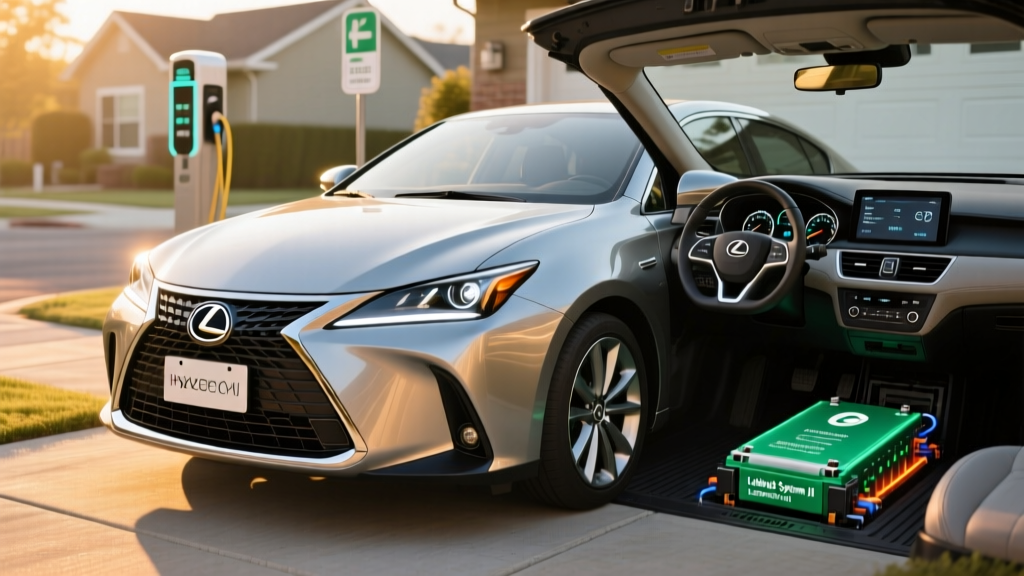
One clarification up front: the Lexus CT 200h is a conventional hybrid (HEV), not a plug-in hybrid (PHEV). It charges its battery exclusively through regenerative braking and the gasoline engine — there is no plug, no electric-only driving range, and no need for home charging infrastructure. This matters because buyers sometimes confuse it with PHEVs like the Toyota Prius Prime or the Lexus NX 450h+.
HEV vs PHEV: Where the CT 200h Fits
| Feature | Conventional Hybrid (HEV) — Lexus CT 200h | Plug-In Hybrid (PHEV) — e.g., Prius Prime | Battery Electric (BEV) — e.g., Tesla Model 3 |
|---|---|---|---|
| Plug-in charging | No — self-charging | Yes — Level 1/2 AC | Yes — Level 1/2/DC fast |
| Electric-only range | None (EV assist only at low speed) | ~35–44 miles (2026 Prius Prime) | 250–360+ miles |
| Battery size | 1.3 kWh (NiMH) | 13.6 kWh (Li-ion) | 60–82 kWh (Li-ion/NMC/LFP) |
| Federal tax credit (§30D) | Not eligible | Up to $7,500 (if eligible) | Up to $7,500 (if eligible) |
| Best for | No home charging access; simple commuting | Short commutes with home charging | Full electric lifestyle; home L2 charger |
The CT 200h's advantage is simplicity. You never need to think about charging — you just fill up at any gas station and drive. Its disadvantage is that it cannot run on electricity alone for meaningful distances, so you'll always be burning gasoline, even on short trips where a PHEV or BEV would use zero fuel.
Fuel Economy: EPA Ratings vs Real-World MPG
| Metric | EPA Rating | Real-World Expectation |
|---|---|---|
| City MPG | 43 MPG | 44–48 MPG (hybrids excel in stop-and-go) |
| Highway MPG | 40 MPG | 36–40 MPG (aerodynamic drag + small engine works harder) |
| Combined MPG | 42 MPG | 40–45 MPG depending on driving mix |
The CT 200h uses Toyota's Hybrid Synergy Drive with a 1.8-liter Atkinson-cycle four-cylinder engine paired with an electric motor and a nickel-metal hydride (NiMH) battery pack. Combined output is 134 horsepower. That's modest — the 0-60 mph time sits around 9.8 seconds — but the payoff is fuel economy that consistently delivers.
According to fueleconomy.gov, the CT 200h's 42 MPG combined rating held steady across its U.S. production run (2011–2017). In real-world driving, city-heavy commuters frequently report exceeding the EPA city figure. Hybrid powertrains recapture energy during braking and low-speed driving, so congested urban routes actually improve efficiency. Highway driving is where the CT 200h falls slightly short of its sticker, since the 1.8L engine must work harder at sustained speeds without electric-motor assist dominance.
With a 11.9-gallon fuel tank, expect a real-world driving range of approximately 475–535 miles per tank depending on your commute profile.
Powertrain and Battery Specifications
| Specification | Detail |
|---|---|
| Engine | 1.8L Atkinson-cycle inline-4 (2ZR-FXE) |
| Engine output | 98 hp / 105 lb-ft torque |
| Electric motor output | 80 hp / 153 lb-ft torque |
| Combined system output | 134 hp |
| Transmission | eCVT (planetary gearset, not a belt CVT) |
| Battery chemistry | Nickel-Metal Hydride (NiMH) |
| Battery capacity | 1.3 kWh |
| Drivetrain | Front-wheel drive |
| 0-60 mph | ~9.8 seconds |
| Curb weight | ~3,130 lbs |
The eCVT in the CT 200h is a key reliability point. Unlike belt-driven continuously variable transmissions found in some competitors, Toyota's planetary-gear eCVT has no belts, no clutches, and no traditional friction components to wear out. It's widely considered one of the most durable transmissions ever put into production.
Battery Life, Warranty, and Replacement Cost
Lexus CT 200h Hybrid Battery Warranty & Lifespan
- Original warranty: 8 years / 100,000 miles (10 years / 150,000 miles in CARB states like California, New York, Massachusetts)
- Real-world battery lifespan: 150,000–200,000+ miles with normal use
- Replacement cost (OEM new): $2,500–$4,000 including labor
- Replacement cost (remanufactured/refurbished): $1,000–$2,000 including labor
- Individual module replacement: $200–$500 (if only 1-2 cells are weak)
The NiMH battery in the CT 200h shares its architecture with the Toyota Prius, which means decades of field data support its longevity. NiMH chemistry degrades more gracefully than early lithium-ion packs — it loses capacity gradually rather than experiencing sudden drop-off. Many CT 200h and Prius owners report reaching 180,000+ miles on the original battery pack with only minor efficiency loss.
If the battery does need replacement, the CT 200h benefits from an enormous aftermarket ecosystem. Remanufactured hybrid batteries from suppliers like Green Bean Battery or Dorman are widely available and typically come with their own limited warranties. A qualified hybrid-shop technician can perform the swap in 1–2 hours.
For a used 2026 buyer, the critical step is checking the battery's state of health (SoH). Ask for a hybrid battery diagnostic report — many Toyota/Lexus dealerships can run this, and independent shops with hybrid scan tools (like Techstream) can measure individual module voltages to flag weak cells before they fail.
Reliability, Safety, and Ownership Costs
The CT 200h inherits Toyota's legendary reliability DNA. The 2ZR-FXE engine and hybrid system are shared with the third-generation Prius (2010–2015), one of the most extensively validated powertrains in automotive history. Common maintenance items are minimal: standard brake jobs last longer than in gas-only cars thanks to regenerative braking reducing pad wear, and the eCVT requires no fluid changes under normal use.
Safety-wise, the CT 200h earned a Top Safety Pick designation from the IIHS in later model years with good ratings in moderate overlap front, side, roof strength, and head restraint tests. It lacks modern ADAS features like automatic emergency braking or lane-keeping assist that became standard on later Lexus models (Lexus Safety System+ was not available on the CT).
Annual maintenance costs are low. Expect to spend roughly $400–$600 per year on routine service (oil changes, tire rotations, cabin air filters) at an independent shop. Insurance premiums are typically modest for a luxury-badged vehicle, averaging $1,200–$1,600 annually depending on your state and driving record.
Pricing and Tax Credit Eligibility
Since the CT 200h is discontinued, all U.S. purchases are on the used market. As of early 2026, typical pricing runs:
- 2011–2013 models (100k–140k miles): $7,000–$10,000
- 2014–2015 models (80k–120k miles): $10,000–$14,000
- 2016–2017 models (50k–90k miles): $14,000–$19,000
Tax credit status: The federal §30D clean vehicle credit applies only to new plug-in vehicles (BEVs and PHEVs) meeting battery-sourcing and MSRP requirements under current IRS rules. The CT 200h, as a conventional HEV, does not qualify for the federal EV tax credit. However, the used clean vehicle credit (up to $4,000 or 30% of sale price, whichever is lower) also requires the vehicle to be a plug-in EV or fuel-cell vehicle — so the CT 200h is excluded there as well.
Some states offer separate hybrid incentives or HOV lane access for hybrids, but these vary by jurisdiction and have largely phased out for conventional HEVs. Check your state's DMV or energy office for current rules.
Who Should Choose the CT 200h vs a PHEV or Full EV?
Choose the Lexus CT 200h if:
- You don't have access to home or workplace charging (apartment, street parking)
- You want a premium badge with Lexus build quality under $15,000
- Your commute is city-heavy and you want 42+ MPG without behavior changes
- You want minimal ownership complexity — no charging cables, no plug, no range planning
- You plan to keep the car 5+ years and value proven long-term reliability
Choose a PHEV (like a used Prius Prime or new RAV4 Prime) if:
- You have home Level 1 or Level 2 charging and a commute under 40 miles
- You want to drive mostly on electricity daily but need gas flexibility for road trips
- You want to reduce fuel consumption to near zero on weekdays
Choose a full EV (like a Model 3, Bolt, or Ioniq 5) if:
- You have reliable home Level 2 charging
- You want zero tailpipe emissions and the lowest per-mile fuel cost
- You want modern ADAS, OTA updates, and current tech features
- You qualify for the §30D federal tax credit (income and sourcing rules apply)
Pros
- Proven, bulletproof Toyota hybrid powertrain with massive service network
- Real-world city MPG often exceeds EPA 43 MPG rating
- Lexus build quality, quiet cabin, premium materials for the price
- Low annual maintenance costs; regen braking extends pad life significantly
- Abundant used inventory and strong aftermarket battery support
- No charging infrastructure required — works for apartment dwellers
Cons
- Slow acceleration (9.8s 0-60) — highway merging requires planning
- No modern ADAS features (no AEB, no lane-keeping, no adaptive cruise)
- Dated infotainment — no Apple CarPlay/Android Auto on most model years
- Tight rear seat and limited cargo space (14.3 cu ft behind rear seats)
- Highway MPG falls below EPA rating at sustained 70+ mph speeds
- No EV tax credit eligibility of any kind
Frequently Asked Questions
How many MPG does the Lexus CT 200h hybrid get?
The EPA rates the CT 200h at 43 city / 40 highway / 42 combined MPG. In real-world city-heavy driving, many owners report 44–48 MPG thanks to regenerative braking efficiency. Highway-only driving at 70+ mph may yield 36–39 MPG. With its 11.9-gallon tank, expect 475–535 miles per fill-up.
Does the Lexus CT 200h need to be plugged in?
No. The CT 200h is a conventional hybrid (HEV), not a plug-in hybrid. It charges its small 1.3 kWh NiMH battery through regenerative braking and the gasoline engine. You never plug it in — you simply refuel at any gas station.
How long does the CT 200h hybrid battery last, and what does replacement cost?
The NiMH hybrid battery typically lasts 150,000–200,000+ miles with normal use. Original warranty was 8 years/100,000 miles (10 years/150,000 miles in CARB states). A new OEM replacement costs $2,500–$4,000 installed; remanufactured options run $1,000–$2,000 installed. Individual module repair can cost as little as $200–$500.
Is the Lexus CT 200h reliable?
Yes — it's one of the most reliable compact luxury cars available. The powertrain is shared with the Toyota Prius, which has decades of durability data. The eCVT transmission has no wear-prone belts or clutches. Major failures are rare; routine maintenance is inexpensive.
Does the Lexus CT 200h qualify for any tax credit?
No. Under current IRS §30D rules, the federal clean vehicle credit applies only to plug-in electric vehicles (BEVs and PHEVs) and fuel-cell vehicles. The CT 200h, as a conventional hybrid, does not qualify for the new or used federal EV tax credit. Some state-level incentives may apply — check your state energy office.
What year Lexus CT 200h is best to buy used?
The 2014–2017 models received a facelift with updated styling, improved infotainment (though still dated by modern standards), and minor refinements. The 2016–2017 models are generally the most desirable on the used market. However, the powertrain remained identical across all years, so mechanical reliability is consistent regardless of model year. Prioritize maintenance history and battery SoH over model year.
How does the CT 200h compare to a used Toyota Prius?
They share the same powertrain, so MPG and reliability are nearly identical. The CT 200h offers a quieter cabin, more premium interior materials, Lexus dealership experience, and hatchback styling. The Prius offers more rear-seat room, greater cargo volume, slightly better highway MPG, and lower used pricing. If luxury-badge comfort matters, choose the CT. If practicality and lowest cost matter, choose the Prius.