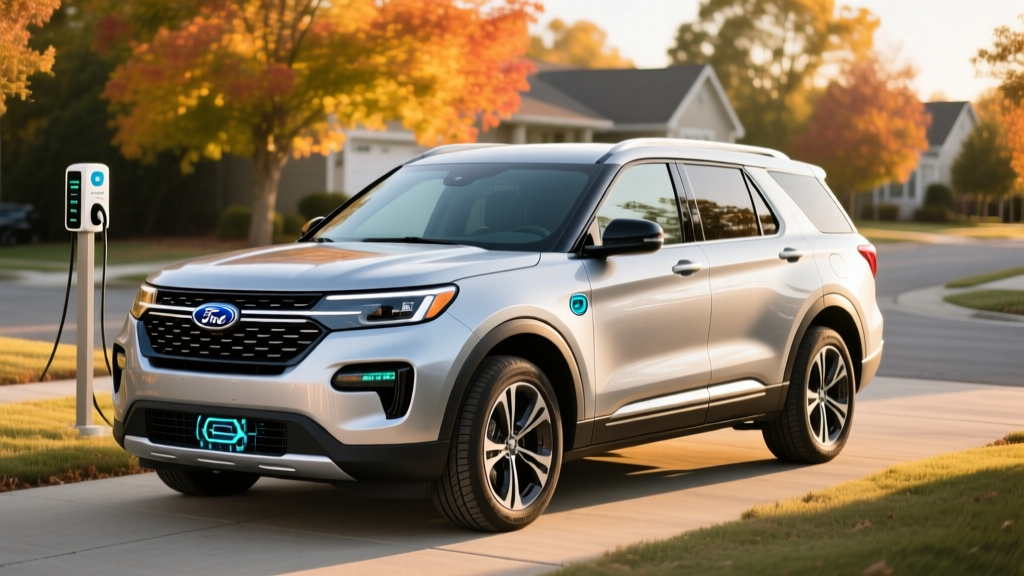
The 2020 Ford Explorer Hybrid arrived as Ford's first hybridized three-row SUV, pairing a 3.3-liter V6 with an electric motor for 318 combined horsepower. For buyers in 2026 browsing the used market, it remains one of the few hybrid midsize SUVs offering seven-passenger seating, standard all-wheel drive, and no plug-in requirement. But with a first-year powertrain and documented transmission complaints, is it a smart used buy? This guide covers every number that matters.
2020 Ford Explorer Hybrid: Powertrain and Performance Specs
The Explorer Hybrid uses Ford's fourth-generation hybrid system, combining a naturally aspirated 3.3L V6 engine with a 35-kW electric motor integrated into a 10-speed automatic transmission. Unlike mild hybrids that use a small motor for stop-start assist, this is a full parallel hybrid — the electric motor can propel the vehicle at low speeds independently, and both power sources work together under hard acceleration.
| Specification | Value |
|---|---|
| Engine | 3.3L V6 naturally aspirated |
| Electric Motor | 35 kW (47 HP) AC synchronous |
| Combined Output | 318 HP / 322 lb-ft torque |
| Transmission | 10-speed automatic (hybrid-specific) |
| Drivetrain | Standard Intelligent 4WD (AWD) |
| Hybrid Battery | 1.35 kWh lithium-ion (air-cooled) |
| 0-60 mph | ~7.5 seconds (est.) |
| Towing Capacity | 5,000 lbs (with Class III hitch) |
| Seats | 7 (standard) |
| Cargo (behind 3rd row) | 18.2 cu ft |
The 1.35 kWh battery pack is small by PHEV or BEV standards — that's by design. A conventional hybrid (HEV) battery doesn't store energy for electric-only driving; it buffers regenerative braking energy and provides torque-fill assistance. You never plug it in. The gas engine and regenerative braking handle all charging.
Fuel Economy: EPA Ratings vs. Real-World MPG
The EPA rated the 2020 Explorer Hybrid at 23 city / 26 highway / 24 combined MPG — though Ford's official AWD hybrid listing on fueleconomy.gov shows 23/26/24 for the 4WD variant. These numbers may underwhelm buyers expecting Prius-like efficiency, but context matters: this is a 4,700-pound, three-row AWD SUV.
| Driving Cycle | EPA MPG |
|---|---|
| City | 23 MPG |
| Highway | 26 MPG |
| Combined | 24 MPG |
Compared to the gas-only 2020 Explorer with the 2.3L EcoBoost (20/27/23 MPG AWD), the hybrid gains about 1 MPG combined but delivers smoother city driving and more low-end torque. Against the gas V6 Explorer (3.0L EcoBoost, 18/24/20 MPG), the hybrid advantage widens to 4 MPG combined.
Real-World MPG: What Owners Actually Report
Owner forums and Fuelly data for the 2020 Explorer Hybrid cluster around 22-25 MPG combined in mixed driving. City-heavy commutes with frequent stops tend to push toward the higher end (regenerative braking works hardest in stop-and-go traffic), while sustained highway driving at 75+ mph can drop to 21-22 MPG due to the vehicle's aerodynamic drag and weight.
Cold weather impacts are modest compared to a full EV — expect a 1-2 MPG drop in sub-freezing temperatures as the engine runs more frequently to provide cabin heat. This is normal for all hybrids.
HEV vs. PHEV vs. Full EV: Which Powertrain Fits You?
The 2020 Explorer was only offered as a conventional hybrid (HEV). Ford did not produce a plug-in hybrid (PHEV) Explorer for the U.S. market in 2020, though a PHEV variant was sold in Europe. Understanding the difference is essential before shopping.
Conventional Hybrid (HEV): Small battery (~1-2 kWh), charged by the engine and regenerative braking. No plug. No electric-only range to speak of. Improves MPG by 10-25% over gas-only.
Plug-in Hybrid (PHEV): Larger battery (10-25 kWh), can be plugged in to charge. Offers 20-40 miles of electric-only driving before the gas engine engages. Requires home charging access to maximize value.
| Factor | HEV (Explorer Hybrid) | PHEV (e.g., Toyota RAV4 Prime) | Full EV (e.g., Tesla Model X) |
|---|---|---|---|
| Plug Required? | No | Yes (for EV range) | Yes |
| Electric-Only Range | ~0 miles | 20-42 miles | 250-350 miles |
| Fuel Cost (per mile) | ~$0.14 | ~$0.05 (EV mode) / ~$0.14 (gas) | ~$0.04-$0.06 |
| Home Charging Needed? | No | Recommended | Essential |
| Tax Credit (New) | None | Up to $7,500 (§30D) | Up to $7,500 (§30D) |
| Maintenance | Gas + hybrid system | Gas + hybrid + EV systems | EV only (minimal) |
| Best For | No home charging, road trips | Short commute + home charger | Home charger, low daily miles |
- You can't install a home charger (apartment, street parking, HOA restrictions)
- You regularly tow (5,000 lbs capacity)
- You take frequent long road trips and don't want to plan charging stops
- You want three rows and AWD without a BEV price premium
- You have reliable home Level 2 charging
- Your daily commute is under 40 miles round-trip
- You want to minimize fuel costs and tailpipe emissions
- You qualify for the federal §30D tax credit on a new purchase
Battery Warranty, Lifespan, and Replacement Cost
Hybrid battery longevity is consistently the top concern for used hybrid buyers. Ford warranted the 2020 Explorer Hybrid's high-voltage battery for 8 years or 100,000 miles (whichever comes first). In states that adopted California Air Resources Board (CARB) emissions standards — including California, New York, Massachusetts, and several others — that warranty extends to 10 years or 150,000 miles.
- Federal warranty: 8 years / 100,000 miles
- CARB-state warranty: 10 years / 150,000 miles
- Warranty trigger: Battery capacity drops below ~70% of original (Ford's hybrid battery threshold)
- Replacement cost (out of warranty): $2,500 - $4,500 for the hybrid battery module, plus ~$500-$800 labor
- Typical lifespan: 150,000-200,000+ miles based on data from Ford's Fusion Hybrid and C-Max Hybrid, which use similar chemistry
The Explorer Hybrid's 1.35 kWh pack is air-cooled and relatively small, which means less thermal stress per cell compared to larger PHEV or BEV packs. Ford's track record with hybrid batteries from the Fusion Hybrid and Escape Hybrid generations has been solid, with most packs lasting well beyond warranty limits. However, the 2020 Explorer Hybrid is a first-year application of this specific powertrain, so long-term data at 150K+ miles is still accumulating as of 2026.
Reliability: Known Issues and What to Watch For
The 2020 Explorer Hybrid had a rough launch year. It's important to be direct about this: the model received multiple NHTSA recalls related to the high-voltage battery and electrical system, and owner complaints on NHTSA and consumer forums centered heavily on the 10-speed transmission.
Common Issues Reported
- Transmission shudder and harsh shifts: The most frequent complaint. Ford issued software updates and, in some cases, transmission replacements under warranty. Verify that any used 2020 model has received all TSB (Technical Service Bulletin) updates.
- High-voltage battery recall: Certain 2020 Explorer Hybrids were recalled for battery cell defects that could cause a loss of motive power. Check the VIN on NHTSA's recall lookup before purchasing.
- Electrical gremlins: Some owners reported infotainment freezes and accessory power issues — common across the 6th-generation Explorer platform, not unique to the hybrid.
- Build quality: The 2020 Explorer's Chicago assembly plant had quality-control challenges in this first model year. Panel gaps, interior rattles, and trim fitment issues are more common on 2020 models than on 2022+ examples.
For a used 2026 purchase, the critical steps are: (1) confirm all recalls have been performed, (2) pull a vehicle history report, (3) have a pre-purchase inspection done by a Ford dealer or hybrid-qualified mechanic, and (4) verify the hybrid battery's state of health via Ford's diagnostic tool.
Pricing and Tax Credit Eligibility (2026 Used Market)
The 2020 Explorer Hybrid launched with a base MSRP of approximately $52,495 (Limited trim, which was the only hybrid trim offered). With destination and typical options, many stickered between $54,000 and $58,000.
As of early 2026, used 2020 Explorer Hybrid pricing typically ranges from $22,000 to $32,000 depending on mileage, condition, and region. High-mileage examples (80K+) can dip below $22,000, while low-mileage, well-maintained units push toward $32,000.
Federal Tax Credit
The 2020 Explorer Hybrid does not qualify for the federal §30D new clean vehicle credit. It is a conventional hybrid, not a plug-in vehicle — the IRS requires a minimum battery capacity of 4 kWh and plug-in capability for §30D eligibility. However, if you're purchasing used from a dealer, you may qualify for the Used Clean Vehicle Credit (§25E) — but only if the vehicle is a qualified plug-in EV or fuel cell vehicle. Since the Explorer Hybrid is a conventional HEV, it does not qualify for any federal tax credit, new or used.
Some states offer hybrid-specific incentives or reduced registration fees, but these vary by jurisdiction. Check your state's energy office or department of revenue for current programs.
Pros and Cons: The Honest Verdict
Pros
- 318 HP with smooth hybrid torque-fill
- Standard AWD with 5,000-lb towing
- No plug-in requirement — works anywhere
- Three-row seating for seven passengers
- Modest fuel savings over V6 gas Explorer
- Hybrid battery warranty (8-10 years)
Cons
- First-year reliability concerns (transmission, battery recalls)
- Only 24 MPG combined — modest hybrid gain
- No federal tax credit eligibility
- Limited trim availability (Limited only)
- Used prices remain elevated vs. gas Explorer
- Small cargo area behind 3rd row (18.2 cu ft)
Frequently Asked Questions
How many MPG does the 2020 Ford Explorer Hybrid get?
The EPA rates it at 23 city / 26 highway / 24 combined MPG. Real-world owner reports cluster around 22-25 MPG combined, with city driving favoring the higher end and sustained highway speeds pulling it toward the lower end.
Does the 2020 Explorer Hybrid need to be plugged in?
No. It is a conventional hybrid (HEV), not a plug-in hybrid. The battery charges through regenerative braking and the gas engine. There is no plug port and no electric-only driving range.
Is the 2020 Ford Explorer Hybrid reliable?
The 2020 model year had documented issues, particularly with the 10-speed transmission and a high-voltage battery recall. Later model years (2022+) improved. If buying a 2020, confirm all recalls are completed and get a pre-purchase inspection. The hybrid battery itself has a strong longevity track record based on Ford's earlier hybrid platforms.
What does it cost to replace the hybrid battery?
Out of warranty, expect $2,500 to $4,500 for the battery module plus $500-$800 in labor, totaling roughly $3,000-$5,300. However, most Ford hybrid batteries last 150,000-200,000+ miles. At 6 years old in 2026, most 2020 examples will still have some remaining factory warranty coverage (8 years/100,000 miles federally, 10 years/150,000 in CARB states).
Does the 2020 Explorer Hybrid qualify for any tax credit?
No. As a conventional hybrid without plug-in capability, it does not qualify for the federal §30D new vehicle credit or the §25E used vehicle credit. Some state-level programs may offer minor incentives — check your state's energy office.
Should I buy the 2020 Explorer Hybrid or a newer model?
If budget allows, a 2022-2024 Explorer Hybrid is a safer bet — Ford resolved most first-year transmission and electrical issues. If the 2020's price is compelling, prioritize examples with complete service records, all recalls performed, and remaining hybrid battery warranty.
How does it compare to the Toyota Highlander Hybrid?
The 2020 Highlander Hybrid achieves 35-36 MPG combined (EPA) — significantly better than the Explorer Hybrid's 24 MPG. However, the Explorer Hybrid offers more horsepower (318 vs. 243), higher towing capacity (5,000 vs. 3,500 lbs), and standard AWD. If fuel economy is your top priority, the Highlander Hybrid wins decisively. If towing and power matter more, the Explorer Hybrid has the edge.