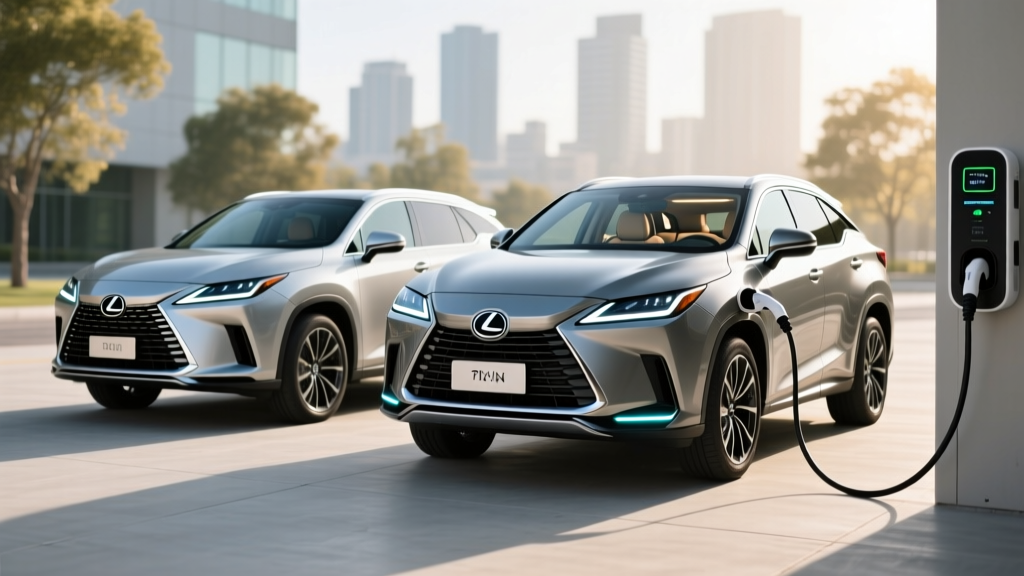
Family SUV buyers hunting for a Lexus 7 seater hybrid now have three distinct flavors of the full-size TX to evaluate for 2026: the turbocharged TX 350, the conventional hybrid TX 500h, and the plug-in hybrid TX 550h+. Each seats up to seven across three rows and wears the same upscale bodywork, but their powertrains, fuel economy, and ownership economics diverge sharply. This guide breaks down every spec that matters — EPA MPG, real-world efficiency, battery warranty, electric-only range, and federal tax credit eligibility — so you can match the right TX to your driving routine.
Understanding the TX Lineup: HEV vs PHEV vs Gas
Before diving into numbers, it's essential to separate conventional hybrids from plug-in hybrids, because the ownership experience is fundamentally different.
Conventional Hybrid (HEV) — TX 500h
- No plug required; the gasoline engine and regenerative braking recharge a small battery
- Battery: ~1.8 kWh (nickel-metal hydride)
- Electric-only driving: brief low-speed assists only, not a standalone EV mode
- Best for: drivers without home charging access who want better MPG without behavior change
Plug-In Hybrid (PHEV) — TX 550h+
- Plug in to access ~33 miles of pure electric range before the gas engine engages
- Battery: 18.1 kWh usable (lithium-ion)
- Supports Level 2 AC charging; no DC fast charging
- Best for: drivers with home Level 2 charging and commutes under 35 miles round-trip
The base TX 350 is a conventional turbocharged gasoline model — no electrification. It exists as a price-of-entry option, but if you're specifically searching for a Lexus 7 seater hybrid, the TX 500h and TX 550h+ are your targets.
Fuel Economy: EPA MPG and Real-World Expectations
Lexus publishes EPA-estimated fuel economy for each TX variant. Here's how they stack up, sourced from fueleconomy.gov:
| Model | Powertrain | City MPG | Highway MPG | Combined MPG | Combined MPGe (PHEV) |
|---|---|---|---|---|---|
| TX 350 (AWD) | 2.4L Turbo I-4 | 20 | 26 | 22 | — |
| TX 500h (AWD) | 2.4L Turbo Hybrid | 27 | 28 | 27 | — |
| TX 550h+ (AWD) | 3.5L V6 PHEV | 27 (hybrid mode) | 27 (hybrid mode) | 27 (hybrid mode) | 65 MPGe |
Real-World MPG vs EPA Sticker
TX 500h: The 27 MPG combined EPA estimate is achievable in mixed suburban driving. In heavy city traffic, Toyota's hybrid synergy system shines — expect 28-30 MPG thanks to frequent regenerative braking. On sustained 75-mph highway runs, figure 25-26 MPG. In sub-freezing winter conditions, expect a 2-3 MPG drop as the engine runs more frequently for cabin heat.
TX 550h+: When the battery is depleted and the vehicle operates as a conventional hybrid, 27 MPG combined is realistic. The real efficiency win comes from electric-only commuting: if your daily drive is under 33 miles and you charge nightly, you may burn almost zero gasoline on weekdays.
TX 550h+ Electric-Only Range and Charging Specs
The plug-in TX 550h+ carries an 18.1 kWh usable lithium-ion battery pack. Here's what that delivers:
| Specification | TX 550h+ Value |
|---|---|
| EPA Electric-Only Range | 33 miles |
| Total Combined Range (EV + Gas) | ~420 miles |
| Battery Capacity (Usable) | 18.1 kWh (lithium-ion) |
| Level 1 Charging (120V, 1.4 kW) | ~12 hours (0-100%) |
| Level 2 Charging (240V, 6.6 kW) | ~3 hours (0-100%) |
| DC Fast Charging | Not supported |
| Charge Port | J1772 (Level 1/2 AC) |
The absence of DC fast charging is standard for PHEVs in this class — the battery is small enough that Level 2 replenishes it fully overnight. If you install a 240V Level 2 home charger (typically a $500-$1,200 installation depending on panel proximity), a nightly top-up from 20% to 100% takes roughly 2.5 hours, easily fitting within off-peak electricity windows.
Powertrain Output: Horsepower and Performance
| Model | Engine | Combined System HP | Combined Torque (lb-ft) | 0-60 mph (est.) |
|---|---|---|---|---|
| TX 350 | 2.4L Turbo I-4 | 275 hp | 317 | 6.5 sec |
| TX 500h | 2.4L Turbo + Electric Motors | 366 hp | 406 | 5.7 sec |
| TX 550h+ | 3.5L V6 + Electric Motors | 406 hp | ~400 | 5.5 sec |
Both hybrid variants use Lexus's DIRECT4 all-wheel-drive system with rear-axle electric motors that can vector torque side-to-side. The TX 500h's turbo-hybrid pairing is notably punchy for a three-row family hauler, while the TX 550h+ V6 PHEV adds smoothness and the quiet, instant torque of electric-only motoring around town.
Pricing, Trims, and Tax Credit Eligibility
| Model / Trim | MSRP (2026 est.) |
|---|---|
| TX 350 Premium | $61,000 |
| TX 500h Premium | $67,500 |
| TX 500h Luxury | $72,000 |
| TX 550h+ Luxury | $78,500 |
| TX 550h+ Ultra Luxury | $83,000 |
Does the Lexus TX Qualify for a Federal Tax Credit?
Under current IRS §30D rules, the TX 550h+ PHEV is eligible for up to $7,500 in federal clean vehicle tax credits, provided you meet all requirements. The TX 500h (conventional hybrid) and TX 350 (gasoline) do not qualify for the §30D credit.
- MSRP Cap: SUVs must have an MSRP at or below $80,000. The TX 550h+ Luxury qualifies; the Ultra Luxury trim at ~$83,000 exceeds the cap and is ineligible.
- Buyer Income Limits: Modified AGI must not exceed $300,000 (married filing jointly), $225,000 (head of household), or $150,000 (single).
- Battery Sourcing: Critical minerals and battery components must meet escalating domestic-content thresholds. Lexus, as a Toyota subsidiary, sources components globally — verify current-year compliance on the IRS qualified vehicles list before purchase.
- Point-of-Sale Transfer: You can elect to transfer the credit to the dealer at purchase, reducing your out-of-pocket cost by up to $7,500 on the spot, subject to dealer participation.
Tax credit eligibility rules change frequently. Always confirm with a tax professional and check the latest IRS qualified vehicle list before committing to a purchase.
Battery Warranty, Reliability, and Replacement Costs
Hybrid Battery Warranty Coverage
| TX 500h (HEV): | 10 years / 150,000 miles — hybrid battery and components |
| TX 550h+ (PHEV): | 10 years / 150,000 miles — plug-in hybrid battery |
| Powertrain Warranty: | 6 years / 70,000 miles |
| Bumper-to-Bumper: | 4 years / 50,000 miles |
Lexus (and parent company Toyota) has built an industry-leading reputation for hybrid reliability, with over 25 years of hybrid production since the original Prius. The TX 500h's nickel-metal hydride battery pack is a mature, well-understood technology with a track record of lasting well beyond its warranty period. Replacement cost for the HEV battery, should it be needed out of warranty, typically runs $2,500-$4,000 including labor at a Lexus dealer.
The TX 550h+'s larger lithium-ion pack is more expensive to replace — estimated at $8,000-$12,000 out of warranty — though PHEV packs in Toyota/Lexus vehicles have shown strong longevity in the RAV4 Prime and NX 450h+ platforms that share architecture. Degradation of 10-15% over 100,000 miles is typical, meaning you might see electric-only range drop from 33 to roughly 28 miles after a decade of use.
In IIHS testing and owner surveys, the TX platform has performed well in safety and dependability metrics, consistent with Lexus's historical top-tier reliability rankings.
Who Should Buy the Lexus TX Hybrid vs a Full EV or Gas SUV?
Choose the TX 500h (HEV) If:
- You lack access to home or workplace charging
- You want a meaningful MPG improvement over the gas TX 350 without changing your fueling routine
- You regularly tow (5,000 lb capacity) and want simpler powertrain logistics on road trips
- Your budget is under $73,000 and you don't want to manage charging logistics
Choose the TX 550h+ (PHEV) If:
- You can install a Level 2 (240V) charger at home
- Your daily commute is under 33 miles round-trip (you'll rarely burn gas on weekdays)
- You qualify for the $7,500 federal tax credit (income and MSRP caps apply)
- You want EV-like quietness around town but gas-engine flexibility for road trips without charging-station planning
Consider a Full BEV Instead If:
- Your daily driving exceeds 33 miles and you want zero gasoline use
- You have reliable home charging and access to DC fast chargers for road trips
- You want lower per-mile fuel costs (electricity at $0.14/kWh ≈ $0.04/mile vs hybrid gas at ~$0.12/mile)
- Models like the Rivian R1S, Tesla Model X, or Kia EV9 fit your space and budget requirements
Pros and Cons at a Glance
Pros
- True seven-passenger seating in all three rows — the third row fits adults on shorter trips
- TX 500h achieves 27 MPG combined in a 5,000-lb SUV — a ~23% improvement over the TX 350
- TX 550h+ qualifies for up to $7,500 federal tax credit (trim and income dependent)
- Lexus's 10-year/150,000-mile hybrid battery warranty is among the best in the industry
- DIRECT4 AWD with torque vectoring provides confident handling for the class
- Quiet, refined cabin with Lexus Safety System+ 3.0 standard
Cons
- TX 550h+ lacks DC fast charging — irrelevant for daily use but limits EV-mode road-trip flexibility
- 33 miles of electric-only range is modest; rivals like the Volvo XC90 Recharge offer ~35-38 miles
- Ultra Luxury trim exceeds the $80,000 MSRP cap, forfeiting the federal tax credit
- No third-row USB-C ports on lower trims
- Hybrid battery replacement costs are significant out of warranty, especially the PHEV pack
- Cargo space behind the third row is tight at ~14 cu ft (20 cu ft in six-seat config)
Frequently Asked Questions
How many MPG does the Lexus TX 7 seater hybrid get?
The TX 500h conventional hybrid achieves an EPA-estimated 27 city / 28 highway / 27 combined MPG. The TX 550h+ plug-in hybrid matches 27 MPG combined when operating as a hybrid after the battery is depleted, and earns a 65 MPGe combined rating when factoring in electric-only driving.
How far can the TX 550h+ go on electric power alone?
The EPA rates the TX 550h+ at 33 miles of electric-only range. In real-world conditions — moderate temperatures, suburban speeds under 50 mph — you can expect 30-33 miles. Highway driving at 70+ mph or cold weather below freezing will reduce this to roughly 25-28 miles.
Does the Lexus TX hybrid need to be plugged in?
Only the TX 550h+ (PHEV) benefits from plugging in. The TX 500h (conventional hybrid) never needs a plug — it recharges its small battery through the gasoline engine and regenerative braking. You simply fill it with gas like any other vehicle.
Is the Lexus TX hybrid reliable, and what does battery replacement cost?
Lexus and Toyota have the longest track record in hybrid technology, with millions of hybrid vehicles on the road. The TX's hybrid components are covered by a 10-year/150,000-mile warranty. Out-of-warranty replacement costs are estimated at $2,500-$4,000 for the TX 500h battery and $8,000-$12,000 for the TX 550h+ pack.
Does the Lexus TX hybrid qualify for any tax credit?
The TX 550h+ plug-in hybrid may qualify for up to $7,500 under the federal §30D clean vehicle credit, subject to the $80,000 MSRP cap (excludes Ultra Luxury trim), buyer income limits, and battery sourcing requirements. The conventional TX 500h does not qualify for this credit. Check the IRS qualified vehicles list and consult a tax professional before purchase.
Can the TX 550h+ DC fast charge?
No. The TX 550h+ supports Level 1 (120V) and Level 2 (240V) AC charging only, via a J1772 connector. A full charge on Level 2 takes approximately 3 hours. This is typical for PHEVs — the 18.1 kWh battery is small enough that overnight AC charging is practical.
How does the TX hybrid compare to the Toyota Grand Highlander Hybrid?
The Grand Highlander Hybrid shares a platform with the TX and offers similar seven-passenger seating, but at a lower price point ($48,000-$58,000) and with slightly different tuning. The Grand Highlander Hybrid Max achieves 27 MPG combined, similar to the TX 500h. The Lexus differentiates with more premium materials, standard DIRECT4 AWD, available PHEV powertrain, and a quieter cabin.