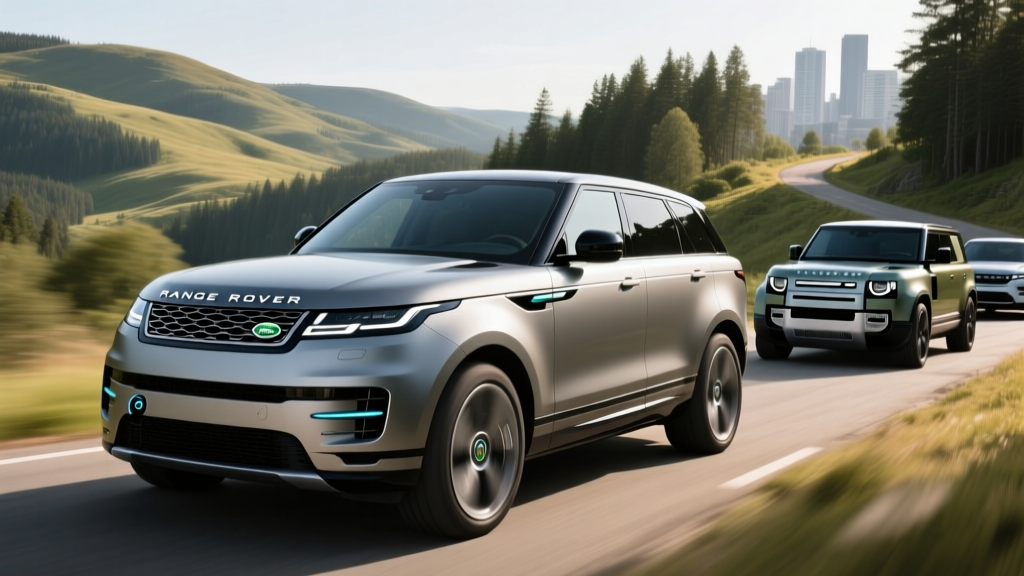
If you want the off-road credibility and luxury of a Land Rover but aren't ready to commit to a full battery-electric vehicle, the brand's plug-in hybrid lineup offers a pragmatic middle ground. For 2026, Land Rover sells three PHEV models in the United States — the Range Rover Sport PHEV, the Range Rover PHEV, and the Defender 110 PHEV — each pairing a turbocharged gasoline engine with a sizable traction battery and an electric motor capable of genuine zero-emission commuting. This guide breaks down every critical number: EPA electric-only range, combined MPGe and gas-only MPG, battery capacity in kWh, AC and DC charging speeds, powertrain output, MSRP by trim, and federal tax-credit eligibility under current IRS §30D rules.
Land Rover's 2026 PHEV Lineup at a Glance
Land Rover currently offers plug-in hybrid variants across its three core nameplates. All three use the company's MLA-Flex (Modular Longitudinal Architecture) platform, which was engineered from the outset to accommodate battery packs without compromising cabin or cargo space. Below is the side-by-side spec table for quick comparison before we dig into each model.
| Model | Battery (kWh usable) | EV Range (EPA mi) | Combined HP | 0-60 mph (sec) | Gas MPG (combined) | Max DC Charge (kW) | Starting MSRP |
|---|---|---|---|---|---|---|---|
| Range Rover Sport P460e | 31.8 | 48 | 454 | 5.2 | 22 | 50 | $89,300 |
| Range Rover P530e (SWB) | 31.8 | 51 | 523 | 4.9 | 22 | 50 | $112,000 |
| Defender 110 P400e | 23.5 | 37 | 398 | 6.5 | 21 | 50 | $78,500 |
Sources: fueleconomy.gov, Land Rover USA spec sheets. MSRP excludes destination; figures reflect base PHEV trims.
HEV vs PHEV: What Land Rover Actually Sells
Before diving deeper, it's worth clarifying the distinction between a conventional hybrid (HEV) and a plug-in hybrid (PHEV), because Land Rover's U.S. catalog uses both.
Conventional Hybrid (HEV) — e.g., Range Rover MHEV
Land Rover's mild-hybrid (MHEV) models use a small 48-volt system that assists the gas engine during acceleration and enables stop/start, but they cannot drive on electric power alone and do not plug in. Think of MHEV as a slightly more efficient gas engine, not a true electrified vehicle.
Plug-in Hybrid (PHEV) — the models in this guide
The P460e, P530e, and P400e carry large high-voltage batteries (23.5–31.8 kWh usable) paired with a dedicated electric motor. They can drive 37–51 miles on electricity alone, plug into Level 2 home chargers and DC fast chargers, and function as pure EVs for daily commuting before the gas engine takes over on longer trips.
If your commute is under 40 miles round-trip and you can charge at home, a Land Rover PHEV will run on electrons alone most weekdays, burning gasoline only on road trips or when you exceed the electric buffer.
Electric-Only Range and Efficiency: The Daily-Commute Test
EPA-rated electric-only range is the single most practical figure for a PHEV buyer. Here's what each model delivers and what you should actually expect in the real world.
| Model | EPA EV Range | Real-World EV Range* | EPA Combined MPGe | Gas-Only Combined MPG |
|---|---|---|---|---|
| Range Rover Sport P460e | 48 mi | 38–44 mi | 54 MPGe | 22 MPG |
| Range Rover P530e (SWB) | 51 mi | 40–47 mi | 54 MPGe | 22 MPG |
| Defender 110 P400e | 37 mi | 29–34 mi | 49 MPGe | 21 MPG |
*Real-world estimates assume 70 mph highway driving in 40–80°F conditions. Cold weather (below 32°F) can reduce EV range by 20–30% due to cabin heating loads and increased battery resistance. City driving at moderate speeds often matches or slightly exceeds EPA figures thanks to regenerative braking.
The Range Rover P530e's 51-mile EPA rating is the standout. If your one-way commute is 20 miles or less, you'll complete it without the inline-six ever firing — provided you charge at home overnight. The Defender 110's 37-mile rating is more modest; its boxy aerodynamics and heavier curb weight eat into electric efficiency at highway speeds.
Battery, Charging Speeds, and the DC Fast-Charging Advantage
One of Land Rover's smartest engineering decisions was equipping all three PHEVs with 50 kW DC fast-charging capability — a feature many competitors still lack. Most PHEVs on the market are limited to Level 2 AC charging only, which means topping up at a public station takes hours. With DC capability, a Land Rover PHEV can replenish its battery meaningfully during a road-trip rest stop.
| Charge Level | Power | Range Rover Sport/P530e (0–100%) | Defender 110 P400e (0–100%) |
|---|---|---|---|
| Level 1 (120V household) | ~1.4 kW | ~23 hours | ~17 hours |
| Level 2 (240V home/public) | 7.4 kW | ~5 hours | ~3.5 hours |
| DC Fast Charge (CCS) | Up to 50 kW | 10–80% in ~40 min | 10–80% in ~30 min |
Real-world charging note: The 50 kW peak rate is sustained only up to roughly 60–65% state of charge, after which the charge curve tapers to protect battery health. Expect the final 20% to add significant time — plan accordingly on road trips and aim to charge only to 80% at DC stations for the best time-to-energy ratio.
For home charging, a Level 2 wallbox (240V, 32A minimum) is strongly recommended. A full overnight charge on Level 2 easily replenishes the battery for the next morning's commute. Installation costs for a Level 2 home charger typically range from $800 to $2,500 depending on your electrical panel capacity and wiring distance — factor this into your purchase budget.
Powertrain Performance: Electric Torque Meets Turbo Six
Each Land Rover PHEV pairs a 3.0-liter turbocharged inline-six gasoline engine with an electric motor integrated into the ZF 8-speed automatic transmission. The combined system outputs are substantial:
- Range Rover Sport P460e: 454 hp combined, 516 lb-ft torque. The electric motor contributes 141 hp on its own. 0-60 mph in 5.2 seconds.
- Range Rover P530e: 523 hp combined, 590 lb-ft torque. The higher-output variant uses a more aggressive engine tune. 0-60 mph in 4.9 seconds — remarkably quick for a full-size luxury SUV.
- Defender 110 P400e: 398 hp combined, 472 lb-ft torque. 0-60 mph in 6.5 seconds. The lower output reflects the Defender's off-road gearing emphasis over straight-line speed.
All three models feature standard all-wheel drive with Land Rover's Terrain Response system. The PHEV powertrain adds a "EV" drive mode that prioritizes electric-only operation, and a "Save" mode that preserves battery charge for later use — useful if you want electric-only driving in a city center after a highway stretch.
Pricing and Federal Tax-Credit Eligibility
Land Rover PHEVs carry premium price tags, and federal tax-credit eligibility is nuanced. Under current IRS §30D rules, the new clean-vehicle credit offers up to $7,500, but several requirements must be met simultaneously:
- MSRP cap: SUVs/vans/pickups must have an MSRP at or below $80,000. The Range Rover Sport P460e ($89,300) and Range Rover P530e ($112,000) exceed this cap and do not qualify for the federal credit. The Defender 110 P400e at $78,500 base falls under the cap, but higher trims push it above $80,000.
- Buyer income cap: Modified adjusted gross income must not exceed $150,000 (single), $225,000 (head of household), or $300,000 (joint filing).
- Battery sourcing: Critical minerals and battery components must meet phased-in domestic/free-trade sourcing thresholds that tighten each year. Land Rover's battery supply chain has historically struggled to meet these thresholds — verify current-year compliance on the IRS qualified vehicle list before assuming eligibility.
- Point-of-sale transfer: If eligible, the $7,500 credit can be applied at the dealership as an immediate price reduction rather than waiting for tax filing.
Battery Warranty
All three Land Rover PHEVs carry an 8-year/100,000-mile high-voltage battery warranty (whichever comes first), consistent with federal requirements for hybrid and PHEV traction batteries. The warranty covers capacity loss below 70% of original rated capacity. Replacement cost for a PHEV traction battery out of warranty is estimated at $8,000–$14,000 depending on the model, though real-world failure rates for modern NMC cells are low within the first decade of ownership.
Always verify current credit eligibility at irs.gov before purchase. Rules and qualified vehicle lists are updated regularly.
Real-World Ownership: Who Should Choose a Land Rover PHEV?
Land Rover PHEVs aren't for everyone. They make the most sense for a specific buyer profile:
Choose a Land Rover PHEV if:
- Your daily commute is under 40 miles round-trip and you have home Level 2 charging access.
- You want genuine off-road capability and luxury without the range anxiety of a full EV on long road trips.
- You regularly tow (the Range Rover Sport PHEV is rated up to 5,510 lbs; the Defender 110 P400e up to 6,614 lbs).
- You want to reduce fuel consumption in city driving without changing your road-trip habits.
Choose a full EV instead if:
- Your commute exceeds 50 miles one-way and you want zero gasoline use.
- You want the lowest possible operating cost — EVs eliminate oil changes, spark plugs, and exhaust maintenance.
- You have reliable home and workplace charging and rarely tow heavy loads.
Stick with a conventional gas or MHEV Land Rover if:
- You cannot charge at home or work (apartment/condo without charging access).
- Your daily driving regularly exceeds the EV range and you'd never use the electric-only benefit.
In mixed driving — commuting on electricity during the week, gasoline on weekend road trips — a Land Rover PHEV owner who charges daily can achieve an effective annual fuel economy well above the EPA gas-only rating. One owner tracking fuel use over 12 months with a 25-mile daily commute reported an effective 42 MPG equivalent, compared to the 22 MPG the vehicle returns on gas alone. The math only works if you plug in consistently; a PHEV that never charges is simply a heavier, less efficient gas car.
Reliability, Maintenance, and Long-Term Costs
Land Rover's reliability reputation has historically trailed Japanese and German rivals, and PHEV complexity adds another variable. The high-voltage system, electric motor, and associated power electronics introduce components that conventional Land Rovers don't have. That said, the electric drivetrain itself has fewer moving parts than a traditional powertrain — no transmission wear from the electric motor, no exhaust system on the electric side, and regenerative braking extends brake pad life significantly.
Key ownership cost considerations:
- Insurance: PHEV Land Rovers carry higher premiums than their gas counterparts — expect 10–20% more, driven by higher repair costs and vehicle MSRP.
- Maintenance: Oil changes still apply (for the gas engine), but intervals may stretch if most miles are electric. Budget $1,200–$1,800 annually for scheduled maintenance after the warranty period.
- Tires: Heavier curb weight (the Range Rover P530e weighs over 5,800 lbs) accelerates tire wear. Expect replacement every 25,000–35,000 miles.
- Depreciation: Luxury PHEVs historically depreciate faster than luxury EVs or gas models, partly due to buyer uncertainty about long-term battery health. Plan for 45–55% value retention at 5 years.
Frequently Asked Questions
How many MPG does a Land Rover PHEV get?
On gasoline alone, the Range Rover Sport P460e and Range Rover P530e return 22 MPG combined (EPA), while the Defender 110 P400e returns 21 MPG combined. When factoring in electric-only driving, the combined MPGe rating is 54 MPGe for the Range Rover models and 49 MPGe for the Defender — but this figure only holds if you charge regularly.
How far can a Land Rover PHEV go on electric only?
The Range Rover P530e achieves the longest EPA-rated EV range at 51 miles. The Range Rover Sport P460e delivers 48 miles, and the Defender 110 P400e manages 37 miles. Real-world highway driving typically yields 80–90% of these figures; cold weather can reduce them by 20–30%.
Does a Land Rover PHEV qualify for the federal tax credit?
Only the base Defender 110 P400e potentially qualifies, as its $78,500 MSRP falls under the $80,000 SUV cap. However, battery-sourcing requirements under §30D may disqualify it depending on the current-year IRS list. The Range Rover Sport and Range Rover PHEVs exceed the MSRP cap and are ineligible regardless of income or sourcing. Verify at irs.gov before purchasing.
Is the Land Rover PHEV battery reliable, and what does replacement cost?
Land Rover covers the high-voltage battery for 8 years or 100,000 miles against capacity loss below 70%. Out-of-warranty replacement is estimated at $8,000–$14,000. Modern NMC cells have demonstrated low failure rates within the first decade, but long-term data beyond 10 years for these specific packs is still limited.
Can I DC fast charge a Land Rover PHEV?
Yes. All three models support up to 50 kW DC fast charging via a CCS connector. A 10–80% charge takes approximately 30–40 minutes depending on the model. This is uncommon among PHEVs and is a significant advantage for road-trip charging.
Hybrid vs PHEV vs EV — which Land Rover is right for me?
If you can charge at home and commute under 40 miles daily, the PHEV offers the best of both worlds — electric commuting with gas-powered road trips. If you have no charging access, a conventional MHEV (gas-only with mild-hybrid assist) is simpler. If you want the lowest operating cost and have reliable charging, consider waiting for Land Rover's upcoming all-electric Range Rover (announced, expected late 2026/2027) or look at competitors like the BMW iX or Mercedes EQS SUV today.
Data sourced from fueleconomy.gov, Land Rover USA, and the IRS clean vehicle credit page. Specifications and pricing reflect 2026 model year at time of publication and are subject to change.