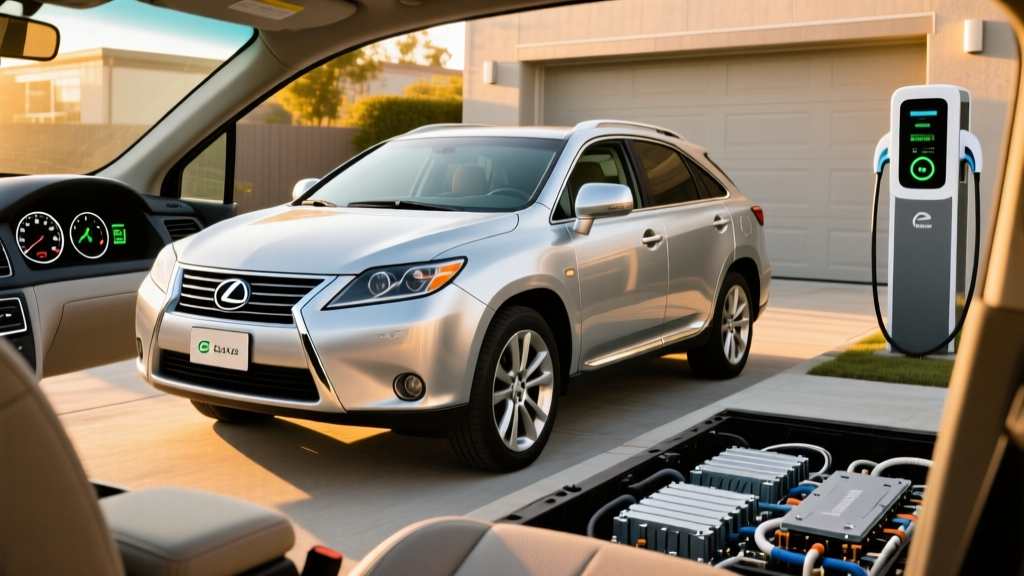
The 2007 Lexus RX 400h hybrid was one of the first luxury hybrid SUVs sold in the United States, combining a V6 engine with electric motors years before electrification went mainstream. Nearly two decades later, used examples still appear on the market, often priced between $5,000 and $9,000 depending on condition and mileage. For buyers considering this early-generation hybrid, the critical questions center on real-world fuel economy, battery longevity, and whether the RX 400h remains a smart buy or a maintenance liability.
This guide breaks down every specification that matters for a 2026 used-car purchase: EPA and real-world MPG, powertrain details, hybrid battery replacement costs, reliability track record, and how the RX 400h compares to modern hybrids, PHEVs, and full EVs available today.
HEV vs PHEV: Where the 2007 RX 400h Fits
Important distinction: The 2007 Lexus RX 400h is a conventional hybrid (HEV), not a plug-in hybrid (PHEV). It cannot be plugged in and has no electric-only driving range to speak of. The small nickel-metal hydride (NiMH) battery recharges exclusively through regenerative braking and the gasoline engine. You will never see an electric-only range figure for this vehicle because it was never designed for plug-in operation.
Modern PHEVs like the 2026 Toyota RAV4 Prime or Lexus NX 450h+ offer 30–40 miles of electric-only range and require plugging in to realize their efficiency advantage. The RX 400h requires zero behavioral change from a gas-car owner — you simply fuel up and drive. The tradeoff is that its efficiency gains are modest compared to plug-in alternatives.
2007 Lexus RX 400h Fuel Economy: EPA vs Real-World MPG
| Metric | EPA Estimate | Real-World Expectation |
|---|---|---|
| City MPG | 31 MPG | 28–33 MPG (hybrids often beat EPA in stop-and-go) |
| Highway MPG | 27 MPG | 24–27 MPG (less regen benefit at steady speed) |
| Combined MPG | 29 MPG | 25–29 MPG depending on driving mix |
The EPA rates the 2007 RX 400h at 29 MPG combined — a strong figure for a 4,500-pound luxury SUV in 2007, though unremarkable by 2026 standards. For context, the current-generation 2026 Toyota RAV4 Hybrid achieves 39 MPG combined, and the 2026 Honda CR-V Hybrid reaches 40 MPG combined.
Real-world MPG for the RX 400h depends heavily on driving style and battery condition. City driving yields the best results because regenerative braking recaptures energy during frequent stops. Highway driving at 70–80 mph diminishes the hybrid advantage. Owners reporting on fuel-tracking platforms typically log 25–28 MPG combined over long periods, with some achieving 30+ MPG on gentle city commutes.
A degraded hybrid battery will reduce fuel economy. If the NiMH pack has lost significant capacity, the engine runs more frequently to compensate, dropping real-world MPG to 22–24 combined. This is a key diagnostic when evaluating a used RX 400h.
Powertrain Specifications and Performance
| Specification | 2007 Lexus RX 400h |
|---|---|
| Engine | 3.3L V6 (3MZ-FE) |
| Engine Horsepower | 211 hp @ 5,600 rpm |
| Electric Motors | Front motor (123 kW) + Rear motor (50 kW) |
| Combined System Output | 270 hp (net) |
| Transmission | eCVT (electronically controlled continuously variable) |
| Drivetrain | AWD (e-AWD via rear electric motor, no mechanical link) |
| Hybrid Battery | NiMH, ~1.9 kWh (gross), not plug-in capable |
| 0–60 mph | ~7.3 seconds |
| Curb Weight | ~4,510 lbs |
| Towing Capacity | 3,500 lbs |
Lexus used its Hybrid Synergy Drive system, pairing the 3.3-liter V6 with two electric motors. The front motor handles primary propulsion and regeneration, while the smaller rear motor provides all-wheel-drive traction without a driveshaft — an elegant solution that eliminated mechanical complexity. The eCVT transmission has no traditional gears or belts; it uses a planetary gearset to blend engine and motor power seamlessly.
Performance was brisk for the era. The 270 net horsepower and instant electric torque gave the RX 400h quicker acceleration than the gas-only RX 350, despite the 250-pound hybrid-system weight penalty. The eCVT operates without shift shock, though some drivers find the engine drone under hard acceleration unpleasant — a characteristic of all CVT-based hybrid systems.
Hybrid Battery Lifespan, Warranty, and Replacement Cost
Original hybrid battery warranty: 8 years / 100,000 miles (10 years / 150,000 miles in CARB states including California, New York, Massachusetts, and others adopting California emissions standards).
Current status (2026): All 2007 RX 400h vehicles are well beyond factory warranty coverage. Any hybrid battery failure is an out-of-pocket expense unless an extended warranty was purchased and remains active.
The NiMH battery in the RX 400h typically lasts 150,000–200,000 miles before significant degradation forces replacement, though some units fail earlier and others exceed 250,000 miles. Heat is the primary enemy — vehicles in Arizona, Texas, and Southern California tend to see shorter battery life than those in cooler climates.
Replacement cost breakdown:
- OEM new battery (Lexus dealer): $3,500–$5,000 installed
- Remanufactured battery (specialist shop): $2,000–$3,000 installed
- Used/salvage battery: $800–$1,500 plus installation ($500–$800 labor)
- Individual cell/module replacement: $500–$1,200 if only specific modules have failed (requires diagnostic testing)
When evaluating a used 2007 RX 400h, ask whether the hybrid battery has been replaced. A receipt for a recent OEM or quality remanufactured battery adds significant value. If the original battery is still in the vehicle with 180,000+ miles, budget $2,500–$4,000 for near-term replacement.
A failing hybrid battery triggers a check-engine light with codes like P0A80 (replace hybrid battery) or individual module imbalance codes. Fuel economy drops noticeably, and the vehicle may enter a reduced-power limp mode. Unlike a full EV battery replacement costing $10,000–$20,000, the RX 400h's small NiMH pack is relatively affordable to replace.
Reliability Track Record and Common Issues
The 2007 RX 400h benefits from Toyota/Lexus engineering and shares its V6 engine with the Camry and Highlander — one of the most reliable powertrains of its generation. The eCVT transmission has an excellent longevity record with no belts or clutch packs to wear out. NHTSA records show relatively few powertrain complaints for this model year.
Known issues beyond the hybrid battery:
- Inverter coolant pump: Can fail around 120,000–160,000 miles. Replacement costs $400–$700. Failure risks inverter overheating, which is a much costlier repair ($2,000+).
- Brake actuator assembly: The regenerative braking system uses an electro-hydraulic actuator that can develop faults at high mileage. Dealer replacement runs $1,500–$2,500.
- 12V auxiliary battery: Located in the rear cargo area. Standard replacement every 4–5 years, $150–$250.
- Rack and pinion steering: Some owners report power steering rack leaks above 140,000 miles ($800–$1,200 repair).
Overall, the RX 400h is among the more reliable vehicles of its era, provided the hybrid battery is in good health. Lexus dealerships and independent Toyota/Lexus specialists can service all hybrid components, and aftermarket parts availability remains strong.
Pricing and Tax Credit Eligibility in 2026
Used market pricing (2026):
- Fair condition (180,000+ mi, needs battery): $4,000–$5,500
- Good condition (120,000–160,000 mi, battery healthy): $6,000–$8,000
- Excellent condition (under 100,000 mi, new battery): $8,500–$10,500
Tax credit status: The 2007 Lexus RX 400h does not qualify for the federal §30D new clean vehicle credit — that credit applies only to new vehicle purchases. For used vehicles, the IRS previously offered a used clean vehicle credit of up to $4,000 (30% of sale price, max $4,000), but this credit is limited to qualified plug-in EVs and PHEVs with at least 7 kWh of battery capacity. The RX 400h, with its ~1.9 kWh NiMH battery and no plug-in capability, does not meet the battery-capacity threshold. No federal tax credit is available for this vehicle.
Some states offer rebates for used hybrid purchases, but these vary by jurisdiction and change frequently. Check your state energy office or department of environmental quality for current programs.
Who Should Buy the 2007 RX 400h vs Modern Alternatives
Reasons to Choose the 2007 RX 400h
- Low entry price ($5,000–$8,000) for a luxury AWD SUV
- Proven Toyota/Lexus reliability with strong parts availability
- No charging infrastructure needed — behaves like a gas car
- Better fuel economy than a gas-only SUV of similar size and age (e.g., 2007 BMW X5 at ~17 MPG)
- Smooth, quiet ride quality typical of Lexus
Reasons to Look Elsewhere
- 29 MPG combined is modest by 2026 hybrid standards (RAV4 Hybrid: 39 MPG)
- Hybrid battery replacement is likely needed if original ($2,500–$5,000)
- No federal or state tax incentives available
- Dated infotainment, no modern ADAS features (no automatic emergency braking, no lane-keeping)
- Outdated navigation system, no Apple CarPlay/Android Auto without aftermarket head unit
- Higher emissions than any modern hybrid or EV
Choose the 2007 RX 400h if: You need an affordable AWD SUV with lower running costs than a comparable gas vehicle, you want Lexus comfort without a luxury price tag, and you have a trusted mechanic who can evaluate the hybrid battery before purchase.
Choose a modern hybrid (2024–2026 RAV4 Hybrid, CR-V Hybrid, Highlander Hybrid) if: You want 35–40 MPG combined, full factory warranty coverage, modern safety features, and zero near-term battery replacement risk. Monthly payments on a new hybrid may be competitive with the combined cost of a used RX 400h plus a battery replacement.
Choose a PHEV (RAV4 Prime, NX 450h+) if: You have home charging access and want 30–40 miles of daily electric driving with a gas engine for road trips. PHEVs offer the best of both worlds but cost $40,000–$55,000 new and may qualify for the §30D federal tax credit of up to $7,500 depending on MSRP caps, income limits, and battery sourcing requirements.
Choose a full EV (Model Y, IONIQ 5, EV6) if: You have reliable home Level 2 charging, your daily driving is under 250 miles, and you want the lowest per-mile energy cost (~$0.04–$0.06/mile on residential electricity vs ~$0.14/mile for the RX 400h at 27 MPG and $3.50/gallon gas).
Maintenance Costs and Total Ownership Picture
Annual maintenance on a 2007 RX 400h with 140,000+ miles typically runs $1,200–$2,000 including oil changes, brake service, tire replacement, and minor repairs. This is moderate for a luxury SUV of its age but higher than a newer mainstream vehicle.
Cost-per-mile fuel estimate: At 27 MPG combined and $3.50/gallon regular unleaded (the RX 400h does not require premium fuel), you'll spend approximately $0.13 per mile on gasoline. A modern 39 MPG hybrid drops that to $0.09/mile. A home-charged EV at $0.15/kWh and 3 mi/kWh drops it to $0.05/mile.
Insurance costs are low relative to new vehicles — expect $800–$1,200/year depending on your profile and state, as the vehicle's low book value keeps comprehensive and collision premiums minimal.
Frequently Asked Questions
How many MPG does the 2007 Lexus RX 400h hybrid get?
The EPA rates the 2007 RX 400h at 31 MPG city, 27 MPG highway, and 29 MPG combined. Real-world owners typically report 25–28 MPG combined, with city-heavy driving yielding results closer to or slightly above the EPA city figure thanks to regenerative braking. Highway-heavy driving at 75+ mph will return 23–26 MPG.
Is the 2007 RX 400h a plug-in hybrid?
No. The 2007 RX 400h is a conventional hybrid (HEV). It has no plug, no electric-only driving range, and the battery charges solely through regenerative braking and the gasoline engine. You fuel it exactly like a gas car.
How much does it cost to replace the hybrid battery?
An OEM replacement battery at a Lexus dealer costs $3,500–$5,000 installed. Remanufactured batteries from independent specialists run $2,000–$3,000 installed. Used salvage batteries cost $800–$1,500 plus installation labor. Individual module replacement, when only specific cells have failed, costs $500–$1,200.
How long does the hybrid battery last?
Typical lifespan is 150,000–200,000 miles or 12–18 years, whichever comes first. Heat accelerates degradation. Many 2007 examples have already had at least one battery replacement. Always verify battery health via OBD-II scan tool before purchasing.
Does the 2007 RX 400h qualify for any tax credit?
No. The federal §30D new vehicle credit does not apply to used purchases. The used clean vehicle credit requires a minimum 7 kWh battery capacity and plug-in capability, neither of which the RX 400h has. Check your state for any local hybrid incentives, though most target new plug-in vehicles.
Is the 2007 RX 400h reliable?
Yes, with caveats. The Toyota-derived V6 and eCVT are among the most reliable powertrain components of the era. The main risk is hybrid battery failure ($2,500–$5,000) and the brake actuator ($1,500–$2,500). A pre-purchase inspection by a Lexus or hybrid specialist is strongly recommended.
Can I tow with the 2007 RX 400h?
Yes, the RX 400h is rated to tow 3,500 pounds when properly equipped with the factory towing package. Hybrid system cooling is adequate for this rating, though sustained mountain towing will reduce fuel economy significantly and increase transmission fluid temperatures.
How does the RX 400h compare to a modern hybrid SUV?
A 2026 RAV4 Hybrid delivers 39 MPG combined (vs 29), has full warranty coverage, modern ADAS safety systems, Apple CarPlay, and costs roughly $33,000–$42,000 new. The RX 400h costs $5,000–$8,000 but carries battery replacement risk and lacks modern safety tech. The value proposition depends entirely on budget and risk tolerance.