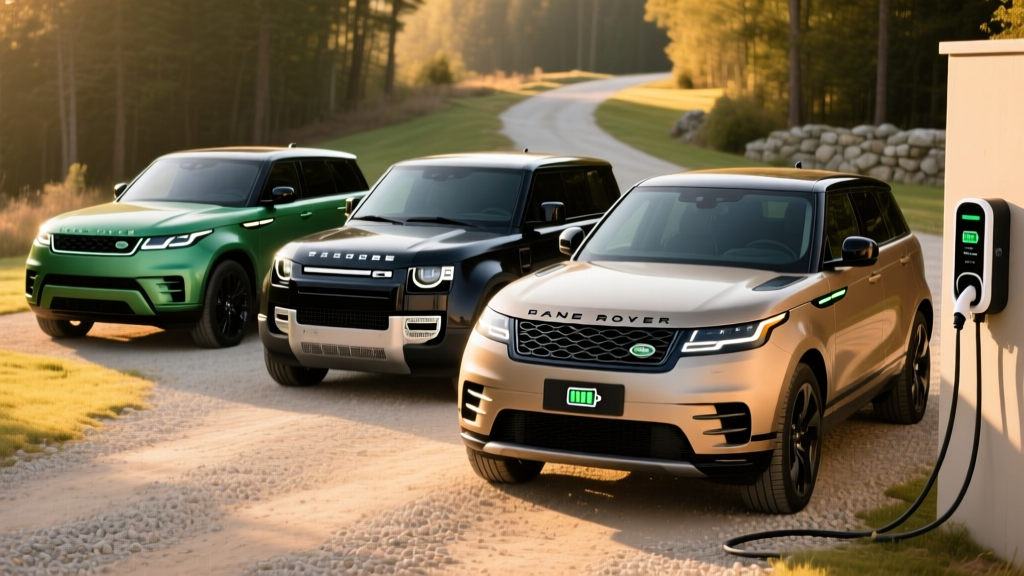
If you've been asking "does Land Rover make a hybrid?" the answer is a qualified yes — but with an important distinction. For the 2026 model year, Land Rover offers plug-in hybrid electric vehicles (PHEVs) across several nameplates, not conventional self-charging hybrids (HEVs). That means every electrified Land Rover currently on sale requires you to plug it in to unlock its full efficiency and electric-only driving potential.
Land Rover phased out its mild-hybrid (MHEV) inline-six options in the U.S. market and is now channeling its electrification strategy through PHEV variants of the Range Rover, Range Rover Sport, Defender, and Range Rover Evoque. These pair turbocharged engines with substantial battery packs and electric motors for legitimate zero-emission commuting paired with off-road capability.
Land Rover's 2026 PHEV Lineup at a Glance
Here's how the current lineup breaks down by model, powertrain, and efficiency:
| Model | Powertrain | Combined HP | Battery (kWh) | EV Range (mi) | EPA Combined MPG | Base MSRP |
|---|---|---|---|---|---|---|
| Range Rover P550e | 3.0L I6 turbo + EV motor | 542 hp | 23.1 kWh usable | ~48 mi | 21 MPG (gas) / 54 MPGe | $121,275 |
| Range Rover Sport P550e | 3.0L I6 turbo + EV motor | 542 hp | 23.1 kWh usable | ~44 mi | 22 MPG (gas) / 52 MPGe | $99,875 |
| Defender 110 P400e | 3.0L I6 turbo + EV motor | 398 hp | 19.2 kWh usable | ~37 mi | 20 MPG (gas) / 48 MPGe | $82,475 |
| Range Rover Evoque P300e | 1.5L I3 turbo + EV motor | 300 hp | 14.9 kWh usable | ~34 mi | 28 MPG (gas) / 58 MPGe | $54,675 |
Source: fueleconomy.gov and Land Rover USA spec sheets. MPGe reflects combined gas + electric operation. EV range figures are EPA estimates; expect 15–25% reduction in cold weather or sustained highway driving.
HEV vs PHEV: Why Land Rover Only Offers Plug-Ins
Conventional Hybrid (HEV): Uses a small battery (typically 1–2 kWh) recharged solely through regenerative braking and the engine. No plug. Electric-only driving is limited to very low speeds for short distances. Examples: Toyota RAV4 Hybrid, Honda CR-V Hybrid.
Plug-In Hybrid (PHEV): Carries a much larger battery (15–23+ kWh) that you charge via a plug — at home on a Level 2 charger or on public AC chargers. Provides 30–50 miles of genuine electric-only range before the gas engine engages. Land Rover's entire electrified lineup falls here.
Land Rover chose the PHEV route because its buyers typically want substantial electric-only range for daily commuting while retaining the towing and off-road range that a pure EV can't yet match in remote terrain. The tradeoff: if you never plug in a PHEV, you're hauling a heavy dead battery and getting worse fuel economy than a comparable gas model.
Real-World MPG: What Owners Actually See
| Model | EPA City | EPA Highway | EPA Combined | Real-World Expectation |
|---|---|---|---|---|
| Range Rover P550e (gas only) | 19 MPG | 24 MPG | 21 MPG | 18–22 MPG depending on driving style |
| Range Rover Sport P550e (gas only) | 20 MPG | 25 MPG | 22 MPG | 19–24 MPG; better in stop-and-go with regen |
| Defender 110 P400e (gas only) | 18 MPG | 22 MPG | 20 MPG | 17–21 MPG; weight and aero work against it |
| Evoque P300e (gas only) | 25 MPG | 31 MPG | 28 MPG | 26–32 MPG; city driving favors hybrid operation |
A critical point about PHEV fuel economy: these MPG figures apply when the battery is depleted and you're running on the gas engine alone. When the battery is charged and you're driving within the electric-only range, your liquid fuel consumption drops to zero. A Range Rover P550e owner with a 20-mile commute who charges nightly might visit a gas station once every few months.
Hybrid-mode MPG can exceed EPA estimates in city driving where regenerative braking recaptures energy during frequent stops. Highway driving at 75+ mph tells a different story — aerodynamic drag on these large, heavy SUVs pushes fuel consumption higher, and the electric motor provides less assistance at sustained high speeds.
Electric-Only Range and Charging Specs
Electric-only range is the single most important spec for a PHEV buyer. It determines whether your daily commute can be completed without burning a drop of gasoline.
| Model | EPA EV Range | Battery (usable kWh) | Level 2 Charge Time (0–100%) | DC Fast Charge? |
|---|---|---|---|---|
| Range Rover P550e | 48 mi | 23.1 kWh | ~2.5 hours at 7.2 kW | No (AC only) |
| Range Rover Sport P550e | 44 mi | 23.1 kWh | ~2.5 hours at 7.2 kW | No (AC only) |
| Defender 110 P400e | 37 mi | 19.2 kWh | ~2 hours at 7.2 kW | No (AC only) |
| Evoque P300e | 34 mi | 14.9 kWh | ~2 hours at 7.2 kW | No (AC only) |
None of Land Rover's 2026 PHEVs support DC fast charging. This is common in the PHEV segment — the battery packs are small enough that Level 2 AC charging fully replenishes them in 2–3 hours, which covers most overnight and workplace-charging scenarios. The onboard charger maxes out at 7.2 kW across the lineup, meaning a standard Level 1 household outlet (1.4 kW) will take 10–16 hours for a full charge — adequate only if your daily driving is minimal.
Real-World Range Caveat: EPA electric-range estimates assume moderate temperatures and mixed driving. Expect 25–34 miles of real-world EV range from the Range Rover P550e in winter conditions (below 40°F), as the battery's available capacity shrinks and cabin heating draws additional power. In summer with moderate highway driving, you may match or slightly exceed the 48-mile sticker.
Battery Warranty, Reliability, and Replacement Cost
Land Rover covers its PHEV high-voltage batteries with an 8-year / 100,000-mile warranty that guarantees the battery will retain at least 70% of its original capacity. This is consistent with the industry standard set by most automakers and aligns with federal emissions warranty requirements.
Regarding reliability: Land Rover's overall brand reliability scores from sources like J.D. Power and Consumer Reports have historically lagged behind Japanese and Korean competitors. The PHEV powertrain adds complexity — an electric motor, inverter, onboard charger, and high-voltage battery on top of the conventional engine and transmission. However, the hybrid-specific components (battery and motor) have proven more durable than the infotainment and air-suspension systems that typically drive Land Rover's lower reliability rankings.
If a PHEV battery does need replacement out of warranty, expect a dealer quote in the $8,000–$14,000 range depending on the model. The Evoque's smaller pack sits at the lower end; the Range Rover's 23.1 kWh pack at the higher end. These costs should factor into long-term ownership planning for buyers who intend to keep their vehicle past the 8-year mark.
Tax Credit Eligibility for Land Rover PHEVs
Under the current IRS §30D Clean Vehicle Credit rules, PHEVs can qualify for up to $7,500 in federal tax credits — but several hurdles apply to Land Rover's lineup:
- MSRP cap: SUVs must have an MSRP at or below $80,000. This immediately disqualifies the Range Rover P550e ($121,275) and Range Rover Sport P550e ($99,875) from the federal credit.
- Battery sourcing: The vehicle's battery components and critical minerals must meet escalating domestic-content and free-trade-agreement thresholds. Land Rover's supply chain has not consistently met these requirements.
- Buyer income limits: Modified adjusted gross income must not exceed $300,000 (joint), $225,000 (head of household), or $150,000 (single).
- Point-of-sale transfer: Eligible credits can be transferred to the dealer at purchase, reducing the out-of-pocket price rather than waiting for a tax refund.
Bottom line: As of the 2026 model year, the Range Rover Evoque P300e is the only Land Rover PHEV with an MSRP below the $80,000 SUV cap. However, battery-sourcing compliance is uncertain and changes periodically. Always verify current eligibility on the fueleconomy.gov tax credit lookup tool before purchasing, and consult a tax professional for your specific situation.
Who Should Buy a Land Rover PHEV?
Pros
- 30–48 miles of electric-only range covers most commutes gas-free
- Combined 300–542 hp provides strong acceleration and towing capability
- Retains Land Rover's off-road hardware (terrain response, wading, articulation)
- No range anxiety on road trips — gas engine takes over seamlessly
- Luxury interior, technology, and brand cachet
Cons
- No DC fast charging limits public charging utility
- Heavy vehicles deliver mediocre MPG once the battery depletes
- High starting prices, especially above the tax-credit MSRP cap
- Brand reliability historically trails competitors
- PHEV complexity adds potential long-term maintenance cost
Choose a Land Rover PHEV if: You want luxury and off-road capability, have home or workplace Level 2 charging, your daily commute fits within 30–45 miles, and you take road trips where pure-EV charging infrastructure is sparse.
Choose a full EV instead if: You want lower running costs, zero tailpipe emissions, DC fast charging for road trips, and you don't need serious off-road capability. Consider the BMW iX, Rivian R1S, or Tesla Model X.
Choose a conventional HEV if: You can't charge at home or work, want simplicity with no plug, and prioritize fuel economy over electric-only driving. The Toyota Grand Highlander Hybrid or Lexus TX 500h offer three rows without a plug.
Frequently Asked Questions
Does Land Rover make a conventional hybrid that doesn't need to be plugged in?
No. For the 2026 model year in the U.S., Land Rover only offers plug-in hybrids (PHEVs). The brand previously sold mild-hybrid (MHEV) inline-six models, but these used small 48-volt systems that provided minimal efficiency gains and have been discontinued in favor of the PHEV lineup.
How many MPG does a Land Rover hybrid get?
Once the battery is depleted, Land Rover PHEVs return 20–28 MPG combined depending on the model. The Evoque P300e leads at 28 MPG combined; the Defender 110 P400e returns 20 MPG. However, if you charge daily and commute within the electric range, your effective gasoline consumption can be near zero for daily driving.
How far can a Land Rover PHEV drive on electric only?
The Range Rover P550e leads the lineup at 48 EPA-rated miles of electric-only range. The Range Rover Sport P550e achieves 44 miles, the Defender 110 P400e manages 37 miles, and the Evoque P300e delivers 34 miles. Cold weather and highway speeds reduce these figures by 15–25%.
Is the Land Rover PHEV battery reliable and what does replacement cost?
Land Rover's PHEV batteries are covered by an 8-year / 100,000-mile warranty guaranteeing at least 70% capacity retention. Out-of-warranty replacement costs range from approximately $8,000 (Evoque) to $14,000 (Range Rover). The high-voltage components themselves have been reasonably durable, though Land Rover's overall vehicle reliability scores remain below average.
Does a Land Rover PHEV qualify for the federal tax credit?
Only the Range Rover Evoque P300e (MSRP ~$54,675) falls under the $80,000 SUV MSRP cap required by the IRS §30D credit. The Range Rover, Range Rover Sport, and Defender PHEVs all exceed this cap and are ineligible. Even for the Evoque, battery critical-mineral and component sourcing requirements must be met — verify on fueleconomy.gov before purchasing.
Can I charge a Land Rover PHEV at a DC fast charger?
No. Land Rover's 2026 PHEVs accept only AC charging — Level 1 (120V household) or Level 2 (240V home/public). The onboard charger peaks at 7.2 kW, so a full Level 2 charge takes approximately 2–2.5 hours. This is typical for PHEVs, whose smaller batteries don't require DC fast-charging infrastructure.