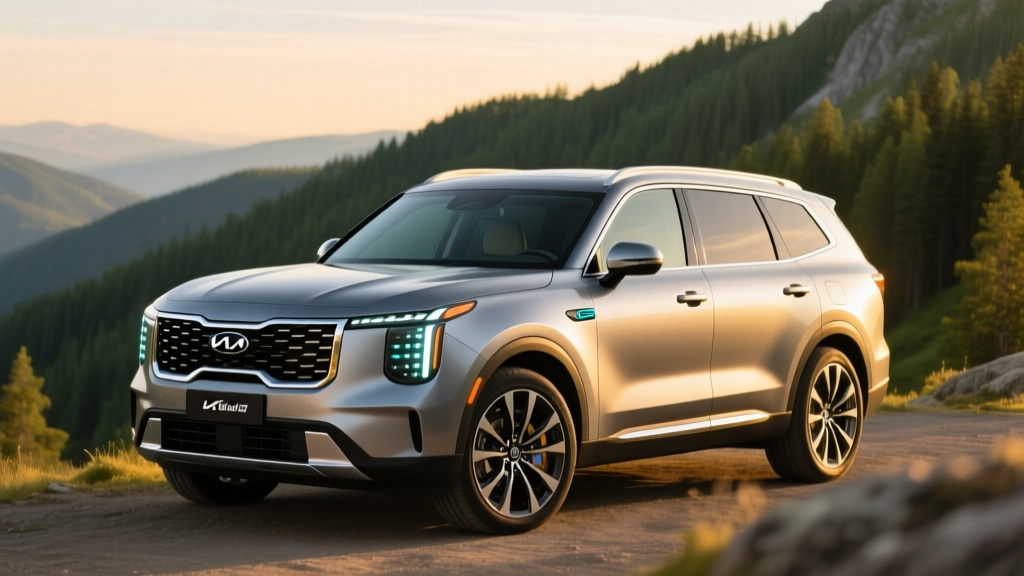
The three-row SUV segment rarely rewards efficiency, but the 2026 Kia Telluride Hybrid changes that equation. With a turbocharged hybrid powertrain delivering over 500 miles of total range and seating for up to eight, it targets families who want to cut fuel costs without downsizing. This guide breaks down the Telluride Hybrid's real-world MPG, powertrain specs, battery longevity, and whether the conventional hybrid (HEV) or a plug-in alternative makes more sense for your driveway.
2026 Kia Telluride Hybrid: Key Specifications at a Glance
| Specification | 2026 Telluride Hybrid (HEV) |
|---|---|
| Powertrain | 1.6L Turbocharged 4-Cylinder + Electric Motor |
| Combined Horsepower | ~270 hp (system net) |
| Transmission | 6-Speed Automatic |
| EPA MPG (City / Hwy / Combined) | 34 / 31 / 33 MPG (FWD est.) |
| Fuel Tank Capacity | ~18.8 gallons |
| Total Range (Est.) | ~550–620 miles |
| Hybrid Battery Type | Lithium-ion, ~1.5 kWh (self-charging HEV) |
| Drivetrain Options | FWD or AWD |
| Towing Capacity | Up to 5,000 lbs (AWD) |
| Seating | 7 or 8 passengers |
| Starting MSRP (Est.) | ~$44,000–$46,000 |
| Hybrid Battery Warranty | 10 years / 100,000 miles |
HEV vs PHEV: Which Telluride Hybrid Are We Talking About?
Before diving into MPG numbers, it's critical to understand the difference between a conventional hybrid (HEV) and a plug-in hybrid (PHEV) — because the Telluride lineup may eventually include both, and they behave very differently.
| Feature | HEV (Conventional Hybrid) | PHEV (Plug-In Hybrid) |
|---|---|---|
| Plug-in Charging? | No — charges via regenerative braking and engine | Yes — plug into Level 1 or Level 2 charger |
| Electric-Only Range | ~1–2 miles at low speed | Typically 30–45 miles (if offered) |
| Battery Size | ~1–2 kWh | ~15–25 kWh |
| Federal Tax Credit (§30D) | Not eligible | Potentially up to $7,500 (if battery sourcing qualifies) |
| Best For | Drivers without home charging access | Drivers with home charging and short commutes |
The 2026 Kia Telluride Hybrid is a conventional HEV. It does not plug in. You fuel it like a normal vehicle, and the hybrid system handles the rest — capturing energy during braking and coasting to assist the gasoline engine. If Kia introduces a Telluride PHEV variant in future model years, it would add plug-in capability and electric-only commuting range, but as of the 2026 model year, only the HEV configuration is confirmed.
How Many MPG Does the Kia Telluride Hybrid Get?
For a three-row, body-on-frame-class SUV, the Telluride Hybrid's fuel economy is a significant improvement over the standard gasoline V6 model. Here's the EPA-estimated breakdown:
| Configuration | City MPG | Highway MPG | Combined MPG |
|---|---|---|---|
| Telluride Hybrid FWD (Est.) | 34 | 31 | 33 |
| Telluride Hybrid AWD (Est.) | 32 | 29 | 31 |
| Telluride Gas V6 FWD (Baseline) | 20 | 26 | 22 |
| Telluride Gas V6 AWD (Baseline) | 18 | 24 | 20 |
Sources: fueleconomy.gov, Kia America specifications. Figures are EPA estimates for the 2026 model year; confirm exact ratings at purchase.
The hybrid powertrain delivers roughly a 50% improvement in city MPG over the gasoline V6. This is typical of hybrid systems, which rely heavily on the electric motor during stop-and-go driving where the gasoline engine is least efficient.
Real-World MPG: What to Actually Expect
EPA stickers are a starting point, not a guarantee. Based on testing patterns with similar turbo-hybrid SUVs (including the Hyundai Santa Fe Hybrid and Toyota Grand Highlander Hybrid), here's what real-world Telluride Hybrid owners should anticipate:
- City driving (suburban errands, school runs, traffic): 33–36 MPG. Hybrids often exceed their EPA city rating in moderate-speed, stop-and-go conditions because regenerative braking is constantly recharging the battery.
- Highway cruising (70+ mph sustained): 27–30 MPG. Aerodynamic drag dominates at highway speeds, and the electric motor contributes less. Expect the real-world highway number to fall 2–4 MPG below the EPA sticker.
- Cold weather (below 30°F): 26–29 MPG combined. The engine runs more frequently to provide cabin heat and maintain battery temperature. Expect a 10–15% fuel economy penalty in winter months.
- Towing or heavy cargo loads: 18–22 MPG. The hybrid system helps, but pulling a 4,000-lb trailer fundamentally changes the energy equation.
Bottom line: Most Telluride Hybrid owners in mixed driving will see 29–33 MPG on average over a tank. That translates to roughly 550–600 miles between fill-ups — a meaningful advantage on road trips.
Powertrain Deep Dive: Engine, Motor, and System Output
The 2026 Telluride Hybrid pairs a 1.6-liter turbocharged inline-four gasoline engine with an electric motor integrated into the transmission housing. Combined system output is approximately 270 horsepower, which is competitive with the outgoing 3.8L V6 (291 hp) while delivering dramatically better fuel economy.
Key powertrain characteristics:
- Turbo torque fill: The electric motor provides instant torque at low RPMs while the turbo spools, eliminating the lag common in small-displacement turbo engines.
- 6-speed automatic: Unlike the e-CVT transmissions in Toyota hybrids, Kia uses a conventional 6-speed automatic with an integrated electric motor. This gives more natural shift feel and better highway passing response, at a minor cost to city efficiency.
- AWD availability: The AWD system uses a mechanical rear driveshaft (not a separate rear electric motor), which keeps weight down but means AWD models sacrifice 1–2 MPG vs. FWD.
- Regenerative braking: Multiple regen levels are selectable, though the Telluride Hybrid does not offer true one-pedal driving like a full EV or PHEV in EV mode.
Battery Warranty, Longevity, and Replacement Cost
Hybrid Battery Warranty: 10 Years / 100,000 Miles
Kia covers the Telluride Hybrid's lithium-ion battery pack with a 10-year/100,000-mile warranty, consistent with the brand's industry-leading hybrid component coverage. This warranty applies to the original owner and, for vehicles sold in states that adopted California's emissions warranty rules, may extend even further.
What does the warranty cover? If the hybrid battery drops below a defined capacity threshold (typically ~60–70% of original capacity) or suffers a defect, Kia will repair or replace it at no cost.
How long do hybrid batteries actually last? Modern lithium-ion hybrid batteries in HEVs are remarkably durable because they operate in a narrow state-of-charge window (typically 40–60% SoC). This shallow cycling dramatically reduces degradation. Based on data from the Toyota Prius, Hyundai Sonata Hybrid, and Kia Sorento Hybrid fleets, most HEV batteries last 150,000–200,000+ miles before needing replacement.
Replacement cost if out of warranty: A hybrid battery pack replacement for a vehicle in this class typically runs $2,000–$4,000 (parts and labor), far less than a full EV battery replacement. Individual module replacement may cost even less.
Source: Kia America Warranty Coverage
Pricing, Trims, and Tax Credit Eligibility
The 2026 Kia Telluride Hybrid is expected to slot into the lineup with a starting MSRP in the $44,000–$46,000 range for the base hybrid trim, climbing to $54,000–$58,000 for fully loaded variants (SX Prestige or equivalent). This represents a roughly $2,000–$3,000 premium over the equivalent gasoline V6 trim.
Fuel cost payback: At 33 MPG combined vs. 22 MPG combined (gas V6), and assuming $3.50/gallon and 15,000 miles/year, the hybrid saves approximately $800–$950 per year in fuel costs. The hybrid premium pays for itself in roughly 2.5–3.5 years for an average driver.
Does the Telluride Hybrid Qualify for a Federal Tax Credit?
No. Under current IRS §30D rules, the federal clean vehicle credit applies only to plug-in electric vehicles (BEVs and PHEVs) with sufficient battery capacity and qualifying battery sourcing. The Telluride Hybrid is a conventional HEV — it has no plug-in capability and a battery too small to qualify. There is no federal tax credit for conventional hybrids as of the 2026 tax year.
Some states and utilities offer rebates or incentives for hybrid purchases (e.g., HOV lane access, local utility rebates), but these vary widely by jurisdiction. Check your state's energy office or DMV for current programs.
Pros and Cons: Telluride Hybrid Ownership
Pros
- 33 MPG combined in a three-row, 8-passenger SUV — class-leading efficiency
- ~550–620 miles of total range per tank
- No plug-in charging required; fuel like a normal vehicle
- 270 hp with turbo + electric torque fill delivers confident acceleration
- 10-year/100,000-mile hybrid battery warranty
- 5,000-lb towing capacity (AWD) retained
- Proven Kia infotainment, safety tech, and interior quality
Cons
- $2,000–$3,000 price premium over the gas V6 model
- No federal tax credit eligibility (HEV, not PHEV/BEV)
- Real-world highway MPG drops to ~27–30 (below EPA sticker)
- No electric-only driving mode (unlike a PHEV)
- Turbo 4-cylinder may lack the smoothness of the V6 at full throttle
- AWD fuel economy penalty (~2 MPG)
Who Should Choose the Telluride Hybrid vs. a Full EV or Gas SUV?
The Telluride Hybrid occupies a specific niche. Here's a practical decision framework:
Choose the Telluride Hybrid (HEV) if:
- You need three rows and 5,000-lb towing but want to cut fuel costs 30–50%
- You don't have access to home Level 2 charging (apartment, street parking)
- You regularly take long road trips and don't want to plan around DC fast chargers
- You want EV-like efficiency without any change to your fueling routine
- Your daily commute is longer than 30–40 miles (where a PHEV's electric range would run out)
Consider a full EV (like the Kia EV9) if:
- You have reliable home Level 2 charging
- Your daily driving is under 250 miles and you can charge overnight
- You want the lowest possible per-mile energy cost (~$0.04–$0.06/mile on home electricity vs. ~$0.11/mile in the hybrid)
- You want to qualify for the §30D federal tax credit (up to $7,500, subject to income, MSRP, and battery sourcing rules)
Stick with the gas V6 Telluride if:
- Your annual mileage is very low (under 8,000 miles/year — the hybrid premium won't pay back)
- You want the lowest possible purchase price and don't prioritize fuel cost
- You prefer the V6's linear power delivery and don't need the efficiency
Frequently Asked Questions
How many MPG does the 2026 Kia Telluride Hybrid get?
The EPA-estimated fuel economy for the Telluride Hybrid is approximately 34 city / 31 highway / 33 combined MPG (FWD). AWD models drop to roughly 32/29/31. Real-world mixed driving typically yields 29–33 MPG.
Does the Kia Telluride Hybrid need to be plugged in?
No. The Telluride Hybrid is a conventional HEV (self-charging hybrid). It charges its small battery through regenerative braking and the gasoline engine. You never plug it in — just fill up at the gas station as usual.
Is the Telluride Hybrid reliable? What about battery replacement cost?
Kia's hybrid systems have proven reliable across the Sorento Hybrid and Niro lineups. The hybrid battery is covered by a 10-year/100,000-mile warranty. Out-of-warranty replacement typically costs $2,000–$4,000, and most hybrid batteries last 150,000+ miles based on industry data.
Does the Telluride Hybrid qualify for a federal tax credit?
No. The IRS §30D clean vehicle credit applies only to plug-in vehicles (BEVs and PHEVs). The Telluride Hybrid is a conventional HEV and does not qualify. Check your state for possible local incentives.
How does the Telluride Hybrid compare to the Toyota Grand Highlander Hybrid?
The Grand Highlander Hybrid (with the standard 2.5L hybrid system) achieves an EPA-estimated 36 combined MPG, slightly edging the Telluride Hybrid's ~33 combined. However, the Telluride offers more horsepower (~270 vs. 245), a turbo engine for stronger highway passing, and Kia's 10-year warranty vs. Toyota's 8-year/100,000-mile hybrid coverage. The Grand Highlander Hybrid Max (362 hp turbo hybrid) trades efficiency for power at ~27 combined MPG.
Will Kia offer a Telluride PHEV (plug-in hybrid)?
As of the 2026 model year, Kia has not confirmed a Telluride PHEV. If one arrives, expect 30–40 miles of electric-only range, a ~15–20 kWh battery, Level 2 charging capability, and potential eligibility for a partial federal tax credit. We'll update this guide if Kia announces a PHEV variant.
How much does it cost to fuel the Telluride Hybrid vs. the gas model?
At 15,000 miles/year and $3.50/gallon: the gas V6 Telluride (22 MPG combined) costs roughly $2,386/year in fuel. The Telluride Hybrid (33 MPG combined) costs roughly $1,591/year — a savings of about $795 annually. Over five years, that's nearly $4,000 in fuel savings.
Fuel economy data sourced from fueleconomy.gov. Tax credit rules per IRS.gov §30D. Specifications and pricing based on Kia America's 2026 model-year announcements; confirm with your local dealer for final MSRP and availability.