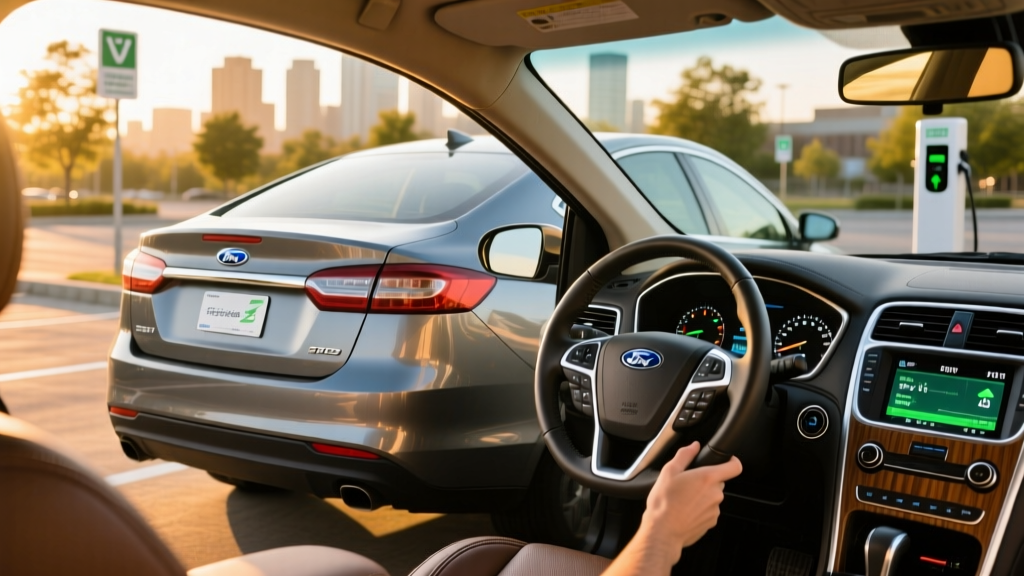
The 2013 Ford Fusion SE Hybrid arrived as Ford's second-generation hybrid midsize sedan, competing head-on with the Toyota Camry Hybrid and Hyundai Sonata Hybrid. Over a decade later, it remains a popular used-hybrid option for buyers seeking proven fuel economy without plug-in complexity. This guide covers the real-world ownership picture — MPG, battery longevity, reliability, and whether this first-gen Fusion Hybrid still makes sense in 2026.
2013 Ford Fusion SE Hybrid: Key Specifications at a Glance
| Specification | Value |
|---|---|
| Powertrain | 2.0L Atkinson-cycle I-4 + electric motor (HEV) |
| Combined Horsepower | 188 hp (net system) |
| Engine Output | 141 hp @ 6,000 rpm / 129 lb-ft torque |
| Electric Motor Output | 118 hp / 117 lb-ft torque |
| Transmission | eCVT (planetary gearset, no fixed gears) |
| Hybrid Battery | 1.4 kWh lithium-ion (air-cooled) |
| EPA MPG (City / Highway / Combined) | 44 / 41 / 44 |
| Fuel Tank Capacity | 13.5 gallons |
| EPA Estimated Range | ~594 miles per tank |
| 0–60 mph | ~8.1 seconds |
| Cargo Volume | 12.0 cu ft (trunk) |
| Original MSRP (2013 SE Hybrid) | $27,200 (base) |
| Used Price Range (2026) | $6,500–$10,500 depending on mileage/condition |
How Many MPG Does the 2013 Fusion SE Hybrid Actually Get?
The EPA rates the 2013 Ford Fusion SE Hybrid at 44 MPG city, 41 MPG highway, and 44 MPG combined. That city-higher-than-highway split is a hallmark of conventional hybrids: regenerative braking and electric-motor assist shine in stop-and-go traffic, while the gasoline engine bears more load at sustained highway speeds.
| Driving Scenario | EPA Estimate | Real-World Expectation |
|---|---|---|
| City (stop-and-go) | 44 MPG | 42–48 MPG (often exceeds EPA) |
| Highway (70+ mph) | 41 MPG | 36–40 MPG (aero drag, engine-dominant) |
| Combined | 44 MPG | 39–45 MPG depending on mix |
| Cold Weather (below 30°F) | — | 34–38 MPG (engine runs more for cabin heat) |
Real-world note: Owners who drive predominantly in city conditions frequently report exceeding the EPA city estimate, sometimes hitting 46–48 MPG on flat urban routes in mild weather. Highway-heavy commuters should plan on 37–40 MPG. Cold weather hits all hybrids hard — the engine runs more frequently to maintain cabin heat and battery temperature, dropping economy by 10–15%. Source: fueleconomy.gov.
HEV vs. PHEV: Understanding What the 2013 Fusion Hybrid Is (and Isn't)
A common source of confusion: Ford sold two electrified Fusion variants in the 2013 model year — the Fusion Hybrid (HEV) and the Fusion Energi (PHEV). They are fundamentally different vehicles. The SE Hybrid badge refers to the conventional HEV.
| Feature | Fusion Hybrid (HEV) | Fusion Energi (PHEV) |
|---|---|---|
| Plugs in to charge? | No — self-charging via engine + regen | Yes — Level 1 (120V) or Level 2 (240V) |
| Battery Size | 1.4 kWh lithium-ion | 7.6 kWh lithium-ion |
| Electric-Only Range | ~0.5–1 mile at low speed | ~19 miles (EPA rated) |
| Combined MPG / MPGe | 44 MPG combined | 100 MPGe (electric) / 38 MPG (gas only) |
| DC Fast Charging | Not applicable | No DC fast charge capability |
| Level 2 Charge Time | Not applicable | ~2.5 hours (240V, 3.3 kW onboard charger) |
| Trunk Space | 12.0 cu ft | 8.2 cu ft (battery intrusion) |
| 2013 Original MSRP | $27,200 | $38,700 (before incentives) |
Bottom line: The 2013 Fusion SE Hybrid is a conventional HEV. You never plug it in. It generates all its electricity internally through the gasoline engine and regenerative braking. If you're looking for plug-in electric-only driving, you'd need the Fusion Energi — a separate, more expensive model with its own trade-offs (notably reduced trunk space).
Powertrain Deep Dive: How the 2013 Fusion Hybrid Drives
Ford paired a 2.0-liter Atkinson-cycle four-cylinder engine with a permanent-magnet electric motor through an eCVT (electronically controlled continuously variable transmission). Unlike a belt-driven CVT found in some competitors, Ford's eCVT uses a planetary gearset that blends engine and motor power seamlessly — there are no fixed gear ratios and no rubber-band acceleration feel.
Combined system output is 188 horsepower, which is adequate for daily commuting and highway merging but won't feel sporty. The 0–60 mph time of roughly 8.1 seconds places it mid-pack among 2013 midsize sedans. Where the powertrain excels is low-speed smoothness: the electric motor handles initial acceleration from stops, and the engine engages progressively. At low speeds (typically under 25 mph on flat ground with light throttle input), the car can operate in EV mode for short distances — roughly half a mile to a mile — before the engine restarts.
The transition between electric and gas power is generally well-managed, though some owners note the engine can be audible when it kicks on at low speeds, especially when the battery is depleted or the climate system demands heat. Ford's SmartGauge instrument cluster with EcoGuide coach marks helps drivers maximize electric-mode operation and regenerative braking efficiency.
Battery Health, Warranty, and Replacement Cost
2013 Fusion Hybrid Battery Warranty (Original)
- Coverage: 8 years / 100,000 miles (10 years / 150,000 miles in CARB states — CA, NY, MA, and others adopting California emissions standards)
- Capacity Threshold: Ford warranted the battery against failure or significant capacity loss that impairs hybrid system function
- Current Status (2026): Original factory warranty has expired for all 2013 models. Any remaining coverage would be from an extended warranty purchased separately.
Is the 2013 Fusion Hybrid reliable? The 2013 Fusion Hybrid has a generally solid reliability record. The 2.0L Atkinson-cycle engine is relatively low-stress, and Ford's eCVT planetary gearset has proven durable — it lacks the wear-prone belts or cones of other CVT designs. The most common age-related concerns are standard for a 12–13-year-old vehicle: suspension bushings, brake components (though regen braking extends pad life significantly), and 12V auxiliary battery replacement.
Hybrid battery replacement cost: If the 1.4 kWh lithium-ion traction battery fails out of warranty, expect to pay $2,000–$3,500 for a refurbished or aftermarket replacement including labor at an independent hybrid specialist. A new OEM battery from a Ford dealer typically runs $3,500–$5,000+ installed. Third-party rebuild services (which replace degraded cells within the existing pack casing) can bring costs to the lower end of that range. Given the car's current used value of $6,500–$10,500, a full OEM battery replacement represents a significant percentage of the vehicle's worth — something to factor into your purchase decision.
Practical tip for used buyers: Before purchasing, have a hybrid-qualified mechanic perform a battery health check. Tools like Ford's IDS scanner or aftermarket OBD-II readers with hybrid data capability can report battery state of health (SoH), internal resistance, and cell voltage variance. A pack with cell imbalance exceeding 0.2–0.3V between modules is a red flag. Also check whether the vehicle was originally sold in a CARB state, as those units received the longer 10-year/150,000-mile battery warranty — though even that has now expired for 2013 models.
Tax Credits and Incentives: What Applies in 2026?
Federal tax credit: The 2013 Ford Fusion Hybrid does not qualify for the federal §30D new clean vehicle tax credit. That credit applies only to new vehicle purchases meeting current battery sourcing, MSRP, and buyer income requirements — and it has always been limited to plug-in vehicles (PHEVs and BEVs) with battery capacity of at least 7 kWh. The Fusion Hybrid's 1.4 kWh battery never qualified. The Fusion Energi (PHEV) originally qualified for up to $3,750 in federal credit when new, but that incentive is long expired for 2013 purchases.
Used EV/PHEV credit (§25E): The federal used clean vehicle credit (up to $4,000 or 30% of sale price, whichever is less) applies only to used BEVs and PHEVs — not conventional hybrids. Neither the Fusion Hybrid nor the Fusion Energi typically qualifies because the Energi's original MSRP and battery sourcing requirements create eligibility complications. Consult IRS guidance on the §25E credit or a tax professional before assuming eligibility.
State incentives: Some states offer modest incentives for used hybrid purchases, though these are far less common than EV/PHEV incentives. Check your state's energy office or DMV for current programs. Most state-level hybrid incentives have sunset as policy focus shifted to full electrification.
Who Should Buy the 2013 Fusion Hybrid — and Who Shouldn't
Pros
- 44 MPG combined real-world — excellent for a midsize sedan, especially in city driving
- No plug-in requirement — ideal for apartment dwellers or those without home charging access
- Smooth eCVT with no fixed-gear shift shock
- Strong regenerative braking extends brake pad life (many owners report 80,000+ miles on original pads)
- Competitive used pricing ($6,500–$10,500) with low running costs
- Spacious 12 cu ft trunk (no battery intrusion unlike the Energi PHEV)
Cons
- Original battery warranty has expired — replacement is a $2,000–$5,000 risk
- Highway MPG drops to 36–40 real-world — less advantage on long commutes
- Cold-weather fuel economy penalty of 10–15%
- No EV-only driving beyond very short, low-speed bursts
- No federal or state tax credits available on used purchase
- 12-year-old vehicle — expect age-related maintenance (suspension, seals, electronics)
Decision Framework: Hybrid vs. PHEV vs. Full EV
- Choose this HEV (2013 Fusion Hybrid) if: You want maximum MPG without changing your fueling habits, lack access to home or workplace charging, drive a city-heavy commute, and want a sub-$10,000 sedan with low running costs.
- Choose a used PHEV (e.g., Fusion Energi, Prius Prime) if: You have reliable Level 2 charging access at home or work, your daily commute is under 20–25 miles (covering most trips on electricity), and you want to reduce fuel consumption dramatically while retaining gas-engine flexibility for road trips.
- Choose a full EV (BEV) if: You have home Level 2 charging, want the lowest per-mile energy cost (~$0.04–$0.06/mile vs. ~$0.09/mile for this hybrid at $3.50/gal), are eligible for federal/state EV incentives on a new or qualifying used purchase, and your daily driving is within the vehicle's range.
Ownership Costs: What to Budget in 2026
At 44 MPG combined and a national average regular gas price of approximately $3.20/gallon (early 2026), the Fusion Hybrid costs roughly $0.073 per mile in fuel. Compare that to a comparable 2013 gas-only midsize sedan at 28 MPG combined: $0.114 per mile. Over 15,000 miles per year, that's a fuel savings of about $615 annually.
Insurance for a 2013 Fusion Hybrid runs roughly $900–$1,300/year depending on your profile and state — generally comparable to the gas model since the vehicle's value is modest. Maintenance costs are typically lower than gas counterparts: no transmission fluid changes on the eCVT (Ford specifies lifetime fluid), extended brake pad life from regen, and no starter motor to replace. Budget $500–$800/year for routine maintenance (oil changes every 7,500–10,000 miles, tire rotation, cabin filter, fluid checks).
The financial wildcard remains the hybrid battery. While many 2013 Fusion Hybrids are still running on their original packs at 120,000–180,000+ miles, lithium-ion degradation is a function of both age and heat exposure. Vehicles that spent years in hot climates (AZ, TX, FL) face higher battery degradation risk. Setting aside $2,000–$3,000 as a contingency reserve is prudent for any used hybrid purchase of this age.
Frequently Asked Questions
How many MPG does the 2013 Ford Fusion SE Hybrid get?
The EPA rates it at 44 MPG city, 41 MPG highway, and 44 MPG combined. In real-world driving, city commuters often see 42–48 MPG, while highway-heavy drivers should expect 36–40 MPG. Cold weather can reduce economy to 34–38 MPG.
Does the 2013 Fusion SE Hybrid need to be plugged in?
No. The Fusion SE Hybrid is a conventional hybrid (HEV). It charges its 1.4 kWh battery internally through the gasoline engine and regenerative braking. You fuel it exactly like a regular gas car. The separate Fusion Energi model is the plug-in variant.
How far can the 2013 Fusion Hybrid drive on electric power alone?
Under very light throttle at low speeds (under ~25 mph on flat ground), the Fusion Hybrid can operate in EV mode for roughly 0.5 to 1 mile. This is not meaningful electric-only range — it's designed to smooth out stop-and-go operation and reduce fuel consumption in traffic, not to replace gasoline driving.
Is the 2013 Fusion Hybrid reliable, and what does a battery replacement cost?
The 2013 Fusion Hybrid has a solid reliability record. The eCVT planetary gearset is durable, and the Atkinson-cycle engine runs under lower thermal stress than conventional engines. The main concern at this age is hybrid battery health. Replacement costs range from $2,000–$3,500 (refurbished/aftermarket) to $3,500–$5,000+ (new OEM from a dealer). Many original batteries are still functioning at 150,000+ miles, but a pre-purchase battery health scan is strongly recommended.
Does the 2013 Ford Fusion Hybrid qualify for any tax credit in 2026?
No. Conventional hybrids (HEVs) do not qualify for the federal §30D new vehicle credit or the §25E used clean vehicle credit. Those credits are reserved for plug-in vehicles (PHEVs and BEVs) meeting specific battery capacity, sourcing, MSRP, and income requirements. Some states may offer minor incentives — check your state energy office for current programs.
What is the difference between the Fusion Hybrid and Fusion Energi?
The Fusion Hybrid (HEV) has a 1.4 kWh battery, does not plug in, and gets 44 MPG combined. The Fusion Energi (PHEV) has a 7.6 kWh battery, plugs into Level 1 or Level 2 charging, offers about 19 miles of electric-only range, and gets 38 MPG once the battery is depleted. The Energi also sacrifices trunk space (8.2 cu ft vs. 12.0 cu ft) due to the larger battery.
How does the 2013 Fusion Hybrid compare to a 2013 Toyota Camry Hybrid?
The 2013 Camry Hybrid is rated at 41 MPG combined (40 city / 39 highway per fueleconomy.gov), slightly below the Fusion Hybrid's 44 combined. The Camry Hybrid typically commands a premium on the used market due to Toyota's reputation for hybrid battery longevity. Both are strong used hybrid choices — the Fusion offers better city MPG and a more engaging interior, while the Camry offers a slight edge in long-term battery track record and resale value.
What should I check before buying a used 2013 Fusion Hybrid?
Prioritize: (1) a hybrid battery health scan showing cell voltage balance and state of health, (2) maintenance records confirming regular oil changes, (3) brake pad thickness (regen braking should yield long pad life, but verify), (4) 12V battery age (a weak 12V battery can cause hybrid system errors), and (5) check for any open recalls via NHTSA's recall lookup.