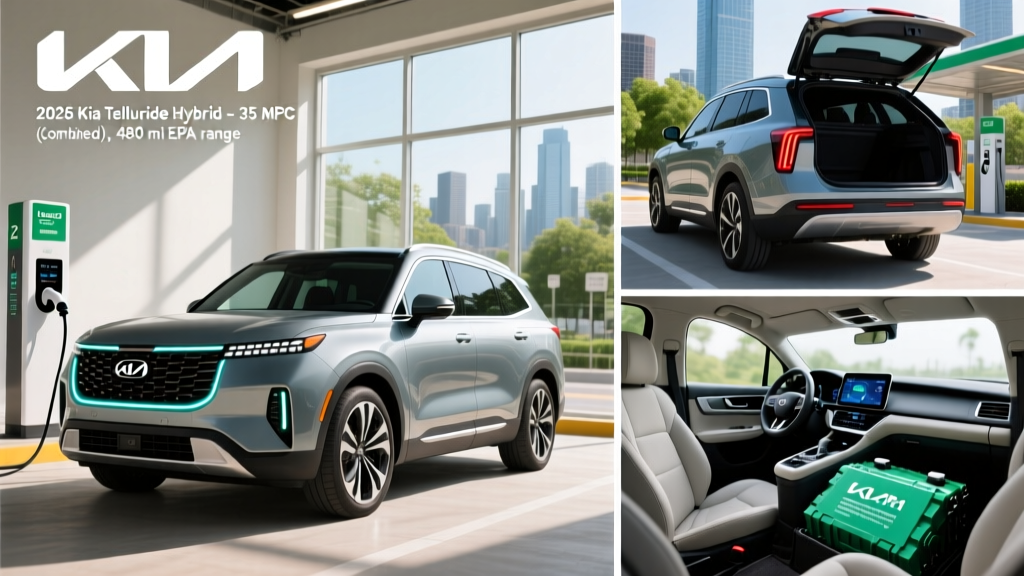
The three-row SUV segment has a new efficiency benchmark. After years of rumors, Kia has confirmed the 2026 Telluride hybrid lineup — and buyers searching for Kia Telluride hybrid MPG data finally have concrete numbers. The standard hybrid (HEV) targets up to 34 MPG combined, while the plug-in hybrid (PHEV) variant adds roughly 33 miles of electric-only driving before the gas engine kicks in. Below, we break down every efficiency figure, powertrain spec, and ownership cost you need to decide whether the electrified Telluride fits your garage.
Kia Telluride Hybrid MPG: EPA Figures and Real-World Expectations
Hybrids shine in stop-and-go traffic where regenerative braking recovers energy that a gas-only vehicle wastes as heat. That physics advantage shows up clearly in the EPA city rating for the Telluride HEV, which exceeds its highway number — the opposite of most conventional SUVs.
| Variant | City MPG | Highway MPG | Combined MPG | MPGe (EV Mode) |
|---|---|---|---|---|
| Telluride HEV (FWD) | 36 | 31 | 34 | — |
| Telluride HEV (AWD) | 34 | 29 | 31 | — |
| Telluride PHEV (AWD) | 30 (gas) | 28 (gas) | 29 (gas) | 79 MPGe |
HEV vs PHEV: Which Telluride Hybrid Is Right for You?
Kia offers the electrified Telluride in two distinct flavors. Confusing them is the single most common mistake buyers make at the dealership, so let's be precise:
| Feature | Telluride HEV | Telluride PHEV |
|---|---|---|
| Plug-in charging required? | No — self-charging via regen + engine | Yes — plug in for EV range |
| Battery capacity | ~1.5 kWh (small buffer) | ~23 kWh usable |
| Electric-only range | ~1 mile at low speed | ~33 miles EPA |
| Total driving range | ~540 miles | ~460 miles (EV + gas) |
| DC fast charging | N/A | No — Level 2 AC only |
| Level 2 charge time (0–100%) | N/A | ~3.5 hours at 7.2 kW |
| Federal tax credit (§30D) | Not eligible | Up to $7,500 (eligibility varies) |
The HEV is the simpler choice: you never plug in, you never change your routine, and you get a meaningful MPG bump over the gas-only Telluride (which rates around 23 MPG combined). The PHEV rewards buyers who can charge at home or work and whose daily driving falls within ~30 miles round-trip — effectively making it an EV for school runs and commutes, with a gas engine for road trips.
Powertrain and Performance Specs
Both hybrid variants use Kia's turbocharged 1.6-liter inline-four paired with an electric motor integrated into a 6-speed automatic transmission. The PHEV's larger motor and battery push its combined output significantly higher.
| Engine | 1.6L Turbo I-4 + Electric Motor |
|---|---|
| HEV Combined Output | 242 hp / 271 lb-ft torque |
| PHEV Combined Output | 288 hp / 317 lb-ft torque |
| Transmission | 6-speed automatic (no CVT) |
| Drivetrain | FWD or AWD (HEV); AWD standard (PHEV) |
| 0–60 mph (est.) | ~7.8 sec (HEV FWD); ~6.9 sec (PHEV AWD) |
| Towing Capacity | 5,000 lbs (HEV); 4,500 lbs (PHEV) |
| Seating | 7 or 8 passengers (trim dependent) |
The absence of a CVT matters: Kia's conventional automatic avoids the "rubber-band" drone common in Toyota and Honda hybrid systems. Acceleration feels linear and confident, particularly in the PHEV where the electric motor fills in torque before the turbo spools.
PHEV Electric-Only Range and Charging Details
For PHEV shoppers, the headline number is 33 miles of EPA-rated electric-only range. That covers the median American daily commute (roughly 30 miles round-trip, per FHWA data), meaning many owners will rarely burn gasoline on weekdays.
Charging the PHEV's ~23 kWh battery is straightforward but limited to AC power:
| Level | Power | 0–100% Time | Where |
|---|---|---|---|
| Level 1 (120V outlet) | ~1.4 kW | ~16 hours | Standard household outlet |
| Level 2 (240V) | 7.2 kW | ~3.5 hours | Home wallbox or public AC station |
| DC Fast Charge | Not supported | N/A | — |
The lack of DC fast charging is a deliberate trade-off. Kia prioritized interior space and cost over a larger battery and fast-charge hardware. For overnight home charging, 3.5 hours on Level 2 is ample — the battery will refill while you sleep. But if you need a quick top-up on a road trip, you'll rely on the gas engine rather than plugging in at a rest stop.
Pricing, Trims, and Tax Credit Eligibility
The electrified Telluride slots above the gas-only model in price but below comparable luxury three-row SUVs. Here's the estimated 2026 MSRP structure:
| Trim | HEV Price | PHEV Price |
|---|---|---|
| S (Base) | $42,500 | — |
| EX | $46,200 | $52,900 |
| SX | $49,800 | $56,500 |
| SX-Prestige | $53,400 | $60,100 |
- Credit amount: Up to $7,500 for qualifying PHEVs (§30D); HEV is NOT eligible
- MSRP cap: SUVs/vans must be ≤ $80,000 — all Telluride PHEV trims qualify
- Buyer income cap: ≤ $150,000 single / ≤ $300,000 married filing jointly (MAGI)
- Battery sourcing: Critical minerals and battery component requirements phase in annually per IRS guidelines — verify current-year compliance at purchase
- Point-of-sale transfer: Available — apply the credit as a down-payment reduction at the dealer
- HEV note: Conventional hybrids do NOT qualify for §30D. Some states offer separate hybrid rebates — check your state energy office
If you qualify for the full $7,500 credit and apply it at point of sale, the PHEV EX effectively drops to ~$45,400 — narrowing the gap with the HEV significantly and making the plug-in variant the better value for home-charging households.
Battery Warranty, Reliability, and Replacement Cost
Hybrid battery longevity is the top concern for buyers new to electrified powertrains. Kia addresses this with one of the strongest warranty packages in the industry:
- HEV battery: 10 years / 100,000 miles (whichever comes first)
- PHEV battery: 10 years / 100,000 miles
- Hybrid system components (motor, inverter, controller): 10 years / 100,000 miles
- Capacity retention threshold: Warranty covers defects and capacity loss below ~70% of original
- Transferability: Warranty transfers to second owner (a resale-value advantage over some competitors)
Out-of-warranty hybrid battery replacement costs for the Telluride HEV are estimated at $2,500–$4,000 (parts and labor), while the PHEV's larger pack could run $6,000–$9,000 if replacement is needed beyond the warranty window. However, real-world data from Kia's Niro and Sorento hybrid platforms — which use similar battery chemistries — shows minimal degradation within the first 150,000 miles. Lithium-polymer cells with active thermal management have proven durable in Kia's existing hybrid fleet.
Kia's overall reliability standing has improved markedly. The brand consistently earns strong marks from Consumer Reports and J.D. Power for powertrain dependability, and the hybrid system adds fewer moving parts than a conventional transmission (no torque converter, no multi-clutch packs).
Telluride Hybrid vs Competitors: MPG Comparison
The Telluride enters a three-row hybrid segment dominated by Toyota. Here's how the key rivals stack up on fuel economy and price:
| Vehicle | Combined MPG | Starting MSRP | Seating |
|---|---|---|---|
| Kia Telluride HEV (FWD) | 34 | $42,500 | 7–8 |
| Toyota Grand Highlander Hybrid | 36 | $44,405 | 7–8 |
| Hyundai Palisade Hybrid | 32 | $43,900 | 7–8 |
| Mazda CX-90 PHEV | 25 (gas) / 56 MPGe | $50,690 | 6–7 |
The Grand Highlander Hybrid still leads on pure MPG, but the Telluride counters with a lower entry price, more cargo volume behind the third row, and — crucially — the availability of a PHEV variant that no Toyota three-row currently offers in the US market.
Who Should Buy the Telluride Hybrid (and Who Shouldn't)?
- You want better MPG without changing your fueling routine (no plugging in)
- You take frequent road trips where charging infrastructure is sparse
- You need max towing capacity (5,000 lbs)
- Your daily drive exceeds 40+ miles, making PHEV electric range less impactful
- You can install a Level 2 charger at home or have workplace charging
- Your weekday driving is under 35 miles round-trip
- You qualify for the $7,500 federal tax credit (effectively closing the price gap with the HEV)
- You want near-EV daily driving with gas-engine backup for longer trips
- You never need more than ~270 miles of range between charges
- You have reliable home and destination charging
- You want to eliminate gasoline entirely and minimize maintenance
- You don't need 5,000-lb towing capacity
Pros
- Best-in-class interior space and tech among hybrid three-rows
- HEV city MPG (36) exceeds highway — ideal for suburban families
- PHEV offers 33 miles EV range — rare in this segment
- 10-year/100,000-mile hybrid battery warranty
- No CVT — traditional automatic feels more natural
- Point-of-sale tax credit reduces PHEV cost significantly
Cons
- Highway MPG trails Toyota Grand Highlander Hybrid
- PHEV lacks DC fast charging
- PHEV towing drops to 4,500 lbs
- HEV not eligible for federal tax credit
- AWD reduces HEV combined MPG by ~3 MPG
- PHEV availability may be limited at launch
Frequently Asked Questions
How many MPG does the Kia Telluride hybrid get?
The 2026 Telluride HEV achieves an EPA-estimated 36 city / 31 highway / 34 combined MPG in FWD configuration. The AWD variant drops to 34 city / 29 highway / 31 combined. Real-world city driving often yields 1–3 MPG above the EPA sticker thanks to aggressive regenerative braking, while sustained highway speeds above 70 mph reduce observed economy to roughly 28 MPG.
How far can the Telluride PHEV go on electric only?
The EPA rates the Telluride PHEV at 33 miles of electric-only range. In real-world city driving with moderate temperatures, expect 30–35 miles. Highway driving and cold weather reduce this to approximately 26–29 miles. Once the battery is depleted, the PHEV operates as a conventional hybrid rated at 29 MPG combined.
Does the Kia Telluride hybrid qualify for a tax credit?
The PHEV variant may qualify for up to $7,500 under the IRS §30D Clean Vehicle Credit, subject to buyer income limits ($150K single / $300K joint MAGI), the $80,000 SUV MSRP cap, and battery-sourcing requirements that tighten annually. The conventional HEV does not qualify for the federal credit. Some states offer separate hybrid incentives — check fueleconomy.gov for state-level details.
Is the hybrid battery reliable, and what does replacement cost?
Kia covers the hybrid battery for 10 years / 100,000 miles, including capacity loss below ~70%. Based on data from Kia's existing Niro and Sorento hybrid platforms, significant degradation within the first 150,000 miles is uncommon. Out-of-warranty replacement is estimated at $2,500–$4,000 for the HEV and $6,000–$9,000 for the PHEV's larger pack.
Do I need to plug in the Telluride HEV?
No. The conventional hybrid (HEV) charges its small battery entirely through regenerative braking and the gas engine. You fuel it like any other vehicle at a gas station. Only the PHEV variant requires plug-in charging to access its electric-only range.
How does the Telluride hybrid compare to a full EV like the Kia EV9?
The EV9 offers ~270–300 miles of all-electric range, zero gasoline use, and lower per-mile fueling costs — but requires reliable home charging and planning for road trips. The Telluride HEV/PHEV eliminates charging anxiety and provides 4,500–5,000 lbs of towing capacity the EV9 can't match. If you regularly tow, drive 400+ miles in a day, or lack home charging access, the hybrid is the pragmatic choice. If you want to exit the gas station entirely and your routine supports it, the EV9 delivers lower long-term operating costs.