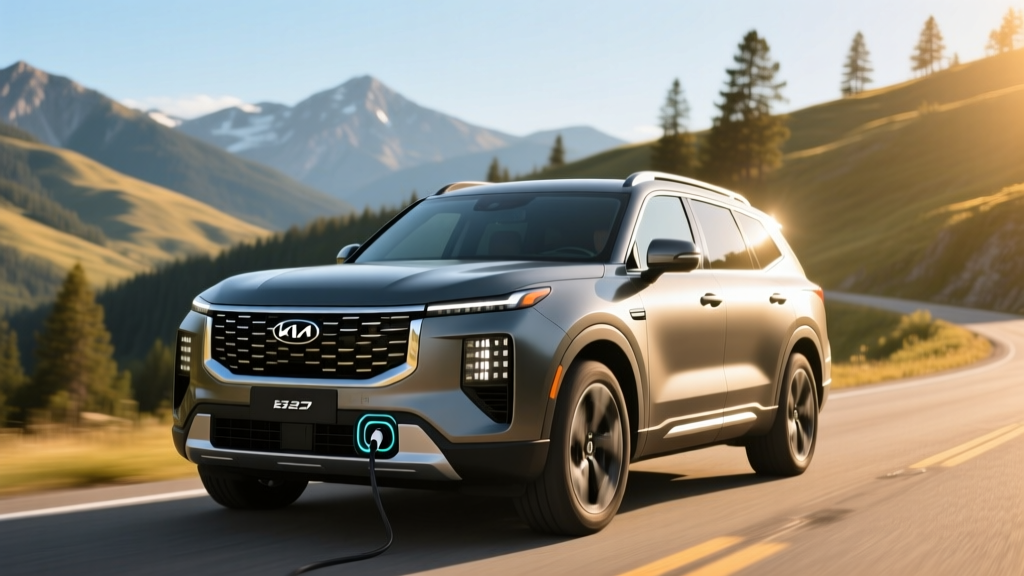
The Kia Telluride has been a three-row SUV benchmark since its debut, but one thing it has never offered in the U.S. market: a hybrid powertrain. That's expected to change with the next-generation model. Searches for the Kia Telluride 2027 hybrid have surged as buyers look for a fuel-efficient family hauler that doesn't require going full electric. Here's what we know — and what remains preliminary — about Kia's hybrid flagship.
Why a Hybrid Telluride Matters Now
The current fourth-generation Telluride (introduced for 2023) offers a 3.8L V6 making 291 hp and returns an EPA-estimated 23 MPG combined (20 city / 26 highway) in front-wheel-drive form. That's respectable for a 4,500-pound SUV, but it trails the hybridized competition. The Toyota Grand Highlander Hybrid achieves 36 MPG combined, and the Mazda CX-90 PHEV delivers 56 MPGe with 26 miles of electric-only range.
A hybrid Telluride would close that gap while preserving the towing capacity, cargo volume, and interior space that made it an IIHS Top Safety Pick favorite. For buyers who aren't ready for a full BEV but want meaningful fuel savings, the timing aligns with rising fuel costs and tighter CAFE standards pushing automakers toward electrification across their lineups.
HEV vs PHEV: Which Telluride Hybrid Is Coming?
Industry reporting and Kia's global powertrain strategy suggest the U.S. market will receive both a conventional hybrid (HEV) and a plug-in hybrid (PHEV) variant. Understanding the difference is essential before you decide which to wait for.
Conventional Hybrid (HEV)
- No plug required — charges via regenerative braking and the engine
- Smaller battery (~1.5–2.0 kWh)
- Lower cost, simpler ownership
- No electric-only driving beyond very low-speed creep
- Target: buyers without home charging access
Plug-In Hybrid (PHEV)
- Plugs into a Level 1 or Level 2 charger
- Larger battery (~18–25 kWh estimated)
- 30–40 miles of electric-only range
- Higher upfront cost, potential tax credit eligibility
- Target: buyers with home charging and short commutes
Kia currently uses a 1.6L turbocharged four-cylinder hybrid architecture in the Sorento HEV and PHEV. The Telluride, being larger and heavier, is expected to receive a more potent version — likely a 2.5L turbocharged four-cylinder paired with an electric motor, similar to what Hyundai has deployed in the Santa Fe Hybrid and the Palisade in select markets.
Estimated MPG and Efficiency
Based on Kia's existing hybrid systems and the Telluride's weight class, here are our projected EPA figures. We'll update these when official numbers are published on fueleconomy.gov.
| Powertrain | City MPG | Highway MPG | Combined MPG | MPGe (PHEV) |
|---|---|---|---|---|
| HEV (est.) | 33–35 | 30–32 | 32–34 | N/A |
| PHEV (est., charge-depleting) | — | — | — | 50–58 |
| PHEV (est., charge-sustaining / gas only) | 28–30 | 27–29 | 28–29 | N/A |
Powertrain and Performance Specs
| Specification | HEV (Est.) | PHEV (Est.) |
|---|---|---|
| Engine | 2.5L turbo I-4 | 2.5L turbo I-4 |
| Engine HP | ~277 hp | ~277 hp |
| Electric Motor | ~60 hp (integrated) | ~95 hp |
| Combined System Output | ~320 hp | ~360 hp |
| Transmission | 6-speed auto | 6-speed auto |
| Drivetrain | FWD / AWD | AWD standard |
| 0–60 mph (est.) | ~6.8 sec | ~6.2 sec |
| Towing Capacity (est.) | 5,000 lbs | 5,000 lbs |
The PHEV variant's larger electric motor provides stronger low-end torque, which should make it feel noticeably quicker off the line than the HEV — an advantage in merging and passing situations. Both should retain the current Telluride's 5,000-pound towing rating, though expect a slight reduction in range when towing near capacity.
PHEV Battery, Electric Range, and Charging
For the plug-in hybrid variant, the battery is the critical differentiator. Based on Kia's current PHEV architecture (used in the Sorento PHEV with a 13.8 kWh pack), the Telluride PHEV is expected to feature a significantly larger battery to move its greater mass.
Estimated Battery & Range
- Battery capacity: ~20–25 kWh (usable)
- Chemistry: NMC (nickel manganese cobalt)
- Electric-only range: 32–40 miles (EPA est.)
- Total combined range: ~450–500 miles (electric + gas)
Charging Times
- Level 1 (120V, 1.4 kW): ~14–18 hours (0–100%)
- Level 2 (240V, 7.2 kW): ~3–4 hours (0–100%)
- DC fast charging: Not expected — most PHEVs in this class omit DC capability
The lack of DC fast charging is typical for PHEVs — the Toyota RAV4 Prime, Jeep Wrangler 4xe, and Kia's own Sorento PHEV all rely on Level 2 AC charging only. For most PHEV owners who charge overnight at home, this is not a practical limitation. The 32–40 mile electric range covers the average American's daily round-trip commute (FHWA data shows the average is roughly 30 miles), meaning many owners could run on electricity most weekdays and use gasoline only for longer weekend trips.
Pricing and Tax Credit Eligibility
Official MSRP won't be confirmed until closer to launch, but based on the current Telluride's pricing ladder and the premium Kia charges for hybrid powertrains in the Sorento lineup, here are projected starting prices by trim:
| Trim | HEV Est. MSRP | PHEV Est. MSRP |
|---|---|---|
| S / Base | $42,000–$44,000 | — |
| EX | $46,000–$48,000 | $52,000–$54,000 |
| SX | $50,000–$52,000 | $56,000–$58,000 |
| SX-Prestige | $54,000–$56,000 | $60,000–$63,000 |
Does the Telluride Hybrid Qualify for a Federal Tax Credit?
Under current IRS §30D rules, only the PHEV variant would potentially qualify for a federal clean vehicle credit — conventional HEVs do not qualify. However, eligibility is far from guaranteed and depends on several factors that Kia must certify at the time of sale:
- MSRP cap: SUVs must be priced at or below $80,000 — the Telluride PHEV should clear this.
- Buyer income cap: Modified AGI ≤ $150,000 (single) / $300,000 (joint).
- Battery sourcing: Critical minerals and battery components must meet escalating domestic/free-trade-partner percentages. This is the wildcard — many Hyundai/Kia models have struggled with this requirement.
- Point-of-sale transfer: If eligible, the credit can be applied as a discount at the dealer rather than waiting for tax filing.
- Final assembly: Must occur in North America. If the Telluride continues to be built in West Point, Georgia, this requirement is met.
Based on Kia's recent track record with the Sorento PHEV and EV6 credit eligibility, expect the Telluride PHEV to qualify for a partial credit ($3,750) if battery component sourcing falls short of the critical minerals threshold, or the full $7,500 if Kia secures compliant supply chains by 2027. Consult a tax professional and check the IRS's updated qualifying vehicle list at purchase time — these rules change frequently.
Battery Warranty and Long-Term Reliability
Battery Warranty Coverage (Projected)
Hybrid battery: 10 years / 100,000 miles (capacity retention above 70% of original)
Powertrain: 10 years / 100,000 miles
Bumper-to-bumper: 5 years / 60,000 miles
Kia has offered this warranty structure across its hybrid lineup for years, and there's no indication the Telluride will differ. This is among the strongest hybrid battery warranties in the industry — Toyota offers 10 years / 150,000 miles on hybrid batteries, while most competitors match Kia's 10/100,000.
Is the Hybrid System Reliable?
Kia's hybrid systems have proven generally dependable. The Sorento Hybrid and PHEV, which share the core architecture the Telluride will use, have not been subject to major battery-related recalls. The 1.6T hybrid system in particular has accumulated millions of real-world miles across the Hyundai/Kia fleet globally.
Hybrid battery replacement cost is a common concern. For context, a Kia Sorento Hybrid battery replacement currently runs $3,000–$5,000 out of warranty. The Telluride's larger pack would likely cost $4,000–$7,000 if replacement is needed after the warranty period. However, modern hybrid batteries rarely require full replacement — individual module repairs or reconditioning often suffice at lower cost. Data from long-term Hyundai/Kia hybrid owners shows typical degradation of 8–12% over 100,000 miles, well within the warranty threshold.
Telluride Hybrid vs. Full EV vs. Gas: Which Should You Choose?
Choose the HEV (Conventional Hybrid) If:
- You don't have access to home or workplace charging
- You want a simple ownership experience — no plugs, no charging apps
- Your budget is tighter and you want the lowest entry price
- You do a mix of city and highway driving and want ~33 MPG without thinking about it
- You tow frequently and want predictable range
Choose the PHEV (Plug-In Hybrid) If:
- You have a garage or driveway where you can install a Level 2 charger
- Your daily commute is under 35 miles round-trip (you'll rarely use gas)
- You want to drive electric most days but need gas flexibility for road trips
- You qualify for the federal tax credit, reducing the price premium
- You want stronger acceleration from the larger electric motor
Consider a Full EV Instead If:
- You have reliable home charging and access to DC fast chargers on your routes
- You want zero tailpipe emissions and minimal maintenance (no oil changes, no engine)
- Your household has a second vehicle for longer trips, or you're comfortable with road-trip charging
- You want the lowest per-mile fuel cost — electricity is typically $0.04–$0.06/mile vs. $0.12–$0.16/mile for a hybrid on gas
What to Watch Before You Buy
Kia is expected to reveal the next-generation Telluride — including full hybrid specs — in late 2026 or early 2027, with U.S. deliveries following shortly after. If you're considering one, here's what to monitor:
- Official EPA certification: Wait for fueleconomy.gov listings before trusting third-party MPG estimates.
- Tax credit status: Check the IRS qualifying vehicle list at the time of purchase — battery sourcing rules tighten annually.
- Third-row and cargo impact: Hybrid batteries are typically mounted under the floor or rear seats. Verify that cargo volume and third-row legroom aren't compromised vs. the gas model.
- AWD system details: Some hybrids use a rear electric motor for AWD rather than a mechanical driveshaft. This can affect towing behavior and off-road capability.
- Real-world charging: For the PHEV, confirm the onboard charger rating (kW) — a 7.2 kW onboard charger fills the battery roughly twice as fast as a 3.3 kW unit.
Frequently Asked Questions
How many MPG does the 2027 Kia Telluride hybrid get?
Based on Kia's current hybrid systems and the Telluride's size, expect the conventional HEV to achieve approximately 32–34 MPG combined (33–35 city, 30–32 highway). The PHEV will deliver roughly 50–58 MPGe when operating on its electric charge, and 28–29 MPG combined in gas-only (charge-sustaining) mode. These are estimates — official EPA numbers will be published closer to launch.
How far can the Telluride PHEV go on electric only?
We estimate 32–40 miles of electric-only range, based on the expected 20–25 kWh battery and the Telluride's weight. That covers most daily commutes without using gasoline. Total combined range (electric + full gas tank) should reach 450–500 miles.
Does the 2027 Telluride hybrid qualify for a tax credit?
Only the PHEV variant could qualify for the federal §30D clean vehicle credit — conventional HEVs are ineligible. The credit amount ($3,750 or $7,500) depends on battery sourcing compliance at time of purchase, and buyer income caps apply ($150K single / $300K joint). State-level incentives may also apply; check your local DMV or energy office for details.
Is the hybrid battery reliable, and what does replacement cost?
Kia's hybrid systems have a strong reliability track record, backed by a 10-year / 100,000-mile hybrid battery warranty. Out-of-warranty replacement for a Telluride-sized pack would likely cost $4,000–$7,000, but full replacements are rare — most issues are resolved with module-level repairs. Expect 8–12% degradation over 100,000 miles based on data from Kia's existing hybrid fleet.
Should I wait for the hybrid or buy the current gas Telluride?
If fuel economy is a priority and you can wait, the hybrid will likely save $800–$1,200 per year in fuel costs over the current V6 (assuming 15,000 miles/year and $3.50/gallon). However, the hybrid will carry a $2,000–$5,000 price premium depending on trim. If you need a vehicle now and your annual mileage is under 10,000 miles, the current gas Telluride remains an excellent three-row SUV with proven reliability.