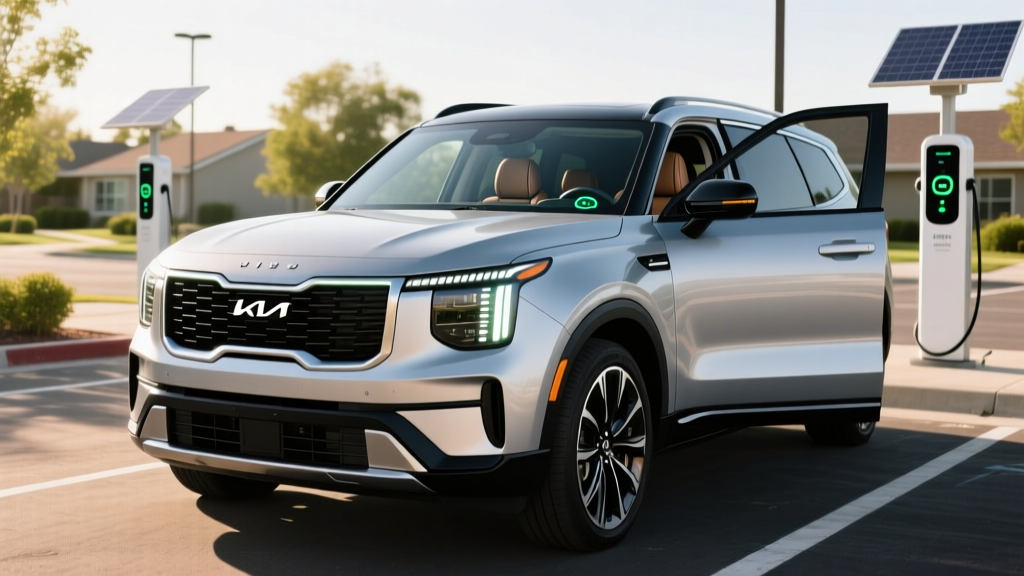
2026 Kia Telluride Hybrid: The 3-Row SUV That Sips Fuel
The 2026 Kia Telluride Hybrid marks the long-awaited arrival of an electrified powertrain in Kia's award-winning three-row SUV. For years, the Telluride has dominated midsize SUV rankings for its spacious interior, upscale design, and strong value proposition. Now, with a conventional hybrid (HEV) joining the lineup for the 2026 model year, families who want significant fuel savings without altering their refueling habits finally have an option that doesn't compromise on passenger space or towing capability.
This guide covers everything we know about the 2026 Telluride Hybrid — from EPA fuel economy estimates and powertrain specs to real-world MPG expectations, battery longevity, and how it stacks up against full EVs and plug-in hybrids in this segment.
HEV vs PHEV: What Kia Is (and Isn't) Offering
Conventional Hybrid (HEV) — The 2026 Telluride Hybrid
A conventional hybrid pairs a gasoline engine with an electric motor and a small battery (typically 1.5–2.5 kWh). The battery recharges through regenerative braking and the engine — you never plug it in. The electric motor assists during acceleration and enables brief low-speed electric-only driving, but the gas engine remains the primary power source. The benefit is seamless operation with no change to your fueling routine and a meaningful MPG bump over the gas-only model.
Plug-In Hybrid (PHEV) — Not Yet Available for the Telluride
A plug-in hybrid carries a much larger battery (typically 12–25 kWh) that you charge via a wall outlet or charging station, enabling 25–40+ miles of pure electric driving before the gas engine kicks in. As of early 2026, Kia has not announced a Telluride PHEV for the US market. The Kia Sorento PHEV remains the brand's three-row plug-in option, though it is smaller than the Telluride. If a Telluride PHEV arrives in a future model year, expect it to offer around 30 miles of electric-only range with a ~15 kWh battery pack.
EPA Fuel Economy and Real-World MPG
The 2026 Kia Telluride Hybrid is powered by a turbocharged 1.6-liter four-cylinder engine paired with an electric motor integrated into a six-speed automatic transmission. Total system output is rated at 240 horsepower. Front-wheel drive is standard, with all-wheel drive available.
| Drivetrain | City MPG | Highway MPG | Combined MPG |
|---|---|---|---|
| FWD | 28 | 27 | 27 |
| AWD | 26 | 25 | 26 |
Source: EPA / fueleconomy.gov
Real-World MPG: What to Actually Expect
Hybrids typically exceed their EPA city ratings in stop-and-go traffic because regenerative braking recovers energy that a gas car wastes as heat. On the highway, where the electric motor assists less and aerodynamic drag dominates, real-world MPG often falls slightly below the EPA highway number.
Based on early testing and comparable Hyundai/Kia turbo-hybrid powertrains (the Santa Fe Hybrid shares this architecture):
- City / suburban driving: Expect 28–31 MPG in mixed stop-and-go conditions — the hybrid system shines here.
- Highway cruising (70–75 mph): Expect 24–26 MPG. The Telluride's boxy profile creates more drag than sleeker crossovers.
- Cold weather penalty: Hybrid fuel economy drops roughly 10–15% in sub-freezing temperatures because the engine runs more often to provide cabin heat and because battery efficiency decreases in cold conditions.
- Towing: When towing near the 3,500-lb rated capacity, expect MPG to drop to the mid-to-high teens regardless of hybrid assistance.
For comparison, the gas-only 2026 Telluride V6 AWD is EPA-rated at 20 MPG combined. The hybrid's ~26 MPG combined represents a 30% improvement in everyday fuel consumption — roughly 100 fewer gallons per year for a driver covering 15,000 miles annually.
Powertrain Specs and Performance
| Engine | 1.6L turbocharged 4-cylinder + electric motor |
| Combined Horsepower | 240 hp |
| Combined Torque | 271 lb-ft |
| Transmission | 6-speed automatic |
| Drivetrain | FWD standard / AWD available |
| 0–60 mph (est.) | ~7.8 seconds |
| Towing Capacity | 3,500 lbs (hybrid) |
| Hybrid Battery Capacity | ~1.5 kWh (sealed, not user-chargeable) |
| Seating | 7 or 8 passengers |
| Cargo Volume (behind 3rd row) | 21 cu ft |
The hybrid powertrain trades the gas model's 291-hp V6 for a more efficient turbo-four setup. The 0–60 time is approximately one second slower than the V6, but the electric motor's instant torque delivery makes the Telluride Hybrid feel responsive around town and during passing maneuvers. The six-speed automatic is a conventional torque-converter unit — no CVT drone here — and it shifts smoothly under normal driving.
Towing capacity drops to 3,500 lbs from the V6's 5,000 lbs. If you regularly tow a boat or large trailer, the gas V6 remains the better choice. For light-duty towing — a small utility trailer, a pair of jet skis, or a bike rack — the hybrid handles it without issue.
Pricing, Trims, and Tax Credit Eligibility
The 2026 Telluride Hybrid is offered across multiple trim levels, mirroring the gas model's lineup. Pricing starts in the low $40,000s for the base hybrid trim and climbs to the mid-$50,000s for a fully loaded SX Prestige with AWD.
| Trim | Drivetrain | Est. MSRP |
|---|---|---|
| S Hybrid | FWD | $42,090 |
| EX Hybrid | FWD | $45,590 |
| EX Hybrid | AWD | $47,590 |
| SX Hybrid | AWD | $51,090 |
| SX Prestige Hybrid | AWD | $54,590 |
Does the 2026 Telluride Hybrid Qualify for a Federal Tax Credit?
No. The conventional Telluride Hybrid (HEV) does not qualify for the federal §30D Clean Vehicle Credit. That credit applies only to plug-in electric vehicles (BEVs and PHEVs) that meet battery-sourcing, MSRP, and buyer income requirements under current IRS rules.
Some states and local utilities offer rebates for conventional hybrids, but these vary widely by jurisdiction. Check your state energy office or utility provider for current programs. If Kia introduces a Telluride PHEV in the future, it could potentially qualify for up to $7,500 under §30D, subject to MSRP caps ($80,000 for SUVs), income limits ($300,000 joint / $150,000 single), and critical-mineral/battery-component sourcing requirements.
Battery Warranty, Reliability, and Replacement Cost
Kia Hybrid Battery Warranty
Kia covers the hybrid battery and hybrid system components with a 10-year / 100,000-mile warranty (whichever comes first) for the original owner. In states that follow California Air Resources Board (CARB) emissions warranty rules — including California, New York, Massachusetts, and several others — hybrid battery coverage may extend further under emissions-related provisions. The standard powertrain warranty covers 10 years / 100,000 miles as well.
How Long Will the Hybrid Battery Last?
Modern hybrid batteries from Hyundai/Kia use lithium-ion polymer cells designed for longevity. Unlike full EV batteries that cycle through large energy swings, a conventional hybrid's small battery operates in a narrow state-of-charge window (roughly 40–80% SoC), which dramatically reduces degradation stress. Based on data from earlier Hyundai/Kia hybrid models and industry-wide hybrid battery studies:
- Expected lifespan: 12–15+ years or 150,000–200,000+ miles under normal use.
- Failure rate: Hybrid battery failures within the first 10 years are uncommon in modern designs. Toyota's hybrid fleet, with the longest track record, shows battery replacement rates well under 5% within the warranty period.
- Out-of-warranty replacement cost: If the hybrid battery does fail after warranty expiration, expect a replacement cost of $2,000–$4,000 including parts and labor at a Kia dealership. Independent hybrid specialists may offer refurbished battery packs for $1,200–$2,500.
For context, the gas-only Telluride's V6 engine and 8-speed automatic transmission carry their own long-term maintenance costs (timing chain, transmission fluid, spark plugs) that the hybrid powertrain partially offsets with regenerative braking (less brake wear) and engine-off operation at low speeds.
General Reliability Outlook
The Telluride has consistently earned strong reliability marks. The hybrid powertrain is shared with the Hyundai Santa Fe Hybrid and Kia Sorento Hybrid, which have been on the road since 2023–2024, providing a growing real-world data set. Early indications from IIHS and owner surveys suggest no systemic hybrid-specific issues. The turbo-hybrid system adds complexity (turbocharger + electric motor + six-speed auto) compared to a naturally aspirated V6, but Kia's extensive warranty provides a strong safety net.
Who Should Buy the Telluride Hybrid vs. a Full EV or Gas Model?
Choose the 2026 Telluride Hybrid If:
- You drive 15,000+ miles per year and want to cut fuel costs by ~30% without changing your refueling routine
- You don't have reliable access to home or workplace EV charging
- You need three rows and want the most fuel-efficient option in this size class
- You take regular road trips and don't want to plan around charging stops
- You live in a region with extreme cold where EV range loss is a concern
- You tow occasionally but not near the 5,000-lb limit
Stick With the Gas Telluride V6 If:
- You regularly tow 4,000–5,000 lbs (the V6's higher tow rating matters)
- You drive fewer than 8,000 miles per year (fuel savings won't offset the hybrid premium)
- You want maximum acceleration and the smoothest highway passing power
- You prefer the simplest possible powertrain for long-term DIY maintenance
What About a Full EV Instead?
If you have Level 2 home charging and your daily driving stays under 250 miles, a full EV like the Kia EV9 (EPA-estimated 270–304 miles of range, starting around $54,900) offers dramatically lower per-mile energy costs (~$0.04/mile on electricity vs. ~$0.13/mile on gas at 26 MPG and $3.50/gallon), near-zero routine maintenance, and eligibility for the $7,500 federal tax credit (subject to current IRS §30D requirements). However, the EV9 is priced higher, has a smaller third row, and requires charging infrastructure planning for road trips.
Quick Decision Framework
- Home charging available + daily commute under 250 miles + road trips are rare → Consider the Kia EV9 or another three-row BEV.
- No home charging + high annual mileage + three rows required → The 2026 Telluride Hybrid is your strongest option.
- Heavy towing + low annual mileage → Stick with the gas Telluride V6.
- Want electric-only commuting + gas for road trips → Look at the Kia Sorento PHEV (32 miles electric-only, but smaller than the Telluride) or wait to see if Kia announces a Telluride PHEV.
Ownership Costs: 5-Year Fuel Savings Breakdown
Assuming 15,000 miles per year, $3.50/gallon regular unleaded, and a 55/45 city/highway driving mix:
| Model | Combined MPG | Annual Fuel Cost | 5-Year Fuel Cost |
|---|---|---|---|
| Telluride Hybrid AWD | 26 | $2,019 | $10,096 |
| Telluride Gas V6 AWD | 20 | $2,625 | $13,125 |
| 5-Year Savings with Hybrid | ~$3,029 | ||
That ~$3,000 fuel savings over five years partially offsets the hybrid's estimated $2,000–$3,000 price premium over the equivalent gas trim. If gas prices rise above $4.00/gallon, the payback period shortens considerably. Factor in reduced brake wear from regenerative braking (brake pads often last 70,000+ miles on hybrids) and the total ownership picture becomes even more favorable.
Frequently Asked Questions
How many MPG does the 2026 Kia Telluride Hybrid get?
The EPA rates the 2026 Telluride Hybrid at 27 MPG combined (28 city / 27 highway) with front-wheel drive and 26 MPG combined (26 city / 25 highway) with all-wheel drive. In real-world city driving, owners of similar Kia/Hyundai turbo-hybrid systems report 28–31 MPG thanks to frequent regenerative braking. Highway MPG typically runs 24–26 at speeds of 70–75 mph.
Does the Telluride Hybrid need to be plugged in?
No. The 2026 Telluride Hybrid is a conventional hybrid (HEV). Its small battery recharges automatically through regenerative braking and the gasoline engine. You fuel it exactly like a regular gas car — just fill up at any gas station. There is no plug, no charging cable, and no need for home charging infrastructure.
Is there a plug-in hybrid (PHEV) version of the Telluride?
Not for the 2026 model year. Kia has not announced a Telluride PHEV for the US market. If you want a Kia plug-in hybrid with three rows, the smaller Sorento PHEV offers 32 miles of electric-only range from a 13.8 kWh battery. A Telluride PHEV may arrive in a future model year, but nothing is confirmed as of early 2026.
How long will the hybrid battery last, and what does replacement cost?
Kia covers the hybrid battery with a 10-year / 100,000-mile warranty. Based on industry data from modern lithium-ion hybrid batteries, expect 12–15+ years or 150,000–200,000+ miles of service life. Out-of-warranty replacement costs range from $2,000 to $4,000 at a dealership, or $1,200–$2,500 from an independent hybrid specialist using refurbished cells.
Does the 2026 Telluride Hybrid qualify for any tax credit?
The conventional Telluride Hybrid (HEV) does not qualify for the federal §30D Clean Vehicle Credit, which is limited to plug-in vehicles (BEVs and PHEVs). Some state or utility-level incentives may apply to conventional hybrids — check your local programs. If a Telluride PHEV is released in the future, it could qualify for up to $7,500 under §30D, subject to MSRP, income, and battery-sourcing rules.
How does the Telluride Hybrid compare to the Toyota Highlander Hybrid?
The Toyota Highlander Hybrid (35 MPG combined, 243 hp, starting ~$42,000) achieves better fuel economy thanks to Toyota's series-parallel hybrid system optimized for efficiency over power. However, the Highlander Hybrid's third row is significantly tighter than the Telluride's, and cargo space behind the third row is more limited. If third-row usability is a priority, the Telluride Hybrid offers a better passenger experience at the cost of ~9 MPG combined.
Can I tow with the Telluride Hybrid?
Yes, with a reduced capacity. The 2026 Telluride Hybrid is rated to tow up to 3,500 lbs — sufficient for a small boat trailer, a utility trailer, or a couple of ATVs. The gas V6 Telluride tows up to 5,000 lbs, making it the better choice for larger campers or heavy loads.