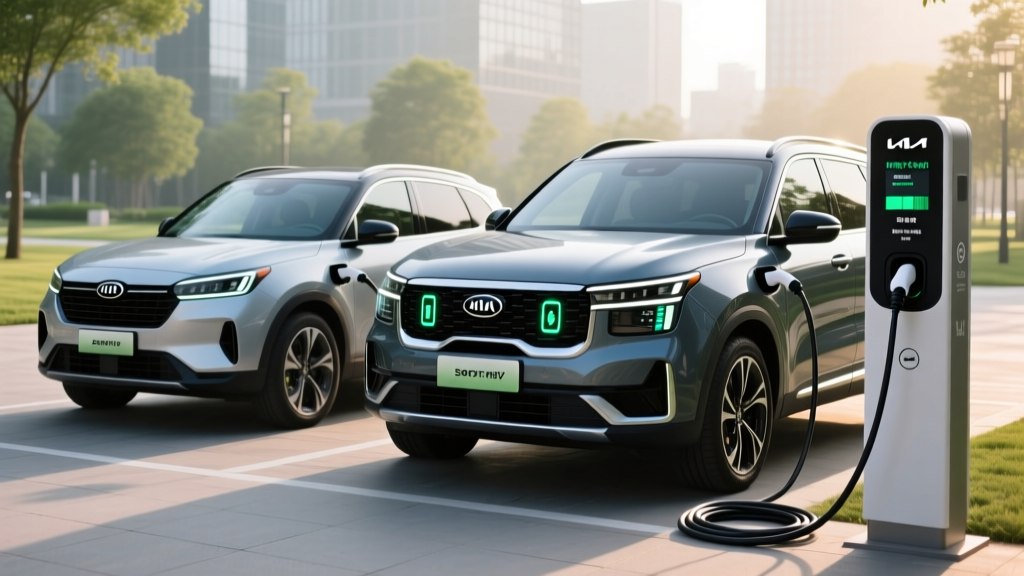
Kia offers two of the most practical plug-in hybrids on the market for 2026: the compact Sportage PHEV and the midsize three-row Sorento PHEV. Both pair a turbocharged gasoline engine with a sizable battery and electric motor, delivering roughly 30–34 miles of electric-only driving before the hybrid powertrain takes over. For buyers who want daily EV commuting without range anxiety on road trips, a Kia plug-in hybrid is a compelling middle ground — but the two models serve very different needs.
This guide breaks down the real numbers behind each 2026 Kia PHEV: EPA efficiency, battery specs, charging times, powertrain output, pricing, federal tax credit eligibility, and long-term reliability. We'll also clarify how Kia's plug-in hybrids differ from its conventional hybrids and full EVs so you can make the right choice.
HEV vs PHEV: What Kia Plug-In Hybrid Buyers Need to Know
Before diving into specs, it's critical to understand the difference between Kia's conventional hybrids and its plug-in hybrids. Kia sells both versions of the Sportage and Sorento, and they are not interchangeable.
| Feature | Kia Hybrid (HEV) | Kia Plug-In Hybrid (PHEV) |
|---|---|---|
| Plug-in charging required? | No — charges via regenerative braking and engine | Yes — plug in for maximum EV range and efficiency |
| Electric-only range | None (electric motor assists at low speeds only) | ~30–34 miles EPA |
| Battery size | ~1.5 kWh | 13.8 kWh usable |
| Combined HP | ~226 hp (Sportage) | ~261 hp (Sportage/Sorento) |
| Base MSRP range | ~$30,000–$38,000 | ~$40,000–$52,000 |
| Federal tax credit eligible? | No | Potentially — see §30D rules below |
The conventional HEV is ideal if you cannot charge at home or work. The PHEV rewards owners who can plug in nightly: if your daily commute is under 34 miles round-trip, you may drive for weeks without burning a drop of gasoline, yet still have the gas engine for a 400+ mile road trip without stopping to charge.
2026 Kia Sportage PHEV: Specs, Range, and Efficiency
The Sportage PHEV is Kia's compact crossover plug-in hybrid. It seats five, offers competitive cargo space, and delivers the longest electric-only range in Kia's PHEV lineup.
| Specification | 2026 Kia Sportage PHEV |
|---|---|
| EPA electric-only range | 34 miles |
| EPA MPGe (electric + gas) | 84 MPGe combined |
| EPA MPG (gas-only hybrid mode) | 35 city / 34 highway / 35 combined |
| Total combined range | ~430 miles (electric + gas) |
| Battery capacity | 13.8 kWh (lithium-ion polymer) |
| Powertrain | 1.6L turbo I4 + electric motor |
| Combined output | 261 hp / 258 lb-ft torque |
| Transmission | 6-speed automatic with AWD |
| 0–60 mph | ~7.4 seconds |
| Level 2 charge time (10–100%) | ~3 hours 25 minutes (7.2 kW onboard charger) |
| DC fast charging | Not available |
| Starting MSRP (X-Line trim) | ~$40,490 |
| Battery warranty | 10 years / 100,000 miles |
The Sportage PHEV's 34-mile electric-only range is among the best in the compact PHEV segment. In real-world testing, expect 28–32 miles of EV range in mixed driving with moderate climate control use, and potentially as low as 22–25 miles in cold weather (below freezing) when the heat pump and battery conditioning draw additional energy. Highway-speed EV-only driving also reduces range due to aerodynamic drag — plan on roughly 25 miles if you sustain 70 mph.
Once the battery depletes, the Sportage PHEV operates as a conventional hybrid, returning an EPA-estimated 35 MPG combined. Real-world owners frequently report 33–37 MPG in mixed driving, with city MPG sometimes exceeding the EPA estimate thanks to regenerative braking at lower speeds.
2026 Kia Sorento PHEV: Three-Row Plug-In Hybrid
The Sorento PHEV is one of the few plug-in hybrids offering three rows of seating. It shares the same powertrain architecture as the Sportage PHEV but wraps it in a larger, heavier body.
| Specification | 2026 Kia Sorento PHEV |
|---|---|
| EPA electric-only range | 32 miles |
| EPA MPGe (electric + gas) | 79 MPGe combined |
| EPA MPG (gas-only hybrid mode) | 33 city / 33 highway / 33 combined |
| Total combined range | ~440 miles (electric + gas) |
| Battery capacity | 13.8 kWh (lithium-ion polymer) |
| Powertrain | 1.6L turbo I4 + electric motor |
| Combined output | 261 hp / 258 lb-ft torque |
| Transmission | 6-speed automatic with AWD |
| 0–60 mph | ~7.8 seconds |
| Level 2 charge time (10–100%) | ~3 hours 25 minutes (7.2 kW onboard charger) |
| DC fast charging | Not available |
| Starting MSRP (SX Prestige trim) | ~$51,790 |
| Battery warranty | 10 years / 100,000 miles |
The Sorento PHEV sacrifices roughly 2 miles of EV range compared to the Sportage due to its greater weight and less aerodynamic profile. In practice, expect 26–30 miles of electric-only driving in moderate conditions, dropping to around 20–23 miles in winter. The gas-hybrid-mode MPG is slightly lower at 33 combined, but still competitive for a three-row SUV. For families who need six-passenger capacity and want to eliminate daily gasoline consumption on short commutes, the Sorento PHEV has few direct rivals — the Toyota RAV4 Prime is smaller, and the Jeep Grand Cherokee 4xe is significantly more expensive.
Charging a Kia Plug-In Hybrid: What to Expect
Neither the Sportage PHEV nor Sorento PHEV supports DC fast charging. This is standard for most plug-in hybrids — the battery is small enough that Level 2 AC charging is sufficient for overnight replenishment.
| Charging Level | Power | Time (10–100%) | Practical Notes |
|---|---|---|---|
| Level 1 (120V household outlet) | ~1.4 kW | ~11–12 hours | Adequate for overnight if you drive under 30 miles/day |
| Level 2 (240V home charger) | 7.2 kW (vehicle max) | ~3 hours 25 minutes | Fully replenishes during off-peak utility hours |
| DC Fast Charging | N/A | N/A | Not supported on Kia PHEVs |
For most PHEV owners, a standard 120V outlet in the garage is adequate — plugging in when you get home and unplugging in the morning will fully recharge the 13.8 kWh battery overnight. However, a Level 2 home charger (240V) provides flexibility: if you make multiple short trips throughout the day, a quick 1–2 hour top-up between errands restores meaningful EV range.
A Level 2 home charger installation typically costs $500–$1,500 for the equipment and electrician labor, depending on panel proximity and permit requirements. See our home charger installation guide for a detailed cost breakdown.
Federal Tax Credit Eligibility for Kia PHEVs
Under the IRS §30D Clean Vehicle Credit, qualifying plug-in hybrids can receive up to $7,500 in federal tax credits. However, eligibility depends on several requirements that change periodically and vary by buyer.
- MSRP cap: SUVs must have an MSRP at or below $80,000. Both the Sportage PHEV (~$40,490) and Sorento PHEV (~$51,790) clear this threshold comfortably.
- Buyer income limits: Modified adjusted gross income must not exceed $150,000 (single), $225,000 (head of household), or $300,000 (joint filers).
- Battery sourcing requirements: A percentage of critical minerals and battery components must be sourced from the U.S. or free-trade-agreement countries. These thresholds increase annually and may affect Kia PHEV eligibility — Kia's battery supply chain has been evolving, and partial credit ($3,750) is possible if only one requirement is met.
- Point-of-sale transfer: Eligible buyers can transfer the credit to the dealer at purchase, reducing the out-of-pocket price immediately rather than waiting for a tax refund.
- Final assembly: Vehicle must undergo final assembly in North America. Verify the specific VIN on the NHTSA database before purchasing.
As of early 2026, Kia PHEV tax credit eligibility is model- and build-date-dependent due to battery component sourcing rules. Always confirm current eligibility on fueleconomy.gov or consult a tax professional before relying on the credit in your purchase decision.
Battery Warranty and Long-Term Reliability
Kia backs the high-voltage battery in both the Sportage PHEV and Sorento PHEV with a 10-year / 100,000-mile warranty — one of the longest in the industry. This warranty covers defects and capacity loss below a specified threshold (typically 70% state of health). Hybrid battery replacement costs for Kia's 13.8 kWh pack are estimated at $4,000–$6,500 out of warranty, though most PHEV batteries outlast the vehicle with proper care. Avoid routinely charging to 100% and leaving the car in extreme heat to maximize longevity.
Side-by-Side: Sportage PHEV vs Sorento PHEV
| Category | Sportage PHEV | Sorento PHEV |
|---|---|---|
| EV range | 34 mi ✓ | 32 mi |
| MPGe combined | 84 MPGe ✓ | 79 MPGe |
| Gas-mode MPG | 35 combined ✓ | 33 combined |
| Seating | 5 passengers | 6 passengers ✓ |
| Cargo (behind 2nd row) | ~32 cu ft | ~30 cu ft (2-row config) |
| Towing capacity | 2,000 lbs | 2,000 lbs |
| Base MSRP | ~$40,490 ✓ | ~$51,790 |
| Powertrain | 261 hp, 1.6T + motor | 261 hp, 1.6T + motor |
| Battery | 13.8 kWh | 13.8 kWh |
| AWD | Standard | Standard |
Kia PHEV vs Full EV vs Gas: Which Powertrain Fits You?
Choose a Kia PHEV if: You can charge at home (even a 120V outlet works), your daily commute is under 34 miles round-trip, and you want the option for long road trips without planning charging stops. Ideal for one-car households or apartment dwellers who can install a charger.
Choose a Kia conventional hybrid (HEV) if: You have no access to any charging — no garage outlet, no workplace charger, no realistic path to install one. The HEV still saves fuel without any plug-in requirement.
Choose a full EV (like the Kia EV6 or EV9) if: You have reliable home Level 2 charging, your daily driving is under 250 miles, you want zero tailpipe emissions, and you're ready to plan road trips around DC fast charging. Full EVs have lower running costs but require more charging infrastructure commitment.
The economics are straightforward: if you charge nightly and commute 30 miles/day, a Kia PHEV can operate on electricity for 90%+ of your weekday driving. At the U.S. average electricity rate of ~$0.17/kWh, fully charging the 13.8 kWh battery costs roughly $2.35 — equivalent to about 7 cents per mile. Compare that to a 25 MPG gas vehicle at $3.30/gallon, which costs about 13 cents per mile. The PHEV cuts your daily fuel cost roughly in half on electric days.
Real-World Ownership: What EPA Numbers Don't Tell You
Kia's PHEVs tend to meet or slightly exceed EPA MPG estimates in city driving, where regenerative braking recovers energy at every stop. Highway driving is a different story — at sustained 75+ mph, expect gas-mode fuel economy to drop 3–5 MPG below the EPA highway figure due to aerodynamic drag and the engine running at higher RPMs without electric assist.
Cold weather is the largest variable. In temperatures below 32°F, lithium-ion battery chemistry becomes less efficient, and cabin heating draws significant energy. Expect EV-only range to drop 20–35% in winter conditions — the Sportage's 34-mile rating may shrink to 22–27 miles in a Minnesota January. Preconditioning the cabin while plugged in (using the Kia Access app) mitigates this by warming the battery and interior before you depart.
Tire choice also matters. The Sportage and Sorento PHEV come with low-rolling-resistance all-season tires from the factory. Swapping to aggressive all-terrain or winter tires can reduce EV range by 5–10% and gas-mode MPG by 2–4 MPG.
Sportage PHEV Pros
- Class-leading 34-mile EV range
- Competitive ~$40K starting price
- Standard AWD and 261 hp
- 10-year/100K-mile battery warranty
- Comfortable, tech-rich interior
Sportage PHEV Cons
- No DC fast charging
- EV range drops significantly in cold weather
- Only available in X-Line and X-Line Prestige trims
- Cargo space slightly reduced vs gas model (battery packaging)
- Tax credit eligibility uncertain due to sourcing rules
Frequently Asked Questions
How many MPG does the Kia plug-in hybrid get?
The 2026 Sportage PHEV returns 35 MPG combined (35 city / 34 highway) in gas-hybrid mode and 84 MPGe when factoring in electric driving. The Sorento PHEV achieves 33 MPG combined and 79 MPGe. In real-world city driving with frequent regenerative braking, owners often see 36–38 MPG in warm weather.
How far can the Kia PHEV go on electric only?
The Sportage PHEV has an EPA-rated 34 miles of electric-only range; the Sorento PHEV has 32 miles. Real-world EV range is typically 28–32 miles in moderate conditions and can drop to 22–25 miles in freezing temperatures or sustained highway speeds above 70 mph.
Does a Kia plug-in hybrid qualify for the federal tax credit?
Potentially. Under IRS §30D rules, both models fall under the $80,000 SUV MSRP cap. However, eligibility depends on the buyer's income, the battery's critical mineral and component sourcing, and North American final assembly. Check fueleconomy.gov for the latest VIN-specific eligibility, and consult a tax professional for your situation.
Is the Kia PHEV battery reliable, and what does replacement cost?
Kia covers the PHEV battery with a 10-year/100,000-mile warranty. The 13.8 kWh lithium-ion polymer pack is designed to retain at least 70% capacity over that period. Out-of-warranty replacement is estimated at $4,000–$6,500. In practice, PHEV batteries experience less stress than full EV batteries because they operate in a narrower state-of-charge window, which extends cycle life.
Can I charge a Kia PHEV on a regular household outlet?
Yes. Level 1 charging on a standard 120V outlet takes about 11–12 hours for a full charge. Since most PHEV owners only deplete 20–30 miles of range daily, an overnight Level 1 charge is usually sufficient. A Level 2 (240V) charger reduces the time to roughly 3.5 hours.
How does the Kia PHEV compare to a full EV like the Kia EV6?
The EV6 offers 232–310 miles of EPA range, DC fast charging up to 239 kW (10–80% in ~18 minutes), and lower per-mile operating costs. But it requires commitment to charging infrastructure and road-trip planning. The PHEV gives you 30+ electric miles for daily commuting plus a gas engine for unlimited range — a better fit for one-car households or buyers without reliable DC fast charger access.
Should I get the Sportage PHEV or the Sorento PHEV?
Choose the Sportage PHEV if you need only two rows of seating and want the best EV range and lowest price (~$40,490). Choose the Sorento PHEV if you need three rows for family hauling and can accept a slightly shorter EV range and higher price (~$51,790). Both share the identical 261 hp powertrain and 13.8 kWh battery.