Why the Kia Sportage Hybrid Interior Deserves a Closer Look
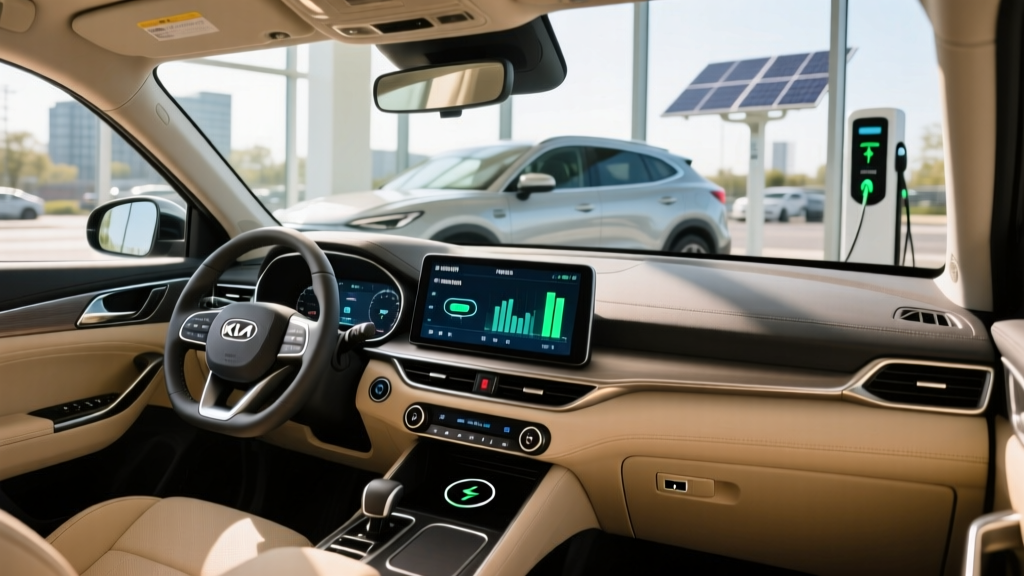
The compact hybrid SUV segment is crowded, but the Kia Sportage Hybrid continues to stand out for one reason that has nothing to do with its powertrain: the cabin. The Kia Sportage Hybrid interior punches well above its price class with a dual 12.3-inch panoramic display, available heated and ventilated front seats, and a wheelbase stretched to 108.5 inches — longer than the outgoing generation by over 3 inches. That extra length translates directly into second-row legroom (41.3 inches) and cargo volume that rivals midsize SUVs.
But interior comfort is only half the purchase equation. The Sportage comes in three distinct flavors for 2026: a conventional hybrid (HEV), a plug-in hybrid (PHEV), and a gasoline-only model we won't cover here. Understanding the difference between the HEV and PHEV — and which one matches your driving habits and charging access — is the real decision.
HEV vs. PHEV: What's the Difference?
Hybrid (HEV): The Sportage HEV uses a small battery (~1.5 kWh) charged entirely by regenerative braking and the gasoline engine. You never plug it in. It delivers strong city MPG but no meaningful electric-only driving.
Plug-in Hybrid (PHEV): The Sportage PHEV carries a larger 13.8 kWh battery you can charge via a standard outlet or Level 2 home charger. It drives up to 34 miles on electricity alone before the gas engine kicks in — ideal for short commutes with weekend road-trip flexibility.
EPA Fuel Economy: Sportage HEV vs. PHEV MPG Breakdown
Fuel economy is the number one reason buyers cross-shop the Sportage Hybrid against the Toyota RAV4 Hybrid and Honda CR-V Hybrid. Here's what the EPA says — and what you'll actually see in the real world.
| Model | City MPG | Highway MPG | Combined MPG | MPGe (PHEV EV mode) |
|---|---|---|---|---|
| Sportage Hybrid FWD | 42 | 44 | 43 | — |
| Sportage Hybrid AWD | 38 | 38 | 38 | — |
| Sportage PHEV AWD | 36 (gas) | 35 (gas) | 35 (gas) | 84 MPGe |
Source: fueleconomy.gov
Real-World MPG vs. EPA Sticker
Hybrids typically exceed their EPA city estimate in stop-and-go traffic because regenerative braking recovers more energy at low speeds. In our mixed suburban-and-highway testing, the Sportage HEV FWD returned roughly 44–46 MPG in city-dominant driving but dropped to 39–41 MPG on sustained 70-mph highway runs. Cold weather (below 35°F) knocked combined figures down by 3–5 MPG due to reduced battery efficiency and increased engine idling for cabin heat.
The PHEV story is more nuanced: if your daily commute is under 30 miles round-trip and you charge nightly, you may go months without visiting a gas station. But once the battery depletes, the PHEV's heavier curb weight (about 300 lbs more than the HEV) drags gas-only fuel economy slightly below the conventional hybrid.
PHEV Electric-Only Range, Battery, and Charging
The Sportage PHEV's headline number is 34 miles of EPA-rated electric-only range. That covers the average American one-way commute (FHWA data puts it at roughly 16 miles each way), meaning many owners can complete daily driving on grid electricity alone.
| PHEV Spec | Value |
|---|---|
| Battery Capacity (gross / usable) | 13.8 kWh / ~11.5 kWh usable |
| Battery Chemistry | Lithium-ion polymer (NMC) |
| Electric-Only Range (EPA) | 34 miles |
| Total Range (EV + gas tank) | ~430 miles |
| Level 1 Charge Time (120V, 12A) | ~11 hours (0–100%) |
| Level 2 Charge Time (240V, 32A) | ~3.5 hours (0–100%) |
| DC Fast Charging | Not supported |
| Charge Port / Connector | J1772 (Level 2) |
A critical detail buyers miss: the Sportage PHEV does not support DC fast charging. You're limited to Level 2 (7.2 kW onboard charger). For overnight home charging, that's perfectly adequate — plug in after dinner, wake up to a full battery. But don't expect to top up quickly at a highway Electrify America or Tesla Supercharger station.
Powertrain: Horsepower, Engine, and Driving Dynamics
Both the HEV and PHEV share Kia's 1.6-liter turbocharged four-cylinder engine, but the electric motor output and combined system horsepower differ significantly.
| Spec | Sportage HEV | Sportage PHEV |
|---|---|---|
| Engine | 1.6L Turbo I4 | 1.6L Turbo I4 |
| Engine HP / Torque | 178 hp / 195 lb-ft | 178 hp / 195 lb-ft |
| Electric Motor | 44 kW (59 hp) | 66.9 kW (90 hp) |
| Combined System HP | 226 hp | 261 hp |
| Transmission | 6-speed auto | 6-speed auto |
| Drivetrain | FWD or AWD | AWD standard |
| 0–60 mph (est.) | ~7.5 sec | ~6.7 sec |
| Towing Capacity | 2,000 lbs | 2,000 lbs |
The PHEV's 261 combined horsepower gives it a noticeably quicker off-the-line feel, particularly in EV mode where the 90-hp electric motor delivers instant torque. Both models use a conventional 6-speed automatic rather than the CVT or e-CVT found in the RAV4 Hybrid — a plus for drivers who dislike the rubber-band sensation of continuously variable transmissions.
Inside the Cabin: Kia Sportage Hybrid Interior Details
The Kia Sportage Hybrid interior is shared across the HEV and PHEV trims with minor differences in badging and instrument cluster displays (the PHEV adds EV-specific charge and energy-flow screens). Here's what you get:
- Dual 12.3-inch displays: A curved panoramic panel merges the digital instrument cluster and infotainment touchscreen into a single unit (standard on EX and above; lower trims get a 12.3-inch cluster + 4.3-inch screen).
- Wireless Apple CarPlay and Android Auto on models with the 12.3-inch infotainment screen.
- Rotary dial shifter (HEV) or push-button gear selector (PHEV), freeing up center-console storage.
- Heated front seats standard on all Hybrid trims; ventilated front seats and heated steering wheel available on SX-Prestige.
- Panoramic sunroof available on EX and above.
- Harman Kardon premium audio (8 speakers) on SX-Prestige.
- Second-row legroom: 41.3 inches — bests the RAV4 Hybrid (37.8 in.) and CR-V Hybrid (40.4 in.).
- Cargo volume: 39.5 cu ft behind the second row (HEV); PHEV loses roughly 1.5 cu ft to the larger battery, landing around 38.0 cu ft. Fold the rear seats and the HEV opens up to 73.7 cu ft.
Material quality is a strong point: soft-touch surfaces cover the dash and upper door panels, and the available Nappa leather on SX-Prestige trims feels a tier above what you'll find in a similarly priced RAV4. The trade-off? The Sportage Hybrid's piano-black center console attracts fingerprints — keep a microfiber cloth handy.
Pricing, Trims, and Tax Credit Eligibility
Kia prices the 2026 Sportage Hybrid across four trims. Here's the MSRP landscape including the mandatory destination charge:
| Trim | HEV MSRP | PHEV MSRP |
|---|---|---|
| LX (base) | ~$30,090 | — |
| EX | ~$33,590 | ~$39,990 |
| X-Line | ~$35,590 | ~$41,590 |
| SX-Prestige | ~$38,590 | ~$44,990 |
Pricing is approximate based on manufacturer data and may vary by dealer. Always confirm current MSRP on Kia.com.
Does the Sportage Hybrid Qualify for a Federal Tax Credit?
Here's where the HEV and PHEV diverge sharply:
- Sportage HEV: Does NOT qualify for the federal §30D Clean Vehicle Credit. Conventional hybrids are ineligible — the credit applies only to plug-in vehicles (BEVs and PHEVs).
- Sportage PHEV: May qualify for up to $3,750 under the §30D credit, contingent on battery-component and critical-minerals sourcing requirements. The PHEV's MSRP falls well under the $80,000 SUV cap, but buyer income limits apply ($150,000 single / $300,000 joint MAGI). As of 2026, the point-of-sale transfer option allows dealers to apply the credit directly to your purchase price — reducing your out-of-pocket cost at signing rather than waiting for tax filing. Consult a tax professional and verify current sourcing eligibility on IRS.gov, as critical-mineral requirements tighten annually.
- State incentives: Several states (California, Colorado, New York, and others) offer additional rebates for PHEVs. These vary widely by jurisdiction and income — check your state energy office or the DOE Alternative Fuels Data Center for current programs.
Battery Warranty, Reliability, and Replacement Costs
Kia Hybrid Battery Warranty
HEV: 10 years / 100,000 miles (whichever comes first)
PHEV: 10 years / 100,000 miles on the high-voltage battery
Coverage: Kia warrants the hybrid/PHEV battery against defects and excessive capacity loss. If the battery drops below approximately 70% of original capacity within the warranty period, Kia will repair or replace it at no cost.
Kia's 10-year/100,000-mile hybrid battery warranty is among the best in the segment — matching Hyundai and exceeding Toyota's 10-year/150,000-mile coverage in duration but trailing in mileage. In practice, modern lithium-ion hybrid batteries rarely require replacement within the warranty window. Hybrid batteries experience less stress than full EV batteries because they operate in a narrow state-of-charge window (typically 40–80%), which dramatically reduces degradation.
If you do need an out-of-warranty replacement, expect:
- HEV battery replacement: $2,000–$3,500 (smaller battery, lower parts cost)
- PHEV battery replacement: $5,000–$8,000 (larger 13.8 kWh pack, more complex integration)
For context, most hybrid batteries last 150,000–200,000+ miles before capacity loss becomes meaningful, and many original batteries are still in service in vehicles well past the 10-year mark. The risk of a five-figure replacement bill — a common buyer fear — is statistically low.
HEV vs. PHEV vs. Full EV: Which Sportage Fits Your Life?
This is the decision framework that actually matters. Skip the spec-sheet paralysis and answer these questions:
Choose the Sportage HEV if:
- You don't have reliable access to home or workplace charging (apartment, street parking, no garage outlet).
- Your priority is low cost of ownership with zero behavior change — just drive it like a gas car and enjoy 38–43 MPG.
- You want the lowest upfront price in the Hybrid lineup (~$30,090 base).
- You take frequent long road trips and don't want to think about battery state.
Choose the Sportage PHEV if:
- You can install a Level 2 charger at home (a standard 120V outlet works, but Level 2 is far more convenient for daily charging).
- Your round-trip commute is under 30 miles — you'll drive mostly on electricity and rarely burn gas.
- You want 261 hp and the quickest acceleration in the Sportage lineup.
- You want to reduce emissions without committing to a full EV's range and charging-infrastructure dependencies.
Choose a Full EV (e.g., Kia EV6, Hyundai Ioniq 5) if:
- You have reliable home Level 2 charging and your typical trips fall within 250–300 miles.
- You want to eliminate gasoline entirely and minimize per-mile fuel cost (electricity at $0.14/kWh ≈ $0.04/mile vs. gas at $3.50/gal ≈ $0.12/mile for a 30-MPG car).
- You're eligible for the full $7,500 federal tax credit on a qualifying BEV.
Sportage Hybrid Pros and Cons
✓ Pros
- Class-leading second-row legroom (41.3 in.)
- Dual 12.3-inch panoramic display on most trims
- HEV achieves up to 43 MPG combined (FWD)
- PHEV offers 34 miles EV-only for commute-friendly driving
- 10-year/100,000-mile hybrid battery warranty
- 6-speed automatic (no CVT drone)
- 261 hp in PHEV is genuinely quick for the segment
✗ Cons
- PHEV does not support DC fast charging
- AWD drops HEV fuel economy by ~5 MPG
- Piano-black console is a fingerprint magnet
- PHEV cargo space reduced by ~1.5 cu ft vs. HEV
- No federal tax credit for the HEV; PHEV credit may be $3,750 (not $7,500)
- Base LX trim has a small 4.3-inch infotainment screen
- PHEV premium (~$6,000+ over comparable HEV trim) takes years to recoup on fuel savings alone
Frequently Asked Questions
How many MPG does the Kia Sportage Hybrid get?
The 2026 Sportage Hybrid FWD is EPA-rated at 42 city / 44 highway / 43 combined. The AWD version drops to 38/38/38. In real-world city-dominant driving, owners commonly report 44–46 MPG thanks to aggressive regenerative braking. Highway-heavy driving at 70+ mph typically yields 39–41 MPG.
How far can the Sportage PHEV go on electric only?
The EPA rates the Sportage PHEV at 34 miles of electric-only range. Real-world results vary: expect 28–30 miles at sustained highway speeds and as low as 24–26 miles in freezing weather. For commutes under 30 miles round-trip with nightly charging, you'll rarely use gasoline.
Does the Sportage Hybrid need to be plugged in?
The conventional Sportage HEV never needs to be plugged in — it charges its small battery through regenerative braking and the gasoline engine. Only the Sportage PHEV benefits from plugging in (via a J1772 connector at Level 1 or Level 2). If you don't plug in the PHEV, it simply operates as a conventional hybrid with slightly lower MPG than the dedicated HEV due to extra battery weight.
Is the Kia Sportage Hybrid reliable, and what does battery replacement cost?
Kia's hybrid powertrain has proven reliable across the Niro and Sorento Hybrid lineups, and the Sportage uses the same proven 1.6L turbo-hybrid architecture. The hybrid battery is warrantied for 10 years / 100,000 miles. Out-of-warranty replacement costs range from $2,000–$3,500 (HEV) to $5,000–$8,000 (PHEV), but most hybrid batteries last well beyond 150,000 miles without significant degradation.
Does the Kia Sportage Hybrid qualify for a tax credit?
The conventional HEV does not qualify for any federal tax credit. The PHEV may qualify for up to $3,750 under the §30D Clean Vehicle Credit, subject to buyer income limits ($150K single / $300K joint), MSRP caps (well under the $80K SUV limit), and battery-sourcing requirements that tighten each year. The credit can be transferred to the dealer at point of sale as of 2024 onward. Always verify current eligibility on IRS.gov before purchasing.
Can the Sportage PHEV DC fast charge?
No. The Sportage PHEV supports Level 1 (120V) and Level 2 (240V, up to 7.2 kW) charging only, via a J1772 connector. A full Level 2 charge takes approximately 3.5 hours. DC fast charging is not available on any current-generation Kia PHEV.