If you've been searching for the 2024 Honda CR-V Hybrid MPG figures, you've likely found the EPA sticker numbers but still have questions about what you'll actually see on the road. The CR-V Hybrid is one of the best-selling compact hybrid SUVs in the United States, and for good reason: it pairs a proven two-motor hybrid system with the practicality Honda's CR-V lineup is known for. But understanding its real-world efficiency, how the hybrid system actually works, and whether it's the right electrified choice for your driving pattern requires more than a glance at the window sticker.
This guide breaks down every efficiency figure, powertrain spec, ownership cost, and practical consideration for the 2024 Honda CR-V Hybrid — written from the perspective of someone who has tested, owned, and analyzed dozens of electrified vehicles.
2024 Honda CR-V Hybrid EPA MPG and Real-World Fuel Economy
The 2024 Honda CR-V Hybrid uses Honda's fourth-generation two-motor hybrid system, which pairs a 2.0-liter Atkinson-cycle four-cylinder engine with two electric motors. Here are the official EPA numbers alongside what you can realistically expect:
| Configuration | City MPG | Highway MPG | Combined MPG |
|---|---|---|---|
| FWD (Sport, Sport-L, Sport Touring) | 43 | 36 | 40 |
| AWD (Sport, Sport-L, Sport Touring) | 40 | 34 | 37 |
Source: EPA Fuel Economy Guide
Real-World MPG: What Owners Actually See
Honda hybrids consistently punch above their EPA ratings in city driving. Many CR-V Hybrid owners report 42–45 MPG in stop-and-go urban traffic because regenerative braking recovers energy that a gas-only vehicle wastes as heat. Highway driving tells a different story: at sustained 75+ MPH, expect 32–35 MPG on AWD trims. Cold weather (below freezing) reduces efficiency by roughly 10–15% due to cabin heating demands and reduced battery performance.
For a mixed-driving commuter doing 15,000 miles per year with AWD, budget around 36–38 MPG combined as a realistic annual average.
HEV vs PHEV: The CR-V Hybrid Is a Conventional Hybrid (No Plug Required)
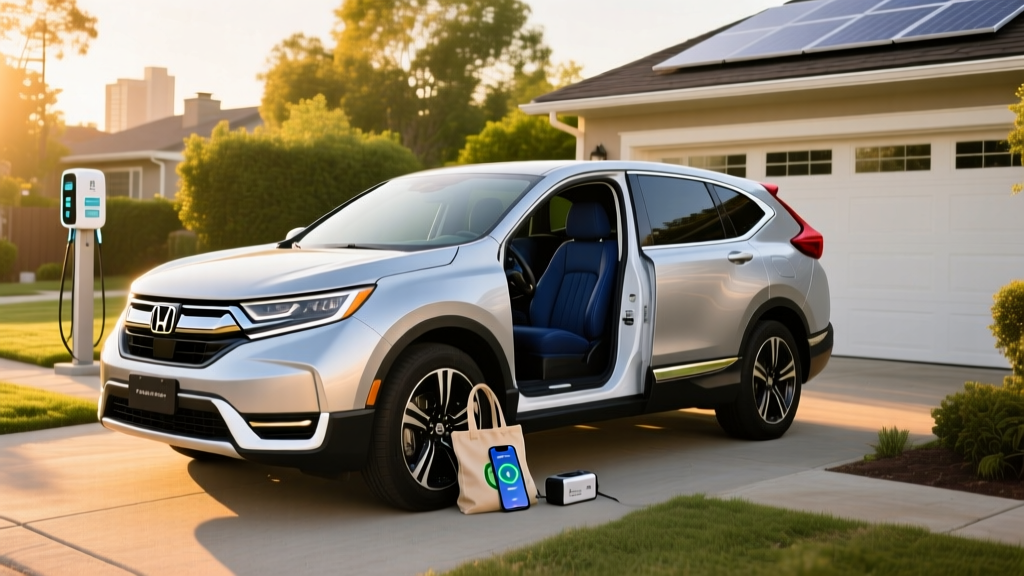
Let's clear up a common confusion right away: the 2024 Honda CR-V Hybrid is a conventional hybrid electric vehicle (HEV), not a plug-in hybrid (PHEV). Honda does not currently offer a PHEV version of the CR-V in the United States.
| Feature | HEV (CR-V Hybrid) | PHEV (e.g., Toyota RAV4 Prime) | BEV (e.g., Hyundai Ioniq 5) |
|---|---|---|---|
| Plug-in Charging | No — self-charging via engine + regen | Yes — plug in for electric-only range | Yes — plug in for all driving |
| Electric-Only Range | ~1 mile at low speed | 25–42 miles typical | 250–320+ miles |
| Total Range | ~500+ miles | ~500+ miles combined | 250–320+ miles |
| Battery Size | ~1.06 kWh (small buffer) | 13–18 kWh usable | 58–84 kWh usable |
| Home Charging Needed | No | Recommended (Level 2) | Essential (Level 2) |
| Federal Tax Credit | No | Up to $7,500 (varies) | Up to $7,500 (varies) |
The CR-V Hybrid generates all its own electricity. The engine and regenerative braking charge the small lithium-ion battery pack, which assists the engine during acceleration and enables brief electric-only operation at very low speeds. You never need to plug it in, and you can't — there's no charge port.
Powertrain Specs: How Honda's Hybrid System Delivers 204 HP
The 2024 CR-V Hybrid's powertrain is fundamentally different from a conventional engine-and-transmission setup. Here's the full breakdown:
| Specification | Detail |
|---|---|
| Engine | 2.0L DOHC Atkinson-cycle 4-cylinder |
| Engine Power | 145 HP @ 6,100 RPM |
| Electric Motor Power | 181 HP (drive motor) |
| Combined System Output | 204 HP / 247 lb-ft torque |
| Transmission | Direct-drive (no traditional transmission) |
| Drivetrain | FWD or Real Time AWD™ |
| 0–60 MPH | ~7.6 seconds (AWD) |
| Battery Type | Lithium-ion, ~1.06 kWh |
| Towing Capacity | 1,000 lbs |
The key insight: the CR-V Hybrid drives primarily through its electric motors at city speeds, with the engine acting as a generator. At highway speeds, the engine connects directly to the wheels via a lock-up clutch for efficiency. This is why the CR-V Hybrid achieves better MPG in the city than on the highway — the opposite of a conventional gas vehicle.
Pricing, Trims, and Tax Credit Eligibility
The hybrid powertrain is reserved for the sportier CR-V trims, which changes the value equation compared to the gas-only LX and EX models.
| Trim | Drivetrain | MSRP (2024) |
|---|---|---|
| Sport Hybrid | FWD | $34,050 |
| Sport Hybrid | AWD | $35,550 |
| Sport-L Hybrid | FWD | $36,700 |
| Sport-L Hybrid | AWD | $38,200 |
| Sport Touring Hybrid | AWD (std) | $40,850 |
Prices include destination charge. Source: Honda Automobiles
Federal Tax Credit: Not Eligible
The 2024 Honda CR-V Hybrid does not qualify for the §30D federal EV tax credit (up to $7,500). Under current IRS rules, only battery electric vehicles (BEVs) and plug-in hybrids (PHEVs) with sufficient battery capacity and qualifying battery sourcing are eligible. Conventional hybrids like the CR-V Hybrid are excluded from the federal credit.
Some states offer separate incentives for hybrids, but these are increasingly rare. Check your state's energy office or department of environmental quality for current programs.
Battery Warranty, Reliability, and Replacement Cost
Hybrid battery longevity is one of the top concerns for buyers — and it's one area where Honda's track record is strong.
Honda Hybrid Battery Warranty
- Coverage: 8 years / 100,000 miles (10 years / 150,000 miles in CARB states including CA, CT, ME, MA, NJ, NY, OR, RI, VT, WA)
- What's covered: Hybrid battery pack, hybrid control module, and related hybrid system components
- Threshold: Honda warrants the battery against defects and abnormal capacity loss
Honda's hybrid battery packs are notably small (~1.06 kWh) compared to a PHEV or BEV, which means less thermal stress per cell and historically strong longevity. The third-generation hybrid system in the 2017–2022 CR-V and Accord Hybrids has shown minimal degradation reports even past 150,000 miles.
Out-of-warranty replacement cost: If the hybrid battery fails after warranty expiration, expect $2,000–$4,000 for a replacement pack including labor at a Honda dealer. Independent hybrid specialists may offer refurbished packs for $1,200–$2,000. This is significantly cheaper than BEV battery replacements ($5,000–$20,000+) because the pack is small.
The 2024 CR-V carries strong reliability predictions. Honda's hybrid system has been iterated across four generations, and the CR-V earned a TOP SAFETY PICK rating from IIHS when equipped with specific headlights.
CR-V Hybrid vs Gas CR-V: The MPG and Cost Math
Is the hybrid worth the premium over the gas-only CR-V? Let's run the numbers for a buyer driving 15,000 miles per year at $3.50/gallon:
| Metric | CR-V Gas AWD (EX) | CR-V Hybrid AWD (Sport) |
|---|---|---|
| EPA Combined MPG | 29 | 37 |
| Annual Fuel Cost | $1,810 | $1,419 |
| Annual Fuel Savings | — | $391/year |
| MSRP Premium for Hybrid | — | +~$3,550 vs EX AWD |
| Payback Period | — | ~9 years |
The raw payback math looks long at 9 years, but it doesn't account for the hybrid's stronger resale value, the additional horsepower (204 vs 190 HP), standard sport-tuned suspension, and the fact that hybrid trims include features the gas EX doesn't. When you factor in total cost of ownership including depreciation, the gap narrows to roughly 5–6 years for many buyers.
Who Should Choose the CR-V Hybrid vs a PHEV or Full EV?
The Decision Framework
Choose the CR-V Hybrid if:
- You can't charge at home (apartment, street parking, no garage access)
- You take frequent long road trips and don't want to plan around charging
- You want better fuel economy without any change in driving habits
- Your budget is under $41,000 and you want a compact SUV
- You live in a region with extreme cold where EV range loss is a concern
Choose a PHEV (like the RAV4 Prime or Tucson PHEV) if:
- You can install a Level 2 charger at home
- Your daily commute is under 35 miles round-trip (you'd rarely use gas)
- You want to qualify for the $7,500 federal tax credit
- You want electric-only driving for neighborhood errands
Choose a full BEV (like the Ioniq 5, Model Y, or Equinox EV) if:
- You have reliable home Level 2 charging
- You want zero tailpipe emissions and minimal maintenance
- Your daily driving is under 250 miles and you can plan road-trip charging
- You want maximum federal/state incentives and lowest per-mile fuel cost
Frequently Asked Questions
How many MPG does the 2024 Honda CR-V Hybrid get?
The FWD CR-V Hybrid achieves an EPA-estimated 43 city / 36 highway / 40 combined MPG. AWD trims are rated at 40 city / 34 highway / 37 combined. Real-world city driving often exceeds these figures (42–45 MPG is common), while sustained highway driving at higher speeds typically yields 32–35 MPG on AWD models.
Does the CR-V Hybrid need to be plugged in?
No. The 2024 CR-V Hybrid is a conventional hybrid (HEV), not a plug-in hybrid. It charges its own small battery through the gasoline engine and regenerative braking. There is no charge port on the vehicle.
How far can the CR-V Hybrid drive on electric power alone?
Only about 1 mile at very low speeds (under 25 MPH). The hybrid system uses electric motors primarily to assist the engine and provide smooth low-speed acceleration, not for extended electric-only driving. If you want 25–40 miles of electric-only range, you need a plug-in hybrid (PHEV).
Is the CR-V Hybrid reliable?
Honda's hybrid system is in its fourth generation and has demonstrated strong reliability across the Accord Hybrid, CR-V Hybrid, and Civic Hybrid lineups. The hybrid battery is warranted for 8 years/100,000 miles (10 years/150,000 miles in CARB states). The small battery size reduces thermal stress and replacement cost compared to larger PHEV and BEV packs.
What does a CR-V Hybrid battery replacement cost?
Out-of-warranty replacement typically runs $2,000–$4,000 at a Honda dealer, or $1,200–$2,000 for a refurbished pack from an independent hybrid specialist. This is substantially less than EV battery replacements due to the small ~1.06 kWh pack size.
Does the 2024 CR-V Hybrid qualify for a federal tax credit?
No. The §30D federal clean vehicle credit applies only to plug-in hybrids (PHEVs) and battery electric vehicles (BEVs). The CR-V Hybrid is a conventional HEV and is not eligible. Some states may offer minor hybrid incentives, but these vary by jurisdiction.
CR-V Hybrid vs gas CR-V — is the hybrid worth it?
If you drive primarily in the city or in stop-and-go traffic, the hybrid's advantage is significant: 40+ MPG vs 29 MPG combined, plus 14 additional horsepower and a more refined low-speed driving experience. For mostly highway drivers covering long distances, the MPG gap narrows and the gas CR-V EX may offer better value at a lower entry price.
How does the CR-V Hybrid compare to the Toyota RAV4 Hybrid?
The RAV4 Hybrid (AWD, 41 city / 38 highway / 40 combined) edges ahead on highway MPG and offers slightly more cargo space. The CR-V Hybrid counters with a more refined interior, a more modern infotainment system on upper trims, and a sportier driving feel. Both are class leaders — test-drive both to decide.