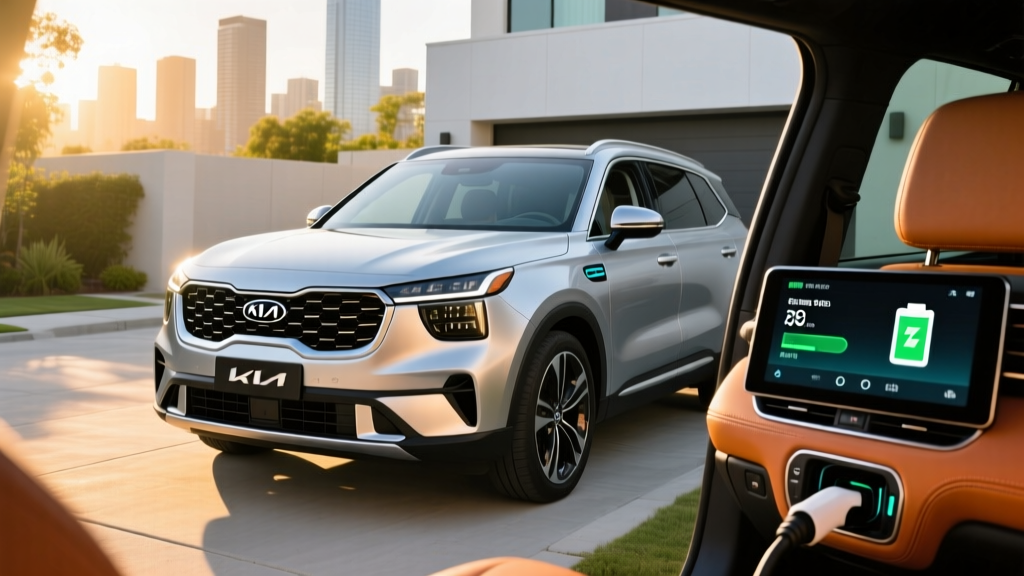
The Kia Sorento has quietly become one of the most versatile three-row crossovers on the market, and its turbocharged hybrid powertrain is the version most buyers should actually consider. For 2026, the Sorento Turbo Hybrid pairs a 1.6-liter turbocharged four-cylinder with a 47.7-kW electric motor to deliver 261 combined horsepower — enough for confident highway merging while still returning an EPA-estimated 34 MPG combined in front-wheel-drive form. That combination of efficiency, three-row practicality, and sub-$40,000 pricing puts it in a narrow class of hybrid SUVs that can genuinely serve as a family's only vehicle.
This guide breaks down the 2026 Kia Sorento Turbo Hybrid's fuel economy, powertrain details, pricing, tax credit eligibility, and battery longevity — plus where it stands against the plug-in hybrid (PHEV) and full EV alternatives.
2026 Kia Sorento Turbo Hybrid: Powertrain and Performance Specs
Kia offers the Sorento in two distinct electrified flavors for 2026: a conventional hybrid (HEV) and a plug-in hybrid (PHEV). The turbo hybrid badge specifically refers to the HEV model, which requires no plug-in charging — the battery recharges through regenerative braking and the gasoline engine. The PHEV variant uses a similar architecture but adds a much larger battery and a more powerful electric motor for genuine electric-only driving.
| Specification | Sorento HEV (Turbo Hybrid) | Sorento PHEV |
|---|---|---|
| Engine | 1.6L Turbo I-4 | 1.6L Turbo I-4 |
| Electric Motor | 47.7 kW (64 hp) | 90.5 kW (121 hp) |
| Combined Horsepower | 261 hp | 304 hp |
| Combined Torque | 258 lb-ft | 258 lb-ft |
| Transmission | 6-speed automatic | 6-speed automatic |
| Battery (usable) | ~1.5 kWh (self-charging) | 13.8 kWh |
| Drivetrain | FWD or AWD | AWD standard |
| 0-60 mph (est.) | ~7.5 sec | ~6.2 sec |
| Towing Capacity | 2,000 lbs | 2,000 lbs |
The HEV's 261 hp is a meaningful step up from the non-turbo base Sorento's 191 hp, and you feel it most during highway on-ramp merges and loaded three-row acceleration. The 6-speed automatic avoids the rubber-band feel of some CVT-based hybrid systems, delivering predictable gear changes that enthusiast-leaning drivers will appreciate.
Fuel Economy: EPA Estimates and Real-World MPG
Fuel economy is where the Sorento Turbo Hybrid justifies its existence over the gas-only model. Here is the official EPA data from fueleconomy.gov for the 2026 model year:
| Drivetrain | City MPG | Highway MPG | Combined MPG |
|---|---|---|---|
| FWD | 36 | 33 | 34 |
| AWD | 34 | 31 | 33 |
Real-World MPG: What Owners Actually See
Hybrid powertrains tend to perform closer to — or even above — their EPA city ratings because stop-and-go driving maximizes regenerative braking and electric motor usage. In mixed suburban and city driving, owners commonly report 35-37 MPG in the FWD Sorento Hybrid, occasionally beating the EPA city figure.
Highway driving is a different story. At sustained 70-80 mph speeds, expect 29-31 MPG — the turbo engine works harder without regenerative assistance, and aerodynamic drag dominates. Cold weather (below 30°F) knocks combined economy down roughly 2-4 MPG due to reduced battery efficiency and increased engine idling for cabin heat. If your commute is mostly highway, the Sorento Hybrid's advantage over the gas model narrows but still delivers roughly 25-28% better fuel economy.
Sorento PHEV: Electric-Only Range and When Plugging In Makes Sense
If you're cross-shopping the turbo hybrid against the plug-in variant, the critical numbers are electric-only range and charging logistics. The 2026 Sorento PHEV carries a 13.8 kWh battery pack and earns an EPA-estimated 32 miles of all-electric range with a combined MPGe of 79 MPGe.
| Metric | Value |
|---|---|
| EPA Electric-Only Range | 32 miles |
| Combined MPGe (electric mode) | 79 MPGe |
| MPG After Battery Depleted (charge-sustaining) | 34 combined |
| Total Combined Range | ~420 miles |
| Battery Capacity | 13.8 kWh |
| Level 2 Charge Time (0-100%) | ~3 hours 25 min (at 7.2 kW) |
| DC Fast Charging | Not available |
| Charge Port | J1772 (Level 2) |
The Sorento PHEV does not support DC fast charging — a limitation shared with most PHEVs due to their smaller battery packs. Level 2 charging at home (240V, 32A) fully replenishes the battery in about three and a half hours, which works well for overnight top-ups. If you can charge nightly at home and your daily round-trip commute is under 30 miles, the PHEV effectively operates as an EV most days, with the gasoline engine available for longer trips.
However, if you lack reliable home or workplace charging access, the PHEV's premium (roughly $7,000-$9,000 over the HEV depending on trim) is difficult to justify. You'd be carrying 400+ lbs of battery you rarely use, and the charge-sustaining MPG is essentially identical to the standard turbo hybrid.
Pricing, Trims, and Tax Credit Eligibility
The 2026 Kia Sorento Turbo Hybrid starts at $38,490 (including destination) for the S trim with FWD. AWD adds approximately $1,800. Higher trims push the price into the mid-$40,000s:
| Trim | Drivetrain | MSRP (incl. destination) |
|---|---|---|
| S | FWD | $38,490 |
| S | AWD | $40,290 |
| EX | AWD | $43,690 |
| SX Prestige | AWD | $48,190 |
Federal Tax Credit: What You Need to Know
Here is where the distinction between HEV and PHEV matters enormously. Under current IRS §30D rules:
- Sorento Hybrid (HEV): Does NOT qualify for the federal §30D plug-in vehicle tax credit. Conventional hybrids are not eligible — the credit applies only to plug-in vehicles with battery packs above a minimum capacity.
- Sorento PHEV: May qualify for up to $7,500, but eligibility depends on three hurdles: (1) buyer income must not exceed $150,000 single / $300,000 joint, (2) MSRP must be under $80,000 for SUVs (all Sorento PHEV trims clear this), and (3) battery critical-mineral and component sourcing requirements, which have tightened significantly and may reduce or eliminate the credit amount depending on the specific model year's supply chain compliance.
The point-of-sale transfer option allows qualifying buyers to apply the credit as an immediate dealer discount rather than waiting to claim it at tax time. Always verify current-year eligibility on irs.gov before purchasing, as battery sourcing requirements shift with new regulatory guidance.
Some states offer additional hybrid or PHEV rebates (California, Colorado, and New York among them), but these vary by jurisdiction. Check your state's energy or DMV website for current programs.
Battery Warranty, Reliability, and Replacement Costs
Kia's turbo hybrid system uses a relatively small lithium-ion polymer battery (~1.5 kWh usable in the HEV) that cycles shallowly — it never fully charges or fully depletes, which dramatically extends cell longevity. Based on data from the Hyundai-Kia hybrid platform now in its second decade of production, hybrid battery degradation to below 70% capacity within the warranty period is uncommon. Most owners will sell the vehicle before any battery-related issue arises.
What If the Battery Fails Out of Warranty?
Replacement cost for the Sorento HEV battery pack is estimated at $2,500-$4,000 including labor — significantly less than full EV battery replacements ($8,000-$20,000+) because the pack is small. For the PHEV's 13.8 kWh pack, expect $6,000-$9,000 out of warranty. Third-party hybrid battery refurbishers are increasingly available and can reduce costs by 30-40%.
Overall reliability for the Sorento Hybrid platform has been solid. The 1.6L turbo engine is well-proven across Hyundai-Kia's lineup, and the 6-speed automatic hybrid transmission avoids the complexity of CVTs. The most commonly reported issues in owner forums relate to infotainment software glitches rather than powertrain concerns.
HEV vs. PHEV vs. Full EV: Which Sorento Fits Your Life?
Choosing between the Sorento Turbo Hybrid, the Sorento PHEV, and a fully electric three-row SUV (like the Kia EV9 or Hyundai Ioniq 9) depends on your charging access, driving patterns, and budget.
Choose the HEV (Turbo Hybrid) If:
- You cannot charge at home or work
- Your budget is under $42,000
- You drive 15,000+ miles/year with frequent long road trips
- You want maximum simplicity — no charging cables, no apps
- You value 600+ miles of range between fill-ups
Choose the PHEV If:
- You can install a Level 2 charger at home
- Your daily commute is under 30 miles round-trip
- You qualify for the federal or state PHEV credit
- You want electric weekday driving with gas flexibility for weekends
- You're not ready to commit to full EV charging logistics
Choose a Full EV (Kia EV9) If:
- You have reliable home Level 2 charging
- Your daily driving is under 250 miles and you can plan road-trip charging
- You want the lowest per-mile energy cost (~$0.04-$0.08/mile vs. $0.12-$0.15/mile for the hybrid)
- You qualify for the full $7,500 federal credit plus state incentives
- You want zero tailpipe emissions and minimal maintenance (no oil changes, no transmission fluid)
Pros and Cons at a Glance
Pros
- 34 MPG combined with three rows — rare in the segment
- 261 hp turbo powertrain feels responsive, not lethargic
- 600+ mile total range eliminates refueling stops on most trips
- 10-year/100,000-mile hybrid battery warranty
- Conventional 6-speed auto (no CVT drone)
- Starting price under $39,000 for a three-row hybrid SUV
Cons
- Third row is tight for adults — best for kids on short trips
- AWD fuel economy drops to 33 MPG combined
- No DC fast charging on the PHEV variant
- HEV does not qualify for federal plug-in tax credit
- Highway MPG (31-33) less impressive than city (34-36)
- Infotainment system can lag compared to competitors
Frequently Asked Questions
How many MPG does the 2026 Kia Sorento Turbo Hybrid get?
The FWD Sorento Hybrid earns an EPA-estimated 36 city / 33 highway / 34 combined MPG. The AWD version is rated at 34 city / 31 highway / 33 combined. In real-world suburban driving, many owners see 35-37 MPG, while sustained highway driving at 75+ mph yields 29-31 MPG.
How far can the Sorento PHEV go on electric only?
The 2026 Sorento PHEV is EPA-rated for 32 miles of all-electric range. In mild weather at city speeds, you may see 34-36 miles. In cold weather or at highway speeds, expect 24-28 miles before the gasoline engine engages.
Does the Kia Sorento Hybrid qualify for a tax credit?
The conventional Sorento Hybrid (HEV) does not qualify for the federal §30D plug-in vehicle tax credit — it has no plug. The Sorento PHEV may qualify for up to $7,500 depending on your income, the vehicle's MSRP, and current battery-sourcing requirements. Check the latest rules at irs.gov before purchasing.
Is the Sorento Hybrid reliable, and what does battery replacement cost?
The Sorento Hybrid platform has demonstrated solid reliability, with the 1.6L turbo and hybrid transmission well-proven across Hyundai-Kia's lineup. The hybrid battery is warranted for 10 years / 100,000 miles. Out-of-warranty replacement costs approximately $2,500-$4,000 for the HEV pack and $6,000-$9,000 for the PHEV pack — both significantly less than full EV battery replacements.
Do I need to plug in the Sorento Turbo Hybrid?
No. The Sorento Turbo Hybrid (HEV) is a conventional, self-charging hybrid. It recovers energy through regenerative braking and the gasoline engine — there is no plug and no need for external charging. Only the Sorento PHEV variant requires plug-in charging to access its electric-only range.
How does the Sorento Hybrid compare to the Toyota Highlander Hybrid?
The Highlander Hybrid delivers slightly better fuel economy (35-36 MPG combined) and a more established reliability reputation, but it uses a CVT that feels less responsive and starts at a higher price point. The Sorento Turbo Hybrid's 261 hp and 6-speed automatic provide a more engaging driving experience, and its starting MSRP is roughly $2,000-$3,000 lower. If driving feel and value matter, the Sorento wins; if maximum proven longevity and a slightly higher MPG figure matter, the Highlander has the edge.