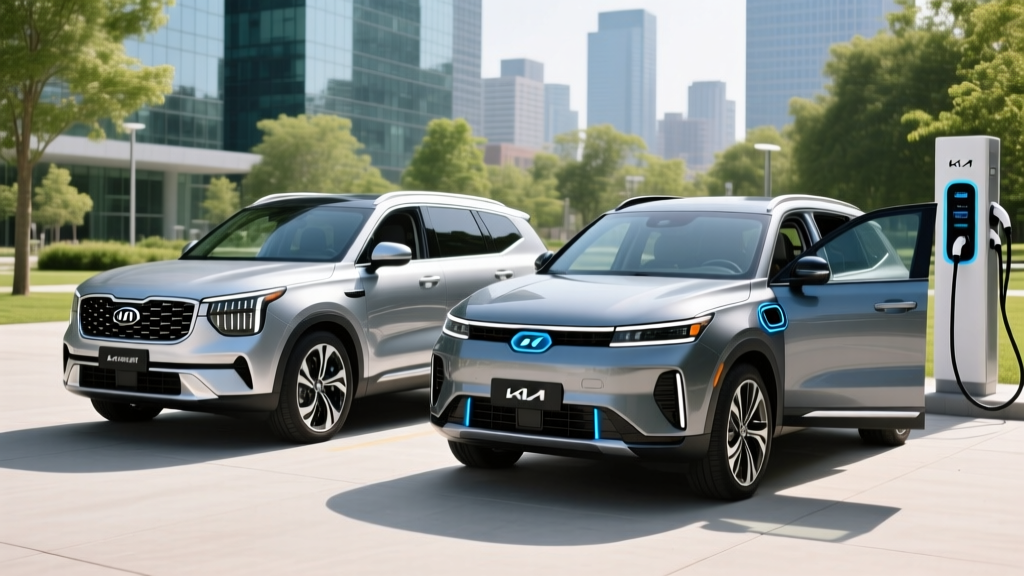
The midsize three-row SUV segment is crowded, but few nameplates offer buyers a genuine choice between a conventional hybrid and a plug-in hybrid under one roof. The 2026 Kia Sorento Hybrid and Sorento Plug-In Hybrid do exactly that, pairing a turbocharged 1.6-liter four-cylinder with electric motors to deliver strong fuel economy without sacrificing the third-row practicality families demand. If you've been searching for a sorento kia hybrid, this guide breaks down every spec that matters — from EPA MPG and electric-only range to battery warranty and federal tax credit eligibility — so you can decide which version fits your driveway.
HEV vs PHEV: Which Sorento Hybrid Is Which?
Kia sells two distinct electrified Sorento models, and confusing them is the most common buyer mistake. Here's the fundamental difference:
| Feature | Sorento Hybrid (HEV) | Sorento Plug-In Hybrid (PHEV) |
|---|---|---|
| Plugs in? | No — self-charging via engine & regen | Yes — charges from outlet or station |
| Battery size | ~1.49 kWh (small buffer) | 13.8 kWh usable |
| Electric-only driving | Minimal (low-speed assist only) | 32 miles EPA |
| Combined HP | 232 hp | 261 hp |
| Drivetrain | AWD standard | AWD standard |
| Federal tax credit | None | Up to $7,500 (subject to §30D rules) |
The conventional HEV never plugs in. It recovers energy through regenerative braking and the engine, storing it in a small battery that assists during acceleration and enables brief electric-only creep at low speeds. The PHEV carries a much larger battery that you charge externally, enabling genuine electric-only commuting before the gasoline engine engages.
Fuel Economy: Real MPG Numbers for Both Models
Fuel economy is the headline reason buyers cross-shop hybrids. Here are the official EPA figures from fueleconomy.gov for the 2026 model year:
| Metric | Sorento HEV (AWD) | Sorento PHEV (AWD) |
|---|---|---|
| City MPG | 34 | 79 MPGe (charge-sustaining: 33) |
| Highway MPG | 34 | 79 MPGe (charge-sustaining: 34) |
| Combined MPG | 35 | 79 MPGe / 33 gas-only combined |
| Electric-only range | N/A | 32 miles |
| Total range (full tank + full charge) | ~460 miles | ~430 miles |
Real-World MPG vs EPA Sticker
Hybrids have a well-documented tendency to exceed their EPA city estimates in real-world stop-and-go driving because regenerative braking recaptures energy that a gas car wastes as heat. In mixed suburban testing, owners of the Sorento HEV consistently report 33–37 MPG combined, with some exceeding 38 MPG on flat city routes. Highway-only driving at 75+ mph tends to drop the HEV closer to 30–32 MPG because the electric motor provides less benefit at sustained high speeds and aerodynamic drag dominates.
The PHEV's real-world economy depends entirely on your charging habits. If your commute is under 32 miles round-trip and you charge nightly, you may burn gasoline only on weekend road trips. Once the battery depletes, the PHEV operates as a conventional hybrid at roughly 33 MPG combined — slightly less than the HEV due to the extra weight of the larger battery pack.
Powertrain Specs: What's Under the Hood
Both Sorento hybrids share a 1.6-liter turbocharged four-cylinder engine, but the electric motor and total output differ meaningfully.
| Specification | HEV | PHEV |
|---|---|---|
| Engine | 1.6L turbo I-4 | 1.6L turbo I-4 |
| Electric motor | 47.7 kW (64 hp) | 72 kW (97 hp) |
| Combined system output | 232 hp / 262 lb-ft | 261 hp / 262 lb-ft |
| Transmission | 6-speed automatic | 6-speed automatic |
| Drivetrain | AWD | AWD |
| 0–60 mph | ~7.6 sec | ~7.0 sec |
| Towing capacity | 2,000 lbs | 2,000 lbs |
The PHEV's larger electric motor gives it noticeably stronger off-the-line acceleration and more confident highway merging. Both models use a traditional six-speed automatic rather than the continuously variable transmissions (CVTs) found in some competitors, which gives them a more natural driving feel at the cost of a marginal efficiency penalty.
PHEV Charging: Battery Size, Charge Time & What You Need at Home
The Sorento PHEV's 13.8 kWh battery pack is the key to its 32-mile electric range. Here's how charging works in practice:
| Charging Method | Power | 0–100% Time | Practical Notes |
|---|---|---|---|
| Level 1 (120V household outlet) | ~1.4 kW | ~10 hours | Overnight top-up works for short commutes |
| Level 2 (240V home/public) | ~3.3 kW (onboard charger limit) | ~3.5 hours | Full charge in a workday or overnight easily |
| DC Fast Charge | Not supported | N/A | No CCS/CHAdeMO DC capability |
An important limitation: the Sorento PHEV's onboard charger is capped at 3.3 kW, which means even a 48-amp Level 2 home charger will only deliver 3.3 kW to the battery. This is common among PHEVs with smaller packs — the battery simply can't accept higher AC charge rates safely. DC fast charging is not available on this vehicle, which is typical for plug-in hybrids in this class.
For most PHEV owners, a standard 120V outlet is sufficient to replenish 32 miles of range overnight. A Level 2 installation ($500–$1,500 depending on electrical panel proximity) adds convenience and ensures a full battery every morning, but it's not strictly necessary the way it is for a full battery-electric vehicle.
Pricing, Trims & Federal Tax Credit Eligibility
The 2026 Sorento Hybrid and PHEV are priced at a premium over the gas-only Sorento, but the fuel savings and available incentives narrow the gap.
| Model / Trim | MSRP (incl. destination) | Est. Tax-Credit-Adjusted |
|---|---|---|
| Sorento HEV S | $38,390 | $38,390 (no credit) |
| Sorento HEV EX | $41,690 | $41,690 (no credit) |
| Sorento HEV SX Prestige | $46,090 | $46,090 (no credit) |
| Sorento PHEV EX | $51,490 | ~$43,990 (with $7,500 credit) |
| Sorento PHEV SX Prestige | $55,090 | ~$47,590 (with $7,500 credit) |
Federal §30D Tax Credit: Does the Sorento Qualify?
The Sorento HEV does not qualify for any federal EV tax credit — conventional hybrids are ineligible under IRS rules.
The Sorento PHEV may qualify for up to $7,500 under the IRS §30D Clean Vehicle Credit, but eligibility is not automatic. Per current IRS guidelines, you must meet all of the following:
- Income caps: Modified AGI ≤ $150,000 (single), $225,000 (head of household), or $300,000 (joint)
- MSRP cap: SUVs/vans/pickups must have MSRP ≤ $80,000 — the Sorento PHEV clears this easily
- Battery sourcing: A percentage of critical minerals and battery components must be sourced from the U.S. or FTA partners. This requirement has tightened annually since 2024, and some PHEV models have lost partial or full credit eligibility as a result. Verify current sourcing compliance on fueleconomy.gov before purchasing
- Point-of-sale transfer: As of 2024, you can transfer the credit to the dealer for an upfront price reduction rather than waiting to claim it on your tax return
Battery Warranty, Longevity & Replacement Cost
Battery anxiety is the number-one concern for first-time hybrid buyers. Here's what Kia covers:
Kia Hybrid Battery Warranty
- Duration: 10 years / 100,000 miles (whichever comes first)
- Coverage: Defects and capacity loss below a specified threshold (typically ~70% state of health)
- Transferable: Yes, to subsequent owners (varies by state — confirm with dealer)
- Standard powertrain warranty: 10 years / 100,000 miles
How Long Do Hybrid Batteries Actually Last?
Kia's hybrid battery packs use lithium-ion polymer cells that are far less stressed than those in full EVs. The HEV's ~1.49 kWh battery cycles shallowly — it rarely drops below 40% or charges above 80% state of charge, which dramatically extends cycle life. Real-world data from Hyundai/Kia's hybrid platform (shared across the Tucson, Sportage, and Sorento) shows the vast majority of packs retain over 90% capacity after 100,000 miles.
The PHEV's 13.8 kWh battery undergoes deeper cycles but still benefits from a substantial buffer (the full pack is ~15.9 kWh gross, with the top and bottom buffers protecting longevity). Most PHEV owners report negligible range loss in the first 3–5 years of ownership.
Battery Replacement Cost
If a hybrid battery does fail outside warranty, replacement costs for the Sorento HEV battery pack typically range from $2,500 to $4,000 including labor, based on current parts pricing. The PHEV's larger pack is more expensive — expect $5,000 to $8,000. However, out-of-warranty failures remain rare. Toyota and Hyundai/Kia hybrids routinely exceed 200,000 miles on original battery packs.
Reliability, Safety & Ownership Costs
The Sorento hybrid platform benefits from several years of iterative refinement. The 1.6L turbo hybrid powertrain has been in Kia/Hyundai products since the 2022 model year, giving mechanics and owners enough data to establish reliability patterns. Common praise points include smooth power delivery and minimal drivetrain complaints; common criticisms center on early-build infotainment glitches (largely resolved in 2024+ models) and the third row being tight for adults on longer trips.
For safety ratings, the NHTSA awarded the Sorento a 5-star overall rating (NHTSA), and the IIHS has rated it a Top Safety Pick in recent model years when equipped with the optional front crash-prevention system.
Insurance costs for the Sorento hybrid are typically 5–10% higher than the gas-only version due to the higher replacement cost of hybrid-specific components, but still lower than full EV insurance premiums in most states.
Who Should Buy the Sorento Hybrid vs a Full EV or Gas SUV?
Not every buyer is best served by a hybrid. Here's a practical decision framework:
Choose the Sorento HEV if:
- You can't charge at home (apartment, street parking, no garage outlet)
- You want 35 MPG without changing any habits — just fill up and go
- Your budget tops out around $42,000–$46,000
- You take frequent long road trips where charging infrastructure is sparse
Choose the Sorento PHEV if:
- You can charge at home (even a standard 120V outlet works)
- Your daily commute is under 30 miles round-trip (you'll rarely burn gas on weekdays)
- You qualify for the $7,500 federal tax credit, bringing the effective price close to the HEV
- You want electric-commute capability without range anxiety on longer trips
Choose a Full EV (like the Kia EV9) if:
- You have reliable home Level 2 charging
- You want zero tailpipe emissions and minimal maintenance (no oil changes, no spark plugs)
- Your daily driving is under 250 miles and you're comfortable planning road-trip charging stops
- You want the lowest per-mile fuel cost — electricity at $0.14/kWh costs roughly $0.04/mile vs. ~$0.13/mile for the HEV at $3.50/gallon
Pros, Cons & Final Verdict
✓ Pros
- 35 MPG combined (HEV) with AWD and three rows
- 32-mile electric-only range (PHEV) covers most commutes
- 10-year / 100,000-mile battery & powertrain warranty
- PHEV eligible for up to $7,500 federal tax credit
- 6-speed automatic avoids CVT drone
- Strong standard safety suite
✗ Cons
- Third row is cramped for adults on long trips
- PHEV's 3.3 kW onboard charger limits Level 2 speed
- No DC fast charging on PHEV
- HEV gets no federal tax credit
- Towing limited to 2,000 lbs (gas Sorento tows 3,500 lbs)
- Highway MPG drops noticeably above 75 mph
Frequently Asked Questions
How many MPG does the Kia Sorento Hybrid get?
The 2026 Sorento HEV with AWD is EPA-rated at 34 city / 34 highway / 35 combined MPG. In real-world suburban driving, many owners report 33–37 MPG combined, with city-heavy routes occasionally exceeding 38 MPG thanks to aggressive regenerative braking. Highway cruising at 75+ mph typically yields 30–32 MPG.
How far can the Sorento PHEV go on electric only?
The Sorento Plug-In Hybrid delivers 32 miles of EPA-rated electric-only range. Real-world electric range varies with temperature and driving style — expect 28–32 miles in mild weather and 22–26 miles in cold weather (below freezing), when cabin heating draws additional energy from the battery.
Does the Kia Sorento Hybrid qualify for a tax credit?
The conventional Sorento HEV does not qualify for any federal tax credit. The Sorento PHEV may qualify for up to $7,500 under the IRS §30D Clean Vehicle Credit, subject to buyer income limits (≤$300K joint), MSRP caps (≤$80K for SUVs — the Sorento clears this), and battery component/critical-mineral sourcing requirements that change annually. Confirm current eligibility at fueleconomy.gov before purchase.
Is the Kia Sorento Hybrid reliable?
Kia's 1.6L turbo hybrid powertrain has been in production since the 2022 model year across multiple Hyundai/Kia models. The platform has earned strong reliability marks from owners and reviewers. The 10-year/100,000-mile powertrain and hybrid battery warranty is among the best in the industry, providing substantial protection against costly repairs.
What does it cost to replace the Sorento hybrid battery?
Out-of-warranty replacement for the HEV battery pack typically runs $2,500–$4,000; the PHEV's larger pack costs $5,000–$8,000. However, real-world failure rates are very low — most Hyundai/Kia hybrid packs retain over 90% capacity well past 100,000 miles, and many exceed 200,000 miles on the original battery.
Do I need to plug in the Sorento Hybrid?
No. The conventional Sorento HEV never plugs in — it charges its small battery through regenerative braking and the gasoline engine. Only the Sorento Plug-In Hybrid (PHEV) requires or benefits from external charging. If you buy the HEV, you fuel it exactly like a gas car.
Hybrid vs PHEV vs EV — which fits my lifestyle?
If you can't charge at home and want maximum simplicity, choose the HEV. If you can charge at home and your commute is under 30 miles, the PHEV gives you electric weekday driving with gas-powered road trip freedom. If you have home charging, drive under 250 miles daily, and want the lowest running costs with zero tailpipe emissions, a full EV like the Kia EV9 is worth considering — but you'll need to plan for DC fast charging on longer trips.