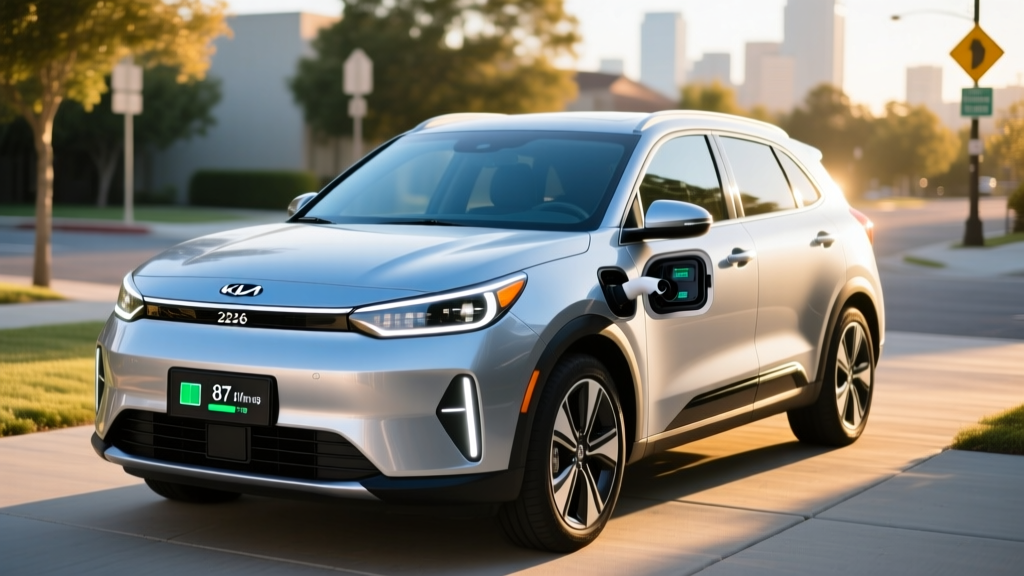
Quick Verdict: The Kia Niro Plug-In Hybrid at a Glance
The 2026 Kia Niro Plug-In Hybrid (PHEV) occupies a narrow but compelling lane: a compact crossover that delivers 33 miles of electric-only driving for daily commutes, then seamlessly transitions to a highly efficient hybrid powertrain for longer trips. With an EPA-estimated 108 MPGe in electric mode and 48 MPG combined once the gasoline engine kicks in, the Niro PHEV is one of the most efficient plug-in vehicles you can buy without committing to a fully electric lifestyle. Starting around $35,590 before destination, it undercuts most PHEV crossovers on price while offering a practical cargo area, solid tech, and Kia's strong 10-year powertrain warranty.
The critical question for buyers: Does the Niro PHEV's 33-mile electric range cover your daily driving, and do you have reliable access to Level 2 charging at home or work? If yes, this vehicle can operate as an EV most days and a hybrid on weekends — a genuine fuel-cost reducer without range anxiety.
HEV vs PHEV: Understanding the Two Kia Niro Variants
Kia sells the Niro in two electrified flavors for 2026, and confusing them at the dealership is easy. Here is the fundamental difference:
| Feature | Kia Niro HEV (Conventional Hybrid) | Kia Niro PHEV (Plug-In Hybrid) |
|---|---|---|
| Plug-in charging | No — charges via regenerative braking and engine | Yes — plug in to charge the larger battery |
| Battery capacity | ~1.56 kWh | 11.1 kWh (usable ~9.8 kWh) |
| Electric-only range | Less than 1 mile at very low speeds | 33 miles (EPA) |
| EPA combined MPG / MPGe | 53 MPG combined | 108 MPGe (electric) / 48 MPG (hybrid) |
| Combined horsepower | 139 hp | 180 hp |
| Starting MSRP (2026) | ~$28,590 | ~$35,590 |
| Federal tax credit eligible | No | Up to $7,500 (subject to §30D rules) |
The conventional Niro HEV never plugs in. Its small battery captures energy from braking and the gasoline engine to assist acceleration and enable brief electric-only crawling. The Niro PHEV, by contrast, has a battery roughly seven times larger and a more powerful electric motor, giving it genuine EV commuting capability. If you can charge at home overnight, the PHEV transforms your weekday driving into near-zero-fuel operation. If you cannot charge regularly, you are paying a $7,000 premium for a heavier vehicle that operates mostly as a slightly less efficient hybrid — in that case, the HEV is the smarter buy.
Fuel Economy Breakdown: MPG, MPGe, and Real-World Expectations
The EPA rates the 2026 Kia Niro PHEV with two separate efficiency figures depending on whether you are driving on stored electricity or gasoline:
| Mode | City | Highway | Combined |
|---|---|---|---|
| Electric-only (MPGe) | 114 MPGe | 101 MPGe | 108 MPGe |
| Hybrid / Gasoline (MPG) | 49 MPG | 47 MPG | 48 MPG |
Source: fueleconomy.gov, EPA estimates for 2026 Kia Niro Plug-In Hybrid.
Real-World MPG vs. EPA Sticker
Hybrids and PHEVs tend to match or exceed their EPA city ratings because stop-and-go traffic maximizes regenerative braking. In mixed suburban driving with frequent stops, owners commonly report 50–55 MPG in hybrid mode — slightly above the EPA's 49 MPG city figure. Highway driving is where real-world numbers can dip below the sticker: sustained 75+ mph cruising with climate control running may yield 42–45 MPG, since the electric motor contributes less at constant high speed and aerodynamic drag dominates.
In electric mode, the 33-mile EPA range assumes moderate temperatures and mixed driving. In cold weather (below 35°F), expect that range to shrink to roughly 25–28 miles as the battery's internal resistance increases and cabin heating draws additional power. Hot-weather highway driving at sustained speeds may similarly reduce electric range to around 28–30 miles. These reductions are typical for all PHEVs and BEVs — plan your commute around the lower bound if you live in a climate with harsh winters.
EPA Electric Range: 33 miles
Real-World Expectation: 28–33 miles (mild weather, mixed driving); 25–28 miles (cold weather or sustained highway)
Powertrain, Battery, and Charging Specifications
| Specification | 2026 Kia Niro PHEV |
|---|---|
| Engine | 1.6L GDI 4-cylinder (104 hp, 109 lb-ft) |
| Electric Motor | Permanent-magnet synchronous (83 hp / 62 kW) |
| Combined System Output | 180 hp / 195 lb-ft torque |
| Transmission | 6-speed dual-clutch automatic (DCT) |
| Battery Chemistry | Lithium-ion polymer (NMC) |
| Battery Capacity | 11.1 kWh total (~9.8 kWh usable) |
| Electric-Only Range (EPA) | 33 miles |
| Total Combined Range | ~440 miles (electric + gasoline) |
| Level 1 Charging (120V, 12A) | ~1.4 kW — approximately 9 hours (0–100%) |
| Level 2 Charging (240V, 32A) | ~3.3 kW onboard charger — approximately 2 hr 45 min (0–100%) |
| DC Fast Charging | Not available — no DC fast-charge capability |
| Charge Port / Connector | J1772 (standard for Level 1 and Level 2 AC charging) |
| 0–60 mph | ~7.2 seconds (estimated) |
| Drivetrain | Front-wheel drive |
Charging the Niro PHEV: What You Need to Know
The Niro PHEV's 3.3 kW onboard charger is the limiting factor for AC charging speed. Even if you connect to a 7.2 kW or 11.5 kW Level 2 home charger, the vehicle will only draw up to 3.3 kW. This is typical for PHEVs — their smaller batteries do not require the high-power chargers that full EVs need, but it does mean you cannot "speed up" charging with a more powerful wallbox.
A standard 120V household outlet (Level 1) delivers roughly 1.4 kW and will fully recharge the Niro PHEV in about 9 hours. For most owners, plugging in overnight on a standard outlet is sufficient to wake up to a full battery every morning. A 240V Level 2 home charger reduces that to under three hours — useful if you need a midday top-up between a morning commute and an afternoon errand.
The Niro PHEV does not support DC fast charging. There is no CCS or NACS port, and you cannot use public fast-charging stations to add range quickly. This is standard for nearly all PHEVs in this class — the battery is simply too small to justify the added cost and weight of DC fast-charge hardware.
Pricing, Trims, and Federal Tax Credit Eligibility
The 2026 Kia Niro Plug-In Hybrid is offered in three trims:
| Trim | MSRP (before destination) | Key Features |
|---|---|---|
| LX | ~$35,590 | 10.25-inch touchscreen, wireless Apple CarPlay/Android Auto, heated front seats, smart cruise control |
| EX | ~$37,190 | Adds Smart power liftgate, LED headlights, Highway Driving Assist, leatherette seats |
| X-Line SX Prestige | ~$41,190 | Adds Harman Kardon audio, sunroof, ventilated front seats, navigation, surround-view monitor |
Destination charge adds approximately $1,375. Pricing based on 2026 model-year MSRP from Kia; verify with local dealer.
Federal Tax Credit: §30D Eligibility
The Kia Niro PHEV may qualify for a federal tax credit of up to $7,500 under IRS Section 30D, but eligibility depends on several factors that change based on battery sourcing rules, buyer income, and MSRP caps. As of 2026, the key requirements are:
- MSRP Cap: The vehicle's MSRP must not exceed $80,000 for SUVs — the Niro PHEV clears this easily at all trims.
- Buyer Income Limits: Modified adjusted gross income (MAGI) must not exceed $150,000 (single), $225,000 (head of household), or $300,000 (joint filers).
- Battery Sourcing: The credit is split into two halves — $3,750 for critical minerals and $3,750 for battery components. Each half has separate sourcing requirements that tighten annually. The Niro PHEV's eligibility for each half depends on Kia's supply chain compliance for the specific model year.
- Point-of-Sale Transfer: Under current rules, you can transfer the credit to the dealer at purchase, reducing your out-of-pocket cost immediately rather than waiting to claim it on your tax return.
- Annual Credit Cap: There is no per-manufacturer cap under current §30D rules (the old 200,000-vehicle cap was eliminated).
Because battery sourcing requirements tighten each year, the exact credit amount — whether $3,750, $7,500, or somewhere in between — must be verified at the time of purchase. Consult the IRS clean vehicle credits page and confirm with your tax professional before relying on a specific credit amount in your purchase decision.
Battery Warranty, Reliability, and Long-Term Ownership Costs
High-Voltage Battery Warranty: 10 years / 100,000 miles (whichever comes first), with a capacity retention threshold typically set at 70% of original capacity. If the battery degrades below this threshold within the warranty period, Kia will repair or replace it.
Powertrain Warranty: 10 years / 100,000 miles — covers the engine, electric motor, transmission, and related components.
Basic Warranty: 5 years / 60,000 miles bumper-to-bumper.
How Long Will the PHEV Battery Last?
Lithium-ion NMC batteries in PHEVs experience gradual capacity loss over time, driven by charge cycles, temperature exposure, and charging habits. Based on industry data from similar Hyundai/Kia PHEV platforms, expect approximately 10–15% capacity loss over 10 years of typical use — meaning your 33-mile electric range might drop to roughly 28–30 miles after a decade. This is well within Kia's 70% warranty threshold (which would represent a range of ~23 miles).
Out-of-warranty battery replacement for the Niro PHEV is estimated at $4,000–$6,500 including parts and labor, based on current pricing for Hyundai/Kia PHEV battery packs. This is significantly less than a full-EV battery replacement because the pack is much smaller (11.1 kWh vs. 60–100+ kWh in a BEV). However, PHEV battery failures within the first 10 years are uncommon — most degradation is gradual and linear rather than catastrophic.
Reliability Track Record
The Niro PHEV shares its powertrain architecture with the Hyundai Ioniq PHEV and Hyundai Tucson PHEV, platforms that have accumulated years of real-world data. The 6-speed dual-clutch transmission is a conventional mechanical design rather than the e-CVT found in Toyota hybrids, and it has proven durable in Kia/Hyundai applications. The Niro lineup has earned strong marks from IIHS in crash testing. Routine maintenance costs are low — there is no engine oil to change more frequently than a standard hybrid schedule, and regenerative braking extends brake pad life considerably.
Who Should Buy the Kia Niro PHEV — and Who Should Look Elsewhere?
Choose the Kia Niro PHEV if:
- Your daily round-trip commute is under 30 miles and you can charge at home overnight
- You want EV-like operating costs on weekdays but need gasoline flexibility for weekend road trips
- You are not ready to commit to a full BEV due to apartment living, unreliable public charging, or frequent long-distance travel
- You value a compact crossover footprint with practical cargo space (19.4 cu ft behind rear seats, 54.6 cu ft folded)
- You want to reduce fuel spending without the higher upfront cost of a long-range BEV
Choose the Kia Niro HEV (conventional hybrid) instead if:
- You cannot install or access Level 2 or even Level 1 charging at home or work
- Your daily driving regularly exceeds 40+ miles, making the PHEV's electric range a small fraction of your total mileage
- You want the lowest possible purchase price and do not qualify for the federal tax credit
Choose a full EV (such as the Kia EV6 or Hyundai Ioniq 5) instead if:
- Your daily driving is consistently under 200 miles and you have reliable home charging
- You want zero tailpipe emissions and minimal maintenance (no oil changes, no spark plugs, no gasoline engine)
- You are willing to pay more upfront for 250+ miles of range and DC fast-charging capability for road trips
Pros
- 33-mile electric range covers most daily commutes
- 48 MPG hybrid mode is among the best in the PHEV crossover class
- 10-year/100,000-mile powertrain and battery warranty
- Lower starting price than most competing PHEV crossovers
- Standard J1772 charging works with any Level 2 home or public AC charger
- Comfortable ride quality and well-organized interior for the price
Cons
- No DC fast-charging capability — public charging limited to Level 2 AC
- 3.3 kW onboard charger limits Level 2 charging speed
- Front-wheel drive only — no AWD option for snow-belt buyers
- Cargo space (19.4 cu ft) trails some competitors like the Toyota RAV4 Prime
- Electric range drops noticeably in cold weather
- Tax credit amount varies based on sourcing rules — not guaranteed at $7,500
Charging Setup and Operating Cost Comparison
| Charging Level | Power (kW) | Time to Full Charge | Approximate Cost (Full Charge) |
|---|---|---|---|
| Level 1 (120V household outlet) | ~1.4 kW | ~9 hours | $1.00–$1.50 (at $0.13/kWh national average) |
| Level 2 (240V home wallbox) | 3.3 kW (vehicle-limited) | ~2 hr 45 min | $1.00–$1.50 (at $0.13/kWh) |
| Public Level 2 (ChargePoint, etc.) | 3.3 kW (vehicle-limited) | ~2 hr 45 min | $2.00–$4.00 (varies by network and pricing) |
| DC Fast Charging | Not supported | N/A | N/A |
Cost Per Mile: Niro PHEV vs. Gasoline Compact Crossover
Driving 33 miles on electricity at the national average of $0.13/kWh and a consumption rate of roughly 30 kWh/100 miles costs approximately $1.30 — about 3.9 cents per mile. Compare that to a gasoline compact crossover averaging 30 MPG at $3.40/gallon, which costs about 11.3 cents per mile. If your daily commute fits within the electric range, you are cutting your per-mile "fuel" cost by roughly two-thirds.
Even in hybrid mode at 48 MPG, the Niro PHEV costs approximately 7.1 cents per mile at $3.40/gallon — still a meaningful advantage over a 30 MPG gas vehicle. Over 15,000 annual miles with 70% electric driving, the savings versus a gas-only crossover can reach $800–$1,200 per year depending on local electricity and fuel prices.
Frequently Asked Questions
How many MPG does the Kia Niro Plug-In Hybrid get?
The EPA rates the 2026 Niro PHEV at 48 MPG combined (49 city / 47 highway) when operating as a hybrid on gasoline. In electric mode, it achieves 108 MPGe combined. In real-world driving, city MPG often meets or slightly exceeds the EPA figure thanks to regenerative braking, while sustained highway speeds above 75 mph may reduce hybrid MPG to the low 40s.
How far can the Kia Niro PHEV go on electric only?
The EPA rates the Niro PHEV at 33 miles of electric-only range. In mild weather with mixed driving, expect 28–33 miles. In cold weather or on sustained highway stretches, plan for 25–28 miles. The gasoline engine starts automatically once the battery depletes, so you are never stranded — the vehicle transitions seamlessly to hybrid mode.
Does the Kia Niro Plug-In Hybrid qualify for a federal tax credit?
The Niro PHEV may qualify for up to $7,500 under the IRS §30D Clean Vehicle Credit, but the actual amount depends on battery component and critical mineral sourcing requirements that tighten annually, as well as buyer income limits and the vehicle's MSRP (which clears the $80,000 SUV cap). The credit can be transferred to the dealer at point of sale. Verify current eligibility on the IRS website and with your tax advisor before purchase.
Is the Kia Niro PHEV reliable, and what does battery replacement cost?
The Niro PHEV's powertrain is shared across the Hyundai/Kia PHEV family and has accumulated years of service data with generally positive reliability outcomes. The high-voltage battery is warranted for 10 years or 100,000 miles against capacity loss below 70%. Out-of-warranty replacement is estimated at $4,000–$6,500, though catastrophic battery failure within the first decade is uncommon. Most owners experience gradual, manageable degradation of roughly 10–15% over 10 years.
Should I buy the Niro PHEV, the Niro HEV, or a full EV?
Choose the PHEV if you can charge at home and your daily driving is under 33 miles — you get EV-like weekday costs with gasoline backup. Choose the HEV if you cannot plug in at all — it still delivers 53 MPG combined without any charging infrastructure. Choose a full EV like the Kia EV6 if your driving is predictable, you have home charging, and you want zero tailpipe emissions with DC fast-charging for road trips. The PHEV is the bridge option for buyers who want electrification without committing fully.
Can the Kia Niro PHEV use DC fast chargers?
No. The Niro PHEV is equipped only with a J1772 AC charge port and a 3.3 kW onboard charger. It cannot connect to CCS, NACS, or CHAdeMO DC fast-charging stations. All charging is done via Level 1 (120V) or Level 2 (240V) AC power. This is normal for PHEVs — the battery is too small to benefit from DC fast-charging infrastructure.
Does the Niro PHEV have all-wheel drive?
No. The 2026 Niro PHEV is front-wheel drive only across all trims. If AWD is a priority for snow and ice, you will need to look at competitors like the Toyota RAV4 Prime (PHEV with AWD) or consider a dedicated EV with dual-motor AWD.