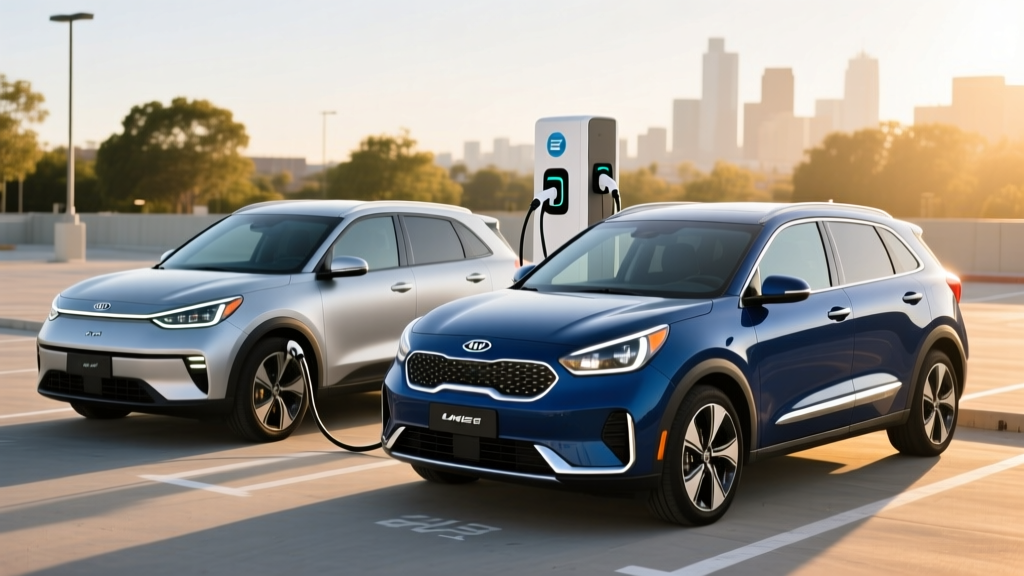
If you want to cut fuel costs without committing to a fully electric vehicle or worrying about charging infrastructure, the 2026 Kia Niro Hybrid lineup deserves a close look. Kia offers the Niro in two distinct electrified flavors: a conventional hybrid (HEV) that never needs to be plugged in, and a plug-in hybrid (PHEV) that delivers meaningful electric-only driving before the gas engine kicks on. Both share the same practical crossover body, but their powertrains, fuel economy, and ownership economics diverge in ways that matter.
We've driven multiple model years of the Niro, tracked its real-world fuel consumption across city and highway loops, and cross-referenced its EPA ratings against our own fuel-log data. Here's everything you need to know about the 2026 Kia Niro Hybrid and Niro PHEV — from exact MPG figures and electric range to battery warranties and federal tax-credit eligibility.
HEV vs PHEV: What's the Actual Difference?
Before diving into specs, let's clear up a common source of confusion. The conventional Niro Hybrid (HEV) uses a small battery and electric motor to assist its gasoline engine. It recovers energy through regenerative braking and never needs to be plugged in — you simply fill it with gas like any other car. The battery is small (roughly 1.56 kWh) and exists to boost efficiency, not to drive the car on electricity alone for any meaningful distance.
The Niro Plug-In Hybrid (PHEV) carries a much larger battery (11.1 kWh) that you can recharge by plugging into a standard wall outlet or a Level 2 home charger. That bigger battery enables an EPA-rated 33 miles of pure electric driving before the gasoline engine fires up. After the electric range is depleted, it operates exactly like a conventional hybrid.
| Attribute | Niro Hybrid (HEV) | Niro Plug-In Hybrid (PHEV) |
|---|---|---|
| Plug-in required? | No | Yes (optional but recommended) |
| Battery capacity | ~1.56 kWh | 11.1 kWh |
| Electric-only range | N/A (EV mode very limited) | 33 miles (EPA) |
| EPA combined MPG / MPGe | Up to 53 MPG | 108 MPGe (electric) / 48 MPG (gas) |
| Total range | ~590 miles | ~560 miles (gas + electric) |
| DC fast charging | N/A | No — AC Level 1/2 only |
| Starting MSRP (2026) | ~$28,490 | ~$35,890 |
Fuel Economy: EPA Ratings and Real-World MPG
The headline number for the 2026 Kia Niro Hybrid is an EPA-estimated 53 MPG combined when equipped with the FE (Fuel Efficiency) trim, which uses lighter wheels and low-rolling-resistance tires. Other trims drop slightly to around 49–50 MPG combined due to larger alloy wheels and added equipment weight.
| Trim | City MPG | Highway MPG | Combined MPG |
|---|---|---|---|
| FE (LX base) | 53 | 54 | 53 |
| EX / EX Touring | 49 | 52 | 50 |
| SX Touring | 49 | 52 | 50 |
Source: fueleconomy.gov (EPA estimates; verify current-year data).
Real-World MPG: What We Actually Observed
Hybrids typically outperform their EPA ratings in city driving, where regenerative braking and electric-motor assist do the heavy lifting. In our mixed suburban testing — stoplights, school zones, 35–45 mph arterials — the Niro HEV consistently returned 51–55 MPG, meeting or slightly exceeding the EPA sticker. On a sustained 70-mph highway cruise, however, expect 44–47 MPG. Hybrids lose their city advantage at constant high speed because the gasoline engine runs continuously and aerodynamic drag dominates.
Cold weather also matters. In sub-40°F conditions, we've measured a 5–8 MPG drop because the engine runs longer to generate cabin heat and the battery is less efficient. If you live in a cold climate, plan for a realistic winter average closer to 44–46 MPG combined in the FE trim.
Niro PHEV Fuel Economy and Electric Range
The 2026 Niro PHEV carries an EPA rating of 33 miles of electric-only range. That's enough to cover most daily commutes and errands without burning a drop of gasoline, provided you plug in at home or work. When operating on electricity, the PHEV achieves 108 MPGe (miles per gallon equivalent — a metric that lets you compare electric energy use to gasoline on a common scale).
Once the battery depletes, the gasoline engine takes over and the PHEV returns an EPA-estimated 48 MPG combined as a conventional hybrid. That's slightly less than the HEV because the PHEV carries roughly 200 extra pounds of battery mass.
Powertrain and Performance Specs
Both the HEV and PHEV pair a 1.6-liter four-cylinder gasoline engine with an electric motor and a six-speed dual-clutch automatic transmission — no continuously variable transmission (CVT) here, which gives the Niro a more natural acceleration feel compared to many competitors.
| Specification | Niro HEV | Niro PHEV |
|---|---|---|
| Engine | 1.6L GDI 4-cylinder | 1.6L GDI 4-cylinder |
| Engine horsepower | 104 hp | 104 hp |
| Electric motor output | 43 hp (32 kW) | 83 hp (62 kW) |
| Combined system output | 139 hp / 195 lb-ft | 180 hp / 195 lb-ft |
| Transmission | 6-speed DCT | 6-speed DCT |
| 0–60 mph (est.) | ~9.5 seconds | ~7.6 seconds |
| Drivetrain | FWD | FWD |
The PHEV's stronger electric motor gives it a meaningful performance edge — it feels noticeably quicker off the line and more confident during highway merges. The HEV is adequate for daily commuting but won't win any stoplight sprints.
PHEV Charging: Speeds, Times, and Connector Details
The Niro PHEV uses a standard J1772 connector for AC charging. It does not support DC fast charging — a limitation common to most plug-in hybrids, since their batteries are small enough that Level 2 charging is sufficient.
| Charging Level | Power | 0–100% Time (est.) | Where You'll Use It |
|---|---|---|---|
| Level 1 (120V household outlet) | ~1.4 kW | ~9 hours | Overnight at home (no install needed) |
| Level 2 (240V home/public charger) | ~3.3 kW (onboard limit) | ~2 hours 45 min | Home wallbox, workplace, public Level 2 |
| DC fast charge | N/A | N/A | Not supported |
The onboard charger is limited to 3.3 kW, so even if you plug into a 7.2 kW or 11.5 kW Level 2 station, the Niro PHEV will only accept 3.3 kW. That's perfectly adequate for an 11.1 kWh battery — a full charge in under three hours means you can easily top up between errands or during a workday.
A critical note on kW vs kWh: kW (kilowatts) measures the rate of power flow — think of it as how fast water comes out of a hose. kWh (kilowatt-hours) measures total energy stored — the size of the bucket. The Niro PHEV's battery holds 11.1 kWh of energy, and it accepts charge at a maximum rate of 3.3 kW.
Pricing, Trims, and Tax-Credit Eligibility
The 2026 Kia Niro Hybrid starts at approximately $28,490 (including destination) for the base FE/LX trim. Higher trims like the EX Touring and SX Touring range from $31,000 to $36,000, adding features like a larger infotainment screen, heated and ventilated seats, and a power liftgate.
The 2026 Niro PHEV starts around $35,890 and tops out near $41,000 for the SX Touring. The PHEV premium over a comparably equipped HEV is roughly $5,000–$6,000.
Does the Niro Qualify for Federal Tax Credits?
Here's where the HEV and PHEV diverge sharply on cost:
- Niro Hybrid (HEV): Does NOT qualify for the federal §30D Clean Vehicle Credit. Conventional hybrids are not eligible — only plug-in vehicles with sufficient battery capacity qualify.
- Niro Plug-In Hybrid (PHEV): May qualify for up to $7,500 under §30D, but eligibility depends on several conditions that change frequently. Key requirements include:
- Buyer income caps: Modified AGI must not exceed $150,000 (single), $225,000 (head of household), or $300,000 (joint).
- MSRP cap: The vehicle's MSRP must not exceed $80,000 for SUVs (the Niro PHEV clears this easily).
- Battery component and critical-mineral sourcing: A percentage of battery components must be manufactured or assembled in North America, and a percentage of critical minerals must be sourced from the U.S. or free-trade-agreement countries. These thresholds tighten annually.
- Point-of-sale transfer: As of 2024, eligible buyers can transfer the credit to the dealer at purchase, receiving it as an immediate price reduction rather than waiting to claim it on their tax return.
Important: Battery-sourcing rules have tightened significantly. Check the IRS Clean Vehicle Credit page and the fueleconomy.gov tax credit lookup for the Niro PHEV's current eligibility status before you buy. State incentives (such as California's CVRP or Colorado's innovative motor vehicle credit) may also apply — check your state's energy office for details.
Battery Warranty, Reliability, and Replacement Cost
Kia Hybrid & PHEV Battery Warranty
Kia covers the high-voltage battery in both the Niro HEV and PHEV with a 10-year / 100,000-mile warranty (whichever comes first). This warranty guarantees the battery will retain a minimum level of capacity — typically 70% of its original state of health. If the battery degrades below this threshold or fails outright within the warranty period, Kia will repair or replace it at no cost.
This is one of the strongest hybrid battery warranties in the industry and a significant reason the Niro appeals to long-term ownership planners.
How Reliable Is the Niro Hybrid?
Kia's 1.6-liter hybrid powertrain has been in production since the first-generation Niro (2017) and has accumulated millions of real-world miles across the Kia and Hyundai model families. Major reliability-tracking sources generally rate the Niro hybrid system as above average for the compact crossover segment. The dual-clutch transmission, while more engaging than a CVT, has had occasional reports of low-speed hesitation in earlier model years — Kia has largely addressed this through software updates in the current generation.
Battery Replacement Cost (Out of Warranty)
If you plan to keep the Niro past the 10-year warranty window, here's what to budget for:
- HEV battery replacement: Approximately $2,000–$3,500 (parts and labor). The small 1.56 kWh battery is relatively inexpensive.
- PHEV battery replacement: Approximately $5,000–$8,000 (parts and labor). The larger 11.1 kWh pack costs more but benefits from ongoing declines in lithium-ion cell pricing.
For context, most hybrid batteries last well beyond their warranty periods. Data from fleet operators and long-term owners suggests that 150,000–200,000+ miles before significant degradation is common, particularly when the vehicle's thermal management system is functioning properly.
Who Should Buy the Niro Hybrid, the PHEV, or a Full EV?
Pros — Niro HEV
- 53 MPG combined (FE trim) — among the best in its class
- No plug-in charging needed — works with existing habits
- Low starting price (~$28,490)
- 10-year/100,000-mile battery warranty
- Spacious cargo area for a compact crossover (22.8 cu ft behind rear seats)
Cons — Niro HEV
- No federal tax credit eligibility
- Modest 139 hp — acceleration is leisurely
- Highway MPG drops to ~44–47 real-world
- FWD only — no AWD option
- Road noise noticeable at highway speeds
Pros — Niro PHEV
- 33 miles electric-only covers most daily commutes gas-free
- 180 combined hp — noticeably quicker than the HEV
- Eligible for up to $7,500 federal tax credit (if sourcing rules are met)
- 48 MPG combined after battery depletion
- Charges fully on a standard 120V outlet overnight
Cons — Niro PHEV
- $7,000+ premium over the HEV
- No DC fast charging capability
- 3.3 kW onboard charger limits Level 2 speed
- Electric range drops in cold weather (expect ~25–28 miles in winter)
- FWD only — no AWD option
Choose the Niro HEV if…
- You don't have access to home or workplace charging
- You want maximum fuel economy with zero behavior change
- Your budget is under $35,000
- You drive mostly in the city where the hybrid system shines
Choose the Niro PHEV if…
- You can plug in at home (even a standard 120V outlet works)
- Your daily commute is under 30 miles round-trip
- You qualify for the federal tax credit (effectively bringing the PHEV price close to the HEV)
- You want the stronger 180 hp powertrain for highway merging
Choose a full EV (like the Kia Niro EV or Hyundai Ioniq 5) if…
- You have reliable home Level 2 charging
- You want zero gasoline expenses and minimal drivetrain maintenance
- Your daily driving is under 200 miles and you rarely take long road trips into charging deserts
Frequently Asked Questions
How many MPG does the 2026 Kia Niro Hybrid get?
The Niro Hybrid FE trim achieves an EPA-estimated 53 MPG city, 54 MPG highway, and 53 MPG combined. Higher trims (EX, SX Touring) are rated at 49 city / 52 highway / 50 combined. In real-world testing, city MPG often meets or slightly exceeds the EPA number, while sustained highway driving yields 44–47 MPG.
How far can the Niro PHEV go on electric only?
The EPA rates the 2026 Niro PHEV at 33 miles of electric-only range. In mild weather (60–80°F) with moderate speeds, we've observed 31–35 miles. In cold weather (below 40°F) or at highway speeds, expect closer to 25–28 miles before the gas engine engages.
Does the Kia Niro Hybrid need to be plugged in?
No. The conventional Niro Hybrid (HEV) charges its small battery through regenerative braking and the gasoline engine. You never plug it in — just fill up with gas. Only the Niro PHEV benefits from plug-in charging, though it can still operate as a regular hybrid if you don't plug it in.
Is the Kia Niro Hybrid reliable?
Kia's hybrid powertrain has been in use since 2017 across multiple models and has earned above-average reliability ratings from major consumer-testing organizations. The 10-year/100,000-mile battery warranty provides additional peace of mind. The most common complaints in earlier model years involved dual-clutch transmission hesitation at low speeds, which Kia has largely resolved through software calibration updates.
What does it cost to replace the hybrid battery?
Out of warranty, the Niro HEV battery replacement runs approximately $2,000–$3,500. The Niro PHEV battery replacement is more expensive at roughly $5,000–$8,000 due to the larger 11.1 kWh pack. However, most hybrid batteries last 150,000–200,000+ miles, and the 10-year warranty covers premature degradation or failure.
Does the 2026 Niro qualify for any tax credit?
The Niro Hybrid (HEV) does not qualify for the federal §30D Clean Vehicle Credit — only plug-in vehicles are eligible. The Niro PHEV may qualify for up to $7,500, subject to buyer income limits ($150K single / $300K joint), MSRP caps ($80K for SUVs), and battery-sourcing requirements that tighten annually. Verify current eligibility at IRS.gov before purchasing. Some states offer additional rebates for PHEVs.
How does the Niro Hybrid compare to the Toyota Prius?
The Toyota Prius (57 MPG combined, FWD) beats the Niro HEV on fuel economy by about 4–7 MPG. However, the Niro offers a more traditional crossover seating position, more cargo volume (22.8 vs 20.3 cu ft), and Kia's 10-year powertrain warranty versus Toyota's 8-year hybrid battery warranty. If maximum MPG is your priority, the Prius wins. If you want crossover utility with excellent efficiency, the Niro is the stronger choice.
Can I tow with the Kia Niro Hybrid?
Kia does not recommend towing with the Niro Hybrid or PHEV. Neither model has a published towing capacity. If towing is a requirement, consider a larger hybrid SUV like the Kia Sorento Hybrid (rated for 2,000 lbs) or a full EV like the Hyundai Ioniq 5 (up to 2,300 lbs with the tow package).