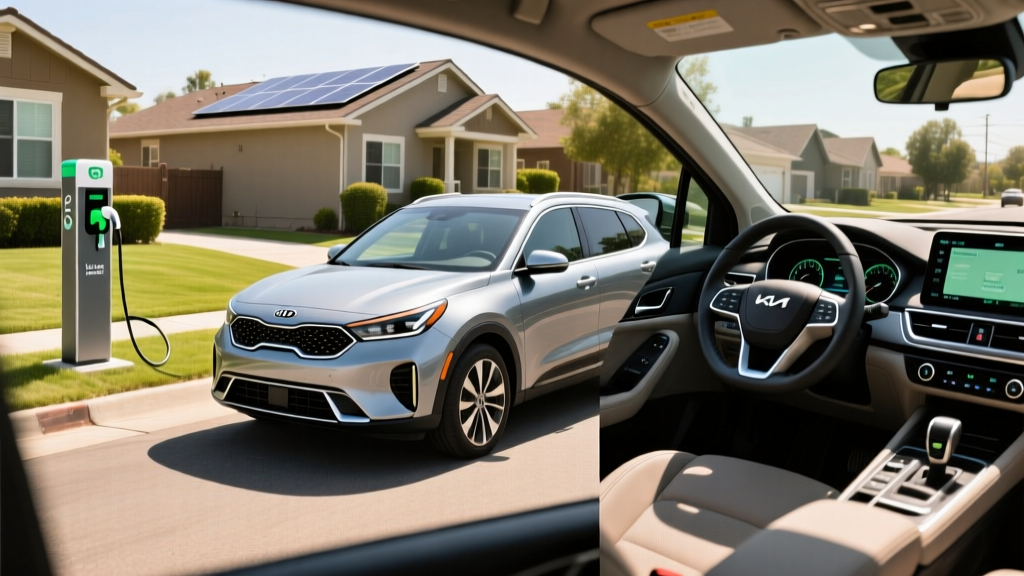
The 2026 Kia Niro Hybrid LX occupies a pragmatic sweet spot in the compact crossover segment: genuine hybrid fuel economy without the complexity, cost, or charging demands of a plug-in hybrid or full electric vehicle. As the base trim in Kia's Niro lineup, the LX strips away premium add-ons to deliver the model's best efficiency numbers at an accessible price point. For buyers who want to cut fuel costs without altering their daily routine — no plugs, no range calculations, no charging-app juggling — the Niro Hybrid LX makes a compelling case.
This guide breaks down the exact specs, real-world fuel economy expectations, powertrain details, battery longevity data, and ownership economics you need before signing a purchase agreement.
Kia Niro Hybrid LX vs. Niro PHEV vs. Niro EV: Understanding the Lineup
Kia sells three electrified Niro variants, and confusing them at the dealership is more common than you'd think. Here's the critical distinction:
Conventional Hybrid (HEV) — Niro Hybrid LX
- No plug required. The battery recharges through regenerative braking and the gasoline engine.
- You fuel it exclusively at gas stations, exactly like a conventional car.
- Best for: drivers without reliable home or workplace charging access.
Plug-In Hybrid (PHEV) — Niro PHEV
- Must be plugged in to access its ~33-mile electric-only range.
- Runs on electricity first, then switches to hybrid mode once the battery depletes.
- Requires a Level 2 home charger (or patience with a 120V Level 1 outlet) to realize its value.
Battery Electric (BEV) — Niro EV
- No gasoline engine. Runs entirely on its ~58 kWh battery pack.
- EPA range around 239 miles; requires regular access to home or public charging.
- Best for: drivers with predictable commutes and reliable home charging.
The Niro Hybrid LX is the simplest proposition: fill up with gas, drive, repeat. The 1.1 kWh lithium-ion battery pack is small, self-charging, and never requires a plug.
Fuel Economy: EPA Ratings and Real-World MPG
The 2026 Niro Hybrid LX carries the highest EPA fuel-economy ratings in the Niro family, thanks to lighter weight and the absence of a large battery pack or plug-in hardware.
| Metric | EPA Rating | Real-World Expectation |
|---|---|---|
| City MPG | 53 MPG | 50–55 MPG (hybrids excel in stop-and-go) |
| Highway MPG | 54 MPG | 47–52 MPG (aerodynamic drag reduces hybrid advantage) |
| Combined MPG | 53 MPG | 48–53 MPG depending on driving mix |
| Fuel Tank Capacity | 11.1 gallons | — |
| Total Range (est.) | ~588 miles | ~530–580 miles real-world |
According to fueleconomy.gov, the Niro Hybrid achieves a combined 53 MPG — a figure that holds up remarkably well in real-world mixed driving. Hybrid powertrains regenerate energy during braking and low-speed operation, meaning city commuters often match or exceed the EPA city estimate. Highway driving is the opposite: at sustained 70–80 MPH speeds, the electric motor contributes less and the 1.6L engine shoulders more load, typically dropping observed economy to 47–52 MPG.
In cold weather (below 35°F), expect a 5–10% reduction in fuel economy due to engine warm-up cycles, cabin heating demands, and denser air. This is modest compared to the 20–30% range loss a full EV experiences in winter.
Powertrain Specs: Engine, Motor, and Combined Output
| Specification | 2026 Kia Niro Hybrid LX |
|---|---|
| Engine | 1.6L GDI 4-cylinder (Atkinson cycle) |
| Engine Output | 104 hp / 111 lb-ft torque |
| Electric Motor | 32 kW (43 hp) permanent-magnet synchronous |
| Combined System Output | 139 hp / 195 lb-ft torque |
| Transmission | 6-speed dual-clutch automatic (DCT) |
| Drivetrain | Front-wheel drive |
| Hybrid Battery | 1.1 kWh lithium-ion (self-charging) |
| 0–60 MPH (est.) | ~9.8 seconds |
| Towing Capacity | Not rated for towing |
The Niro Hybrid uses a parallel hybrid architecture: both the gasoline engine and electric motor can drive the front wheels, either independently or together. Kia's 6-speed dual-clutch transmission is a deliberate choice over the continuously variable transmissions (CVTs) found in the Toyota Prius and Honda CR-V Hybrid. The DCT delivers more natural shift feel and better highway passing response, though it can exhibit slight low-speed hesitation in stop-and-go traffic — a trade-off worth understanding before your test drive.
The 139 combined horsepower is adequate for commuting and suburban driving but not quick. Highway merging requires planning, and loaded uphill grades will push the engine audibly into higher RPMs. If performance is a priority, the Niro PHEV's larger motor (62 kW / 83 hp) provides noticeably stronger acceleration.
Pricing, Trims, and Tax Credit Eligibility
The 2026 Kia Niro Hybrid LX starts at approximately $28,515 including destination charges, positioning it as one of the most affordable hybrid crossovers on the market. For context, the Toyota Prius LE starts around $29,000 but is a liftback, not a crossover; the Hyundai Tucson Hybrid Blue starts closer to $34,000.
| Niro Hybrid Trim | Approx. MSRP (2026) |
|---|---|
| LX (base) | $28,515 |
| EX | $31,215 |
| SX Touring | $35,415 |
Federal Tax Credit: Does the Niro Hybrid LX Qualify?
The conventional Niro Hybrid (HEV) does not qualify for the federal §30D Clean Vehicle Credit. Under current IRS rules, only plug-in electric vehicles (PHEVs and BEVs) with sufficient battery capacity are eligible. The Niro PHEV may qualify for up to $3,750–$7,500 depending on battery sourcing, buyer income, and MSRP caps, but the standard hybrid does not.
Some states and utilities offer rebates for conventional hybrids — check your state energy office or local utility for current programs.
Battery Longevity, Warranty, and Replacement Costs
Hybrid battery anxiety is the most common concern among first-time hybrid buyers. Here's what the data actually shows:
Kia backs the Niro Hybrid's battery pack and hybrid system components with a 10-year / 100,000-mile warranty (8 years / 100,000 miles in states that don't follow California emissions standards). This warranty covers battery capacity loss below a defined threshold — typically 70% of original capacity — as well as hybrid control modules, the electric motor, and the inverter.
The 1.1 kWh battery in the Niro Hybrid is small and operates within a narrow state-of-charge window (roughly 40–80%), which significantly reduces degradation stress. Unlike a full EV battery that cycles through deep charge and discharge events daily, the Niro's hybrid battery experiences shallow, frequent micro-cycles — a pattern that lithium-ion chemistry tolerates extremely well.
| Battery & Warranty Detail | Specification |
|---|---|
| Battery Capacity | 1.1 kWh lithium-ion |
| Hybrid System Warranty (CA states) | 10 years / 100,000 miles |
| Hybrid System Warranty (non-CA) | 8 years / 100,000 miles |
| Limited Vehicle Warranty | 5 years / 60,000 miles |
| Powertrain Warranty | 10 years / 100,000 miles |
| Estimated Battery Replacement (out of warranty) | $2,000–$3,500 |
Real-world failure data from Kia's hybrid lineup (now spanning over a decade with models like the Optima Hybrid and Niro) shows that hybrid battery failures before 150,000 miles are uncommon. When replacement is eventually needed, aftermarket and refurbished hybrid batteries have driven costs down to the $2,000–$3,500 range — a fraction of full EV battery replacement costs.
Who Should Buy the Niro Hybrid LX — and Who Shouldn't
Pros
- 53 MPG combined — among the highest of any crossover
- No plug-in charging required; zero lifestyle change from a gas car
- Low starting MSRP of ~$28,515
- 10-year/100,000-mile hybrid system warranty
- Practical cargo space (~22.8 cu ft behind rear seats)
- Standard safety suite (forward collision avoidance, lane keeping, blind-spot monitoring)
Cons
- Modest 139 hp — highway merging requires patience
- No all-wheel-drive option
- Not eligible for federal §30D tax credit
- Not rated for towing
- DCT can be slightly jerky at very low speeds
- Cabin noise is noticeable under hard acceleration
Hybrid vs. PHEV vs. EV: Which Niro Fits Your Life?
Choose the Niro Hybrid LX if:
- You lack access to home or workplace charging (apartment, street parking, no garage outlet).
- Your budget is under $30,000 and you want maximum MPG without a plug.
- You take frequent long road trips and don't want to plan around charging stops.
- You want the simplest possible transition from a gas car — no apps, no charging cards, no new habits.
Choose the Niro PHEV if:
- You have Level 2 charging at home or work and a commute under 33 miles.
- You want to drive mostly on electricity during the week but need gas flexibility for weekend trips.
- You may qualify for the federal §30D tax credit, which can offset the PHEV's higher MSRP.
Choose the Niro EV if:
- You have reliable daily charging access and your driving stays within ~200 miles between charges.
- You want the lowest per-mile fuel cost (electricity at $0.13/kWh ≈ $4.50 per 100 miles vs. gas at $3.50/gal ≈ $6.60 per 100 miles at 53 MPG).
- You want to eliminate oil changes, spark plugs, and emissions system maintenance entirely.
Reliability and Safety Ratings
Kia's hybrid powertrain has matured significantly since the first-generation Niro's 2017 debut. The 1.6L Atkinson-cycle engine is a well-proven design shared across Hyundai-Kia's hybrid lineup, and the dual-clutch transmission has received software refinements that address early-model shift hesitation complaints.
The Niro has earned strong safety marks. The IIHS has historically rated the Niro well in crashworthiness tests, and the standard Kia Drive Wise safety suite includes forward collision-avoidance assist with pedestrian detection, lane following assist, rear occupant alert, and driver attention warning. NHTSA testing data should be checked for the latest model-year star ratings as they are published.
Long-term owner forums and reliability surveys consistently place the Niro Hybrid in the average-to-above-average tier. The most commonly reported minor issues involve infotainment software glitches and occasional 12V battery drain if the vehicle sits unused for extended periods — neither of which is unique to Kia.
Frequently Asked Questions
How many MPG does the Kia Niro Hybrid LX get?
The EPA rates the 2026 Niro Hybrid LX at 53 MPG city, 54 MPG highway, and 53 MPG combined. In real-world driving, city commuters often match or slightly exceed the 53 MPG city figure thanks to regenerative braking, while sustained highway driving at 75+ MPH typically yields 47–52 MPG.
Does the Niro Hybrid LX need to be plugged in?
No. The Niro Hybrid is a conventional (self-charging) hybrid. Its 1.1 kWh battery recharges automatically through regenerative braking and the gasoline engine. You never plug it in — you only refuel at gas stations.
Is the Kia Niro Hybrid reliable, and what does battery replacement cost?
Kia's hybrid system has proven reliable over multiple generations. The hybrid battery is covered by a 10-year/100,000-mile warranty (in CA-emissions states). Out-of-warranty replacement typically costs $2,000–$3,500, and failures before 150,000 miles are uncommon based on owner data.
Does the Niro Hybrid LX qualify for a federal tax credit?
No. Under current IRS §30D rules, only plug-in vehicles (PHEVs and BEVs) qualify for the federal Clean Vehicle Credit. The conventional Niro Hybrid does not have a large enough battery or plug-in capability to be eligible. Check with your state energy office for any local hybrid incentives.
How does the Niro Hybrid LX compare to the Toyota Prius?
The Prius LE (57 MPG combined) edges out the Niro on pure fuel economy, but the Niro offers more cargo space (~22.8 vs. ~20.0 cu ft), a higher seating position, and crossover styling that many buyers prefer. The Prius is a liftback; the Niro is a compact crossover. If cargo practicality matters, the Niro wins; if maximum MPG is the only goal, the Prius holds the advantage.
Can the Niro Hybrid LX tow a trailer?
No. Kia does not rate the Niro Hybrid for towing. If you need towing capability, consider the Hyundai Tucson Hybrid (2,000 lb rating) or a larger SUV.