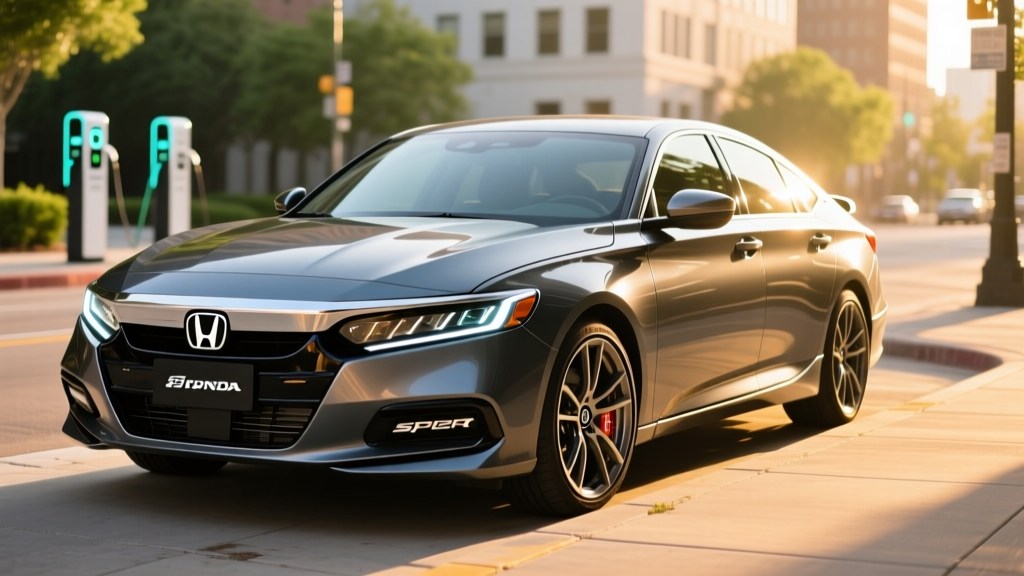
The Honda Accord Hybrid has long occupied the sweet spot for midsize sedan buyers who want serious fuel efficiency without sacrificing driving engagement. The Sport trim sits in the middle of the lineup, offering a sportier aesthetic and more equipment than the base Hybrid LX while keeping the price well under the Touring. For 2026, Honda continues with the proven two-motor hybrid system introduced with this generation, and the Accord Hybrid Sport remains one of the most compelling HEVs in its class — no plug required.
This guide breaks down everything a buyer needs to know: exact EPA MPG figures, real-world fuel economy expectations, the powertrain specs, warranty coverage, pricing, and whether the Accord Hybrid Sport makes more sense than a plug-in hybrid or a full battery-electric vehicle for your daily driving.
2026 Honda Accord Hybrid Sport: Key Specifications at a Glance
| Specification | Value |
|---|---|
| Powertrain Type | Conventional Hybrid (HEV) — no plug-in |
| Engine | 2.0L Atkinson-cycle 4-cylinder |
| Combined System Output | 204 hp / 247 lb-ft torque |
| Transmission | e-CVT (direct-drive with lock-up clutch) |
| EPA Fuel Economy (City / Hwy / Combined) | 51 / 44 / 48 MPG |
| Fuel Tank Capacity | 12.8 gallons |
| Total Driving Range | ~614 miles (EPA est.) |
| 0–60 mph | ~7.2 seconds |
| Drivetrain | Front-wheel drive |
| Hybrid Battery | Lithium-ion, ~1.1 kWh (self-charging) |
| Cargo Volume | 16.7 cu ft |
| Starting MSRP (Sport trim) | $34,990 (excl. destination) |
| Hybrid Battery Warranty | 8 years / 100,000 miles (10 yr/150k in CARB states) |
Fuel Economy: EPA Numbers and Real-World MPG
The 2026 Honda Accord Hybrid Sport carries EPA ratings of 51 MPG city, 44 MPG highway, and 48 MPG combined, per fueleconomy.gov. These figures apply to the Sport, Sport-L, and EX-L Hybrid trims. The base LX Hybrid and top Touring Hybrid are rated slightly higher at 51/44/48 as well for 2026, though earlier model years showed minor variance by trim due to wheel size differences.
| Driving Cycle | EPA Rating | Real-World Expectation |
|---|---|---|
| City | 51 MPG | 50–55 MPG (hybrids excel in stop-and-go) |
| Highway (70–80 mph) | 44 MPG | 40–44 MPG (aero drag and sustained ICE use) |
| Combined | 48 MPG | 44–50 MPG depending on driving mix |
| Cold Weather (below 30°F) | Not rated | 38–44 MPG (engine runs more for cabin heat) |
The Accord Hybrid's two-motor system does its best work in city driving, where regenerative braking recovers energy at every stop and the electric motor handles low-speed propulsion. In real-world testing, many owners report exceeding the EPA city figure on short commutes with moderate traffic. Highway fuel economy is where the system loses ground to its city advantage — at sustained 75–80 mph speeds, the gasoline engine is doing most of the work, and aerodynamic drag penalizes efficiency more than in city cycles.
In cold weather, expect a noticeable drop. The 2.0L engine must run more frequently to provide cabin heat (the Accord Hybrid uses engine waste heat rather than a dedicated heat pump for the cabin), and the battery's charge-discharge efficiency decreases at low temperatures. A 10–15% reduction in combined MPG during deep winter is typical for conventional hybrids.
How the Two-Motor Hybrid Powertrain Works
The Accord Hybrid uses Honda's two-motor hybrid system, which pairs a 2.0-liter Atkinson-cycle inline-4 engine with two electric motors — one functioning primarily as a generator and the other as the drive motor. Combined system output is 204 horsepower and 247 lb-ft of torque, sent to the front wheels through an e-CVT that operates more like a direct-drive system with a lock-up clutch for highway cruising than a traditional belt-and-pulley CVT.
Here's how the system manages power in different scenarios:
- EV Drive: At low speeds and light loads, the drive motor propels the car using energy from the small lithium-ion battery. The gasoline engine stays off.
- Hybrid Drive: During acceleration, the engine spins the generator motor, which sends electricity directly to the drive motor. Excess energy charges the battery.
- Engine Drive: At steady highway speeds, a lock-up clutch mechanically connects the engine to the wheels for maximum efficiency — bypassing the electrical path entirely.
- Regenerative Braking: Lift-off and braking events spin the drive motor as a generator, recovering kinetic energy into the battery.
The hybrid battery pack is small — approximately 1.1 kWh of usable capacity — because it doesn't need to store energy for long electric-only drives. It functions as a buffer, absorbing regenerated energy and releasing it for electric assist. This is the fundamental distinction between a conventional hybrid (HEV) and a plug-in hybrid (PHEV): the Accord Hybrid cannot be plugged in and does not offer meaningful electric-only range. It recovers all its energy from braking and the gasoline engine.
HEV vs. PHEV: Where the Accord Hybrid Fits
The 2026 Accord is offered exclusively as a conventional hybrid (HEV) in the U.S. market — Honda does not currently sell a plug-in hybrid Accord here. If you need electric-only commuting, you'd look at competitors like the Toyota Prius Prime (PHEV, ~44 miles electric-only) or a full EV like the Hyundai Ioniq 6. The Accord HEV trades electric-only capability for simplicity: no charging cable, no range countdown, just fill up and drive.
Pricing, Trims, and Tax Credit Eligibility
The 2026 Honda Accord Hybrid lineup starts at approximately $34,990 for the Sport trim (excluding destination charges of ~$1,195). The Hybrid range includes several trims:
- Hybrid LX: ~$30,490 — base hybrid, well-equipped with Honda Sensing suite
- Hybrid EX-L: ~$34,490 — leather, heated front seats, power moonroof
- Hybrid Sport: ~$34,990 — sport-tuned suspension, 19-inch wheels, black accents, paddle shifters for regen control
- Hybrid Sport-L: ~$36,490 — Sport equipment plus leather interior
- Hybrid Touring: ~$40,490 — full load including Bose audio, wireless CarPlay/Android Auto, heated rear seats
Does the Accord Hybrid Qualify for a Federal Tax Credit?
No. The 2026 Honda Accord Hybrid is a conventional hybrid (HEV), not a plug-in vehicle. Under current IRS §30D Clean Vehicle Credit rules, only battery electric vehicles (BEVs) and plug-in hybrids (PHEVs) with a minimum battery capacity of 7 kWh are eligible for the federal credit of up to $7,500. The Accord Hybrid's ~1.1 kWh pack does not qualify.
Some states offer their own incentives for conventional hybrids, though these are increasingly rare as state programs shift toward plug-in vehicles. Check your state's energy or environmental agency website for current programs. A few states still offer modest rebates ($250–$500) for HEVs, but most hybrid incentives have sunset.
Battery Warranty, Lifespan, and Replacement Cost
Honda Hybrid Battery Warranty
Honda covers the Accord Hybrid's lithium-ion battery pack for 8 years or 100,000 miles (whichever comes first) under the federal emissions warranty. In California Air Resources Board (CARB) states — which include CA, CO, CT, ME, MD, MA, NJ, NY, OR, RI, VT, and WA — the warranty extends to 10 years or 150,000 miles.
The warranty covers battery capacity loss below a specified threshold (typically around 60–70% of original capacity) and any manufacturing defects.
How Long Do Accord Hybrid Batteries Actually Last?
Real-world data from Honda's two-motor hybrid system is encouraging. The Accord Hybrid's battery pack is small and operates within a narrow state-of-charge window — typically between 20% and 80% SoC — which dramatically reduces stress on the cells. Unlike a full EV that cycles through a much wider range, the HEV battery experiences shallow charge-discharge cycles that are far gentler on lithium-ion chemistry.
Based on long-term owner reports and fleet data from earlier-generation Accord Hybrids (2018–2024), most hybrid battery packs last well beyond 150,000 miles with minimal capacity degradation. Failures within the warranty period are uncommon. The small pack size also means replacement costs are significantly lower than a full EV battery.
Battery Replacement Cost
If a replacement is needed out of warranty, expect to pay between $2,000 and $4,000 for a new or remanufactured Accord Hybrid battery pack, including labor. This is a fraction of EV battery replacement costs (which can exceed $10,000–$20,000). Independent hybrid specialists and remanufactured-cell suppliers have also brought costs down in recent years.
Reliability and Long-Term Ownership
The Accord Hybrid benefits from Honda's long track record with hybrid powertrains, dating back to the original Insight and Civic Hybrid. The current two-motor system has been in production since 2023 (for this Accord generation), and its predecessor was used in the 2018–2022 Accord Hybrid with strong reliability results.
Key reliability considerations:
- e-CVT durability: Honda's direct-drive e-CVT has fewer moving parts than a traditional automatic or belt-driven CVT. There are no belts to wear, no clutch packs to burn out. Long-term reliability is excellent.
- Brake wear: Regenerative braking handles most deceleration, meaning the friction brakes see far less use than on a gas-only car. Many Accord Hybrid owners report original brake pads lasting 80,000–100,000+ miles.
- Engine longevity: The 2.0L Atkinson-cycle engine runs under relatively low stress (it's supplemented by the electric motor for acceleration) and uses proven port injection. Oil change intervals remain at the standard Honda maintenance minder schedule.
- No charging infrastructure needed: Unlike a PHEV or BEV, there's no charging port, onboard charger, or charging cable to maintain or replace.
The 2026 Accord carries strong safety credentials, with standard Honda Sensing (adaptive cruise control, lane-keeping assist, automatic emergency braking, and road sign recognition). Check IIHS and NHTSA for the latest crash-test ratings.
Who Should Buy the Accord Hybrid Sport?
Pros
- 48 MPG combined EPA; real-world city driving can exceed 50 MPG
- No plug-in charging required — works with existing gas station infrastructure
- 614-mile total range eliminates range anxiety entirely
- Strong standard safety suite (Honda Sensing)
- Lower battery replacement cost than PHEV or EV
- 247 lb-ft of electric torque gives responsive off-the-line acceleration
- Sport trim adds 19-inch wheels, paddle-selectable regen levels
Cons
- No electric-only driving mode for zero-emission commuting
- Not eligible for the federal §30D tax credit (HEV, not PHEV/BEV)
- Highway MPG drops to ~40 in real-world 80 mph driving
- Cold-weather fuel economy penalty of 10–15%
- FWD only — no AWD option for snow-belt buyers
- Small trunk battery placement slightly reduces cargo flexibility vs. gas Accord (minimal impact)
Accord Hybrid Sport vs. PHEV vs. Full EV: Which Is Right for You?
| Factor | Accord Hybrid (HEV) | PHEV (e.g., Prius Prime) | Full EV (e.g., Ioniq 6) |
|---|---|---|---|
| Plug-in Required? | No | Yes (Level 1 or 2) | Yes (Level 2 + DCFC) |
| Electric-Only Range | ~1 mile at low speed | 35–44 miles | 270–360 miles (full battery) |
| Combined MPG / MPGe | 48 MPG | 48–52 MPG + 114–127 MPGe | 130–140 MPGe |
| Federal Tax Credit | None | Up to $7,500 (if eligible) | Up to $7,500 (if eligible) |
| Home Charging Needed? | No | Recommended | Essential |
| Upfront Cost | ~$35K | ~$33K–$40K | ~$38K–$52K |
| Best For | No home charging; long road trips | Short commute + road trips | Home charging + mostly under 250 mi/day |
Choose the Accord Hybrid Sport if: You don't have reliable access to home or workplace charging, you regularly take road trips exceeding 300 miles, or you simply want maximum efficiency without changing your refueling habits. The HEV is the lowest-friction upgrade from a conventional gas car — you'll cut your fuel costs nearly in half compared to a 28 MPG gas midsize sedan, and you'll never need to think about charging.
Consider a PHEV instead if: You have a garage or driveway where you can install a Level 2 (240V) charger, your daily commute is under 40 miles round-trip, and you still want a gas engine for longer trips. A PHEV lets you do most daily driving on electricity while retaining the Accord Hybrid's road-trip flexibility.
Consider a full EV if: You have home charging, your daily driving is under 250 miles, you want to eliminate gasoline entirely, and you're eligible for the federal tax credit (which can bring EV pricing into Accord Hybrid territory). Full EVs also have fewer moving parts and lower maintenance costs over time.
Frequently Asked Questions
How many MPG does the 2026 Honda Accord Hybrid Sport get?
The EPA rates the 2026 Accord Hybrid Sport at 51 MPG city, 44 MPG highway, and 48 MPG combined. In real-world city driving, many owners see 50–55 MPG thanks to regenerative braking. Highway driving at 75–80 mph typically yields 40–44 MPG.
Does the Honda Accord Hybrid need to be plugged in?
No. The Accord Hybrid is a conventional hybrid (HEV). It charges its small battery entirely through regenerative braking and the gasoline engine. There is no plug, no charging port, and no electric-only driving range of any practical distance.
Is there a plug-in hybrid (PHEV) version of the Honda Accord?
Not in the United States. Honda sells a PHEV Accord in some international markets (notably China), but the U.S. 2026 Accord lineup includes only conventional hybrid (HEV) and no pure gasoline variants. The entire U.S. Accord lineup is hybrid for the current generation.
How reliable is the Accord Hybrid battery, and what does replacement cost?
Honda's hybrid batteries are designed to last the life of the vehicle with minimal degradation, thanks to shallow charge cycles and a narrow state-of-charge operating window. The battery is warranted for 8 years/100,000 miles (10 years/150,000 miles in CARB states). Out-of-warranty replacement costs typically range from $2,000 to $4,000.
Does the Honda Accord Hybrid qualify for any federal tax credit?
No. Under current IRS §30D rules, only plug-in vehicles (BEVs and PHEVs) with a battery capacity of at least 7 kWh qualify for the federal Clean Vehicle Credit. The Accord Hybrid's ~1.1 kWh battery does not meet this threshold. Some states may offer small hybrid incentives — check your state energy office for details.
How does the Accord Hybrid Sport differ from other Hybrid trims?
The Sport trim adds 19-inch alloy wheels, a sport-tuned suspension, black exterior accents, paddle shifters (which control regenerative braking intensity), and a leather-wrapped steering wheel. Fuel economy is the same as the EX-L Hybrid at 48 MPG combined. The Sport-L adds leather seating to the Sport equipment.
Is the Accord Hybrid good for long road trips?
Yes. With a 12.8-gallon fuel tank and 48 MPG combined, the Accord Hybrid can cover approximately 614 miles between fill-ups — more than most EVs can travel on a full charge, and refueling takes three minutes at any gas station. This is the HEV's strongest advantage over a full EV for drivers who regularly take long highway trips.
How does cold weather affect the Accord Hybrid's fuel economy?
Expect a 10–15% drop in combined MPG during sustained cold weather (below 30°F). The gasoline engine runs more frequently to provide cabin heat, and the battery's efficiency decreases at low temperatures. A car rated at 48 MPG combined may average 38–44 MPG in deep winter. This penalty is smaller than what most EVs experience in cold weather (which can see 20–30% range loss).