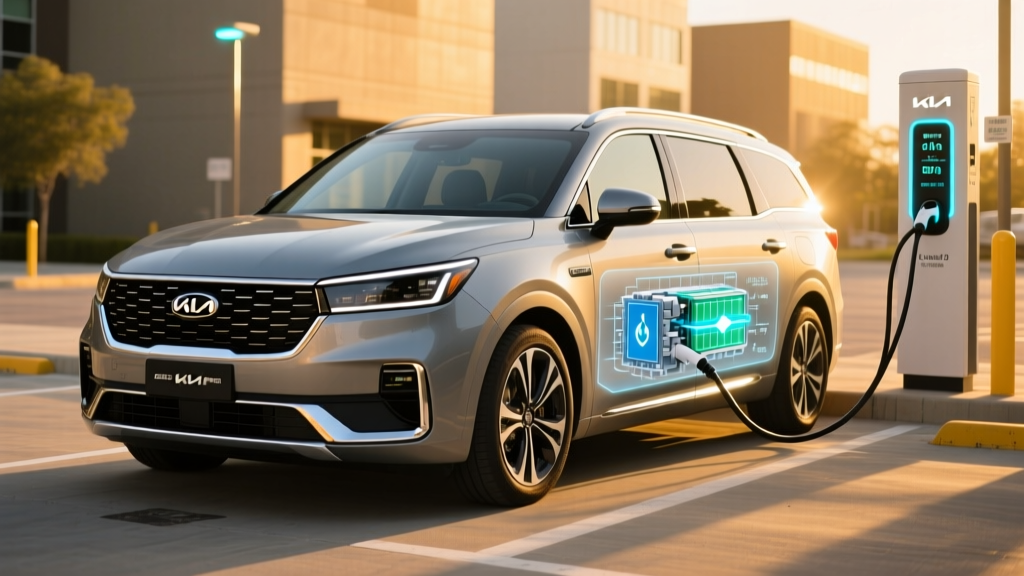
The Kia Carnival has long been one of the most practical minivans on the market, but the introduction of a hybrid powertrain changed the conversation around this three-row family hauler. If you've been searching for detailed Kia Carnival hybrid mileage data—real-world numbers, not just the EPA sticker—you're in the right place. This guide covers everything from fuel economy and powertrain specs to battery warranty, pricing, and whether a hybrid minivan makes more sense for your family than a plug-in hybrid or full EV.
Kia Carnival Hybrid MPG: The Official EPA Numbers
The 2026 Kia Carnival Hybrid pairs a 1.6-liter turbocharged four-cylinder engine with an electric motor integrated into a 6-speed automatic transmission. The result is a combined system output of 245 horsepower and fuel economy that significantly undercuts the gas-only Carnival's thirst.
| Driving Cycle | EPA Estimate |
|---|---|
| City | 34 MPG |
| Highway | 31 MPG |
| Combined | 33 MPG |
Source: fueleconomy.gov
For comparison, the gas-only 2026 Kia Carnival with its 3.5L V6 returns an EPA-estimated 19 city / 26 highway / 22 combined MPG. That's an 11 MPG combined improvement with the hybrid—an enormous gap in a vehicle this size.
Real-World MPG: What Owners Actually See
EPA estimates are a starting point, not a guarantee. Hybrid minivans behave differently than EVs or gas cars in real-world conditions, and the Carnival Hybrid is no exception.
EPA Combined: 33 MPG | Expect ~30-34 MPG in mixed suburban driving. City-heavy routes can push toward 35-36 MPG thanks to regenerative braking. Sustained highway driving at 75+ MPH may drop to 28-30 MPG. Cold weather (below 30°F) typically reduces hybrid efficiency by 5-10% due to increased engine runtime for cabin heat.
Hybrids consistently outperform their EPA city estimates because stop-and-go traffic maximizes regenerative braking and electric-motor assist. If your commute involves school drop-offs, grocery runs, and suburban traffic, you'll likely see numbers at or above the EPA city rating. Highway efficiency is where hybrids lose their advantage—there's less braking to recapture energy, and the gasoline engine does most of the work at sustained speeds.
With an 18.5-gallon fuel tank, the Carnival Hybrid delivers a real-world total range of approximately 555 to 630 miles depending on your driving mix. That's one of the longest total ranges of any three-row vehicle on the market.
Hybrid (HEV) vs Plug-In Hybrid (PHEV): Which Carnival Is Which?
This is where many buyers get confused. The Kia Carnival Hybrid is a conventional hybrid (HEV). It does not plug in. It does not have a large battery you charge overnight. It charges its small battery through regenerative braking and the gasoline engine.
As of the 2026 model year, Kia does not offer a plug-in hybrid (PHEV) version of the Carnival in the U.S. market. If you want a PHEV minivan, the closest competitor is the Chrysler Pacifica Hybrid.
| Feature | HEV (Carnival Hybrid) | PHEV (e.g., Pacifica Hybrid) |
|---|---|---|
| Plugs in? | No | Yes |
| Battery size | ~1.5 kWh | ~16 kWh |
| Electric-only range | Less than 1 mile at low speed | ~32 miles |
| Home charging needed? | No | Yes (Level 2 recommended) |
| Federal tax credit? | No | Up to $7,500 (eligibility varies) |
| Combined MPG (gas engine) | 33 MPG | 30 MPG (after battery depleted) |
The HEV route means zero lifestyle change: you fuel up at gas stations exactly as before, but you visit them far less often. The PHEV route offers electric-only commuting but requires home charging infrastructure and a higher purchase price.
Powertrain and Performance Specs
| Specification | Detail |
|---|---|
| Engine | 1.6L Turbocharged 4-Cylinder |
| Electric Motor | 47 kW (64 HP) integrated |
| Combined System Output | 245 HP / 271 lb-ft torque |
| Transmission | 6-Speed Automatic |
| Drivetrain | Front-Wheel Drive |
| 0-60 MPH | ~7.8 seconds (est.) |
| Towing Capacity | 3,500 lbs |
| Battery Type | Lithium-ion polymer, ~1.5 kWh |
The turbocharged engine provides solid low-end torque, and the electric motor fills in the gap during initial acceleration. The result is a minivan that doesn't feel sluggish off the line—a common complaint with older hybrid systems. The 6-speed automatic avoids the rubber-band feel of CVTs found in some competitors, though it's not as seamless as the multi-mode hybrid transmissions in Toyota's lineup.
Pricing, Trims, and Tax Credit Eligibility
The 2026 Kia Carnival Hybrid is available across multiple trims, starting at approximately $40,700 MSRP for the LXS Hybrid and climbing to roughly $53,000 for the SX Prestige Hybrid. Destination charges add approximately $1,395.
| Trim | Approx. MSRP |
|---|---|
| LXS Hybrid | $40,700 |
| EX Hybrid | $43,500 |
| SX Hybrid | $47,500 |
| SX Prestige Hybrid | $53,000 |
The Kia Carnival Hybrid is a conventional HEV and does not qualify for the federal §30D new clean vehicle credit of up to $7,500. That credit applies to BEVs and PHEVs meeting battery-sourcing, MSRP, and buyer income requirements per IRS guidelines. Some states offer separate rebates for conventional hybrids—check your state energy office or DMV for current programs.
The lack of a federal tax credit is the main financial disadvantage versus a PHEV or EV. However, the Carnival Hybrid's lower starting price compared to PHEV minivans (the Pacifica Hybrid starts around $50,000) often narrows the gap significantly when you factor in the PHEV's required home charging installation.
Battery Warranty, Reliability, and Replacement Cost
Hybrid battery longevity is the single biggest concern for buyers stepping into their first electrified vehicle. Kia addresses this with one of the strongest warranties in the industry.
• Hybrid battery: 10 years / 100,000 miles
• Hybrid system components: 10 years / 100,000 miles
• Powertrain: 10 years / 100,000 miles
• Basic bumper-to-bumper: 5 years / 60,000 miles
Kia's hybrid battery is a small ~1.5 kWh lithium-ion polymer pack—far simpler and less expensive to replace than the 75-100 kWh packs in full EVs. Based on industry data from similar Hyundai/Kia hybrid systems, out-of-warranty replacement costs for the Carnival Hybrid battery are estimated at $2,500 to $4,500 including labor. However, the 10-year/100,000-mile warranty means most original owners will never face this expense.
Hybrid reliability data from Consumer Reports and J.D. Power consistently shows that modern hybrid systems from Korean automakers rank above average. The 1.6L turbo engine in the Carnival Hybrid is shared with the Sorento Hybrid and Sportage Hybrid, which have accumulated substantial real-world mileage data without systemic failure patterns. The key maintenance difference versus the gas-only Carnival: hybrid owners should follow the scheduled inverter coolant service intervals and avoid letting the vehicle sit unused for extended periods (the hybrid battery prefers regular cycling).
Carnival Hybrid vs Full EV vs Gas: Which Fits Your Family?
The three-row family vehicle market now spans gas, hybrid, PHEV, and full EV options. Here's how to decide which is right for you.
- You want better fuel economy with zero lifestyle changes
- You don't have access to home charging (apartment, no garage)
- You regularly drive 400+ miles in a day (road trips, towing)
- You want three rows and a sub-$45,000 starting price
- You plan to keep the vehicle 8-10 years (warranty coverage)
- You have reliable Level 2 home charging
- Your daily driving is under 250 miles
- You want the lowest per-mile fuel cost and zero tailpipe emissions
- You qualify for the $7,500 federal tax credit
- You're willing to pay $55,000+ for a three-row EV
The Carnival Hybrid occupies a specific niche: it's the pragmatic choice for families who want meaningful fuel savings but aren't ready to manage charging logistics. At 33 MPG combined, a family driving 15,000 miles per year would use approximately 455 gallons of fuel. The gas-only Carnival at 22 MPG combined would burn 682 gallons—a difference of 227 gallons, or roughly $750-$900 per year at current fuel prices. Over a 10-year ownership cycle, that's $7,500-$9,000 in fuel savings, which largely offsets the hybrid's higher initial price versus the gas model.
Pros and Cons at a Glance
- 33 MPG combined is best-in-class for a minivan this size
- No charging infrastructure required
- 245 HP provides confident merging and passing
- 10-year/100,000-mile hybrid battery warranty
- 3,500-lb towing capacity retained vs gas model
- 555+ mile total range eliminates road-trip refueling stress
- No federal tax credit eligibility (HEV)
- FWD only—no AWD option unlike the Sienna Hybrid
- Highway MPG drops to ~28-30 at sustained 75+ MPH
- Starting price ~$3,000-$4,000 above gas-only Carnival
- No PHEV variant available for electric-only commuting
- Third-row space slightly reduced vs competitors
Frequently Asked Questions
How many MPG does the Kia Carnival Hybrid get?
The EPA rates the 2026 Kia Carnival Hybrid at 34 city / 31 highway / 33 combined MPG. Real-world results typically range from 28 MPG (highway-heavy, cold weather) to 36 MPG (city-heavy, moderate climate).
Does the Kia Carnival Hybrid need to be plugged in?
No. The Carnival Hybrid is a conventional HEV. It charges its small battery through regenerative braking and the gasoline engine. You fuel it at a gas station exactly like a conventional vehicle.
Is there a plug-in hybrid Kia Carnival?
As of the 2026 model year, Kia does not offer a PHEV Carnival in the U.S. market. If you want a plug-in hybrid minivan, the Chrysler Pacifica Hybrid is the primary alternative, offering ~32 miles of electric-only range.
How long will the Carnival Hybrid battery last?
Kia covers the hybrid battery for 10 years or 100,000 miles. Based on data from similar Hyundai/Kia hybrid systems, these batteries routinely last 150,000+ miles before significant capacity loss. Out-of-warranty replacement is estimated at $2,500-$4,500.
Does the Carnival Hybrid qualify for any tax credit?
The Carnival Hybrid does not qualify for the federal §30D clean vehicle credit because it is a conventional hybrid, not a plug-in vehicle. Some states offer hybrid-specific rebates—check your state's energy office for current programs. Per the IRS, only BEVs and PHEVs meeting battery sourcing and MSRP requirements are eligible for the federal credit.
How does the Carnival Hybrid compare to the Toyota Sienna Hybrid?
The Toyota Sienna Hybrid is standard AWD and achieves an EPA-estimated 36 MPG combined, edging out the Carnival's 33 MPG. However, the Sienna's CVT transmission feels less responsive, and its interior materials and infotainment lag behind the Kia's. The Sienna starts around $39,000, making pricing competitive. If AWD is essential (snow-belt states), the Sienna wins. If you prioritize interior quality, cargo flexibility, and a traditional transmission feel, the Carnival Hybrid has the edge.
What is the total driving range of the Kia Carnival Hybrid?
With its 18.5-gallon tank and 33 MPG combined rating, the Carnival Hybrid delivers approximately 610 miles of EPA-rated range. Real-world range typically falls between 555 and 630 miles depending on driving conditions.