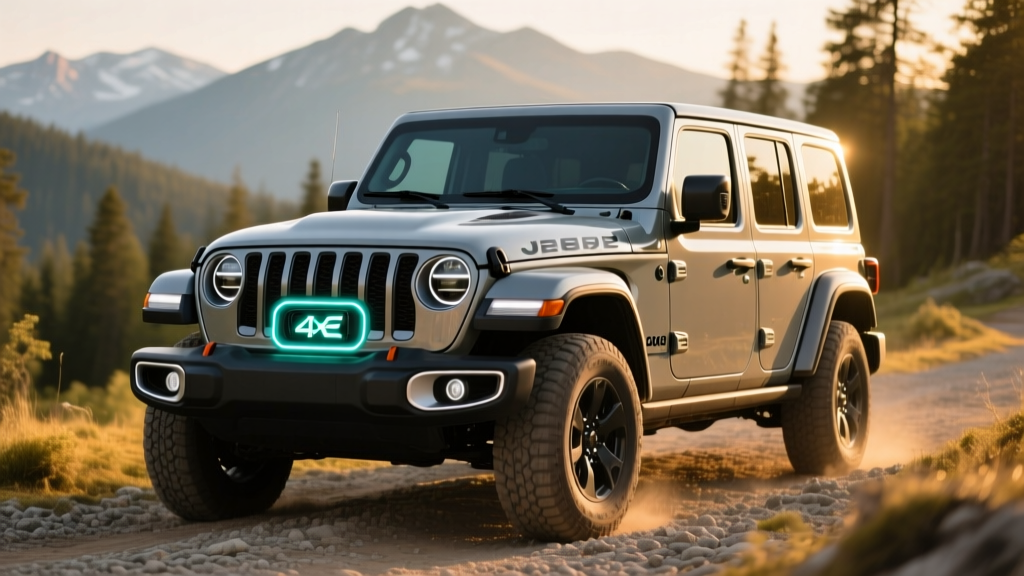
The Jeep Wrangler 4xe pairs a turbocharged 2.0-liter four-cylinder engine with two electric motors and a 17.3 kWh battery pack, creating a plug-in hybrid (PHEV) powertrain rated at 375 horsepower and 470 lb-ft of torque. For buyers searching for the Jeep Wrangler hybrid engine, the 4xe is currently the only electrified Wrangler sold in the U.S. — there is no conventional (non-plug-in) hybrid Wrangler in the lineup. Below, we break down every spec that matters: electric range, fuel economy, charging logistics, battery longevity, tax-credit eligibility, and who should actually buy this rig versus a full EV or gas-only Wrangler.
HEV vs PHEV: Where the Wrangler 4xe Fits
Conventional Hybrid (HEV): A small battery (typically 1–2 kWh) recharges through regenerative braking and the engine. You never plug it in. Examples: Toyota RAV4 Hybrid, Ford Maverick Hybrid. Electric-only driving is limited to brief low-speed bursts.
Plug-In Hybrid (PHEV): A larger battery (15–30+ kWh) that you plug in to recharge, delivering meaningful electric-only range before the gas engine engages. The Wrangler 4xe falls here, with 21 miles of EPA-rated electric driving.
Battery Electric (BEV): No gas engine at all. Full electric range of 250–400+ miles. Examples: Tesla Model Y, Ford F-150 Lightning.
The Wrangler 4xe is strictly a PHEV. If you see references to a "Wrangler hybrid" that doesn't plug in, that's either a misunderstanding or a reference to the mild-hybrid eTorque system Jeep offered on the 3.6L V6 through 2024 — which added negligible electric assist and no electric-only range. The 4xe is the real electrified option.
Wrangler 4xe Powertrain: Engine, Motors, and Combined Output
| Component | Specification |
|---|---|
| Gas Engine | 2.0L turbocharged inline-4 |
| Engine Output (standalone) | 270 hp / 295 lb-ft |
| Electric Motors | Two: one integrated into the transmission bell housing (134 hp), one engine-mounted starter/generator (44 hp) |
| Combined System Output | 375 hp / 470 lb-ft |
| Transmission | 8-speed automatic (TorqueFlite 8HP75) |
| Battery Pack (PHEV) | 17.3 kWh gross / ~14.0 kWh usable, NMC lithium-ion |
| Drivetrain | 4WD with two-speed transfer case (Selec-Trac or Rock-Trac depending on trim) |
| 0–60 mph | ~6.0 seconds (varies by trim and tire) |
| Towing Capacity | 3,500 lbs |
| Ground Clearance | Up to 10.8 inches (Rubicon) |
The 4xe's combined 470 lb-ft of torque is the highest of any Wrangler variant, including the 3.6L V6 and even the former 6.4L V8 Rubicon 392. That torque is available almost instantly thanks to the electric motor, which makes the 4xe feel surprisingly responsive in city driving and low-range off-road crawling. The battery pack is mounted under the rear seats, which preserves cargo space but does eliminate the option for a manual transmission.
Fuel Economy and Electric Range: EPA Numbers vs Real World
| Metric | EPA Rating | Real-World Expectation |
|---|---|---|
| Electric-only range | 21 miles | 17–19 mi (highway/cold); up to 22 mi (city, mild weather) |
| MPGe (electric + gas) | 49 MPGe | Varies heavily with charge frequency |
| Gas-only MPG (combined) | 20 MPG | 17–19 highway; 20–22 city (hybrid assist helps in stop-and-go) |
| Gas-only city | — | Often exceeds EPA combined in real city driving due to regen |
| Gas-only highway | 20 MPG | 17–19 at 70+ mph (aerodynamics of a brick work against it) |
| Total range (full tank + full charge) | ~370 miles | ~320–360 miles depending on conditions |
Real-world range note: The Wrangler 4xe's boxy shape, heavy curb weight (~5,100 lbs on Rubicon trims), and aggressive all-terrain tires take a significant toll on efficiency. On a 70-mph highway cruise in winter conditions, expect electric-only range to drop to 14–16 miles and gas MPG to dip to 17 or lower. In mild city driving with frequent regenerative braking, owners regularly report 22–23 MPG gas-only — slightly above the EPA figure. The lesson: your actual economy depends almost entirely on how often you plug in and what terrain you drive.
According to fueleconomy.gov, the 2025 Wrangler 4xe is rated at 49 MPGe combined when factoring in electric driving, and 20 MPG combined once the battery is depleted. If you charge daily and your commute is under 20 miles round-trip, you may go weeks without visiting a gas station. If you never charge, you're driving a heavy, somewhat inefficient gas vehicle with a dead battery adding weight.
Charging the Wrangler 4xe: Level 1, Level 2, and DC Limitations
| Charging Level | Power | Time (0–100%) | Notes |
|---|---|---|---|
| Level 1 (120V household outlet) | ~1.4 kW | ~12–14 hours | Included portable cord; sufficient for overnight if you start with some charge |
| Level 2 (240V home or public) | 7.2 kW (onboard charger max) | ~2.5–3 hours | Requires a 240V outlet or installed Level 2 station; this is the practical daily method |
| DC Fast Charging | Not supported | N/A | No CCS or NACS DC port — the 4xe cannot use DC fast chargers |
The Wrangler 4xe uses a J1772 connector for AC charging (Level 1 and Level 2). The onboard charger is rated at 7.2 kW, which is adequate for a 17.3 kWh pack — a full Level 2 charge takes roughly 2.5 hours. However, the lack of DC fast charging is a notable limitation. On road trips, you cannot top up at Electrify America, Tesla Supercharger, or any DC station. Once the battery depletes, you're running on gas until you can find a Level 2 charger or plug in at your destination.
Home charging setup: Most 4xe owners install a 240V NEMA 14-50 outlet or a hardwired Level 2 station (like a ChargePoint Home Flex or Emporia Level 2) in their garage. Expect to pay $500–$1,500 for a quality Level 2 charger and $800–$2,500 for electrician installation depending on panel capacity and run length. If your panel needs a 200-amp upgrade, add $1,500–$3,000.
Pricing, Trims, and Federal Tax Credit Eligibility
| Trim | Base MSRP (2025) | Key Features |
|---|---|---|
| Willys 4xe | ~$51,790 | LED lighting, 32-inch tires, Selec-Trac 4WD |
| Sport S 4xe | ~$53,790 | Alpine audio, 7-inch Uconnect, convenience group |
| Sahara 4xe | ~$57,790 | 20-inch wheels, leather, 12-inch Uconnect, body-color fenders |
| Rubicon 4xe | ~$61,790 | Rock-Trac 4WD, front/rear lockers, disconnecting sway bar, 33-inch tires |
| High Altitude 4xe | ~$64,790 | Premium luxury package, 20-inch wheels, full leather, sky one-touch top |
Destination charge adds $1,795 to all trims. Options packages (trailer tow, cold weather, advanced safety) can push a Rubicon 4xe past $70,000.
Federal §30D Tax Credit (2025–2026 rules):
- Credit amount: Up to $7,500 ($3,750 for critical minerals + $3,750 for battery component sourcing)
- MSRP cap: Vehicle must be under $80,000 for SUVs (Wrangler qualifies)
- Buyer income cap: AGI must not exceed $150,000 (single), $225,000 (head of household), or $300,000 (joint)
- Battery sourcing: Critical minerals and component requirements phase in annually and restrict China-sourced materials — check current IRS eligible vehicle list before purchasing
- Point-of-sale transfer: You can transfer the credit to the dealer at purchase for an immediate price reduction (effective January 2024)
Critical caveat: Battery-sourcing requirements tighten each year. A Wrangler 4xe that qualified for the full $7,500 in 2024 may qualify for $3,750 or $0 in 2025–2026 depending on supply-chain changes. Always verify on the IRS website or with a tax professional before relying on the credit in your budget.
Battery Warranty, Lifespan, and Replacement Cost
Jeep 4xe Battery Warranty:
- Coverage: 8 years / 100,000 miles (whichever comes first)
- Capacity retention threshold: Battery is covered if it degrades below 70% of original capacity within the warranty period
- What's covered: Defects, excessive degradation, and complete failure
- What's not covered: Damage from accidents, modifications, or improper charging equipment
The 17.3 kWh NMC battery pack in the Wrangler 4xe is liquid-cooled, which helps manage thermal stress during both charging and off-road use. Based on data from early 2021–2022 model-year 4xe owners now approaching 80,000–100,000 miles, most packs retain 85–92% of original capacity — well above the 70% warranty threshold.
Out-of-warranty replacement cost: If the battery fails after the warranty expires, expect a replacement to cost between $8,000 and $12,000 for the pack itself, plus $1,500–$2,500 in labor. Total: roughly $9,500–$14,500. This is a real long-term ownership risk that buyers should factor in, especially for high-mileage drivers who plan to keep the vehicle past 10 years.
For comparison, the hybrid battery in a Toyota RAV4 Hybrid (much smaller, ~1.6 kWh) costs $3,000–$5,000 to replace. The 4xe's larger PHEV pack carries proportionally higher replacement costs, though it also delivers more daily utility.
Reliability: What Owners and Data Show
The Wrangler 4xe has faced some well-documented issues since its 2021 launch. Early models were subject to multiple recalls, including a significant battery-pack recall in 2023 related to potential cell defects that could cause fires (NHTSA recall 23V-652). Jeep replaced affected battery modules under warranty, and subsequent production runs incorporated updated cell suppliers and improved quality control.
According to NHTSA recall records, the 2024 and 2025 model years have had fewer recalls, though the Wrangler platform overall continues to score below average in predicted reliability surveys from Consumer Reports and J.D. Power. Common owner complaints center on:
- Electrical gremlins (Uconnect infotainment freezes, phantom battery drain)
- Transfer case and driveline clunks when switching between electric and gas modes
- Reduced electric range in cold weather (more pronounced than expected)
- Build-quality inconsistencies (wind noise, water sealing around removable tops)
These issues are not unique to the 4xe — the gas Wrangler shares many of them — but the added complexity of the hybrid powertrain does mean more potential failure points. Buyers prioritizing reliability above all else should cross-shop the Toyota RAV4 Prime PHEV or consider a conventional-hybrid SUV.
Who Should Buy the Wrangler 4xe — and Who Shouldn't
Choose the Wrangler 4xe if:
- You want genuine off-road capability (locking differentials, 10.8" ground clearance, solid axles) with some daily electric commuting
- Your round-trip commute is under 20 miles and you can charge at home nightly
- You need a removable roof/doors and a body-on-frame platform no electric SUV currently offers
- You value the 470 lb-ft of instant torque for rock crawling or towing
- You understand that highway fuel economy will be mediocre (17–20 MPG gas-only)
Look elsewhere if:
- Maximum fuel savings is your top priority — a RAV4 Prime delivers 38 kWh of electric range and 40 MPG gas-only
- You want DC fast charging for road-trip flexibility
- You drive mostly highway miles — the 4xe's aerodynamics and weight destroy efficiency at speed
- You need three rows of seating or car-based ride comfort
- Long-term reliability track record is a dealbreaker
Pros
- 375 hp / 470 lb-ft — the most torque of any Wrangler
- 21 miles electric-only covers many commutes
- Unmatched off-road hardware (Rubicon trim)
- Removable roof and doors — no EV offers this
- Eligible for up to $7,500 federal credit (verify sourcing)
- Liquid-cooled battery with 8-year/100k warranty
Cons
- No DC fast charging
- 17–20 MPG gas-only is poor for a "hybrid"
- Heavy: ~5,100+ lbs hurts handling and braking
- Battery replacement: $9,500–$14,500 out of warranty
- Below-average predicted reliability ratings
- Starting MSRP over $51,000 before options
Frequently Asked Questions
How many MPG does the Jeep Wrangler 4xe hybrid get?
The EPA rates the Wrangler 4xe at 49 MPGe combined (electric + gas) and 20 MPG combined on gas alone. In real-world driving, expect 17–19 MPG on the highway and 20–22 MPG in city traffic when running on gas. If you charge daily and commute under 20 miles, your effective fuel cost drops dramatically.
How far can the Wrangler 4xe go on electric only?
The EPA rates it at 21 miles of electric-only range. In practice, expect 17–19 miles in mixed driving, 14–16 miles in cold weather or at highway speeds, and up to 22 miles in stop-and-go city traffic in mild temperatures. The 17.3 kWh pack (approximately 14 kWh usable) is modest by PHEV standards — the Toyota RAV4 Prime offers 42 miles on its larger battery.
Does the Jeep Wrangler hybrid qualify for a tax credit?
It may qualify for up to $7,500 under the federal §30D clean vehicle credit, but eligibility depends on your income (must be under $300,000 joint AGI), the vehicle's MSRP (must be under $80,000 — Wrangler qualifies), and battery-sourcing compliance, which changes annually. Check the IRS eligible vehicle list before purchasing. Some states offer additional rebates for PHEVs.
Is the Wrangler 4xe hybrid reliable?
Early 2021–2023 models faced battery recalls and electrical issues. The 2024–2025 models show improvement, but the Wrangler platform still scores below average in long-term reliability surveys from major outlets. The hybrid system adds complexity over the gas-only Wrangler. The 8-year/100,000-mile battery warranty provides a safety net, but out-of-warranty replacement costs are steep ($9,500–$14,500).
Hybrid vs PHEV vs EV — which is right for me?
If you want zero lifestyle compromise and can charge at home, a full EV (like a Ford F-150 Lightning or Rivian R1S) eliminates gas entirely with 250–350 miles of range. If you want some electric commuting but need gas for long trips without charging stops, the 4xe PHEV is a valid middle ground. A conventional hybrid (HEV) like the Toyota 4Runner Hybrid (when available) would offer better gas-only MPG without plug-in hassle, but no electric-only range. The 4xe specifically makes sense if you need Wrangler off-road hardware and want to offset your daily commute with electricity.
Can I charge the Wrangler 4xe at a DC fast charger?
No. The Wrangler 4xe only supports AC charging via J1772 at up to 7.2 kW (Level 2). It has no DC fast-charge port. On road trips, once the battery depletes after ~21 miles, you rely entirely on the gas engine until you reach a Level 2 charger or your destination.
What is the battery replacement cost for the Wrangler 4xe?
Out of warranty, a full 17.3 kWh battery pack replacement runs approximately $8,000–$12,000 for parts plus $1,500–$2,500 in labor, totaling $9,500–$14,500. Within the 8-year/100,000-mile warranty, replacement is covered if capacity drops below 70% or if there's a manufacturing defect.