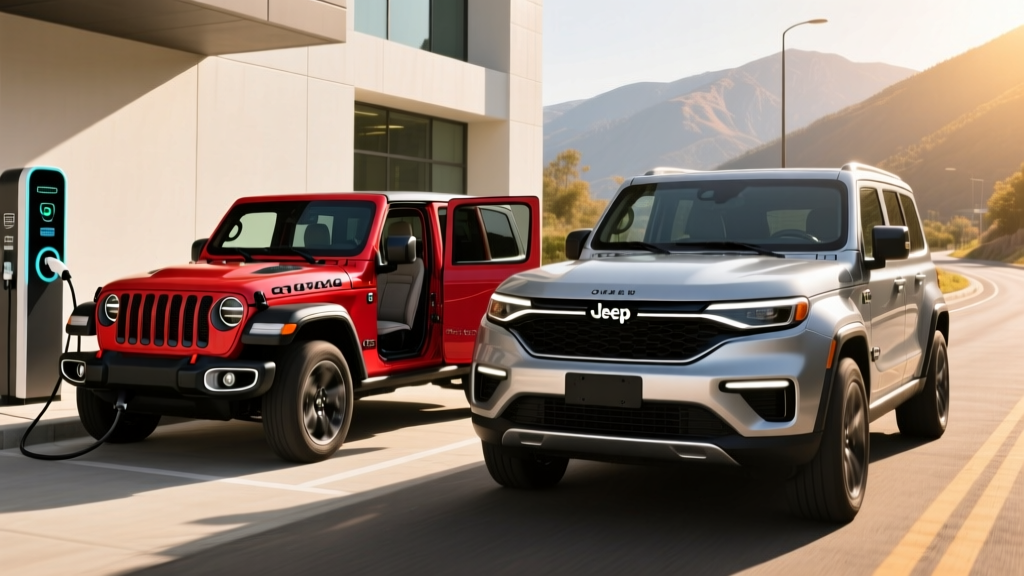
Jeep's 4xe (pronounced "four-by-e") plug-in hybrid lineup occupies a specific niche: body-on-frame and unibody SUVs that deliver short-range electric commuting without sacrificing off-road capability or towing. For 2026, two models carry the 4xe badge — the Wrangler 4xe and the Grand Cherokee 4xe — and they serve very different buyers. This guide breaks down exact EPA figures, real-world efficiency, battery longevity, charging logistics, and whether the federal tax credit still applies.
HEV vs. PHEV: What Jeep Actually Sells
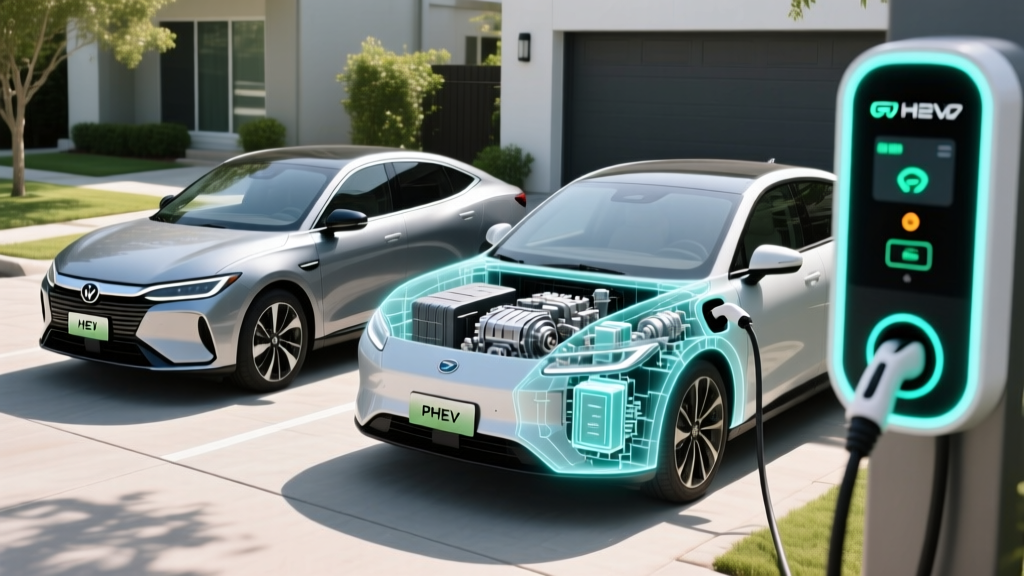
Before diving into specs, it helps to separate Jeep's conventional hybrid technology from its plug-in offerings, because the brand uses both.
| Feature | Conventional Hybrid (HEV) | Plug-In Hybrid (PHEV / 4xe) |
|---|---|---|
| Plug-in charging required? | No — regenerative braking charges battery | Yes — plug in for full electric range |
| Battery size | ~1–2 kWh | 17.3 kWh (Wrangler) / 17.3 kWh (Grand Cherokee) |
| Electric-only driving | Very low speeds, short bursts | 22–26 miles fully electric |
| Federal tax credit | Not eligible under §30D | Up to $3,750 (sourcing-dependent) |
| Example model | Grand Cherokee L (mild hybrid assist) | Wrangler 4xe, Grand Cherokee 4xe |
Jeep's 4xe models are plug-in hybrids (PHEVs). They carry a substantially larger battery than a conventional hybrid and can be charged from a wall outlet, Level 2 charger, or (in limited cases) DC fast charger. If you never plug in, a 4xe still operates as a hybrid — but you'll miss the electric-only commuting benefit and the fuel-cost savings that justify the premium.
2026 Jeep Wrangler 4xe: Range, MPG, and Powertrain Specs
The Wrangler 4xe pairs a 2.0-liter turbocharged inline-4 with two electric motor-generators and a 17.3 kWh lithium-ion battery pack (NMC chemistry). Power routes through an 8-speed automatic and the same 4WD systems available on gas Wranglers, including the Rubicon's Rock-Trac.
| Spec | Value |
|---|---|
| Combined horsepower | 375 hp |
| Combined torque | 470 lb-ft |
| Battery (usable) | 17.3 kWh (NMC) |
| EPA electric-only range | 22 miles |
| EPA MPGe (electric + gas) | 49 MPGe |
| EPA MPG (gas-only, combined) | 20 MPG |
| EPA city / highway (gas) | 20 city / 20 highway |
| Total combined range | ~370 miles |
| Max AC charge rate (Level 2) | 7.2 kW |
| DC fast charging | Not available |
| Level 2 charge time (0–100%) | ~2.5 hours |
| Level 1 charge time (120V) | ~12 hours |
| 0–60 mph | |
| Towing capacity | 3,500 lbs |
| Base MSRP (Willys 4xe) | ~$51,790 |
| Battery warranty | 8 years / 100,000 miles |
Real-World Range Reality Check
The EPA rates the Wrangler 4xe at 22 miles of electric-only range. In real-world testing — particularly at highway speeds (65–75 mph) with climate control active — expect closer to 16–18 miles before the gasoline engine engages. In cold weather (below 32°F), that figure can drop to 13–15 miles as battery efficiency declines and cabin heating draws additional power. For a 10-mile round-trip commute with home charging, the 4xe covers most daily driving on electricity alone.
2026 Jeep Grand Cherokee 4xe: The Family-Oriented PHEV
The Grand Cherokee 4xe uses the same 2.0L turbo + dual-motor architecture but packages it in a more refined, unibody SUV with greater cargo space and a smoother on-road demeanor. The battery capacity is also 17.3 kWh.
| Spec | Value |
|---|---|
| Combined horsepower | 375 hp |
| Combined torque | 470 lb-ft |
| Battery (usable) | 17.3 kWh (NMC) |
| EPA electric-only range | 26 miles |
| EPA MPGe (electric + gas) | 56 MPGe |
| EPA MPG (gas-only, combined) | 23 MPG |
| EPA city / highway (gas) | 23 city / 24 highway |
| Total combined range | ~440 miles |
| Max AC charge rate (Level 2) | 7.2 kW |
| DC fast charging | Not available |
| Level 2 charge time (0–100%) | ~2.5 hours |
| Level 1 charge time (120V) | ~12 hours |
| 0–60 mph | ~6.0 sec |
| Towing capacity | 6,000 lbs |
| Base MSRP (4xe) | ~$61,690 |
| Battery warranty | 8 years / 100,000 miles |
The Grand Cherokee 4xe achieves slightly better electric range (26 miles EPA) thanks to its more aerodynamic profile and lower curb weight relative to its size. On fueleconomy.gov, the Grand Cherokee 4xe shows 56 MPGe combined when factoring in electric operation — a meaningful improvement over the gas-only Grand Cherokee's 22 MPG combined.
Charging the Jeep 4xe: What You Need at Home
Neither Jeep 4xe model supports DC fast charging. All charging is AC-only, via a J1772 connector (the standard for non-Tesla plug-in vehicles in North America).
| Charging Level | Power | Time (0–100%) | Setup |
|---|---|---|---|
| Level 1 (120V household) | ~1.4 kW | ~12 hours | Standard outlet; included cordset |
| Level 2 (240V, 32A) | 7.2 kW | ~2.5 hours | Home wall charger or public L2 station |
For most owners, a Level 2 home charger is the practical minimum. A 240V/32A circuit (requiring a 40A breaker) delivers a full charge in about 2.5 hours — meaning you can recharge during the workday or overnight without issue. Level 1 charging from a standard 120V outlet works, but at 12 hours for a full charge, it's only viable if you drive very few electric miles daily or can leave the vehicle plugged in for extended periods.
Home installation cost: Expect $500–$1,500 for a Level 2 charger installation if your electrical panel has spare capacity. If a panel upgrade (from 100A to 200A service) is needed, costs can reach $2,000–$4,000. Always get a quote from a licensed electrician before purchasing equipment.
Federal Tax Credit: Does the Jeep 4xe Qualify?
Under IRS §30D rules for 2026, the Jeep Wrangler 4xe and Grand Cherokee 4xe may qualify for a partial federal tax credit of up to $3,750, depending on battery component and critical-mineral sourcing compliance. The full $7,500 credit requires meeting both the battery components and critical minerals thresholds; as of 2026, most Jeep 4xe models meet one but not both, resulting in the $3,750 partial credit.
§30D Credit Eligibility Checklist for Jeep 4xe
- MSRP cap: SUVs must be under $80,000 MSRP — both 4xe models qualify on most trims
- Buyer income cap: AGI ≤ $150,000 (single) / $300,000 (joint) — check your tax return
- Battery sourcing: Partial compliance = $3,750; full compliance = $7,500 — verify on fueleconomy.gov for your specific model year
- Point-of-sale transfer: You can transfer the credit to the dealer at purchase for an immediate price reduction, rather than waiting to claim it on your tax return
- Assembly: Must be assembled in North America — both 4xe models are built in Toledo, OH (Wrangler) and Detroit, MI (Grand Cherokee)
Important caveat: Sourcing requirements tighten annually under the Inflation Reduction Act. A trim that qualifies for $3,750 in early 2026 could see that amount change if battery supply chains shift. Always confirm current eligibility on irs.gov or consult a tax professional before relying on the credit in your purchase budget.
Battery Longevity, Warranty, and Replacement Cost
Jeep 4xe Battery Warranty
Stellantis provides an 8-year / 100,000-mile warranty on the 4xe high-voltage battery pack, covering defects and capacity loss below 70% of original capacity. In California and states adopting CARB emissions standards, the warranty extends to 10 years / 150,000 miles under PZEV provisions.
The 17.3 kWh NMC battery in both 4xe models is liquid-cooled, which helps mitigate degradation from thermal stress — a key advantage over passively cooled packs in hot climates. Real-world data from 2021–2024 Wrangler 4xe owners shows typical capacity retention of 90–94% after 60,000 miles, consistent with NMC packs managed by active thermal systems.
Out-of-warranty replacement cost: If the battery requires replacement beyond warranty coverage, expect $8,000–$12,000 for the pack plus labor. This is a meaningful long-term ownership cost to factor in, particularly for high-mileage drivers or those planning to keep the vehicle beyond 10 years. However, PHEV batteries experience less stress than full EV batteries because they operate in a narrower state-of-charge window (typically 15–95% SoC), which reduces calendar and cycle degradation.
Who Should Buy a Jeep Plug-In Hybrid?
Choose the Jeep 4xe If:
- You have a short commute (under 25 miles round-trip) and can charge at home
- You need genuine off-road capability (Wrangler Rubicon 4xe) or towing (Grand Cherokee: 6,000 lbs)
- You want to reduce fuel costs for daily driving but need gas-engine range for road trips
- You're not ready for a full EV due to charging infrastructure gaps in your area
Choose a Full EV Instead If:
- Your daily driving exceeds 30 miles and you want zero gasoline use
- You have reliable home and workplace charging and rarely tow or off-road
- You want lower long-term maintenance costs (no oil changes, no gas engine to service)
Choose a Conventional Gas Model If:
- You cannot install a home charger and lack convenient public Level 2 access
- Your budget doesn't accommodate the 4xe premium (~$5,000–$8,000 over equivalent gas trims)
- You drive predominantly highway miles where PHEV electric range offers minimal benefit
Jeep 4xe Pros
- 22–26 miles electric covers most commutes
- 375 hp / 470 lb-ft — more torque than V6 gas models
- Retains full off-road and towing hardware
- Regenerative braking extends range in stop-and-go traffic
- Eligible for partial $3,750 federal tax credit (verify annually)
Jeep 4xe Cons
- No DC fast charging — road trips run on gas only
- Gas-only MPG is mediocre (20–23 combined)
- $5,000–$8,000 price premium over gas equivalents
- Electric range drops significantly in cold weather and at highway speeds
- Battery replacement cost ($8K–$12K) is a long-term risk
Frequently Asked Questions
How many MPG does the Jeep 4xe get?
When the battery is depleted and the vehicle operates as a conventional hybrid, the Wrangler 4xe returns 20 MPG combined (20 city / 20 highway) and the Grand Cherokee 4xe returns 23 MPG combined (23 city / 24 highway). These figures are confirmed by the EPA on fueleconomy.gov. In real-world city driving with frequent regenerative braking, some owners report 1–2 MPG above the EPA estimate. Highway driving at 75+ mph tends to drop 1–2 MPG below the sticker.
How far can the Jeep 4xe go on electric only?
The Wrangler 4xe is EPA-rated at 22 miles of electric-only range; the Grand Cherokee 4xe at 26 miles. Real-world highway driving at 70 mph typically yields 16–20 miles before the gas engine starts. Cold weather (below freezing) reduces this by roughly 20–30%, to approximately 13–18 miles depending on cabin heating demand.
Hybrid vs. PHEV vs. EV — which fits my lifestyle?
A conventional hybrid (HEV) requires no plug-in and saves fuel through regenerative braking and engine optimization — ideal if you can't charge at home. A plug-in hybrid (PHEV) like the Jeep 4xe gives you 22–26 miles of electric commuting when plugged in, plus a gas engine for longer trips — ideal if you can charge at home but need range flexibility. A full battery EV (BEV) offers 250–400+ miles of electric range and zero gas use — ideal if you have reliable charging and want the lowest operating cost.
Is the Jeep 4xe reliable, and what does battery replacement cost?
Stellantis's 4xe powertrain has been in production since 2021 (Wrangler) and 2022 (Grand Cherokee), and major failure rates have been moderate. The most common complaints relate to software glitches and charging-port door mechanisms rather than battery or motor failures. The high-voltage battery carries an 8-year/100,000-mile warranty (10 years/150,000 miles in CARB states). Out-of-warranty replacement runs $8,000–$12,000. For comparison, the gas-engine components (2.0L turbo) carry the standard 5-year/60,000-mile powertrain warranty.
Does the Jeep 4xe qualify for a federal tax credit?
As of 2026, both the Wrangler 4xe and Grand Cherokee 4xe qualify for a partial $3,750 federal tax credit under IRS §30D, assuming the buyer meets income caps ($150K single / $300K joint AGI) and the vehicle MSRP stays under $80,000. The credit can be transferred to the dealer at the point of sale for an immediate price reduction. Eligibility depends on battery sourcing compliance, which changes periodically — always verify on irs.gov before purchasing.
Can I charge the Jeep 4xe at a DC fast charger?
No. Neither the Wrangler 4xe nor the Grand Cherokee 4xe supports DC fast charging. Maximum charge rate is 7.2 kW on Level 2 (240V AC), which fills the 17.3 kWh battery in approximately 2.5 hours. You can also use a standard 120V household outlet (Level 1), but a full charge takes roughly 12 hours.