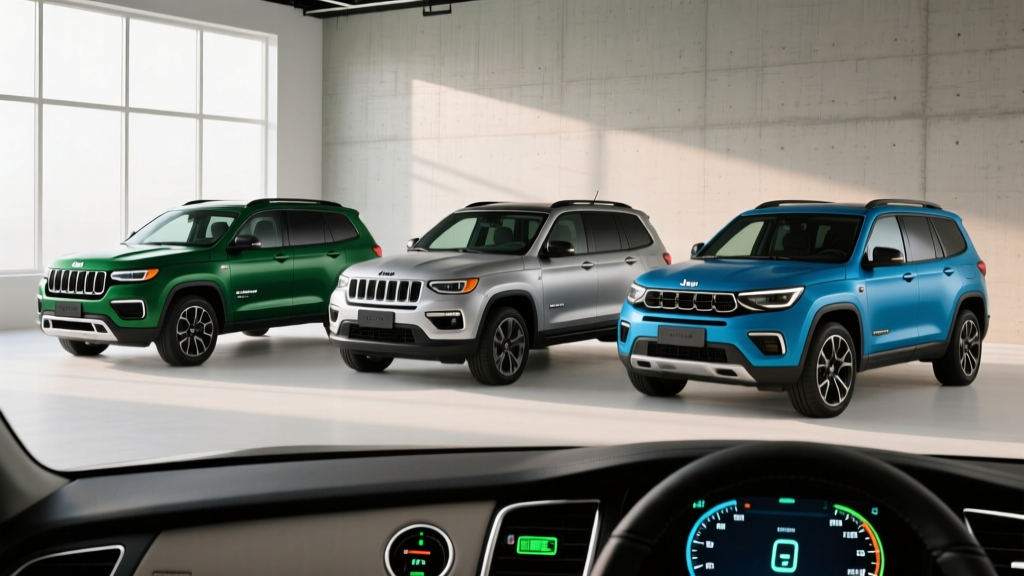
The Jeep 4xe Lineup: Plug-In Hybrids Built for Trail and Commute
If you're researching Jeep hybrid models for 2026, the conversation centers on two vehicles: the Wrangler 4xe and the Grand Cherokee 4xe. Both are plug-in hybrids (PHEVs), meaning they pair a turbocharged gasoline engine with an electric motor and a battery large enough to drive on electricity alone for a meaningful distance. Jeep does not currently sell a conventional hybrid (HEV) — the kind that never plugs in and simply sips less fuel. Every electrified Jeep requires a plug to unlock its full efficiency potential.
This guide breaks down exactly what each model delivers in EPA-rated MPG, electric-only range, charging logistics, powertrain output, pricing, and federal tax credit eligibility under current IRS §30D rules. We'll also address the reliability questions that matter when you're spending $50,000+ on a vehicle with two powertrains under one hood.
HEV vs. PHEV: Why Jeep Went All-In on Plug-In
| Feature | Conventional Hybrid (HEV) | Plug-In Hybrid (PHEV) — Jeep 4xe |
|---|---|---|
| Plugs in? | No — charges via regen and engine | Yes — Level 1 or Level 2 AC charging |
| Electric-only range | 0–2 miles at low speed | 25–26 miles (EPA) |
| Battery size | ~1–2 kWh | 17.3 kWh usable (4xe) |
| Federal tax credit | None | Up to $3,750 under §30D (sourcing-dependent) |
| Best for | Drivers who can't charge at home | Drivers with home/workplace charging access |
Jeep's decision to skip HEVs and focus on PHEVs makes sense for the brand's audience. Wrangler and Grand Cherokee buyers want torque for off-road crawling and towing — an electric motor delivers instant torque at zero RPM, something a mild hybrid system can't match. The trade-off is that you must have access to a 120V outlet (Level 1) or a 240V Level 2 charger to capture the electric-only range benefit. Without plugging in, a 4xe operates as a heavy conventional hybrid with middling fuel economy.
2026 Jeep Wrangler 4xe: Specs, Range, and Real-World MPG
The Wrangler 4xe remains the best-selling PHEV in America, and for 2026 it continues with the proven 2.0-liter turbocharged inline-four paired with two electric motor-generators integrated into the ZF 8-speed transmission housing. Combined output stands at 375 horsepower and 470 lb-ft of torque — figures that match the V-6 mild-hybrid Wrangler's towing rating of 3,500 pounds while delivering substantially more low-end grunt for rock crawling.
| Specification | 2026 Wrangler 4xe (Willys / Sahara) |
|---|---|
| Engine | 2.0L turbo I-4 + dual electric motor-generators |
| Combined Output | 375 hp / 470 lb-ft torque |
| Battery (usable) | 17.3 kWh NMC lithium-ion |
| EPA Electric Range | 25 miles (Willys) / 22 miles (Sahara/Rubicon w/ larger tires) |
| EPA MPG (charge-sustaining) | 20 combined (17 city / 24 highway) |
| MPGe (electric + gas) | 49 MPGe combined |
| Total Range (gas + electric) | ~370 miles |
| Level 2 Charge Time (0–100%) | ~2.0 hours at 7.2 kW |
| DC Fast Charging | Not available |
| 0–60 mph | ~6.0 seconds |
| Towing Capacity | 3,500 lbs |
| Base MSRP (Willys 4xe) | $51,790 (incl. destination) |
2026 Jeep Grand Cherokee 4xe: A Family PHEV With Trail Capability
The Grand Cherokee 4xe uses the same 2.0L turbo + electric motor architecture as the Wrangler but packages it in a more refined, family-oriented SUV with independent rear suspension, a quieter cabin, and available luxury trims (including the Summit Reserve). The battery and powertrain are identical — 17.3 kWh usable, 375 hp, 470 lb-ft — but the Grand Cherokee's superior aerodynamics yield slightly better efficiency.
| Specification | 2026 Grand Cherokee 4xe |
|---|---|
| Engine | 2.0L turbo I-4 + dual electric motor-generators |
| Combined Output | 375 hp / 470 lb-ft torque |
| Battery (usable) | 17.3 kWh NMC lithium-ion |
| EPA Electric Range | 26 miles |
| EPA MPG (charge-sustaining) | 23 combined (23 city / 24 highway) |
| MPGe (electric + gas) | 56 MPGe combined |
| Total Range | ~440 miles |
| Level 2 Charge Time (0–100%) | ~2.0 hours at 7.2 kW |
| DC Fast Charging | Not available |
| 0–60 mph | ~6.3 seconds |
| Towing Capacity | 6,000 lbs (class-leading for PHEV SUVs) |
| Base MSRP (4xe base) | $56,095 (incl. destination) |
The Grand Cherokee 4xe's 6,000-pound tow rating is a standout figure. No other PHEV SUV in its class comes close — the Toyota RAV4 Prime maxes out at 1,500 lbs, and even the Hyundai Tucson PHEV tows just 2,000 lbs. If you need to pull a boat or camper while still driving on electric power around town, the Grand Cherokee 4xe occupies a niche with no direct competitor.
Charging the Jeep 4xe: What You Need at Home
Both 4xe models use a standard J1772 connector for AC charging. Here's the practical breakdown:
| Charging Level | Power | Time (0–100%) | Miles of EV Range Per Hour |
|---|---|---|---|
| Level 1 (120V household outlet) | ~1.4 kW | ~12–14 hours | ~2 miles/hour |
| Level 2 (240V, 32A home charger) | 7.2 kW (vehicle-limited) | ~2.0 hours | ~12 miles/hour |
The 4xe's onboard charger is capped at 7.2 kW, so even if you plug into a 48-amp Level 2 station capable of 11.5 kW, the Jeep will only accept 7.2 kW. This is fine for overnight charging — a depleted battery fully replenishes in about two hours, meaning you can easily "top off" during the workday if your office has Level 2 access.
No DC fast charging. Jeep does not equip the 4xe with DCFC capability. The battery is too small (17.3 kWh) to justify the cost and weight of a DC fast-charge system, and for a PHEV designed to charge overnight or during the workday, AC charging is sufficient. If you need road-trip fast charging, you're shopping for a full BEV, not a PHEV.
Home installation cost: A basic Level 2 home charger (e.g., ChargePoint Home Flex or Emporia Vue) runs $400–$700 for the unit. Professional electrician installation with a 240V/40A circuit typically adds $500–$1,500 depending on your panel's proximity to the garage and whether a panel upgrade (from 100A to 200A service) is needed. Expect a total of $900–$2,200 for a turnkey Level 2 home setup. Always get a quote from a licensed electrician before committing.
Federal Tax Credit Eligibility for Jeep 4xe Models
Under the IRS §30D Clean Vehicle Credit, the Jeep Wrangler 4xe and Grand Cherokee 4xe may qualify for a partial federal tax credit — but the amount is not the full $7,500 and depends on battery component and critical mineral sourcing requirements that shift annually.
- Credit amount: Up to $3,750 for 2026 (meets critical minerals requirement but not full battery component requirement due to sourcing rules).
- MSRP cap: SUVs must have an MSRP at or below $80,000. Both 4xe models qualify at base trims, but loaded Summit Reserve or high-trim Wranglers can exceed this cap — check the window sticker.
- Buyer income cap: Modified AGI must not exceed $150,000 (single), $225,000 (head of household), or $300,000 (married filing jointly).
- Point-of-sale transfer: You can transfer the credit to the dealer at purchase, reducing your out-of-pocket cost immediately rather than waiting for a tax refund.
- Final assembly: Must be assembled in North America — both 4xe models are built in Toledo, OH (Wrangler) and Detroit, MI (Grand Cherokee), so this requirement is met.
Always verify current eligibility on IRS.gov and confirm the specific VIN with the dealer before relying on the credit. Rules around critical mineral sourcing change frequently, and a model that qualifies in January may see its credit amount adjusted mid-year.
Battery Warranty, Reliability, and Replacement Cost
Reliability track record: The 4xe powertrain has been in production since the 2021 model year, giving it a five-year field history. Early 2021–2022 models saw some software-related recalls (BMS communication faults, inverter shutdowns) that Jeep addressed via OTA updates and dealer re-flashes. The 2.0L turbo engine is a known FCA/Stellantis unit with widespread use across the lineup. The ZF 8-speed transmission is one of the most proven automatics in the industry.
Battery replacement cost: Out-of-warranty, a replacement 4xe battery pack currently runs $12,000–$16,000 including parts and labor at a dealership. However, PHEV battery packs experience far less degradation than full BEV packs because they operate in a narrow state-of-charge window (typically 15–85% SoC) and are smaller, generating less heat. With the 8-year/100,000-mile warranty, most original owners will never face this cost. According to NHTSA complaint data, premature battery failures on 4xe models are rare.
For long-term ownership confidence, check IIHS crash-test ratings and J.D. Power dependability scores for the specific model year you're considering.
Who Should Buy a Jeep 4xe — And Who Shouldn't
Choose a Jeep 4xe PHEV if:
- You have access to Level 1 or Level 2 charging at home or work (essential to capture the 22–26-mile EV range)
- Your daily commute is under 25 miles round-trip — you'll drive mostly on electricity
- You need serious off-road capability (Wrangler 4xe) or 6,000-lb towing (Grand Cherokee 4xe) that no full EV in this price range offers
- You want to reduce fuel consumption without range anxiety on long road trips — the gas engine eliminates charging-infrastructure dependence
- You qualify for the partial §30D tax credit and it meaningfully offsets the PHEV price premium over the gas-only model
Choose a full BEV instead if:
- Your commute is longer than 25 miles and you want to drive entirely emission-free daily
- You already have reliable DC fast-charging access and don't need a gas backup
- You want lower long-term maintenance costs (no oil changes, no spark plugs, no turbo)
- You want the full $7,500 federal tax credit (available on qualifying BEVs like the Tesla Model Y, Ford Mustang Mach-E, or Hyundai Ioniq 5)
Choose a gas-only Wrangler or Grand Cherokee if:
- You have absolutely no charging access at home, work, or anywhere in your routine
- The $8,000–$12,000 PHEV premium over the gas model doesn't pencil out given your annual mileage
- You prefer a simpler powertrain with one less system to maintain
Jeep 4xe Pros
- 22–26 miles of electric-only driving covers most commutes
- 375 hp / 470 lb-ft — instant electric torque for trails and towing
- No range anxiety — gas engine for road trips
- Wrangler 4xe retains full Trail Rated capability (33" tires, locking diffs, sway bar disconnect)
- Grand Cherokee 4xe tows 6,000 lbs — class-leading
- Partial federal tax credit reduces effective price
Jeep 4xe Cons
- No DC fast charging — road-trip charging is impractical
- Charge-sustaining MPG (20–23) is mediocre when battery is depleted
- $8,000–$12,000 premium over equivalent gas-only trims
- Heavy — the battery and motors add ~600 lbs, affecting handling and tire wear
- Only ~7.2 kW AC charge rate — fine for overnight, slow for mid-day top-ups
- Cargo space slightly reduced vs. gas models due to battery placement
Frequently Asked Questions
How many MPG does the Jeep 4xe get?
Once the battery is depleted, the Wrangler 4xe returns an EPA-rated 20 MPG combined (17 city / 24 highway) and the Grand Cherokee 4xe achieves 23 MPG combined (23 city / 24 highway). When factoring in electric-only driving, the combined rating is 49 MPGe (Wrangler) and 56 MPGe (Grand Cherokee). Real-world results vary: highway driving at 75+ mph in a boxy Wrangler can drop to 18 MPG, while city driving with frequent regen can push the Grand Cherokee to 24–25 MPG in hybrid mode.
How far can the Jeep 4xe go on electric only?
The Wrangler 4xe (Willys trim with all-terrain tires) achieves an EPA-rated 25 miles of electric-only range; Rubicon and Sahara trims with larger wheel/tire packages drop to 22 miles. The Grand Cherokee 4xe achieves 26 miles. In real-world winter conditions, subtract 20–30% — expect 15–20 electric miles when temperatures drop below freezing. Highway-speed electric driving (70+ mph) also reduces range to approximately 18–20 miles.
Hybrid vs. PHEV vs. EV — which is right for me?
A conventional hybrid (HEV) never plugs in and simply improves MPG by 20–40% over a gas car — ideal if you lack charging access. A PHEV like the Jeep 4xe gives you 22–26 miles of electric driving for daily commutes plus a gas engine for road trips — ideal if you can charge at home but need long-range flexibility. A full EV (BEV) offers 250–350+ miles of range, lower fuel and maintenance costs, and a smoother drive — ideal if you have reliable home charging and your road trips are within the DCFC network. For Jeep buyers specifically, the 4xe PHEV is the only electrified option; there is no all-electric Wrangler or Grand Cherokee yet.
Is the Jeep 4xe reliable, and what does a battery replacement cost?
The 4xe powertrain has been in production since 2021 with generally positive reliability. Early software glitches were addressed via recalls and updates. The high-voltage battery is warrantied for 8 years / 100,000 miles against capacity loss below 70%. Out-of-warranty replacement costs approximately $12,000–$16,000, though the PHEV battery's narrow state-of-charge operating window means degradation is typically modest. Most owners will trade or sell the vehicle before battery replacement becomes necessary.
Does the Jeep 4xe qualify for any tax credit?
Yes — the Wrangler 4xe and Grand Cherokee 4xe may qualify for a partial federal tax credit of up to $3,750 under IRS §30D for 2026, subject to battery critical mineral and component sourcing requirements. Buyer income caps apply ($150K single / $300K joint), and the vehicle MSRP must not exceed $80,000. The credit can be transferred to the dealer at point of sale, reducing your purchase price immediately. Verify eligibility for your specific VIN on fueleconomy.gov and consult a tax professional for personal eligibility.
Can I charge the Jeep 4xe on a regular household outlet?
Yes. Level 1 charging on a standard 120V outlet delivers approximately 1.4 kW, adding about 2 miles of electric range per hour. A full charge from empty takes roughly 12–14 hours. If you drive less than 20 miles per day and plug in every night, Level 1 alone may be sufficient — though a 240V Level 2 installation ($900–$2,200) cuts charge time to about 2 hours and is recommended if you plan to keep the vehicle long-term.
What happens if I never plug in the Jeep 4xe?
The 4xe will operate as a conventional hybrid, using the gasoline engine and regenerative braking to manage the battery. However, you'll see only the charge-sustaining MPG (20–23 combined) and forfeit the electric-only range benefit, the MPGe advantage, and the cost savings of electricity vs. gasoline. You'll also miss the quiet, instant-torque electric driving experience. If you genuinely cannot plug in, the gas-only Wrangler or Grand Cherokee is a more economical choice.